Discovery Before Search: How China and the World Reordered the Marketing Funnel
You open your phone with no shopping plan at all. Ten minutes later you have three tabs open, a saved post, and a cart you did not mean to fill. Nothing interrupted your scroll. Nothing forced a banner in your face. You simply saw something that felt true, and your brain did the rest.
That small, quiet moment is the most important change in digital marketing this decade, and most brands still describe it with the wrong words. It is not advertising. It is not even search in the old sense. It is discovery that happens before the search begins — a shift visible first in China, now spreading everywhere.
The Shift Nobody Labeled
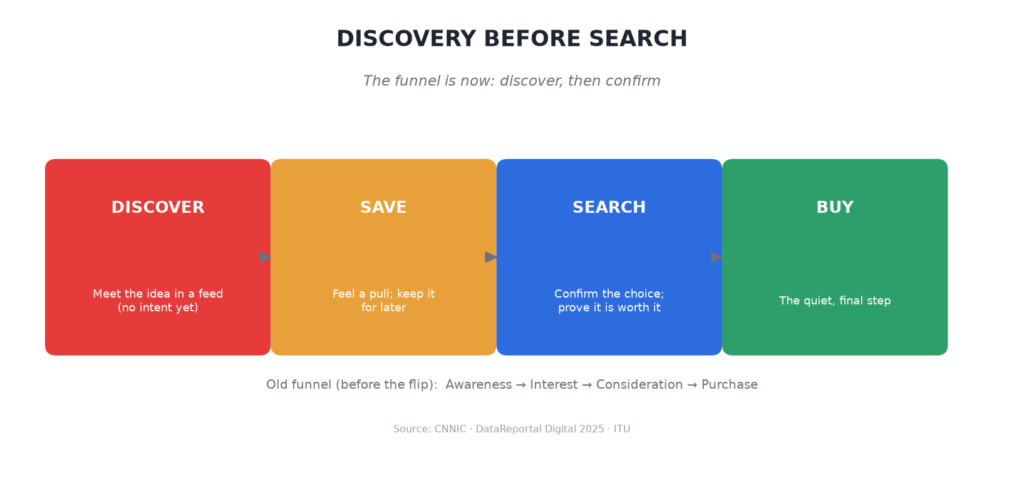
For twenty years, marketing funnel diagrams looked the same. Awareness sat at the top. Interest followed. Then consideration, then purchase. A brand shouted, a consumer heard, and only later did that person type a query into a box to learn more.
That order has quietly inverted. Today a person meets a product inside a feed, feels a pull, and then — sometimes — runs a search to confirm the feeling. Discovery now leads. Search follows to validate, not to start.
This matters because the entire machinery of digital marketing was built for the old sequence. Budgets, attribution models, and creative briefs all assume the consumer arrives with intent already formed. When intent is actually formed inside the feed, those tools misfire.
What “Discovery Before Search” Actually Means
Discovery before search is a behavior pattern, not a feature. It describes the moment a person develops interest in something they were not looking for, inside an environment they opened for other reasons.
Three things separate it from ordinary browsing. First, the trigger is social and personal — a real person’s note, photo, or video, not a banner. Second, the interest is born before any keyword exists; the user cannot search for what they do not yet know. Third, the platform’s job is to surface relevance through signals like taste, friend graph, and behavior, rather than to answer a typed question.
When you understand that, the old debate about “is this a social network or a search engine” stops mattering. The platform is a discovery layer. Search is just the receipt.
China’s Proof Point: A Platform Built on Serendipity
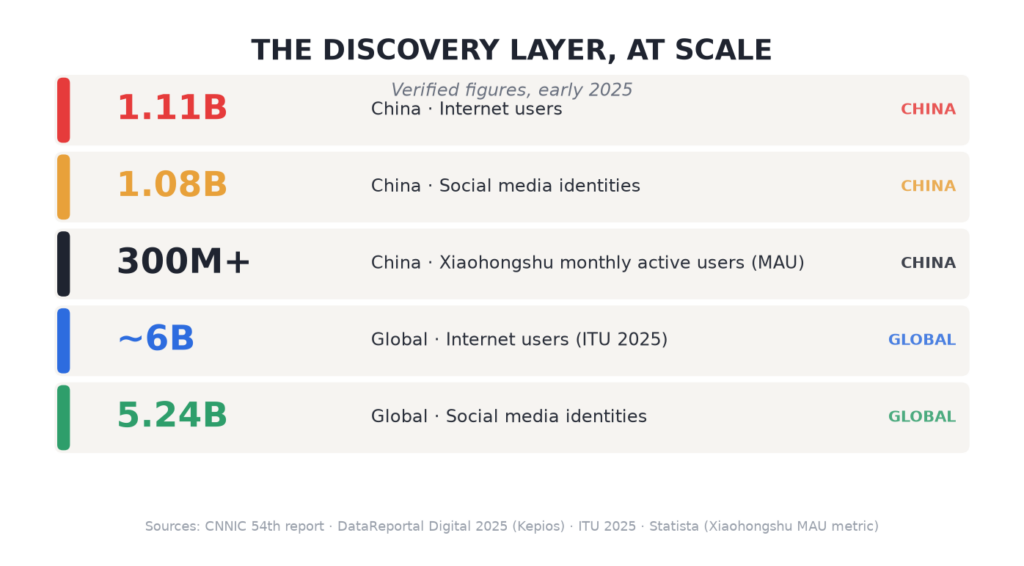
China is the cleanest place to watch this reordering, because its digital habits leapt past the desktop era entirely. At the start of 2025, China had 1.11 billion internet users — more than three-quarters of the population, at 78 percent penetration. Social media is not a side activity there: 1.08 billion people hold active social media identities, and 922 million adults aged 18 and over use social media. That is not an audience; it is public infrastructure.
Inside that landscape sits Xiaohongshu, known in English as RedNote. It is often mistranslated as “a Chinese Instagram with shopping.” That label misses the point. The platform is built around user-written notes — short posts of text, images, and clips — where people document real experiences: a restaurant they loved, a skincare routine that worked, a city corner worth the trip.
What makes it distinctive is the sequence users follow. They do not arrive with a query. They wander, they save, they feel a pull toward something genuine, and only then do they search within the app to go deeper. The platform’s own design rewards the note that earns a save or a collection, not the post that buys the most impressions.
Xiaohongshu counts more than 300 million monthly active users. That scale proves the behavior is not a niche habit of fashion enthusiasts. It is a mainstream reflex: see, feel, save, then search.
The Global Mirror: Social Platforms Become Search Layers
The same reflex now shows up worldwide. By 2025 the International Telecommunication Union estimated that roughly 6 billion people — 74 percent of the world’s population — were using the internet, up from 60 percent in 2020, with 2.2 billion people still offline. In parallel, about 5.24 billion people held active social media identities, close to two-thirds of everyone on Earth. When that many people live inside social feeds, the feed becomes the front door to discovery for the majority of humanity.
In Western markets the mechanics differ by platform, but the underlying habit rhymes. Short-video apps, image feeds, and community threads all now function as the first place people look when they want to know what to buy, where to eat, or how to solve a small problem. The search box has not disappeared. It has moved down the path, from the starting line to the confirmation step.
This is why global marketers keep misreading the data. They measure search volume and assume intent was always there. It was not. It was planted earlier, in a feed, by a person they do not pay.
Why User-Generated Content Outperforms Polished Ads
Brands spend fortunes on glossy assets, yet a shaky phone photo from a stranger often drives more action. The reason is not production quality. It is believability.
A polished ad carries an obvious motive: sell. A user note carries a different motive: share. The audience reads the first as a performance and the second as a confession. Confessions travel; performances get skipped.
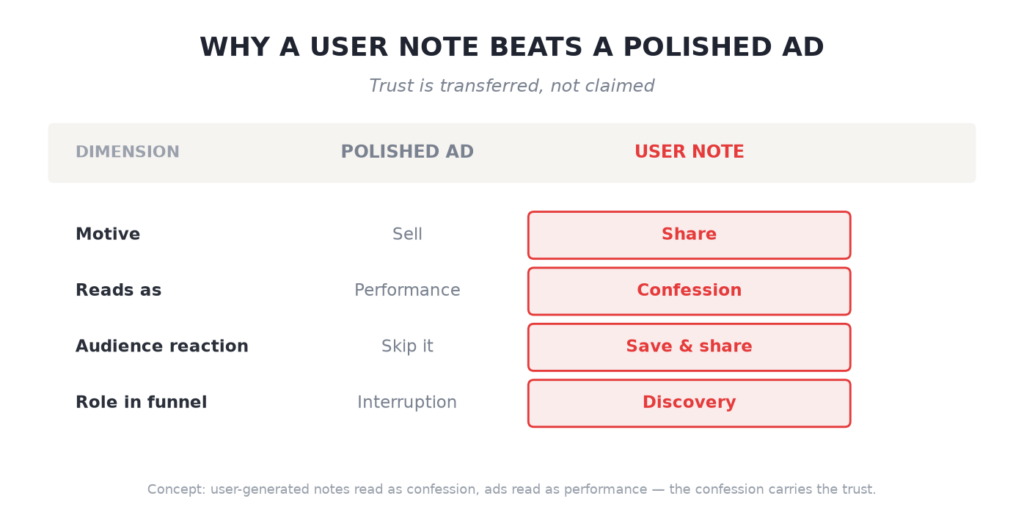
This gap widens at the early stage of intent, exactly when discovery happens. A person who does not yet know they want a product cannot be “targeted” with a keyword they have not thought of. They can only be reached by something that feels like a friend’s recommendation arriving at the right moment.
The Trust Mechanism Behind Organic Discovery
Trust in discovery is not claimed. It is transferred. When one user passes a genuine find to another, a small unit of credibility moves with it — like a lit match handed across a dark room. The second person does not need to verify the brand; they trust the person who lit the way.
That transfer explains why discovery-led growth feels invisible to traditional measurement. The signal is not a click on an ad. It is a save, a share, a screenshot sent to a friend, a “where did you get this” comment. None of those show up cleanly in a last-click report, yet all of them are the actual engine.
Intent Is Formed, Not Found
The old model treated intent as something a consumer already had, waiting to be captured. Discovery-first reality says intent is manufactured inside the experience.
Think of it this way. A search query is a symptom — proof that a need already exists. A saved note is a cause — the moment the need was born. Most marketing budgets chase symptoms. The higher-leverage work is to cause the symptom in the first place, by showing up in the feed where the person was not looking for you.
This single reframe changes everything downstream: what you create, who creates it, and how you know it worked.
Search Behavior Has Flipped
Even the act of searching has changed shape. In a discovery-led path, search is narrower, later, and more comparative. The user already likes the thing. Now they want proof: Is it worth it? What do real owners say? Where is the best version?
Brands that win this stage stop writing keyword-stuffed pages and start answering the questions a curious, half-convinced person actually asks. The search result is no longer the top of the funnel. It is the last nudge before the cart.
Content Formats That Travel Across Borders
Not every format carries discovery equally. Across both China and global markets, a few patterns repeat.
Short, specific notes beat long manifestos. A post that shows one real outcome — a before-and-after, a three-step routine, a single honest review — gives the audience a handle to grab. Visual proof outperforms abstract claims; a photo of a real result is harder to dismiss than a sentence about quality.
The format that travels best is the one that looks like it was made by a peer, not a studio. That is true whether the platform is a Chinese lifestyle app or a Western short-video feed. The geography changes the language, but the credibility rule does not.
The Role of Notes and Short Posts in the Funnel
If discovery leads, then the humble note or short post is the most underrated asset in modern marketing. It is the unit of serendipity.
A single useful note can sit in a feed for months, quietly catching the person who was not shopping yet. Unlike a paid impression that vanishes the moment the budget stops, a good note compounds. It gets saved, quoted, and reshared, each time moving a little more trust into the brand’s account.
Treating notes as disposable social-media filler is the most common, and most expensive, mistake brands make in this environment.
What AI Changes in Discovery
Artificial intelligence now sits underneath the discovery layer, even when users never see it. Recommendation systems decide which notes surface, which feeds a person wakes up to, and which related posts appear after a save. The more a platform learns a user’s taste, the more precisely it can place a discovery in front of them at the exact right moment.
For marketers, this cuts both ways. On one side, AI makes irrelevant content cheaper to filter out, raising the bar for anything you publish. On the other, it rewards substance: systems trained on engagement signals will keep surfacing the notes that earn genuine saves and shares, and bury the ones that only buy attention.
The practical lesson is calm, not panic. You do not need to trick an algorithm. You need to earn the human reaction the algorithm is learning to detect.
Common Mistakes Brands Make When They Misread Discovery
The first mistake is treating a discovery platform like a billboard. Brands import ad creative built for interruption and wonder why it fails. Discovery environments reward contribution, not interruption.
The second is measuring the wrong thing. Teams report on impressions and paid clicks, then conclude discovery “does not work,” when the real movement happened in saves and shares they never tracked.
The third is over-producing. Studio content reads as performance. A note that looks like a real person’s honest moment will almost always outperform a polished asset that screams “advertisement.”
The fourth is impatience. Discovery-led growth is slower to spike and longer to decay than paid bursts. Brands that pull the plug at week three never see the compounding that makes the model worthwhile.
A Discovery-First Content Plan
A useful plan starts with a shift in who creates. Seed a steady stream of genuine notes from real users and credible voices before you scale any paid push. Volume of honest substance matters more than singularity of polish.
Next, design for the save, not the click. Ask whether each note gives the reader a reason to keep it — a tip, a proof, a feeling of “I need this later.” The save is the closest signal to intent formation you will ever get.
Then, close the loop with search. Map the questions a half-convinced person asks and answer them plainly on pages that load fast and read true. Discovery opens the door; search confirms the choice.
Finally, instrument the invisible. Track saves, shares, screenshots, and comment questions as primary metrics. If those move, purchase usually follows on a delay.
What Changes When Discovery Leads
When discovery leads, the brand’s job changes from interruption to presence. You stop hunting intent and start earning it. You measure trust transferred, not impressions bought. You treat a single honest note as infrastructure.
China showed the shape of this first, because its users never got stuck in the desktop-search era. The rest of the world is now arriving at the same behavior through different apps and languages. The platform names differ. The human reflex does not.
The marketers who win the next decade will be the ones who stop asking how to interrupt the scroll and start asking how to be worthy of the save. Discovery is not a channel you buy. It is a reputation you keep.
Summary
Discovery before search describes a behavior where interest forms inside a feed and search only arrives later to confirm it. China’s scale — 1.11 billion internet users at 78 percent penetration, 1.08 billion social media identities, and Xiaohongshu’s 300 million-plus monthly active users — proves the pattern is mainstream, not niche. Globally, roughly 6 billion people are online (74 percent, per the ITU) and 5.24 billion hold social media identities, so the same reflex now defines discovery for most of humanity. User-generated notes outperform polished ads because trust is transferred, not claimed. AI sharpens the matching but cannot replace the human reaction. Brands that measure saves and shares, design for the save, and close the loop with honest search content will earn intent instead of interrupting it.
Frequently Asked Questions
What does “discovery before search” mean in plain terms?
It means a person meets a product or idea inside a feed, develops interest there, and only later runs a search to confirm the choice. The interest is born before any keyword exists.
Is Xiaohongshu a search engine or a social network?
Neither label fits. It is a discovery layer: users wander, save genuine notes, and then search inside the app to go deeper. Search is the receipt, not the starting point.
Why do user notes outperform brand ads in discovery?
A note reads as a peer’s honest share, while an ad reads as a performance with a sales motive. Audiences trust the confession more than the commercial, so the note transfers credibility the ad cannot.
How should a brand measure discovery if last-click reports miss it?
Track saves, shares, screenshots, and comment questions as primary signals. Those actions mark intent formation and usually precede purchase by a delay that flat attribution models ignore.
Can non-Chinese brands apply this model outside China?
Yes. The platforms differ by market, but the reflex is the same wherever large audiences live inside social feeds. Earn the save with honest substance, then answer the confirming search with plain, truthful content.