Digital Marketing & Media Briefing: China and Global Markets
Overview
The money is still flowing, but it is flowing to fewer, smarter places. Global ad spend is on track for double-digit growth in 2026, and China just put a formal government target on its advertising industry through 2030. The through-line on both sides this week is artificial intelligence — not as a buzzword, but as the operating system of how ads get made, how shoppers get helped, and how brands get found inside AI answers.
Three stories defined the week: Google said its Gemini models generated more than 1.5 billion ad assets in a single quarter; Amazon’s Rufus shopping assistant posted triple-digit user growth as agentic commerce moved from demo to default; and in China, the advertising industry turned GEO — generative engine optimization — from a tactic into a governed standard with a published market size.
Global Market: Ad Spending Stays Hot, AI Does the Heavy Lifting
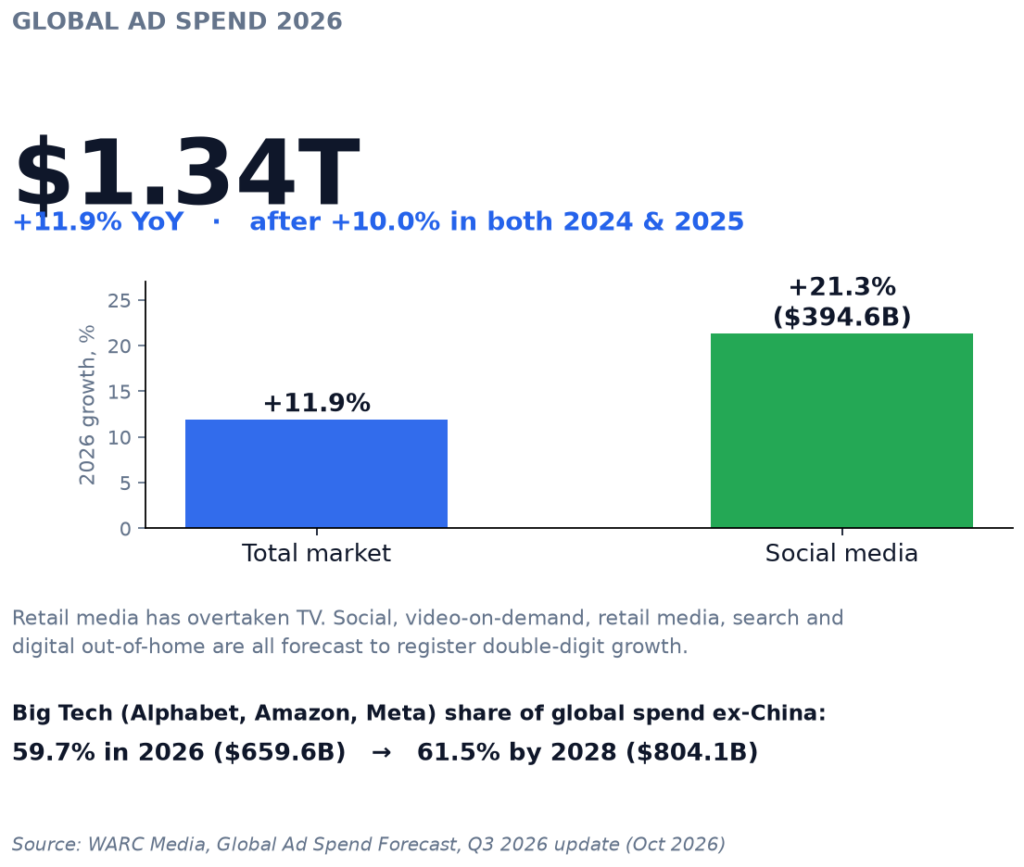
WARC Media’s Q3 2026 update puts global advertising expenditure at $1.34 trillion, up 11.9% for the year, after 10% growth in both 2024 and 2025 [WARC Media, Global Ad Spend Forecast, Oct 2026]. The engine is corporate AI investment plus a crowded events calendar — the Olympics, the FIFA World Cup, and U.S. mid-term elections.
The shape of that spend is shifting underneath the total. Social media is forecast to grow 21.3% to $394.6 billion, and retail media has overtaken television as a channel [WARC Media, Oct 2026]. As third-party cookies fade, first-party data and closed-loop commerce media keep taking budget share. Concentration is the other quiet headline: outside China, Alphabet, Amazon, and Meta are set to capture 59.7% of global ad spend in 2026 — about $659.6 billion — rising to 61.5% ($804.1 billion) by 2028 [WARC Media, Oct 2026].
Google: Gemini Built 1.5 Billion Ad Assets in One Quarter
Philipp Schindler, Google’s chief business officer, said Gemini models helped advertisers generate more than 1.5 billion campaign assets in Q3 2026, up over 7x year on year [Storyboard18 / Google, Oct 2026]. Google’s Search ad revenue still grew 12% to $63.3 billion in the quarter, though the company flagged that AI Mode’s lower monetization is slowing Search ad growth [MSN / Adgully, Oct 2026]. Alphabet’s consolidated revenue hit $127.6 billion, up 25% [Alphabet Q3 2026 earnings]. Google is now pushing AI Mode ads internationally, the same week OpenAI’s ChatGPT ads surfaced a $1-billion annualized revenue run rate [BestMediaInfo, Oct 2026]. The tension is real: AI is both the creative factory and the thing disrupting the old monetization model.
Amazon: Rufus Turns Shopping Into a Conversation
Amazon’s AI shopping assistant Rufus is no longer a side feature. Monthly active users are up 115% year on year, with engagement up 400%, CEO Andy Jassy told analysts [Modern Retail / Amazon earnings, Oct 2026]. Rufus reached 300 million customers in 2025 and drove roughly $12 billion in incremental annualized sales; shoppers who use it are 60% more likely to complete a purchase. The bigger move is agentic: Rufus can now set recurring restock tasks and use “Auto Buy” to purchase when prices drop, and Amazon is rolling out “sponsored prompts” — suggested questions that spark a Rufus conversation. Nearly 20% of shoppers who interact with a brand prompt and Rufus keep talking about that brand [Modern Retail, Oct 2026]. Jassy’s bet: advertising will do well in a world of agentic commerce, because every question is a chance to surface a product.
China Market: Policy, AI Maturity, and the GEO Standard
A Formal Growth Target for Advertising
China issued its advertising-industry development plan for the 15th Five-Year Plan period (2026–2030), setting an average annual growth target of around 10% for the sector [State Administration for Market Regulation and six other authorities, via gov.cn / Xinhua, Oct 20, 2026]. The plan is a government-level signal that advertising stays a policy-prioritized industry, tasked with supporting industrial upgrading, boosting consumption, and taking Chinese brands global.
AI Marketing Is Mainstream — But Payoff Lags
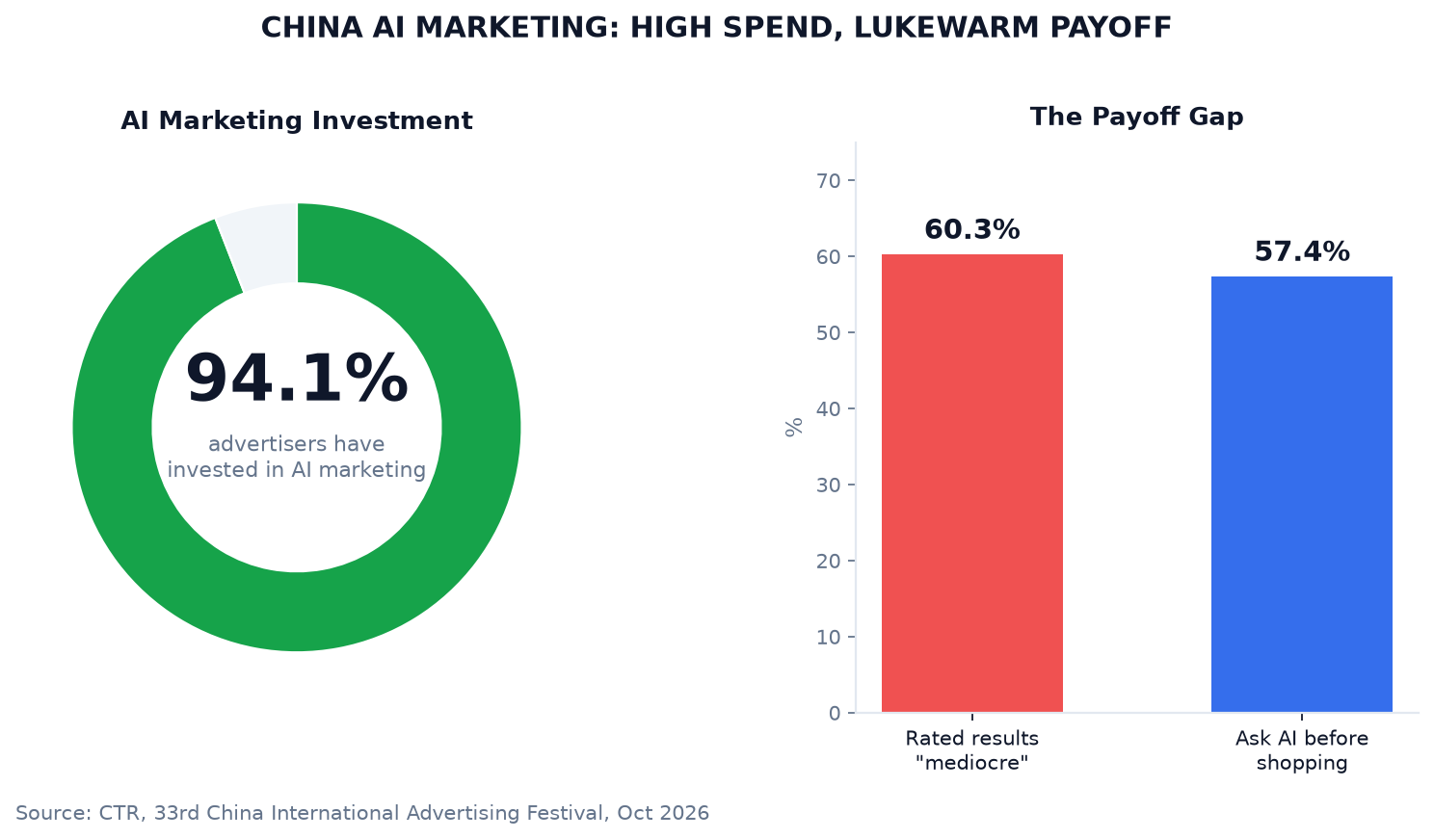
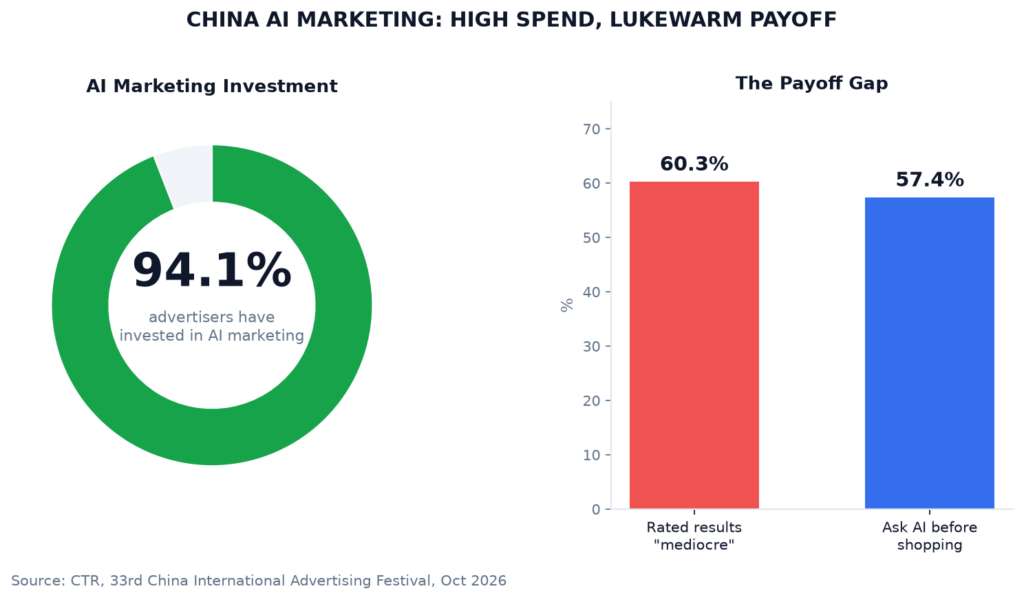
At the 33rd China International Advertising Festival (Oct 23–25, 2026), CTR presented that 94.1% of Chinese advertisers had already invested in AI marketing, yet 60.3% rated the results as only mediocre [CTR, 33rd China International Advertising Festival, Oct 2026]. High spend, weak payoff. Two more CTR figures sharpen the picture: 57.4% of consumers now habitually “ask AI first” before shopping, and the device base for AI applications has expanded from 130 million to 910 million [CTR, Oct 2026]. The festival’s sharper point is the KPI shift — the metrics that matter are no longer impressions and clicks, but AI answer position, AI citation rate, and AI visibility.
GEO Becomes a Governed Discipline
GEO — making a brand visible inside AI-generated answers — moved from blog-post theory to industry standard this week. At a China Advertising Festival side event (Oct 23, 2026), the China Advertising Association released three GEO group standards covering service requirements, effect monitoring and verification, and content-source classification [Sina, Oct 26, 2026]. Frost & Sullivan, with the association’s guidance, published the 2026 China GEO Marketing Practice and Compliance Development Report and a version 1.0 ecosystem map.
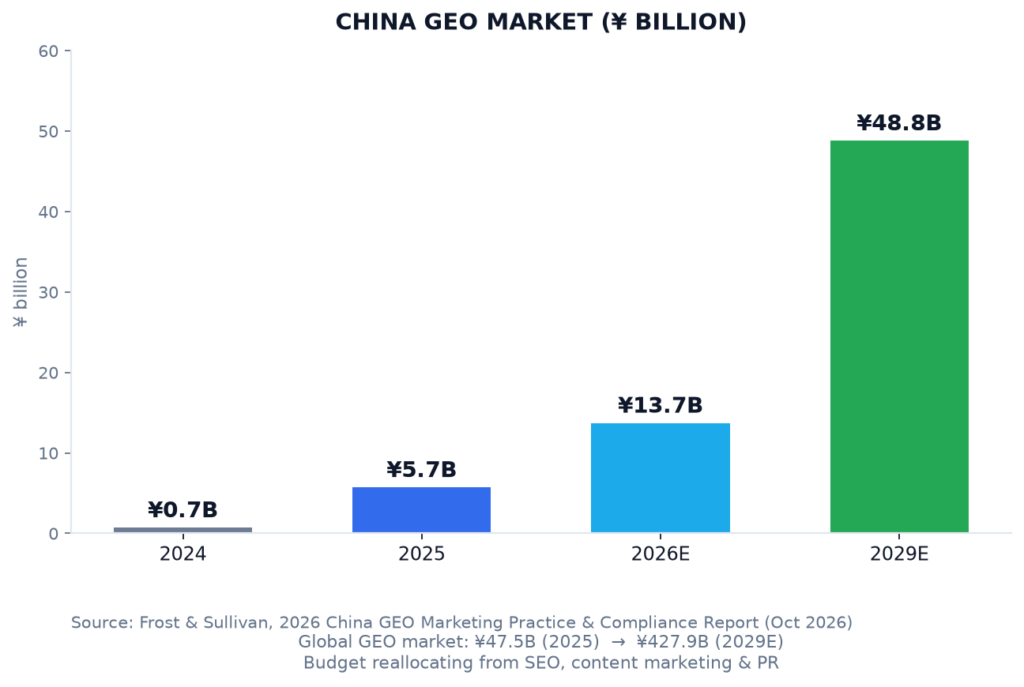
The market sizing is the part worth remembering. Frost & Sullivan estimates China’s GEO market at ¥700 million in 2024, ¥5.7 billion in 2025, about ¥13.7 billion in 2026, and ¥48.8 billion by 2029. The global GEO market is projected to grow from ¥47.5 billion in 2025 to ¥427.9 billion by 2029 [Frost & Sullivan, Oct 2026]. Budget that used to sit in SEO, content marketing, and PR is reallocating to GEO. In the user survey behind the report, 61.7% of respondents said AI played a major or decisive role in how they evaluate products [Frost & Sullivan, Oct 2026]. The compliance frame is “responsible GEO” — verifiable facts, graded and traceable sources, and AI-generated content labeled per regulation. Short-term exposure is losing value; trust is becoming the moat.
The Scale Behind It: China’s AI App Explosion
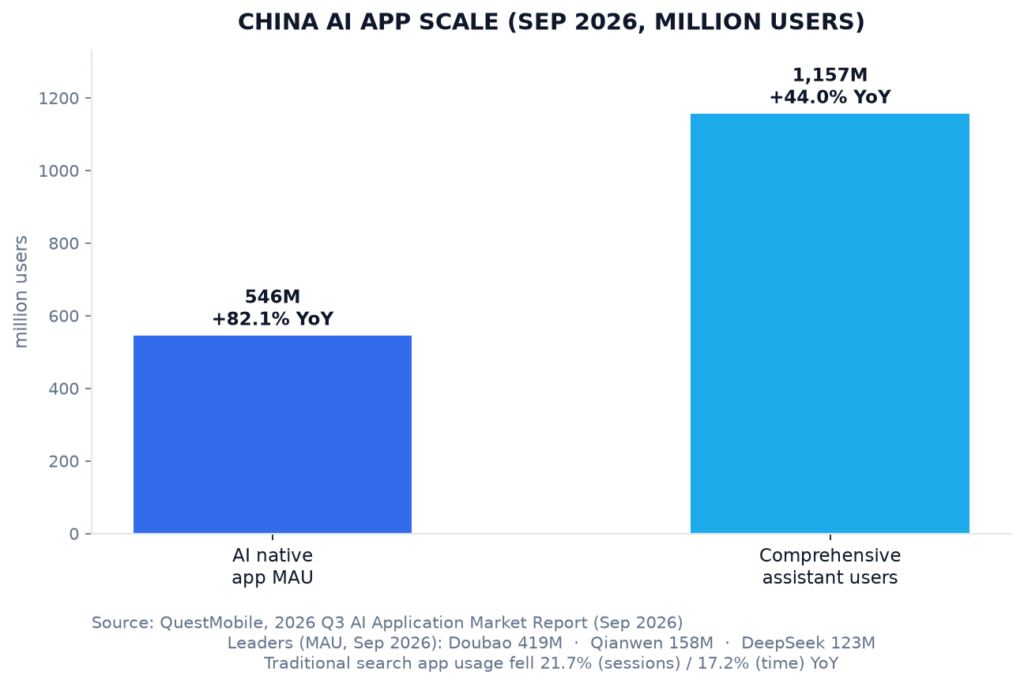
QuestMobile’s Q3 2026 report shows why GEO matters so much in China. As of September 2026, AI comprehensive-assistant users reached 1.157 billion, up 44% year on year; AI native-app monthly active users hit 546 million, up 82.1% [QuestMobile, Q3 2026 AI App Market Report]. The leaders: Doubao at 419 million MAU, Qianwen at 158 million, DeepSeek at 123 million. Traditional search is contracting — search-app usage fell 21.7% in sessions and 17.2% in time versus a year earlier [QuestMobile, 2026]. Users are asking AI first, which is exactly why showing up in the answer — not the link list — is the new battleground.
GEO Cross-Cut: The Metric That Actually Changed
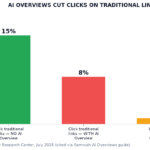
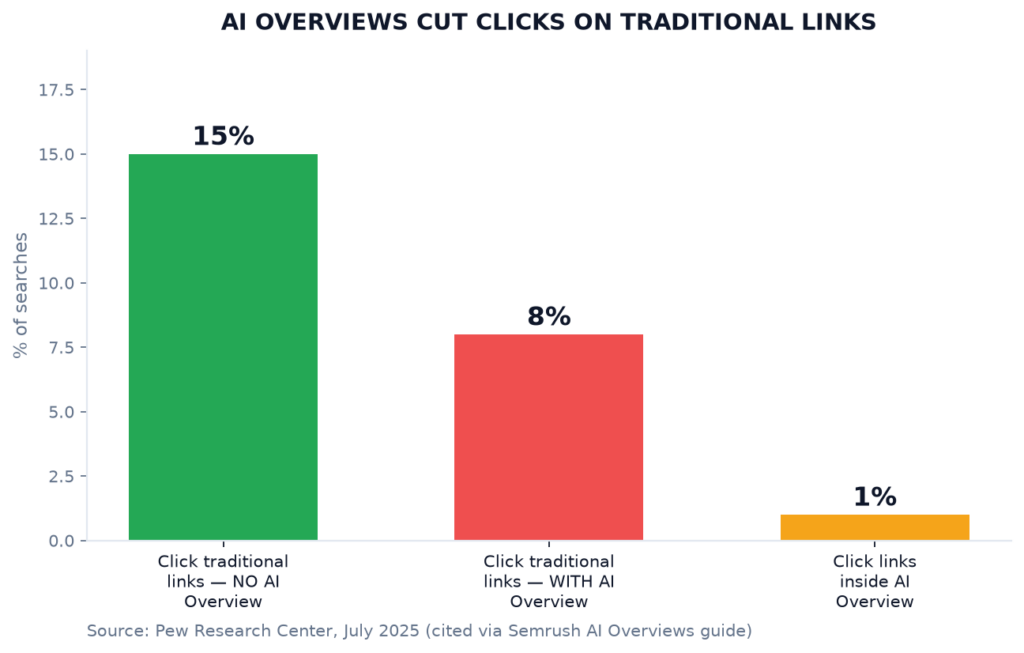
This is the thread tying China and the globe together. Verified data from the Pew Research Center shows the channel is already material in the U.S. — users click traditional result links just 8% of the time when an AI Overview is present, versus 15% without one, and click links inside the overview only 1% of the time [Pew Research Center, July 2025]. Semrush’s own research adds a structural shift: keywords triggering AI Overviews went from 89% informational in October 2024 to just 57% a year later, meaning the summaries are now spreading into commercial and transactional queries where purchase intent lives [Semrush, AI Overviews study].
The implication is blunt: ranking first in blue links no longer guarantees visibility when an AI answer sits on top. AI answer position and AI citation rate are now the metrics that move pipeline — which is precisely what CTR’s KPI shift and China’s GEO standards are responding to.
Verified Data Points at a Glance
| Metric | Figure | Source | Region |
|---|---|---|---|
| Global ad spend, 2026 forecast | $1.34T (+11.9%) | WARC Media, Q3 2026 | Global |
| Social media ad growth, 2026 | +21.3% to $394.6B | WARC Media, Q3 2026 | Global |
| Big Tech (Alphabet/Amazon/Meta) share ex-China | 59.7% (2026) → 61.5% (2028) | WARC Media, Q3 2026 | Global |
| China ad industry growth target | ~10% / yr, 2026–2030 | SAMR et al., gov.cn, Oct 20 2026 | China |
| China GEO market size | ¥0.7B (2024) → ¥5.7B (2025) → ¥13.7B (2026E) → ¥48.8B (2029E) | Frost & Sullivan, Oct 2026 | China |
| Global GEO market size | ¥47.5B (2025) → ¥427.9B (2029E) | Frost & Sullivan, Oct 2026 | Global |
| China advertisers invested in AI marketing | 94.1% | CTR, 33rd China Ad Festival, Oct 2026 | China |
| China advertisers rating AI results mediocre | 60.3% | CTR, 33rd China Ad Festival, Oct 2026 | China |
| Consumers who “ask AI first” before shopping | 57.4% | CTR, Oct 2026 | China |
| AI application device base | 130M → 910M | CTR, Oct 2026 | China |
| Users saying AI decisive in evaluation | 61.7% | Frost & Sullivan survey, Oct 2026 | China |
| Click rate on traditional links w/ AI Overview | 8% (vs 15% without; 1% inside) | Pew Research Center, Jul 2025 | Global |
| AI Overviews triggering keywords (informational) | 89% (Oct 2024) → 57% (Oct 2025) | Semrush, AI Overviews study | Global |
| Google Gemini ad assets, Q3 2026 | >1.5B (+7x YoY) | Google (Schindler), Oct 2026 | Global |
| Amazon Rufus MAU growth | +115% YoY; engagement +400% | Amazon (Jassy), Oct 2026 | Global |
| China AI comprehensive-assistant users | 1.157B (+44% YoY) | QuestMobile, Q3 2026 | China |
| China AI native-app MAU | 546M (+82.1% YoY) | QuestMobile, Q3 2026 | China |
Editorial Note on Removed and Corrected Claims
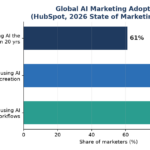
Per the two-pass verification discipline, the following were corrected or removed rather than left unflagged: (1) the HubSpot figure for AI use “across other marketing workflows” was corrected to 75% use AI for media production (the 80% content-creation figure is unchanged); (2) the CTR claim that “68.7% had deployed AI agents” could not be confirmed in the primary source and was removed, with 57.4% “ask AI first” and the 130M→910M device expansion added in its place; (3) the AI Overviews click data was re-attributed from Semrush to its original source, Pew Research Center, and the unverifiable “12.95% of queries” figure was replaced with Semrush’s verified 89%→57% informational-share shift; (4) the prior draft’s Miaozhen survey (10% growth / 76% seeding) remains removed for lack of a reachable primary source.
Summary
This week’s signal is convergence. Globally, ad budgets are growing but concentrating, and AI is doing the creative and shopping work — Google’s 1.5 billion Gemini ad assets and Amazon’s agentic Rufus are the proof points. In China, the state set a 10% ad-growth target, AI marketing is near-universal yet underwhelming in results, and GEO was formalized as a standards-backed discipline with a market set to quintuple by 2029. The shared metric that changed everything is visibility inside AI answers: when an AI summary sits on top, classic rankings stop guaranteeing traffic. Brands that measure AI answer position and citation rate — and build trustworthy, source-backed content — are the ones positioned to win the next leg.