GEO Goes From Hype to Regulated Practice: China’s New Rules and the Global AI Search Shift
Generative Engine Optimization stopped being a vendor buzzword this month. In China, the practice now has its first formal industry standards. Across global markets, fresh measurement data shows AI-generated answers are quietly taking a larger slice of the search experience. Together, the two moves redraw the map for how brands earn visibility in both Chinese and international channels.
China writes the first rulebook for GEO
Beijing hosted the 33rd China International Advertising Festival in its Haidian district, with the event closing in late October 2026. Organizers drew professionals from 27 countries under the theme of digital intelligence and global collaboration. The headline outcome was regulatory rather than commercial: the China Advertising Association issued three industry standards covering Generative Engine Optimization.
The three documents set service requirements for GEO providers, define how GEO effect monitoring and verification should work, and classify content-source subjects by grade and selection criteria. They took effect immediately. China is the first major market to move GEO from loose agency methodology into codified industry rules.
The same festival signaled longer-term planning. An industry ecosystem map for Chinese GEO is being developed with a global strategy consulting firm, aimed at helping brands identify trustworthy technology partners.
Regulators have also sharpened their focus on synthetic promotional content built to manipulate AI outputs. That scrutiny sits inside a broader 2026 policy push toward comprehensive AI legislation, content authenticity requirements, and clearer platform review obligations. For international brands operating in China, adherence to the new GEO frameworks is quickly becoming a baseline for market access and brand safety.
Global markets: AI overviews expand their footprint
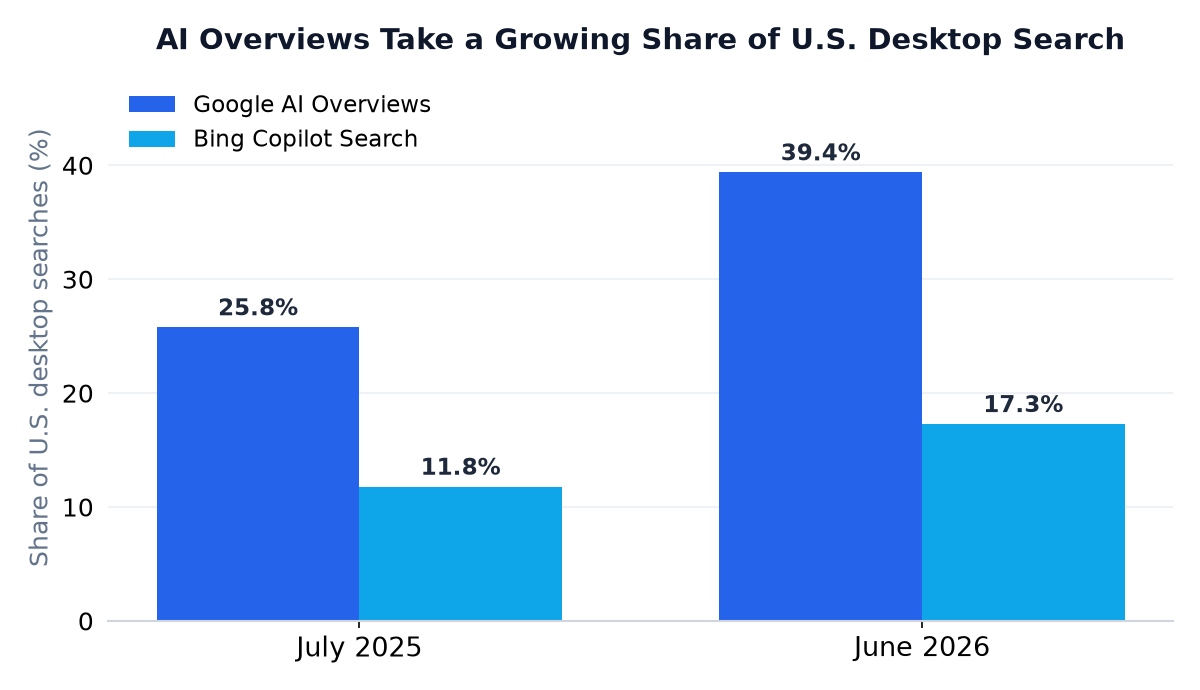
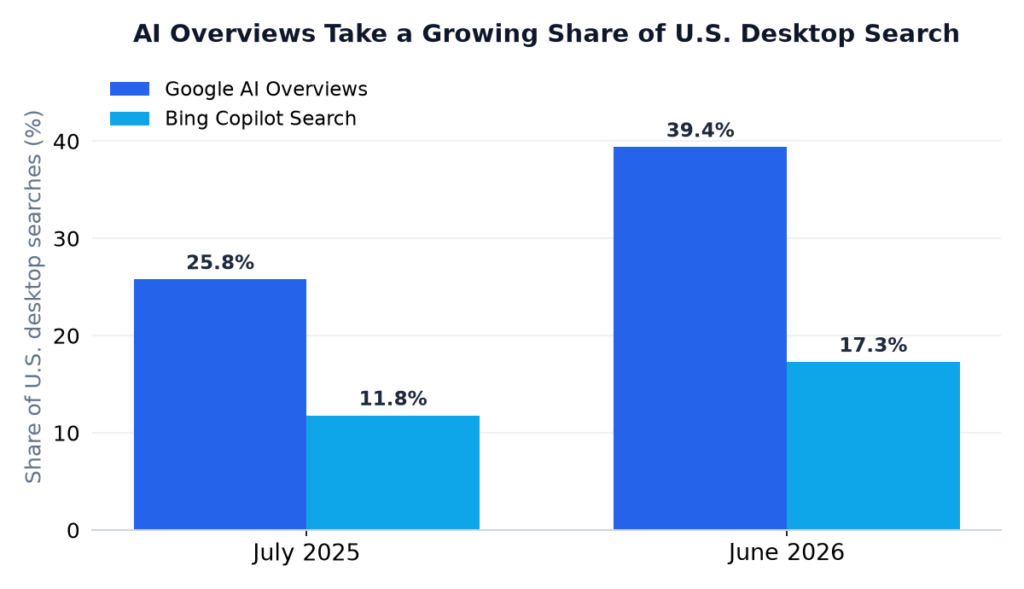
Comscore published its Q2 2026 AI Intelligence Report, offering the clearest recent read on how AI is changing search. Google AI Overviews appeared in 39.4 percent of U.S. desktop searches in June 2026, up from 25.8 percent in July 2025 — a gain of more than 13 points in under a year. Bing’s Copilot Search climbed from 11.8 percent to 17.3 percent over the same window.
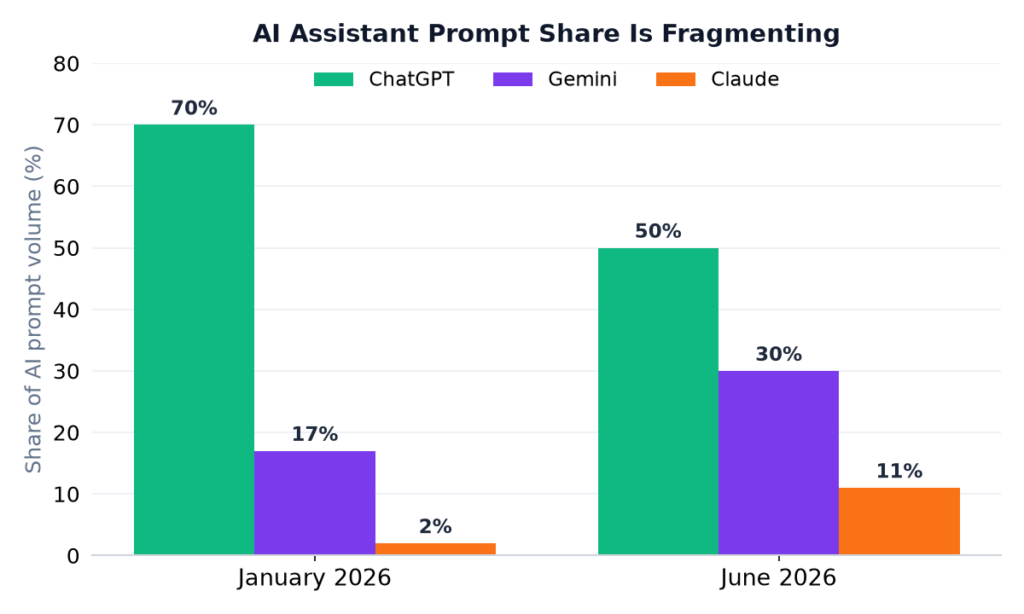
The assistant landscape is fragmenting. ChatGPT remains the largest player but its share of total AI prompt volume fell from 70 percent in January 2026 to 50 percent by June. Gemini nearly doubled, moving from 17 percent to 30 percent, while Claude rose more than fivefold from 2 percent to 11 percent.
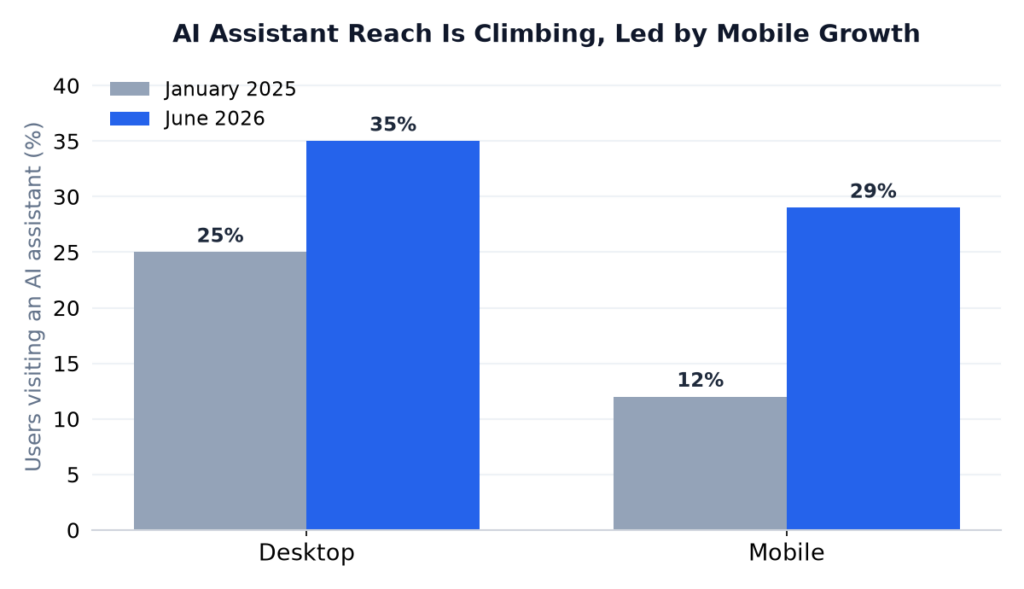
Reach keeps widening. In June 2026, 35 percent of desktop users and 29 percent of mobile users visited an AI assistant, against 25 percent and 12 percent in January 2025. Growth on mobile is now outpacing desktop. Women continue to lead AI assistant usage on mobile across major platforms.
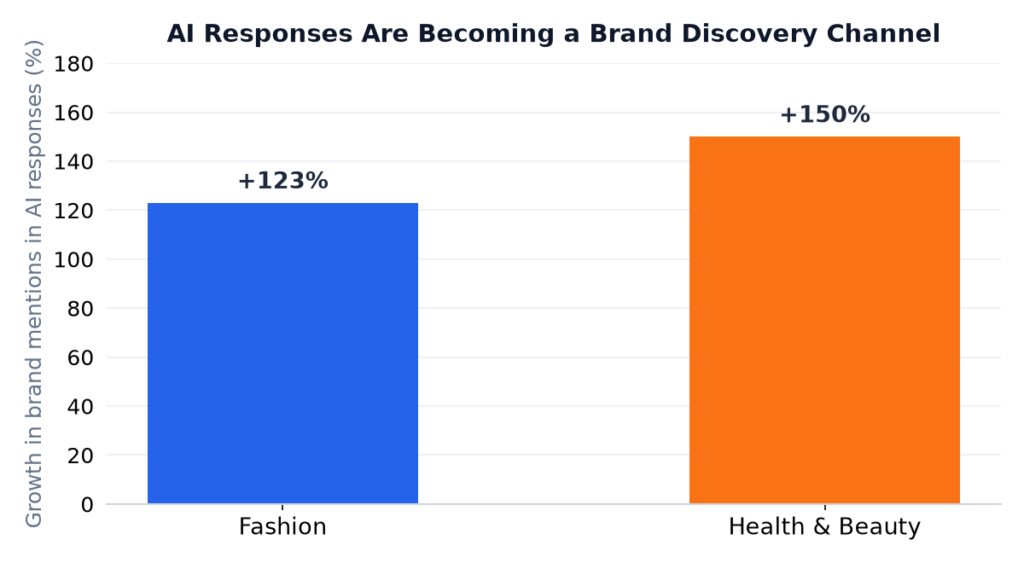
AI is also becoming a discovery and monetization surface. Between January and March 2026, fashion brand mentions inside AI responses grew 123 percent and health and beauty brand mentions grew 150 percent. Sponsored placements appeared in AI travel search results, rising from 6 percent of hotel-related prompts with source links in March 2026 to 24 percent by May.
The research that named the problem
The term GEO was coined in a 2024 study by researchers including Pranjal Aggarwal, published at the ACM SIGKDD conference and circulated through arXiv. The work introduced a benchmark of diverse user queries across multiple domains and source types, then tested how content changes affect visibility inside generative answers.
The core finding: adding statistics, citations, and quotations can lift a source’s visibility in AI-generated responses by up to 40 percent. The effect varies by domain, which means optimization needs to be tailored rather than templated. The paper turned an emerging practice into a measurable discipline and remains the academic anchor for most GEO guidance today.
A forecast that frames the shift
In February 2024, Gartner predicted that traditional search engine volume would drop 25 percent by 2026 as AI chatbots and other virtual agents capture share from organic and paid search. The forecast framed a strategic question for marketers: if fewer users reach websites through classic search, where does discovery happen instead.
That question is no longer theoretical. The latest measurement shows AI answers sitting inside mainstream search results and AI assistants handling a growing share of everyday questions.
What marketers should watch
GEO has moved from experiment to infrastructure. In China, standards give buyers a way to judge providers and give platforms a compliance baseline. Globally, AI answers are a first-class discovery channel that sits alongside, not after, traditional search.
The practical implication is consistent across markets. Content that gets cited by AI tends to be credible, well-sourced, and rich with verifiable statistics. Brands that treat GEO as a reporting and measurement discipline — not a trick — are better positioned as both Chinese and global discovery shift toward generative answers.