42.6% Reach, 1.2% of Time: Charting China’s AI App Economy
The China slide in most 2027 planning decks is built on a number from the middle of 2026, and it is short by roughly a hundred million people. Replace it. The replacement will be out of date by spring too, which tells you something about the category and nothing at all about the slide.
Here is the cleaner way to hold this market in your head. Reach arrived first. Time did not follow. And the money is now being metered at precisely the point where reach and time fail to meet.
1. 546 Million Is a Stopping Point, Not a Finding
In September 2026, standalone AI applications in China reached 546 million monthly active users, up 82.1 percent year on year. The reading comes from QuestMobile’s China Mobile Internet Autumn Report, published in late October, and it sits beside a mobile internet of 1.281 billion users growing 0.9 percent.
Put the two figures side by side and 546 million works out to 42.6 percent of the mobile base. That is arithmetic, not a penetration rate. The two numbers are counted differently and QuestMobile never claims the denominators match. Even so, two in five is the right shape for the market, and “one in three” is now conservative enough to be misleading.
The headline is a stopping point because the question worth asking is not how many people arrived. It is what they do with the two minutes they stay.
| Measure | September 2026 | Change | What it counts |
| AI-native apps | 546 million | +82.1% | Apps with their own icon |
| AI from phone makers | 783 million | +16.9% | Assistant built into the OS layer |
| AI on the PC client | 26 million | +82.3% | Installed desktop client |
| AI plug-ins | Not disclosed | −15.6% | Assistant inside another app |
| AI on PC web pages | Not disclosed | −10.4% | Browser-based assistant |
| All mobile internet | 1.281 billion | +0.9% | The whole market |
| Time per mobile user | 189.8 hours a month | +6.5% | September, per person |
| Peak time per mobile user | 200 hours a month | +7.2% | August, first time above 200 |
Two things in that table are worth a second look. The first is the 0.9 percent. Nothing grows 82 percent in a market adding one percent a year by finding new people, so every one of those 546 million users was taken from something else. The second is the PC client at 26 million, up 82.3 percent. Small number, fastest growth rate on the board, and a reminder that the heavy professional case has not gone away.
2. Three Tiers, One Winner
The market has stratified into a shape that is easy to describe and hard to compete with.
Doubao closed September with 382 million monthly users, up 172.1 percent. Qwen reached 167 million, a rise of 5,076.6 percent against a very small base a year earlier, though it slipped about nine million users from its June peak. DeepSeek held at 130 million. Behind them sit the specialised apps: Yuanbao, Ant’s health assistant, homework and study tools, the image generators, a long tail of vertical products.
The gap between first and second is the story. Doubao is larger than Qwen and DeepSeek combined, and its daily-to-monthly ratio sits near 47 percent, with 178 million daily users against 382 million monthly. Most consumer apps would call 20 to 30 percent healthy. Forty-seven percent describes something closer to a utility than a destination, the kind of thing people open without deciding to.
Qwen’s number deserves a sentence of its own, because a 5,076 percent growth rate invites the wrong conclusion. It is not a small app exploding. It is a product that was rebuilt and redistributed inside a very large distribution system, and the September dip says the redistribution has mostly finished. Growth from here has to come from habit, not from placement.
That distinction matters for anyone planning against this market. Placement growth is bought once. Habit growth compounds, and it also decays, which is why the next two sections are about time rather than users.
3. The 783 Million Nobody Puts in the Deck
Ask a Western marketer how many people use AI in China and you will hear 546 million, or 700 million if they have read the official statistics. Almost nobody says 783 million, which is the number of monthly users of AI applications shipped by phone makers.
Those applications are not a rounding error. They arrive preinstalled, they sit above the app layer, and they are attached to a hardware upgrade cycle rather than an app-store download. You do not acquire them. You inherit them. Apple, Huawei, Xiaomi, Oppo and Vivo all ship an assistant of some kind, and the installed base behind those assistants is larger than the entire standalone AI app category.
There are three reasons this channel gets skipped. It has no app-store ranking, so it does not show up in the charts people screenshot. It has no clean ad unit, so it does not appear in media plans. And its measurement is fragmented across manufacturers who report almost nothing. The channel is invisible mostly because it is inconvenient.
The strategic consequence is blunt. If you size this market at 546 million, you are planning against the smaller half of the installed base, and against the half that has to be earned one download at a time. The 783 million figure is also the one that predicts the next fight: not app versus app, but whether the assistant lives in the operating system or in an icon.
Growth rates hint at where that fight stands. Device-maker AI grew 16.9 percent while standalone apps grew 82.1 percent. The installed base is huge and slow. The app layer is smaller and fast. Neither has won.
4. Four Minutes and Forty Seconds a Day
Now the part that changes budgets.
A Doubao user opened the app 72 times in September and spent 132.5 minutes inside it across the month. DeepSeek users opened theirs 65.9 times and stayed 136.7 minutes. Divide by thirty and you get 4.4 and 4.6 minutes a day. Divide minutes by sessions and you get 1.8 and 2.1 minutes per visit.
Meanwhile the average Chinese mobile user spent 189.8 hours in apps during September, which is 380 minutes a day. Six hours and twenty minutes. Against that, an AI app takes about 1.2 percent of measured mobile time.
Read that again, because it is the least intuitive fact in this dataset. AI apps have reached 42.6 percent of mobile users and occupy something close to one percent of their time. High frequency, minimal duration, and a session length under two minutes.
Two caveats, stated plainly. The 1.2 percent compares AI time per user against total time per user across the whole population, and people who use AI apps are heavier mobile users than average, so the true share is somewhat higher than 1.2 percent. It is not ten times higher. The other caveat is direction of travel. Doubao’s per-user sessions fell 6.1 percent quarter on quarter and its per-user time fell 7.8 percent, while DeepSeek’s rose 5.8 percent and 9.5 percent. The leader lost intensity and the workbench gained it.
Then there is the competition for those minutes. Short drama and short video together accounted for 111.5 percent of the net growth in mobile time. Numbers above 100 percent are not a typo; they mean every other category combined gave time back. AI apps are not yet taking meaningful time from anything. They are taking the first thirty seconds of a decision, then handing the rest of the evening back to video.
5. What the Cross-Shopping Gap Actually Means
Time for a definition, because this phrase gets used loosely.
The cross-shopping gap is the distance between the surface where a purchase question is formed and the surface where the order is recorded. It has three components, and only the first is usually measured.
Reach without time. 42.6 percent of mobile users, roughly 1.2 percent of mobile minutes. A brand can be present at the question and still be nowhere near the transaction.
Intent without checkout. Until the middle of 2026, an assistant could shortlist a hotel, compare two phones and list the ingredients in a moisturiser, and then stop. There was no rail from answer to order. The intent existed; the settlement did not.
Checkout without attribution. Once a rail exists, the order is captured by the commerce platform. The channel fee shows up on the merchant’s P&L. It does not show up in the brand’s media plan, and it does not show up in a click-based attribution model, because there was no click in the ordinary sense. There was a conversation.
Put those three together and you have a structural gap that is not a funnel problem. A funnel problem is a leak you can patch. This is an accounting boundary, and boundaries move only when someone builds a meter across them. In China, someone did.
6. Why the Assistant Did Not Close
It is worth being precise about why the obvious thing did not happen for two years, because the reasons are not technological.
A 1.8-minute session is enough to shortlist and nowhere near enough to check out. Payment is a nine-step process with an address book attached, and no assistant was going to hold a user through it inside a conversation. The interface assumption was wrong: people do not want to shop in a chat window, they want to leave the chat window with a decision.
Second, the intent in an assistant is exploratory. “Which is better for dry skin in winter” is a research question, not a purchase order. Research converts days later, in a different app, often after a video. Any product that treats the question as a transaction will over-read its own funnel.
Third, and the one that gets skipped in most analyses: nobody was paid. An assistant that sends you to a merchant earns nothing unless a fee exists, and a merchant has no reason to be listed unless the fee buys something. That is not a UX problem. It is a commercial design problem, and it explains why the fix arrived as a rate card rather than as a feature.
7. What Doubao’s E-commerce Deal Changed
In July 2026, Doubao stopped being a place where shopping conversations ended.
On 15 July, Doubao was formally listed as a transaction channel for Douyin shops. On 27 July, Douyin’s local services business published a rule: from midnight on 10 August, orders that arrive through Doubao and settle in Douyin’s local services system count as a dedicated channel, with its own service fee, settled separately. The fee falls on merchants only. Consumers do not pay a surcharge.
The rate is the part worth memorising. Software service fee 11.4 percent, plus a 0.6 percent payment fee, for a combined rate of about 12 percent. Local services run higher: 17.4 percent plus 0.6, or 18 percent. Across categories, merchants report a range from roughly 9 to 18 percent.
Mechanically, the assistant now returns product cards inside the reply and completes payment without leaving the app. Around the November shopping festival, ByteDance pushed coupons through Doubao and its sibling apps, and put a “ask Doubao before you buy” entry point above the input box.
Four things changed, and only one of them is about user experience.
The assistant became a billable channel with a published rate. That converts an expensive cost centre into a media property with a take rate, which is a different business with different incentives.
The AI business acquired a GMV line of its own. Before August, an AI shopping conversation produced engagement and goodwill. After August, it produces orders with a channel tag attached, which is what a finance team needs before it will fund anything.
Merchants acquired a new line item that behaves like marketplace commission. Twelve percent is in the same range as a typical e-commerce take rate, and that comparison is the useful one. This is not earned media with a tech gloss. It is a retail channel with a toll.
And the measurement gap became structured rather than accidental. The order carries a channel label inside the commerce system, so the platform can see the AI’s contribution. The brand, sitting outside that system, usually cannot. The gap did not close. It got an invoice.
One thing the rate card does not tell you is volume. Neither ByteDance nor QuestMobile has published GMV that originated in the assistant, and any figure you see quoted for it should be treated as an estimate until one of them does.
8. Who Is Paying for All That Time
The honest answer is that nobody is paying in minutes, because AI apps have not taken many.
Look at where time actually went. Search apps lost 21.7 percent of their per-user session frequency and 17.2 percent of per-user time between August 2025 and August 2026. General news and information apps lost 7.6 percent of session frequency. AI plug-ins lost 15.6 percent of users and AI on PC web pages lost 10.4 percent, as behaviour moved to the shortest path: an icon you open, not an assistant you summon inside something else.
That last pair is the quiet part. The intermediate forms are dying. Multi-step transit products, plug-ins, browser assistants, all the clever wrappers that put AI inside an existing session, are shrinking while the standalone app and the operating-system assistant both grow. Users are choosing the shortest route to an answer even when the longer route is better designed.
So the correct reading of 82 percent growth is not that AI is eating the internet’s evening. It is that AI has taken the first question, the thirty seconds before the evening starts. The minutes are still with short video. The decision point has moved.
9. What It Changes in a Media Plan
Three adjustments follow, and they are all about how you price things rather than how much you spend.
Stop buying the AI audience as a reach buy. A channel with 42.6 percent reach and roughly 1.2 percent of time is not a reach channel. If a plan justifies a line item on audience size alone, it is pricing a one-minute-per-day impression like a thirty-second spot on a medium people actually watch. Either you are buying presence at the question, or you are buying nothing.
Price the assistant like retail, not like media. A 12 percent channel fee on a completed order is a distribution cost. Compare it to marketplace commission, affiliate rates and payment fees, not to CPM. Under that comparison the assistant is cheap for considered purchases with heavy pre-purchase research and expensive for low-margin repeat purchases, which is the opposite of how most AI channel tests are designed.
Ask for channel-level splits before you need them. The new fee schedule means orders arriving through the assistant are tagged at settlement. That tag exists whether or not your analytics stack reads it. The teams that ask for it in Q1 will be able to answer the question everyone will be asking in Q3.
10. What It Changes in SEO and GEO
If sessions last 1.8 minutes, your content has about ninety seconds to be useful and about one line to be quotable.
That is the design constraint, and it explains why the competitive set in AI answers looks nothing like the search results page. QuestMobile ran 28 standardised intent questions across six AI platforms between June and August 2026. The most stable source in the category was cited in 78.0 to 95.6 percent of questions depending on platform. Below that top tier, stability collapsed: among mid-tier sources, citation rates swung between 62.8 and 200.5 percent depending on the buying stage being tested.
Two conclusions follow. Citation behaves like a ranking system with its own rules, and those rules favour documents and reference sources over campaign pages. And concentration is high. A handful of sources are absorbing most of the citations in a category, which means the reward for being one of them is unusually large and the penalty for being summarised by one of them is unusually quiet.
For content, the practical implications are unglamorous. One claim per paragraph. A number with a date attached to it. A definition that still makes sense after it has been lifted out of the page. Entity names spelled the same way everywhere, so a retrieval system can tell that two pages are talking about the same company. None of this is new advice. All of it is now load-bearing.
11. The Three Charts
Three figures carry the argument, and each answers one question.
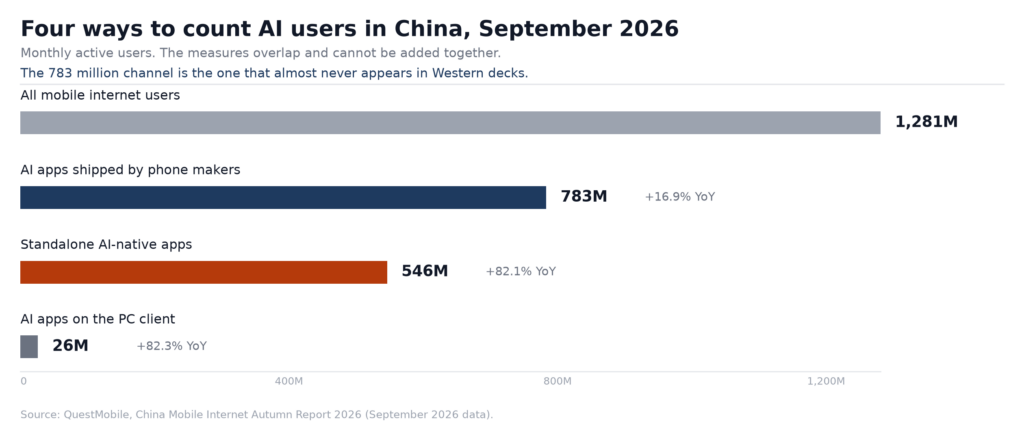
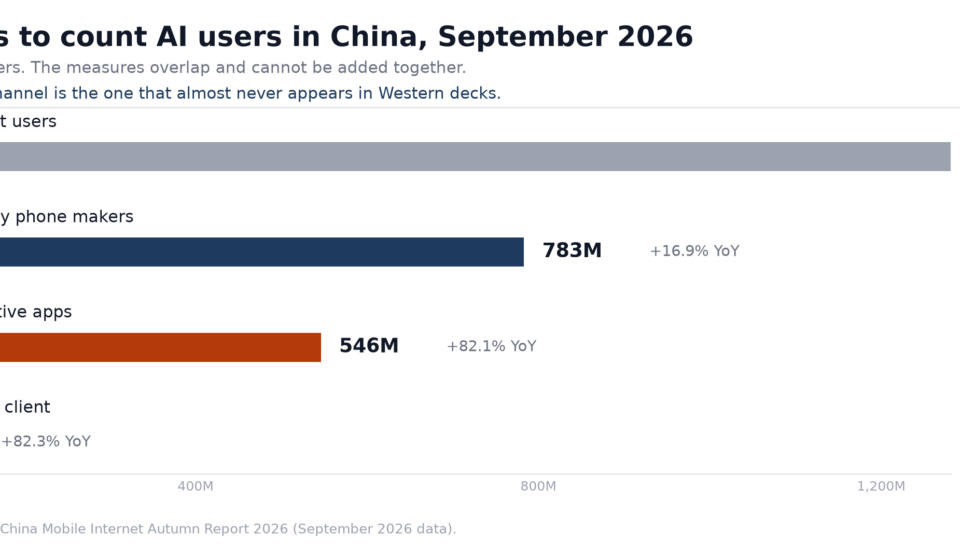
The first is about counting. Four measures, one country, and a spread from 26 million to 1.281 billion. The 783 million bar is the one to point at in a meeting, because it is the channel that decides default behaviour and never appears in a competitive set.
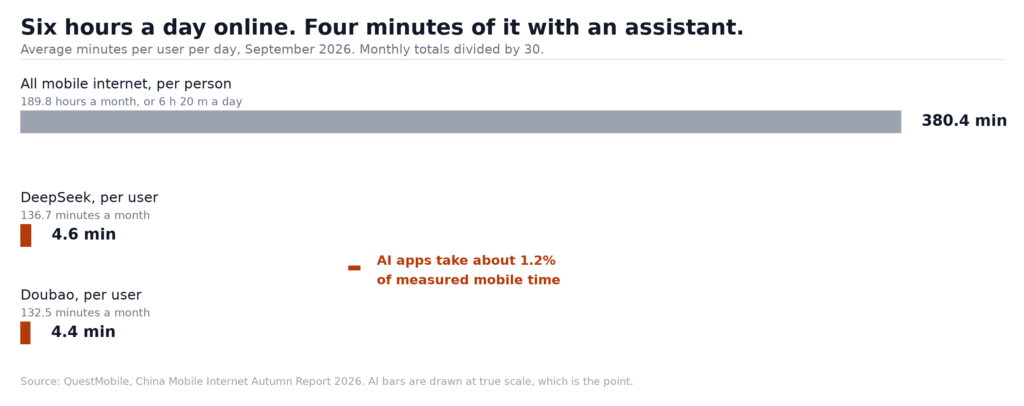
The second is about time. Three bars, and the two AI bars are almost invisible next to six hours of general mobile use. That is not a rendering error. It is the finding: presence without dwell.
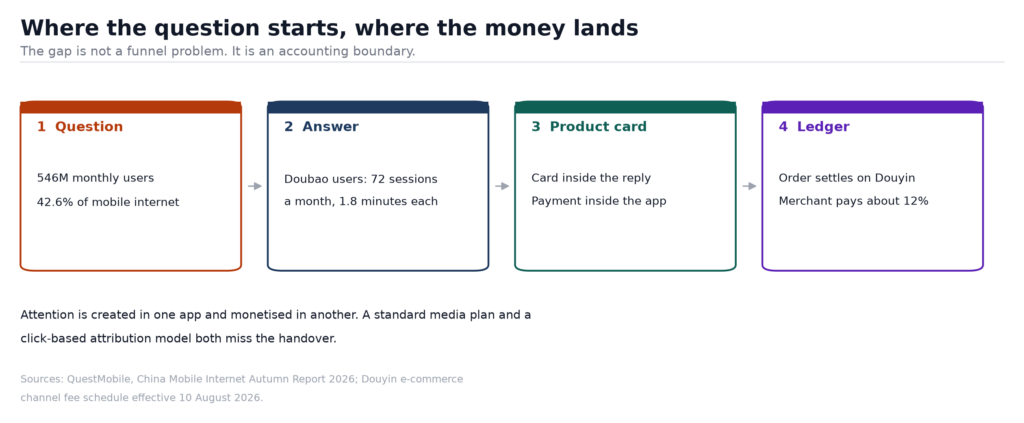
The third is about the handover. Four stages, four owners, and an order that lands in a ledger belonging to the platform rather than the brand. The 12 percent is not the scandal. The invisibility is.
12. Method, Definitions, and What Would Break This
Everything quantitative here comes from QuestMobile’s autumn 2026 report, using its September 2026 readings, plus its third-quarter AI application report and its six-platform citation study, and from Douyin’s published channel fee notices of July and August 2026. Official user statistics are referenced only to explain definitional differences.
Four measurement notes travel with the numbers.
QuestMobile published several tables in October 2026, and they do not all agree. One cut puts Doubao at 419 million and Qwen at 158 million; another, which this manuscript uses, puts them at 382 million and 167 million. Both are QuestMobile figures. Mixing cuts from different tables is the most common error in China AI decks right now, and it is why the tier numbers here are quoted as a set rather than individually.
The category measures overlap and are not defined as mutually exclusive. Do not add them.
The 42.6 percent ratio is a comparison of two reported metrics, not a verified penetration figure.
The 1.2 percent time share compares per-capita AI time with per-capita total mobile time, and the denominators differ in a way that probably understates the true share. Treat it as a magnitude, not a decimal.
What would break the argument? If per-user time in AI apps keeps falling for two more quarters while reach keeps climbing, the habit thesis fails and the category becomes a very large utility nobody lingers in. If the 12 percent channel produces volume too small to measure, the toll becomes a rounding error and the commercial story reverts to advertising. And if device-maker AI starts growing faster than native apps, the 546 million figure becomes the smaller half of a market defined by operating systems. None of these is unlikely. All of them are measurable within two quarters.
The Short Version
China’s AI-native apps passed 546 million monthly users in September 2026, growing 82.1 percent against 0.9 percent for the mobile internet as a whole. Three apps hold the category, and one of them holds most of it. Meanwhile the average user spends about four and a half minutes a day inside an AI app against six hours in apps generally, which means AI has won the first question and not the evening. Since August 2026 the largest assistant has also been a billable retail channel, charging merchants roughly 12 percent on orders it originates. That fee is the first honest price the market has put on an AI-mediated decision, and it is charged at the exact place where the brand can no longer see it.
FAQ
Is 546 million the same as China’s AI user base?
No. 546 million counts standalone AI apps only. Official statistics put generative AI users above 700 million because they include anyone who touched a generative feature inside any product, from a map to a shopping app. The app number is smaller because it excludes embedded usage, not because fewer people use AI.
Why is the phone-maker number larger than the app number?
Because it is inherited rather than downloaded. A preinstalled assistant ships with the handset and counts users who never visited an app store. It is the same behaviour counted at a different layer, which is why the two figures should never be added.
How firm is the 12 percent channel fee?
It is a published schedule, not an estimate: 11.4 percent software service fee plus 0.6 percent payment fee for the categories listed, with local services at 18 percent, and a reported range of roughly 9 to 18 percent across categories. It is charged to merchants and does not add to the consumer’s price.
Does the cross-shopping gap mean AI commerce is not working?
It means AI commerce is being accounted for somewhere else. The assistant originates the order, the commerce platform records it, and the merchant pays a channel fee. Demand is not the missing piece. Visibility is.
Does any of this transfer outside China?
The mechanism does, and it already has. Retrieval, citation and channel fees operate on every major AI platform. The specific numbers do not transfer, and neither does the timing, because the installed base, the payment rails and the retail structure differ. Use this as a preview of the mechanism, not a forecast of the volume.