AI Visibility Is a Distribution Win, Not a Demand Win
AI Visibility Won’t Fix Your B2B Pipeline
You rank in ChatGPT now. Your pipeline didn’t move. Here’s why.
“Being mentioned by an AI is a distribution win. It’s not a demand win. Confusing the two is how budgets disappear.”
I did not invent that line, and I want to be honest about that, because the entire genre of contrarian marketing writing runs on borrowing someone else’s position and passing it off as a coinage. The argument belongs to Neeta Goplani, an experience strategist at the B2B agency Circle & Square. She made it in a B2BMX Insights Q&A that Demand Gen Report published on 2 November 2026, under a headline that says the quiet part out loud: AI Visibility Won’t Fix Your B2B Pipeline.
What follows is her case, rebuilt with the data I could verify, plus a short list of numbers I would stop repeating.
1. The steelman: GEO is not a fantasy
Before I argue with the GEO industry, let me hand it its strongest evidence, because the weakest version of this debate is the one where sceptics pretend AI answers are a fad.
They are not. Generative engine optimisation started as a research problem, not a vendor pitch. Aggarwal and co-authors published GEO: Generative Engine Optimization, accepted at KDD 2024, and their benchmark showed optimisation methods lifting visibility inside generative answers by up to 40%. That is a laboratory result on synthetic queries, not a promise for your website, but it does establish the mechanism: what you publish changes whether you get cited.
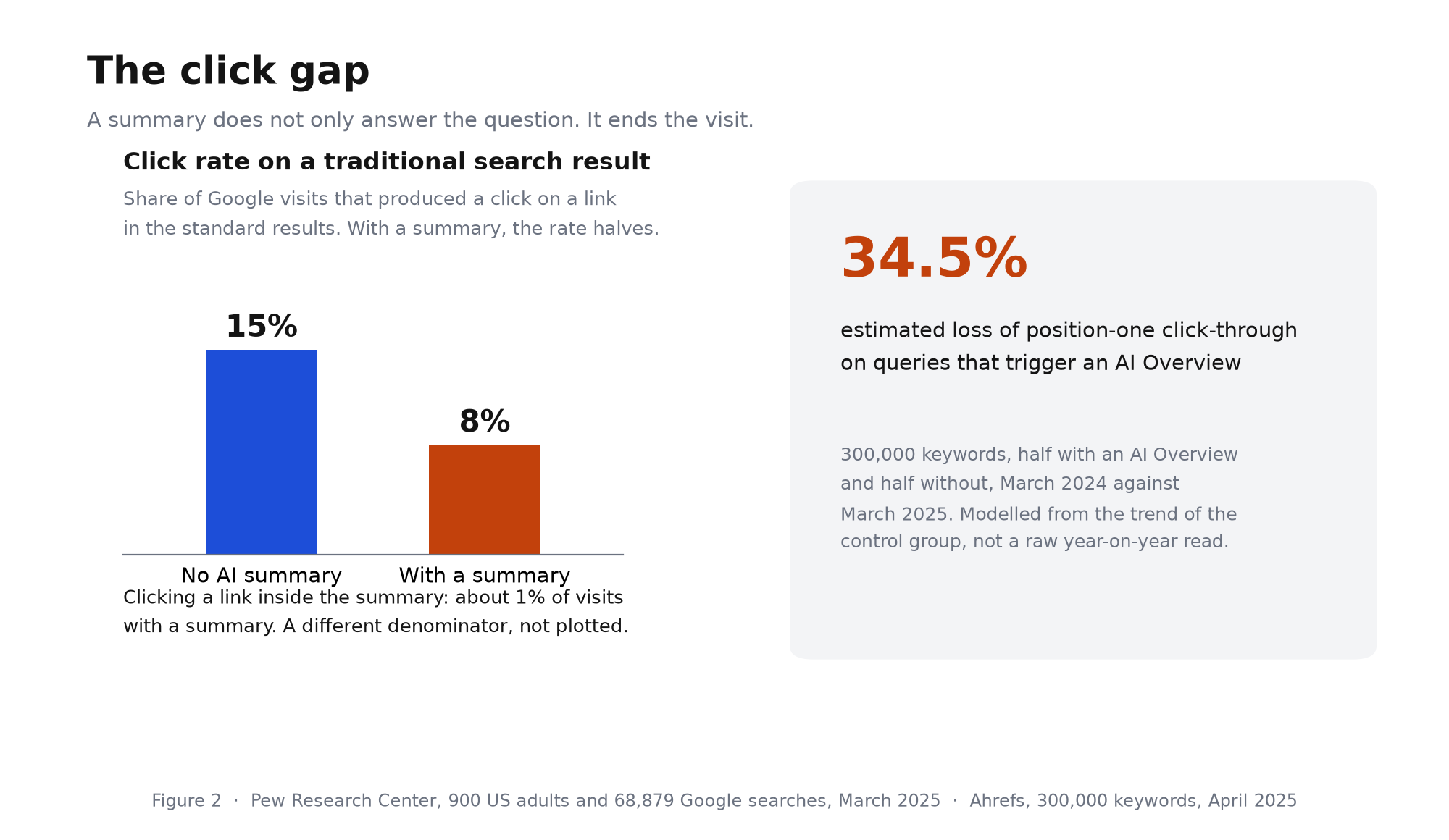
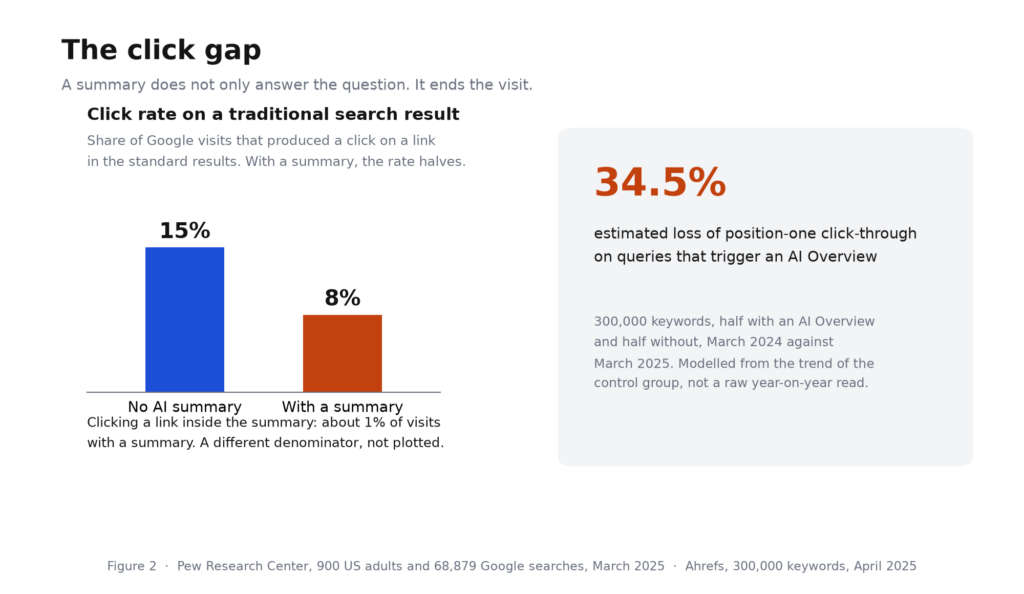
The surface itself is shrinking, which is the other half of the case. In February 2024, Gartner’s Alan Antin forecast that traditional search engine volume would fall 25% by 2026 as chatbots absorbed the queries people used to type. Pew Research Center then measured what that feels like from the user side. Its July 2025 analysis tracked 900 American adults through 68,879 Google searches in March 2025. Roughly 18% of those searches produced an AI summary. When a summary appeared, people clicked a traditional result in 8% of visits. Without one, they clicked in 15%. Clicks on links inside the summary happened in about 1% of visits, and 26% of summary pages ended the browsing session outright, against 16% for pages with only traditional results.
Ahrefs put a number on the same shift from the publisher side: across 300,000 keywords, position-one click-through rate on queries that trigger an AI Overview came in about 34.5% below the level implied by the control group. Modelled, not raw — the estimate is built by projecting the trend of queries with no Overview onto the ones that have one. Still ugly.
2. Where the money argument gets thin
Here is where the sales deck usually goes next. Spend on GEO, the pitch goes, or your country — your category, your company — will lose a nine-figure sum.
New Zealand just produced a clean example. In November 2026, Jono Swanston, general manager of the digital agency Sprocket Digital, estimated that New Zealand businesses could face more than NZ$300 million in spending over five years to protect their AI search visibility. Read the provenance carefully, because the coverage rarely does: it is an industry estimate from an agency, distributed by a public relations firm, and explicitly not confirmed investment. The supporting consumer research is more interesting than the headline — a PwC survey of 1,000 New Zealanders who had used AI while shopping found 44% had cut back on conventional search engines, 64% used AI to compare products, and 31% were comfortable letting an agent complete a purchase. Note the sample: people who already use AI to shop. Not the population.
None of that is dishonest. All of it is being used to justify budgets, which is exactly why you should trace these numbers back to whoever produced them before you sign.
3. The break point: the funnel does not break where you are measuring
Goplani’s argument is not that visibility is worthless. It is that the leak is somewhere else, and that most GEO reporting stops measuring before the leak begins.
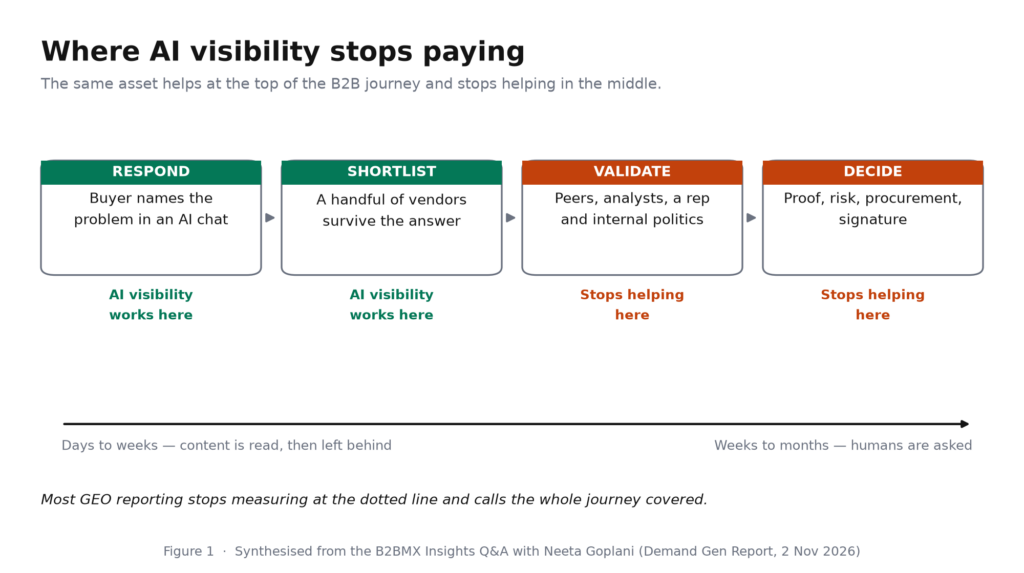
Her framing is blunt: discovery is getting dramatically faster, and the decision is getting more rigorous at the same time. The top of the journey compresses. The middle gets harder. By the time a buyer shows up in your intent data, the shortlist may already have been formed or reshaped by an assistant that read the internet on their behalf.
4. The signal problem: they research in AI, they decide through people
This is the part most GEO decks skip.
Buyers absolutely start in the machine. G2’s 2026 research found that about half of B2B software buyers now begin their research with an AI chatbot rather than a search engine. Then something inconvenient happens. A Gartner survey reported in May 2026 found that 69% of B2B buyers still want a salesperson to validate the insights an AI handed them. The assistant opens the door. A human being walks the buyer through it.
So the machine compresses the front of the journey and hands a better-informed, more suspicious buyer to a rep who has four minutes to sound credible. That is not a visibility problem. That is a routing problem.
5. Three leaks, not one
Ask where the pipeline leaks and most teams point at the bottom of the funnel. Goplani points at three places, and the first one hurts.
At entry, you appear on demand-capture queries and vanish on problem-framing ones. Her example: a client was showing up whenever someone asked for a vendor recommendation, so the dashboard looked healthy. But on the earlier questions — what is this problem, why is it happening, how do people solve it — competitors were everywhere and the client was nowhere. It was joining the conversation at the tail end.
In the middle, everyone gets the same campaign regardless of what they are actually trying to solve. The buyer has told you the problem in their own words, and you reply with a generic nurture sequence.
At the end, nobody has answered the only questions that matter: whether there is a forcing condition, who on the committee can stop this, and whether there is enough proof to make the signature feel safe.
6. The dual-track model
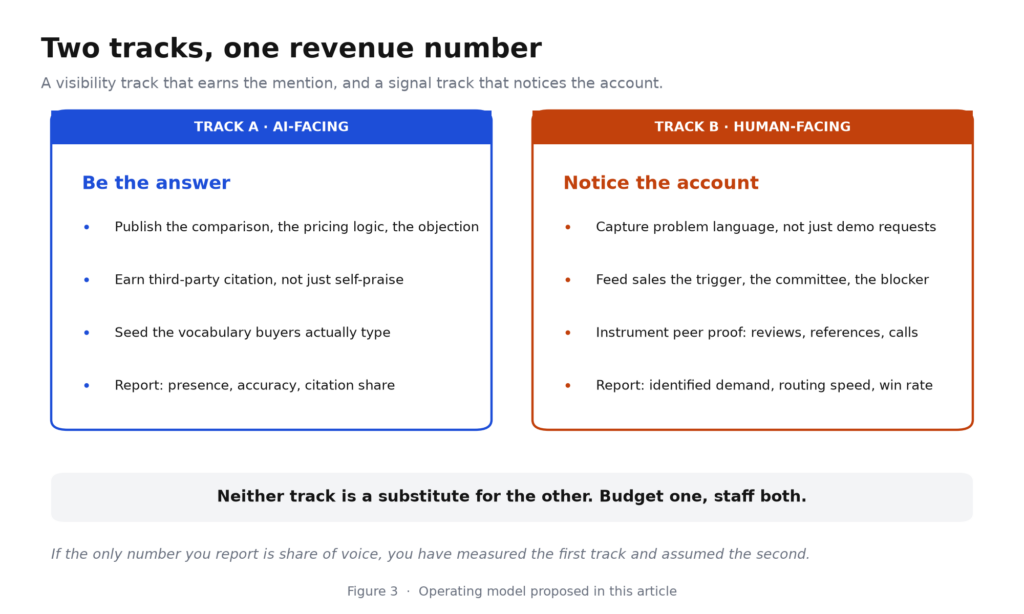
If visibility and signal capture are different jobs, staff them separately and stop pretending one number covers both.
Track A is AI-facing: publish the comparison, the pricing logic, the objection you keep losing to, and earn citations from sources that are not your own website. Track B is human-facing: capture early problem language, route it to a human within hours, and give that human the trigger, the committee map and the blocker.
The handoff between the two tracks is the product, not the dashboard.
7. What to measure instead of share of voice
Share of voice in AI answers is a fine diagnostic and a terrible target. It tells you whether the machine knows you. It cannot tell you whether anyone moved.
Replace it with four numbers you can defend in a board meeting: share of answers where your positioning is described correctly, not just mentioned; the number of accounts that entered your systems from a problem-framing conversation rather than a vendor-comparison one; hours from first signal to first human touch; and win rate split by entry point. If a deal closes after an AI-assisted shortlist, that is not an AI win. That is an AI-assisted qualification with a human close, and you should be able to see both halves.
8. Where GEO genuinely does move pipeline
I am not arguing that GEO is useless. I am arguing that it is conditional, and the conditions are specific.
GEO moves pipeline when the category already has a name, the buyer is comparing rather than discovering, the shortlist is small, and the purchase is assisted by someone who can answer follow-up questions. It also outperforms in new categories, where buyers ask what a thing is before they ask who sells it — that is a pure citation game and worth real money.
It moves almost nothing when your deal is an eight-figure transformation with a nine-person committee, or when your buyer needs an implementation plan before they need a mention.
9. The numbers I would retire
Two of them, at least.
The first is the claim that 84% of AI citations come from earned media. It has been repeated by every PR agency on earth this year, and in August 2026 PR Daily published a piece titled The 84% myth: Why the PR industry’s AI numbers are wrong. When the statistic promoting a service is produced by the industry selling the service, treat it as a hypothesis.
The second is any variant of “AI-referred traffic converts better” without a control for who those visitors already were. Self-selected, high-intent, later-stage visitors convert better. That sentence was true before ChatGPT existed.
10. The test I would apply before the next budget cycle
Ask one question. Can you name the account that moved because of the work, and the conversation that opened it?
If you can, you are running a demand system and AI visibility is one of its inputs. If you cannot, you bought distribution and called it demand. The bill arrives in about three quarters, disguised as a flat pipeline and a very healthy impressions report.
Distribution is not nothing. It is just not the same thing as revenue, and the gap between the two is where this year’s budgets are going to disappear.