What Happens When Livestream Commerce Starts Selling Inference
A rumor is circulating in Chinese livestream-commerce circles: a host sold two trillion tokens in roughly thirty minutes. Let me be clear about what I could — and couldn’t — verify. I have not found a platform announcement, a merchant disclosure, a transaction record, or independent media coverage that confirms the sale. The claim traces back to a single social heat-ranking entry. So this piece is not a report on an event. It is a question about a category.
Treat the “two trillion” figure as a placeholder, not a fact. What matters is the mechanism it implies, because the mechanism is real and already moving.
The strange part isn’t the sale. It’s the price tag on screen.
Livestream hosts have sold lipstick, cars, real estate. The novelty here isn’t that someone might hawk compute on a stream. It’s that the price was legible to the audience. A box of tokens carries a per-million price that an ordinary viewer can compare against published API rates. When a host holds up a deal on inference the way they would a foundation shade, the number on screen is a real, checkable number — not a discount on mystique, but a discount on a commodity.
That legibility is new. Most commerce runs on obscurity: the markup hides in branding, seasonality, scarcity. Tokens are the opposite. Their price is public, and it’s collapsing.
How fast is the price falling?
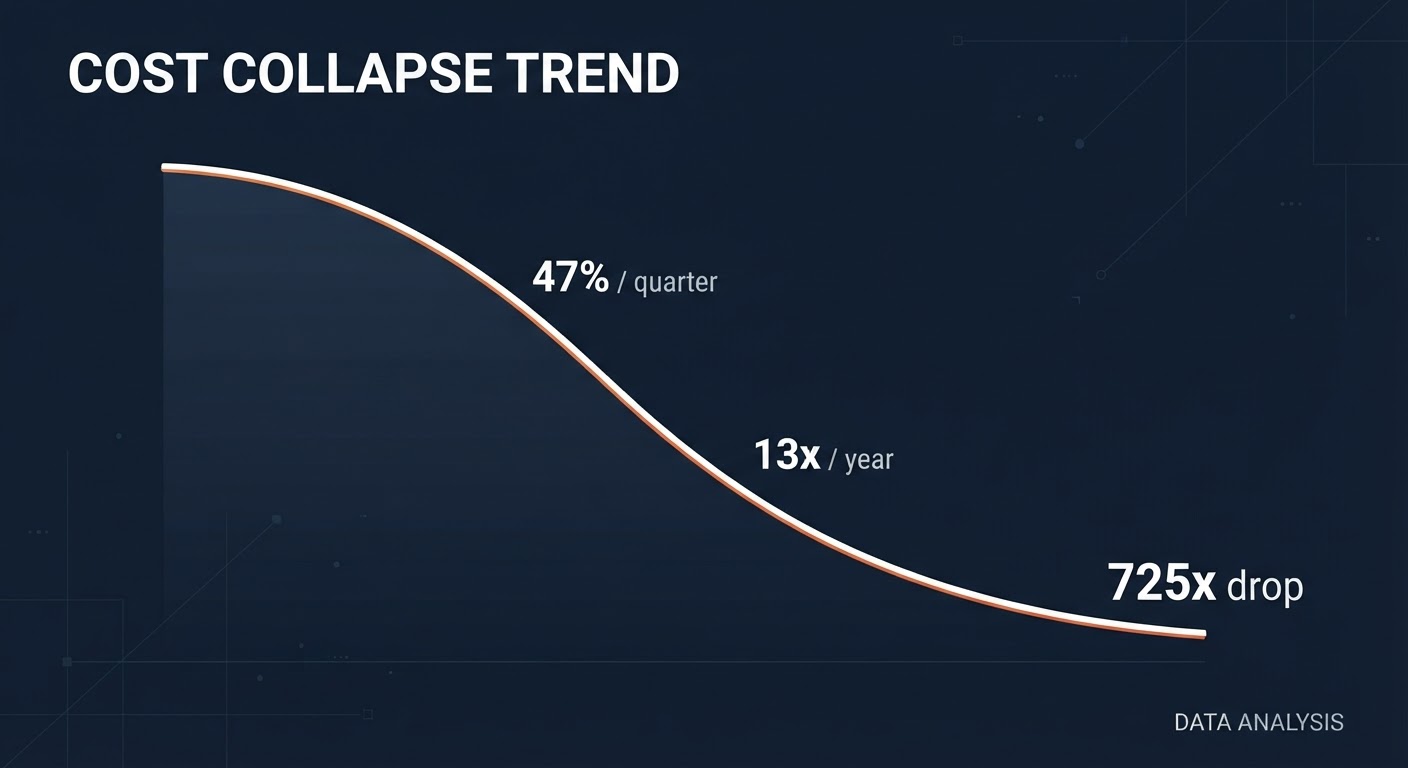
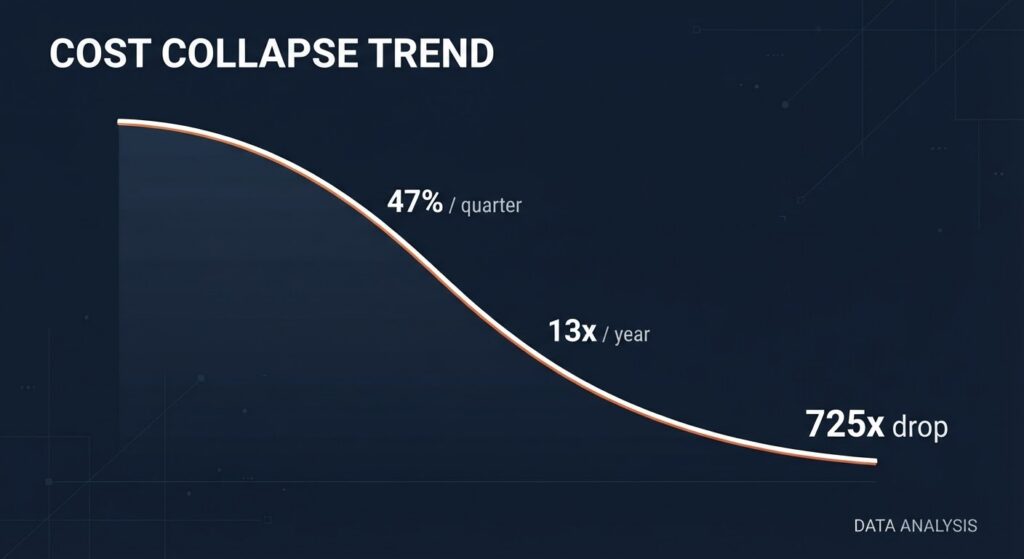
The cleanest numbers come from researchers, not rumor. Epoch AI estimates that the cost of reaching a fixed level of AI performance has fallen about 47 percent per quarter since 2023 — roughly 13 times per year. That is faster than DNA sequencing, faster than general computing, faster than lithium-ion batteries, faster than electricity fell over the century leading up to 1973. A separate measure, from Stanford’s AI Index, puts it in concrete terms: GPT-3.5-level inference dropped from around twenty dollars per million tokens in late 2022 to about seven cents by late 2024 — a decline of more than 280 times in under two years.
Epoch captures the flavor of it. A level of performance that cost thirty cents a question in January 2025 cost four hundredths of a penny by mid-2026. They put the analogy starkly: like a new car’s sticker price falling from fifty thousand dollars to sixty-nine.
Now read that twice. The thing livestream commerce is built to sell — cheap, instant, legible, impulse-friendly — is arriving faster than the channels themselves can learn to sell it.
What a virtual good needs to be merchandisable
Three preconditions, and tokens are strange on all three.
First, it has to be metered. You need a unit that can be counted and priced. Tokens have that — arguably better than lipstick, which no one measures in grams on a stream. A token is a countable thing. That’s the easy one.
Second, it has to be comparable. The buyer needs a reference price to feel like a deal is a deal. Here tokens are a double-edged sword. On one hand, the reference price is public and precise. On the other, that means the discount is immediately auditable — the host cannot inflate the “original price” the way they can for a no-name serum. The transparency that makes it legible is also what caps the markup.
Third, it has to be instantly deliverable. This is where tokens shine — and where the sirens start. There’s no warehouse, no shipping, no returns pile. Delivery is a code and a quota. Frictionless is an understatement — which is exactly what makes the purchase feel weightless, and weightless purchases are the whole game in impulse commerce.
Why “tokens” is a brutally hard SKU
For all that, the token is a terrible product. Three reasons.
Variable utility. A token is not a unit of value; it’s a unit of potential value. The same one million tokens can be worth a different amount depending on the model behind them, the task, the prompt. Lipstick is red or it isn’t. A token is worth whatever the current model makes it worth — and the model improves monthly, which means last week’s token is quietly worth more this week. How do you sell something whose utility you cannot fix at the moment of sale?
No resale. Markets need an exit. A physical good can be returned, regifted, resold. Leftover quota mostly can’t. There’s no liquid secondary market for unused inference. That turns a token into a one-way purchase with no undo — a psychological tax that impulse buyers feel even if they can’t name it.
Trust-dependent. Here’s the real kicker. When you buy a lipstick, you trust a brand you’ve seen advertised for decades. When you buy tokens, you’re trusting that the quota is real, that it won’t be throttled, that the host isn’t reselling you someone else’s expiring bundle. The good is invisible and the verification is hard. Trust becomes the entire product, and a livestream is a terrible place to audit trust.

Does the host become the pricing authority?
This is the hinge the rumor quietly points at. In physical commerce, the brand sets the price and the channel takes a cut. The host may look like the authority — “we negotiated this down for you” — but the authority lives upstream with the manufacturer.
With compute, the arrow points the other way. When the marginal cost of a good is falling 47 percent a quarter, the seller with the audience doesn’t need the brand for pricing power; they need the brand for inventory. If a host can move meaningful volume of inference in an hour, the host — not the model vendor — is the one who discovers what the market will actually pay at this exact moment. Distribution, in a depreciating market, becomes the price-setter.
That’s the rarely discussed hinge in AI commercialization. We’ve spent three years arguing about whether model vendors have a moat. The livestream — if the category forms — suggests the moat might be moving to whoever owns the attention at the checkout.
What has to be true for this to become a category, not a stunt
Four conditions, none of them new to commerce, all of them still out of reach for tokens.
One, a settlement layer someone trusts — a platform or escrow that verifies the quota before the host can claim a sale. Without it, the category collapses into scams on the first viral blowup.
Two, a normalized unit — a standard measure (per-million tokens on a stated model tier) so two streams can be compared. Apples-to-oranges pricing is how a stunt hides; standardization is how a market forms.
Three, a secondary market, or at least rollover — unused quota that can be refunded, transferred, or extended. Without an exit, the naive buyer burns once and never returns.
Four, an incentive for the vendor to participate — which is the interesting one. The vendors are the only party who can mint the supply. If they’d rather sell direct, the stream is just a gray market. The category becomes real only when vendors decide the stream is a cheaper customer-acquisition channel than their own billing page.
The question worth sitting with
So: two trillion tokens in thirty minutes. I can’t confirm it, and I don’t need to. The number doesn’t matter; the legibility does. When a commodity becomes cheap enough to be sold like a physical good, the strange part isn’t the sale. It’s that the audience, for the first time, can see exactly how cheap our thinking has become — and someone is already standing in front of a phone, holding up that number like a shade of red.
That’s not the end of the conversation about AI pricing. It might be the first time the conversation starts with the buyer, not the builder.