The Keyword Before the Category: How CeraVe Built a China Business Out of Two Words
How CeraVe built a China business out of two words — and what happens when everybody starts using them
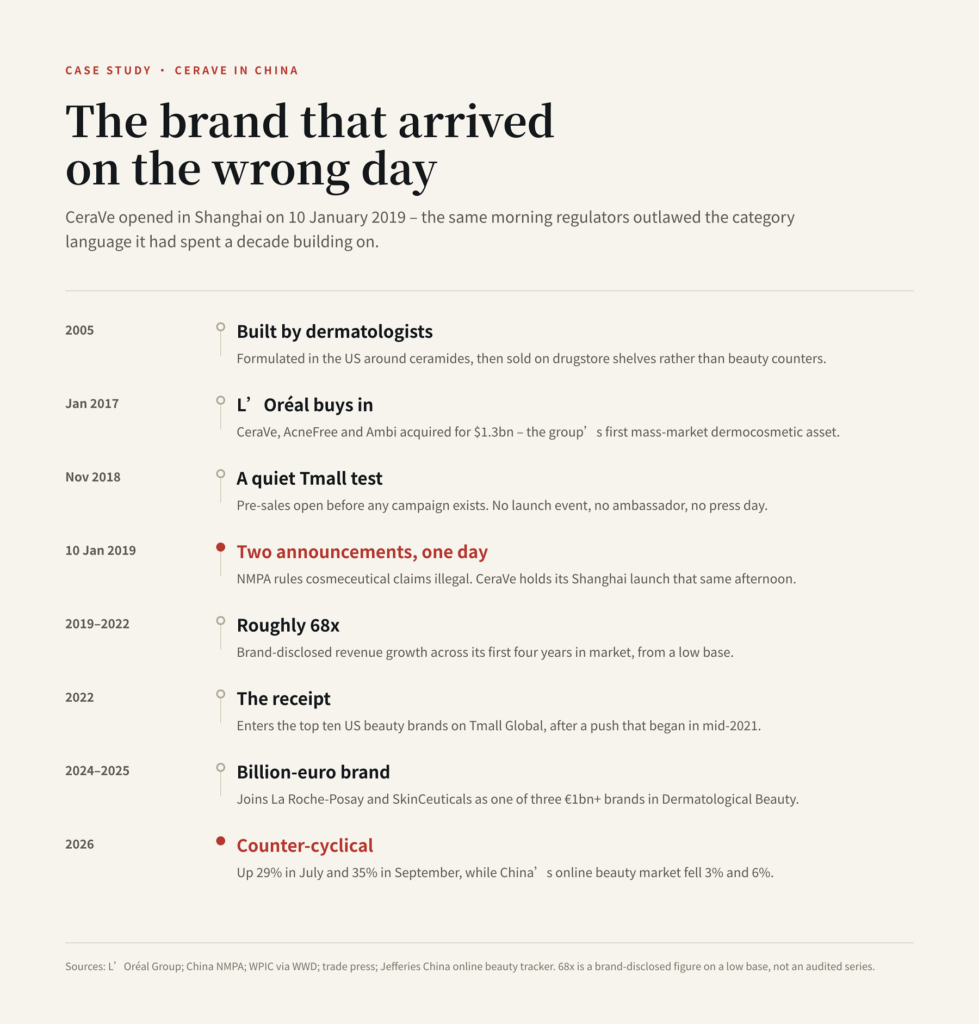
On the morning of 10 January 2019, China’s drug regulator published a routine Q&A on cosmetic labelling. Buried inside was a sentence that erased a category’s name: products registered as cosmetics could no longer be described as cosmeceuticals or “medical skincare”.
That afternoon, L’Oréal held a launch event in Shanghai for CeraVe.
Read it as bad luck and the story ends there. CeraVe had spent fourteen years being the dermatologist’s drugstore brand; the regulator had just outlawed the vocabulary that made that positioning legible. But the collision is the most useful thing in this case, because it forced an answer to a question most foreign brands never answer honestly: if you are not allowed to name your category, what exactly are you selling?
CeraVe’s answer — a skin mechanism, a search term, and an institution — became a template. Six years on, it has also become the problem.
The short version
- CeraVe entered China through Tmall rather than a department-store counter, carrying a claim (“barrier repair”) instead of a brand story.
- It bought credibility before it bought reach: a thousand dermatologists in year one, a co-published white paper, and a clinical case programme that is still running.
- It kept its own Xiaohongshu note count deliberately small — roughly 4,900 notes in total by 2022 — while the average beauty brand on the platform now publishes about 876 paid notes a month.
- The results were real and large: brand-disclosed growth of roughly 68 times in four years, a top-ten slot among US beauty brands on Tmall Global by 2022, and a place among L’Oréal’s three billion-euro dermocosmetic brands.
- In 2026 growth stopped being a curve. It became a series of unrelated weather events — and the keyword CeraVe chose is now the whole category’s shared vocabulary.
1. Context: a brand that landed on the wrong day
1.1 What CeraVe was before it was Chinese
CeraVe was formulated in 2005 with dermatologists, built around ceramides and a slow-release delivery system, and priced for the American drugstore shelf. That price point mattered more than the science in one respect: it made the product a repurchase habit rather than an occasion. L’Oréal bought the brand in January 2017, alongside AcneFree and Ambi, for $1.3 billion — a three-brand package then generating roughly $168 million a year.
Inside L’Oréal’s China portfolio, CeraVe arrived at the bottom of a four-brand pyramid: SkinCeuticals at the top, La Roche-Posay in the middle, Vichy for hydration, and CeraVe for dry, sensitive skin at the mass end. Chinese retail prices ran from about ¥45 to ¥195 a unit, with an average roughly 40 per cent below La Roche-Posay. The brief was not prestige. It was to pull shoppers up from mass skincare into functional skincare, including in third- and fourth-tier cities where the category had barely arrived.
1.2 The label that vanished overnight
The regulator’s Q&A that January did not ban a product. It banned a claim — and, in doing so, removed the shelf label an entire import category had been using to explain itself to Chinese shoppers. Overnight, “cosmeceutical” became a compliance risk rather than a selling point.
L’Oréal’s response at the launch was telling. Asked whether the ruling would change the plan, the vice-president running its China active-cosmetics division said the definition mattered less than what consumers believed about safety, efficacy and science. Then the brand did something more interesting than argue: it moved the claim down one level of abstraction. Not “we are a medical skincare brand” — a category word now illegal — but “your skin barrier is damaged, and ceramides repair it”. A mechanism, not a membership.
That single pivot is the most transferable move in the whole case. Regulators can outlaw a category label. They cannot outlaw a physiological fact.
1.3 A market that was already occupied
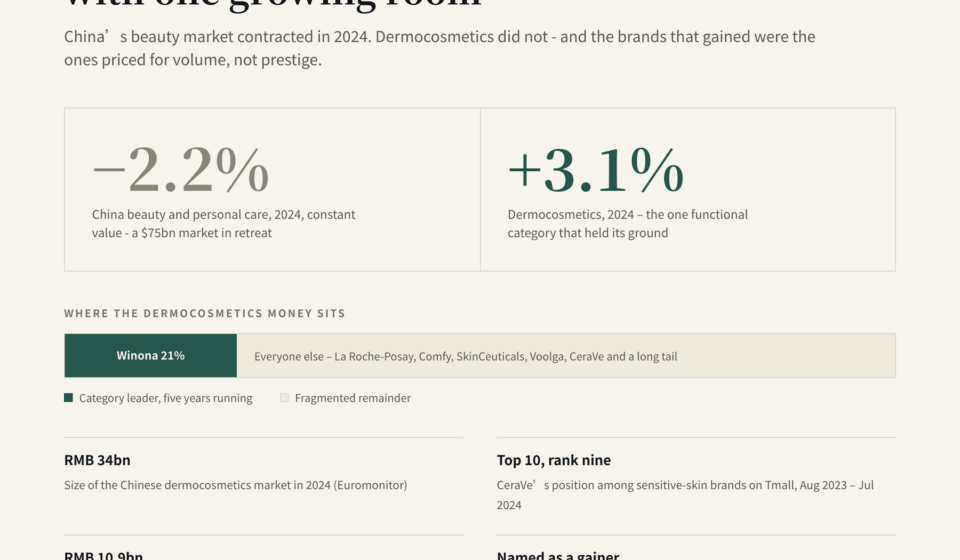
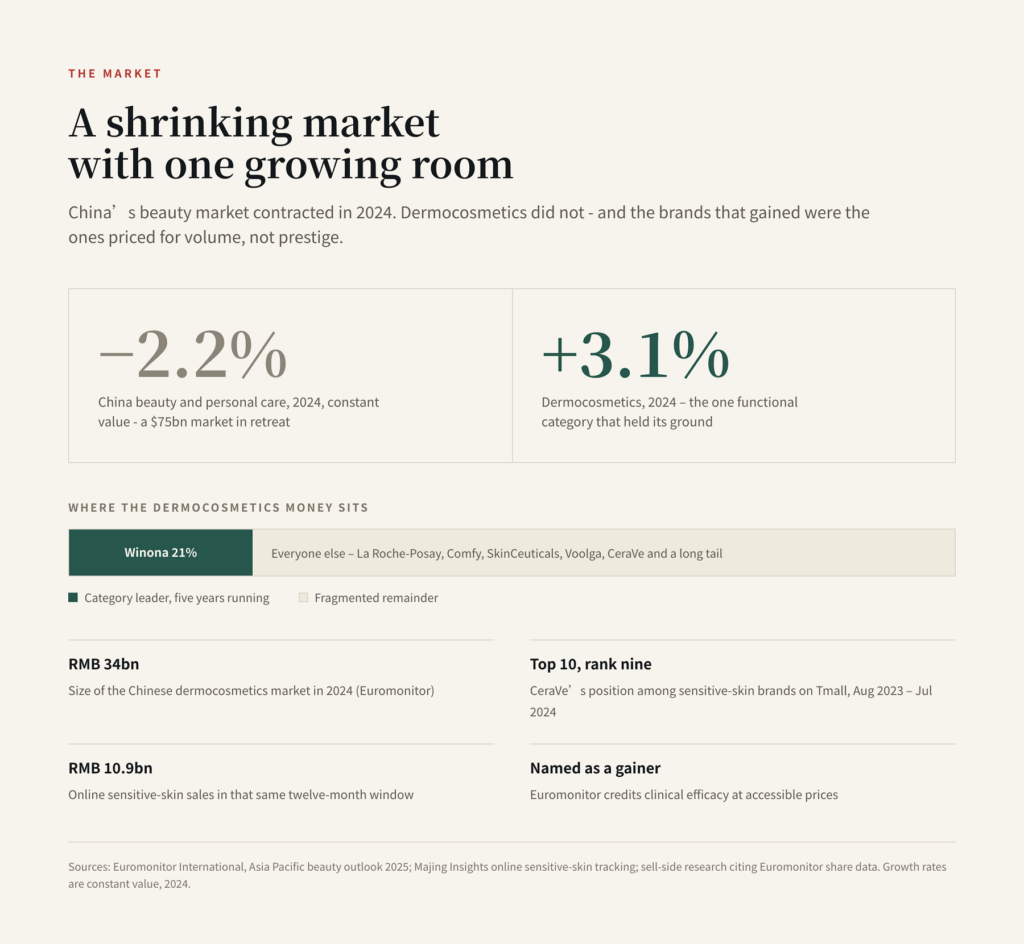
CeraVe did not walk into empty space. By 2024 the Chinese dermocosmetics market was worth about ¥34 billion, and the leader was not foreign. Winona, built by Yunnan-based Betteni around plant actives and hospital validation, held roughly 20.7 per cent of the category and had been first for five consecutive years. La Roche-Posay, Comfy, SkinCeuticals and a long tail split most of the rest.
CeraVe’s position in that ranking was ninth among sensitive-skin brands on Tmall across the twelve months to July 2024 — respectable, not dominant, in a category where roughly ¥10.9 billion of sensitive-skin product moved online across major platforms in the same window.
The macro picture was worse than the category picture. China’s beauty and personal care market shrank 2.2 per cent in 2024, to $75 billion, in constant-value terms. Dermocosmetics grew 3.1 per cent. In a market where the tide was going out, one room was still filling — and Euromonitor’s own account of who gained is the sentence this whole case turns on: brands “like Comfy and CeraVe gained traction by delivering clinical proven efficacy at accessible prices”.
Accessible prices. Hold that thought.
1.4 Why Xiaohongshu was the only front door
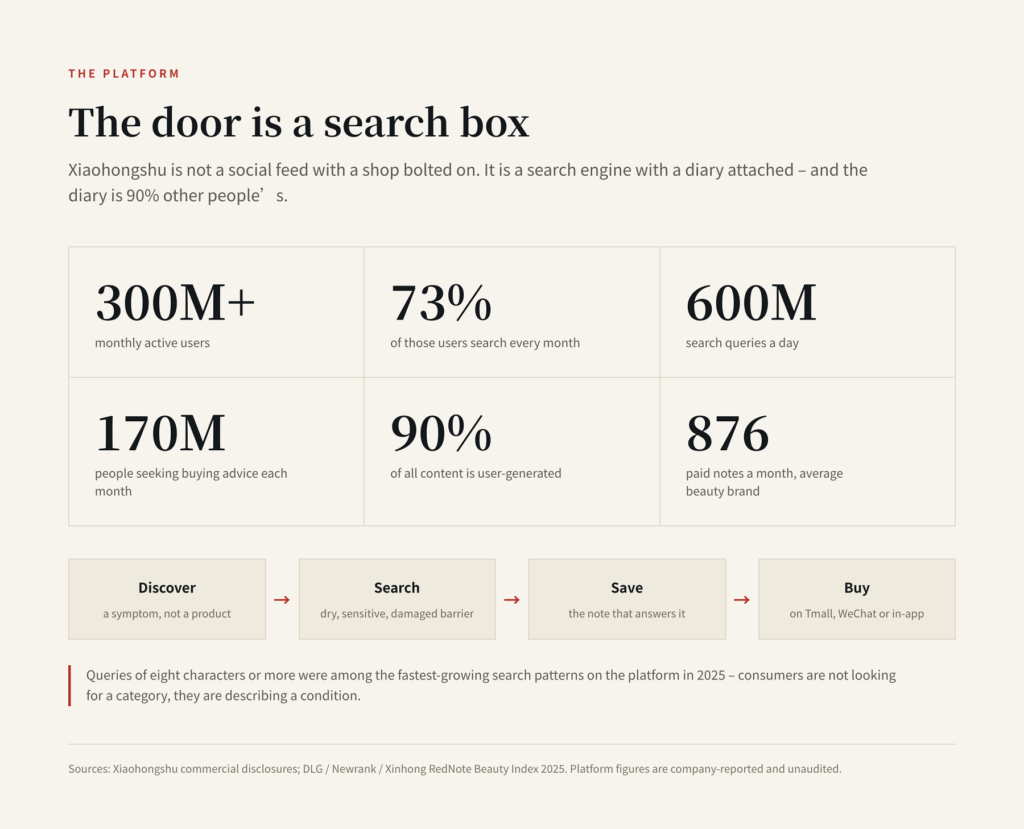
If you have not worked in China, the temptation is to treat Xiaohongshu as Instagram with shopping. It is closer to a search engine with a diary attached. The platform reports more than 300 million monthly active users, 73 per cent of whom search in any given month, on the order of 600 million queries a day. Some 170 million people go there each month specifically to look for buying advice. Around 90 per cent of the content is user-generated.
For a brand selling a mechanism, that structure is a gift. Nobody searches for a brand they have never heard of. People do search, in Chinese and at length, for “dry, sensitive, damaged barrier, which cream” — and in 2025 the fastest-growing queries on the platform were long, specific ones of eight characters or more. The consumer is not shopping a category. She is describing a condition.
Which means the real competition is not fought in the feed. It is fought on the results page, at eleven at night, against forty other notes that all claim to fix the same thing.
2. The architecture: five decisions that did the work
2.1 Decision one: sell a mechanism
The brand did not ask Chinese consumers to learn a French-American company. It asked them to learn a word: barrier. Everything else — ceramide subtypes, the delivery technology, the blue-and-white bottle — was evidence for that word.
The timing helped, and it is worth being precise about how much. By 2022, according to Tmall’s innovation arm, search interest in “repair” had passed 160,000 on the platform’s own index, and traffic to “barrier” was running at 1.7 times the volume of “sensitive”. The vocabulary of the category was migrating from a person (“I am sensitive”) to a part (“my barrier is broken”). CeraVe did not invent that migration, but it was standing exactly where it happened.
2.2 Decision two: buy credibility before reach
In year one, the brand committed to a skin-health education programme spanning ten cities, a hundred hospitals and a thousand dermatologists. It co-published a white paper on dry and sensitive skin with Alibaba’s brand data bank, a physician platform and five hospital dermatology departments. The paper’s headline finding — that about one in three Chinese women report sensitive skin, with some 90 million in the dry-sensitive segment — did two jobs at once: it sized a market and it licensed the brand to speak about it.
Then the brand did the unglamorous, compounding thing. From 2020 it has co-run an annual skin-barrier clinical case competition with the dermatologists’ branch of the Chinese Medical Doctor Association. Six editions, more than a thousand submitted cases by the brand’s own count. None of that is content. All of it is the raw material that makes content believable, and it cannot be bought in a media plan.
2.3 Decision three: a pyramid with a very thin top
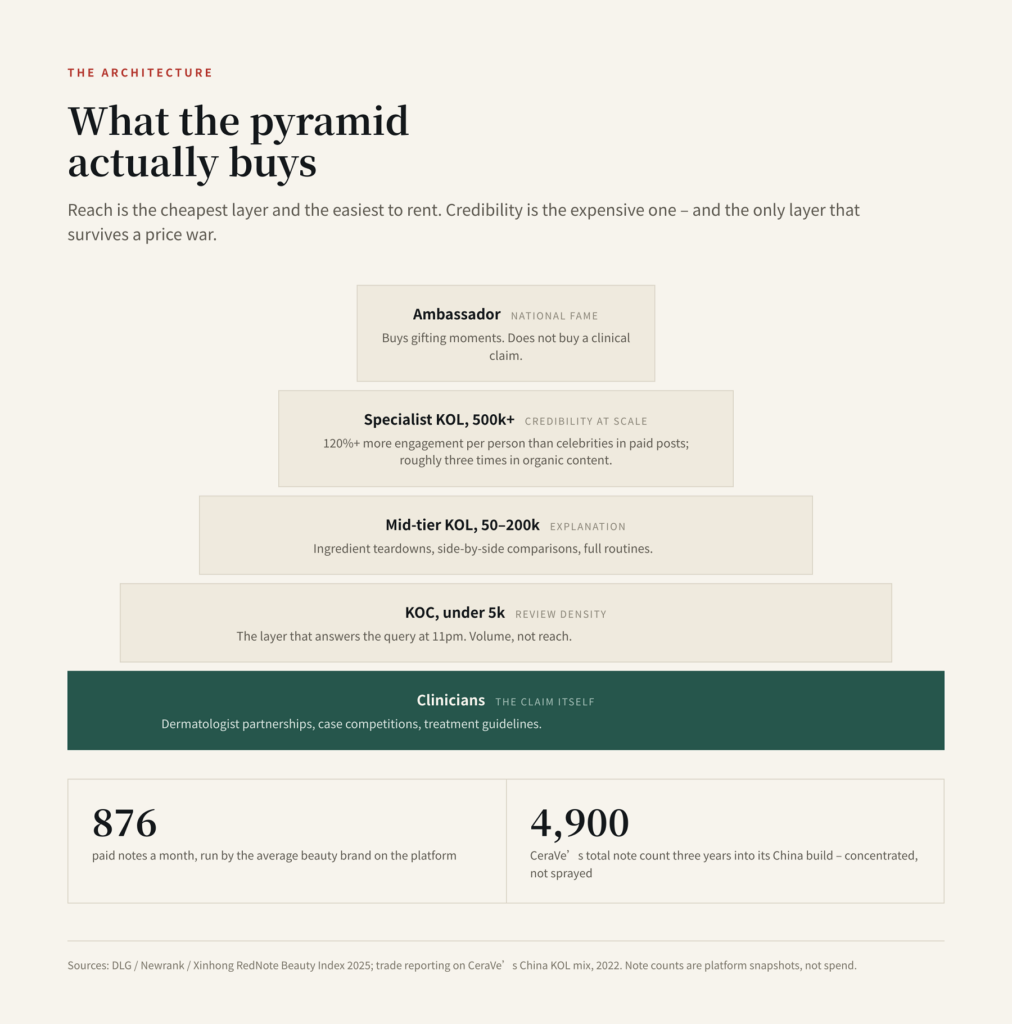
Most foreign brands invert this. They buy a celebrity, a handful of mega-influencers, and hope the middle fills in. CeraVe did the opposite: professional and ingredient-literate creators — chemists, sensitive-skin specialists, dermatology-adjacent accounts — and a small total footprint.
Roughly 4,900 notes by 2022 is not a big number. It is a decision. The average beauty brand on the platform now activates about 876 paid notes a month, roughly eighteen times the luxury sector’s rate, and the specialist tier earns its keep: creators above half a million followers in beauty generate over 120 per cent more engagement per person than celebrities in paid posts, and around three times as much in organic content.
The pyramid did not disappear. It got re-weighted, with the expensive top left mostly empty on purpose.
2.4 Decision four: price as positioning, not as discount
A ¥45 to ¥195 price band is not a compromise. In a market where consumers had started trading down without trading away efficacy, it was the whole argument. It let a shopper buy a clinical claim for the price of a mass moisturiser, then buy it again next month.
This is the part foreign brands most often get wrong. They arrive with a global price ladder, discover the category is expensive to enter, and discount their way to volume — which destroys the clinical positioning that justified the price in the first place. CeraVe started low and stayed low, and the low price read as efficiency rather than desperation.
2.5 Decision five: measure the save, not the applause
The brand’s reporting has consistently leaned on four numbers that are not likes: note saves, search ranking for category terms, engagement rate, and downstream Tmall search and conversion. The agency behind its early product campaign reported a jump of more than 370 per cent in Taobao on-site keyword searches for the brand against its prior average, and first place across three separate repair-lotion rankings.
You can argue about the precision of agency-reported figures. You cannot argue with the choice of instrument. Saves are the closest thing the platform has to a declared intention to buy later, and search rank is the closest thing to owning the moment of doubt.
2.6 The handoff: renting attention, owning the relationship
Xiaohongshu is where the decision is made. It is a poor place to keep a customer. So the brand built the exit ramp early: a WeChat official account and membership programme for post-purchase contact, and, from 2025, offline. In June 2025 it staged a repair-themed launch in Shanghai with Watsons — the pharmacy-adjacent beauty chain — on stage, which reads as a distribution signal rather than a photo opportunity. Over the 2025–26 winter it put its slogan on a landmark at Harbin’s ice festival — the first time the site had carried a brand’s name — set a ceramide molecule inside an ice sculpture, and ran a livestream with its ambassador that drew 7.9 million views, then watched users clip it back onto Xiaohongshu themselves.
That is the handoff in miniature: discovery on the platform, proof in the physical world, relationship in WeChat.
3. Results: what actually happened
3.1 The 68× is the least interesting number in this story
The brand’s general manager told Chinese trade press in 2022 that the business had grown about 68 times in four years. That figure is brand-disclosed, unaudited, and measured off a very low base — a Tmall pre-sale operation that began in November 2018 with no campaign behind it. It tells you the direction. It tells you nothing about the slope.
More useful: by 2022 CeraVe had entered the top ten US beauty brands selling on Tmall Global, having been outside it before a push that began in mid-2021. Rankings are blunt instruments, but they are third-party instruments.
3.2 The receipt
Two independent markers are worth more than any single growth multiple. First, third-party e-commerce tracking put the brand ninth among sensitive-skin brands on Tmall for the year to July 2024 — inside a top ten that included Winona, Curel, La Roche-Posay, Clinique and Cetaphil. Second, L’Oréal itself now files CeraVe as one of three billion-euro brands in its Dermatological Beauty division, alongside La Roche-Posay and SkinCeuticals, all three growing at double digits in the first nine months of 2026 while the division grew 11.6 per cent like-for-like to €6.09 billion.
Note what L’Oréal does not publish: CeraVe’s China revenue. Nobody outside the company has it. Anyone quoting a number for it is quoting an estimate.
3.3 The 2026 stress test
Here the annual report and the monthly tracker part company, which is exactly why the monthly tracker is worth reading.
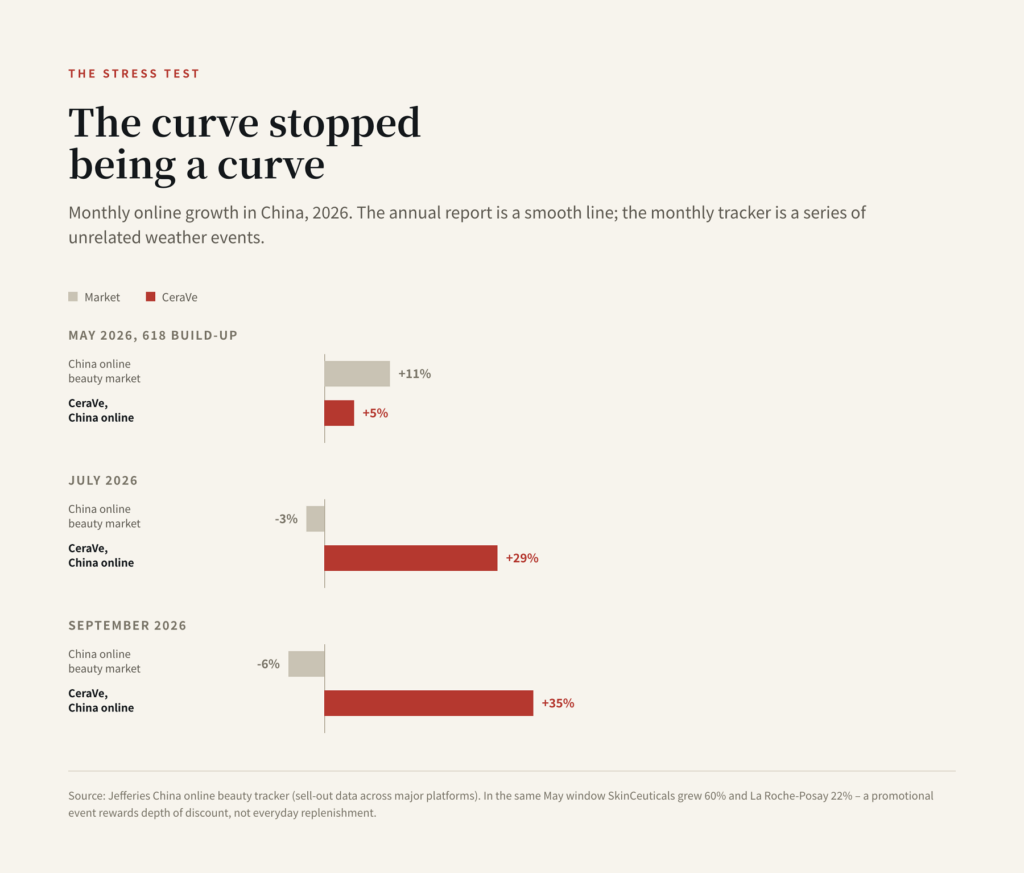
In May 2026, with the 618 shopping festival building, China’s online beauty market grew 11 per cent. CeraVe grew 5. SkinCeuticals grew 60 and La Roche-Posay 22. Two months later the market fell 3 per cent and CeraVe grew 29. By September the market was down 6 per cent and CeraVe was up 35, while SkinCeuticals managed 12, Kiehl’s fell 15 and L’Oréal Paris rose 19.
A brand that underperforms during the build-up to the year’s biggest promotional event, then outperforms when the market falls, is telling you something specific about its demand base. It is not built on gift sets and event-day discounts. It is built on replenishment — people rebuying a cream because the last one ran out, not because the price flashed. That is a durable, boring, compounding kind of demand, and it is the kind most brands say they want and few actually build.
3.4 What did not work
Four things, and they matter more than the wins.
The keyword got crowded. Barrier repair is now the standard vocabulary of Chinese functional skincare. Winona built a ¥4.4 billion brand on sensitive skin and clinical validation, and even it shrank 9.7 per cent in 2025 as the category matured. Comfy, Cetaphil, Curel and a dozen C-beauty challengers all sell the same sentence. CeraVe’s success in owning a word became the reason the word stopped being ownable.
The category stopped growing. Three per cent is not a growth market. It is a reshuffling market, where one brand’s gain is another’s loss and the arithmetic gets ugly.
The pyramid inverted at the top. In 2022 the brand signed a young actor as its face; by 2026 it was running Lunar New Year red-envelope giveaways around a different idol. That is a rational response to a commoditised claim — when the science is no longer exclusive, buy attention. But it is also a drift away from the architecture that worked, and fan commerce is rented, not owned.
The price band became a ceiling. Entering at ¥45 to ¥195 was the right call for penetration and a hard place to escape from later. There is no premium ladder above it, and no obvious way to build one without breaking the promise that made the brand work.
4. What a foreign brand should copy
Pick a claim you can defend for ten years. Not a campaign idea — a mechanism with a literature behind it. Then say it in the consumer’s words, not the category’s.
Treat credibility as a channel. The thousand dermatologists, the white paper, the case competition: none of it fits a media plan, all of it makes every subsequent note more persuasive. Budget for it the way you budget for media.
Keep the top of the pyramid thin. Reach is rent. Note volume is a vanity metric that also raises your cost per search result, because you are bidding against yourself.
Let price carry the positioning. If the claim is “clinical efficacy”, the price has to say “for everyone”, or the claim collapses into aspiration.
Build the exit ramp before you need it. Discovery on a rented platform is a lease with an unknown expiry date. Membership, offline and owned channels are the freehold.
5. The 2026 revision: what I would do differently
Three things, offered as judgement rather than data.
Narrow the claim until it is contestable. “Barrier repair” is now a category, not a position. The defensible version is a sub-population with a specific failure mode — barrier damage from over-cleansing, from actives, from clinical procedures. Specificity is the only remaining moat in a commoditised vocabulary.
Write for the answer layer, not just the feed. Chinese consumers increasingly meet brands inside generated answers as well as ranked notes. That rewards brands whose claim is stated identically, with the same numbers, across their own site, their Tmall store, their note archive and third-party coverage. Consistency is now a distribution strategy.
Measure answer presence, not impressions. The old dashboard asked how many people saw the note. The new one asks whether the brand appears when someone asks a machine, or a stranger, which cream fixes a damaged barrier — and whether it appears with the right sentence attached.
6. A closing note on why this case is uncomfortable
CeraVe’s China story is usually told as a content-marketing win, which flatters everyone and teaches nothing. It is really a story about vocabulary arbitrage: the brand found a phrase the market had not yet claimed, hired the institutions that could make the phrase true, and sold into the gap.
That gap is now closed. Which is why the interesting question for the next foreign brand is not “how do we do what CeraVe did”, but “which sentence is still unclaimed, and can we afford the proof”.
Frequently asked questions
Why did CeraVe enter China through Tmall rather than offline retail?
Because the demand it was targeting was young and online, and because a marketplace gives a new brand search data before it gives it shelf space. Offline — Watsons, sampling, events — came six years later, once the claim had been established.
Was the 2019 regulatory change a setback or an advantage?
Mostly an advantage in disguise. It stripped the category label from every competitor at once and pushed brands toward mechanism language, which is more searchable and more defensible than a category name.
How many Xiaohongshu notes does a brand actually need?
Fewer than agencies will tell you. CeraVe’s own footprint was around 4,900 notes by 2022, against an industry average today of roughly 876 paid notes a month. What mattered was concentration on credible creators, not volume.
Is “barrier repair” still a good positioning in China?
It is still a real need and a crowded claim. It works as a category entry point and fails as a differentiator, because Winona, Comfy, Cetaphil and dozens of others now say the same thing with similar clinical backing.
What is the single most transferable lesson?
Own a mechanism before you own a brand name. Chinese consumers do not search for a company they have never heard of; they search for the problem they woke up with.