How a Global Auto Brand Adapted to China’s AI Showrooms
How BMW re-instrumented a 549-store franchise network instead of replacing it
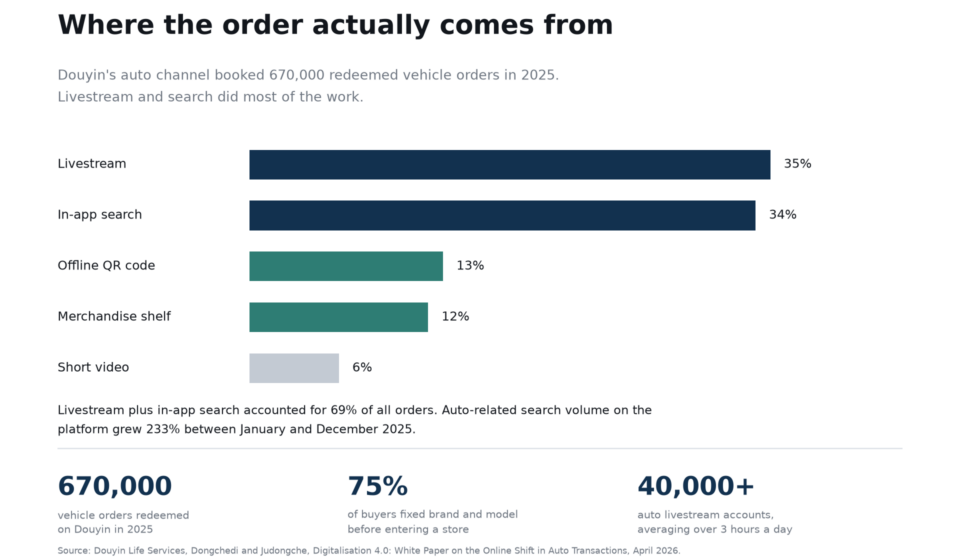
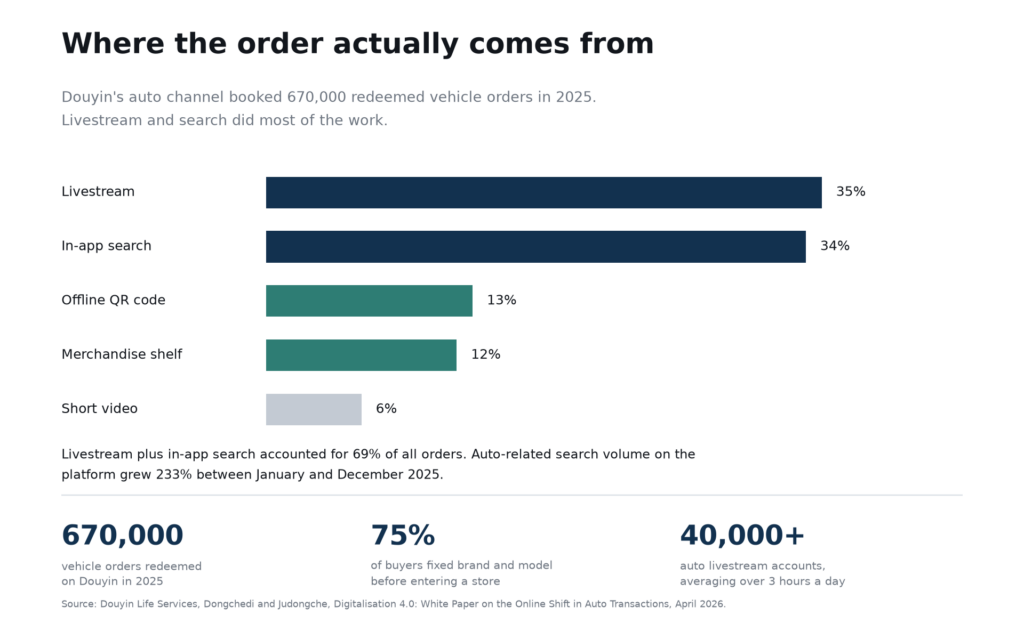
China moved the showroom into the feed, and BMW followed it there. By 2025, roughly three in four Chinese buyers had fixed on brand and model before stepping into a store, and about 70% of the vehicle orders Douyin’s auto channel booked came through livestream and in-app search rather than from a walk-in. BMW’s answer was not the flagship experience center the industry expected. It kept its franchise network, shrank it by 88 outlets in a year, and wired what remained into an AI marketing layer built by a digital subsidiary it founded in 2019. The result is instructive because it is unglamorous: interactions got faster, and probably cheaper, but volume per store still fell 22.2%, and China deliveries dropped 12.5% in 2025 before falling 24.8% in the third quarter of 2026. On this evidence, AI showrooms are a routing and retention technology. They are not a demand-creation one.
The Setup: A 650-Store Network in a Market That Stopped Walking In
What changed inside the showroom
Something quietly decisive happened to the Chinese car purchase between 2021 and 2025: the decision moved upstream of the building.
McKinsey’s China Auto Consumer Survey, which interviewed 2,498 consumers across 19 cities between October 2024 and March 2025, found that the average initial consideration set had grown from 2.5 brands in 2021 to 3.4 by 2024. That sounds like more competition, and it is. But the same survey carries the sting: 98% of combustion-car buyers and close to 90% of EV buyers end up purchasing from inside that set. If a brand is not already on the shortlist before the customer walks in, no amount of salesmanship on the floor will put it there.
Platform data says the same thing in harder numbers. At its November 2025 dealer conference, the Douyin–Dongchedi auto-marketing unit, Judongche, reported that 76.4% of users had completed model selection before visiting a store, that 72% were willing to buy a car online, and that online-sourced leads now contributed more than 58% of transactions. A white paper published in April 2026 by Douyin Life Services, Dongchedi and Judongche put the pre-store decision figure at 75%, and noted that 65% of buyers would pay a deposit of roughly 1,000 yuan to lock a configuration before sitting in the car.
The McKinsey work also settles an argument Chinese marketers have been having for three years. Asked what actually stimulates purchase intent, the net effect of faster technology cycles came out at 10.8%, against 3.6% for price cuts. Discounting has become an expensive way to buy a fraction of a point.
Why the dealership arithmetic broke
Set that against the cost base of a traditional 4S store and the squeeze becomes mechanical.
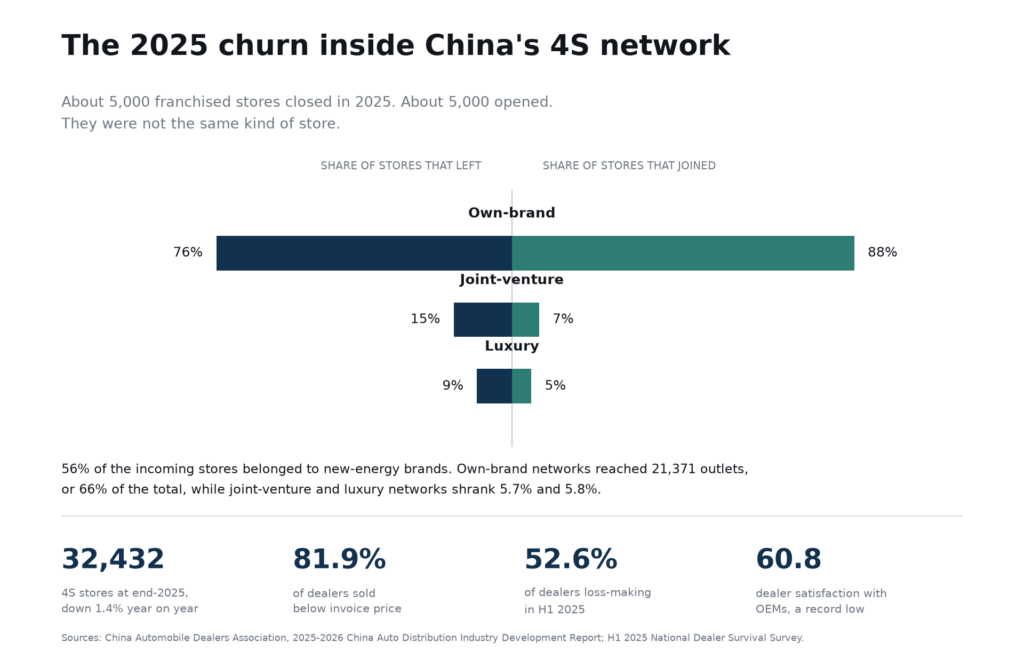
The China Automobile Dealers Association’s industry report, published in March 2026, counted 32,432 franchised passenger-car stores at the end of 2025, down 1.4%. Roughly 5,000 closed and roughly 5,000 opened, but not the same 5,000. Of the new entrants, 56% belonged to new-energy brands; 88% were own-brand. Own-brand networks reached 21,371 outlets, or 66% of the total, while joint-venture and luxury networks contracted 5.7% and 5.8% respectively.
The economics underneath those numbers are brutal. In 2025, 81.9% of dealers sold below invoice price and 51.5% did so at a discount deeper than 15%. In the first half of the year, 52.6% of dealers were loss-making and new-car gross margin sat at minus 22.3%, with only 30.3% meeting their sales targets. Across the full year, dealer satisfaction with manufacturers fell to 60.8 points, the lowest the association has recorded.
A network like that does not need a better showroom. It needs fewer buildings, faster answers, and something useful to do with traffic that now arrives through a phone.
The Brand and the Bet
Why BMW, and why not the NIO House
Every global brand in China faced the same fork. BMW’s version was unusually constrained, which is what makes it a clean case.
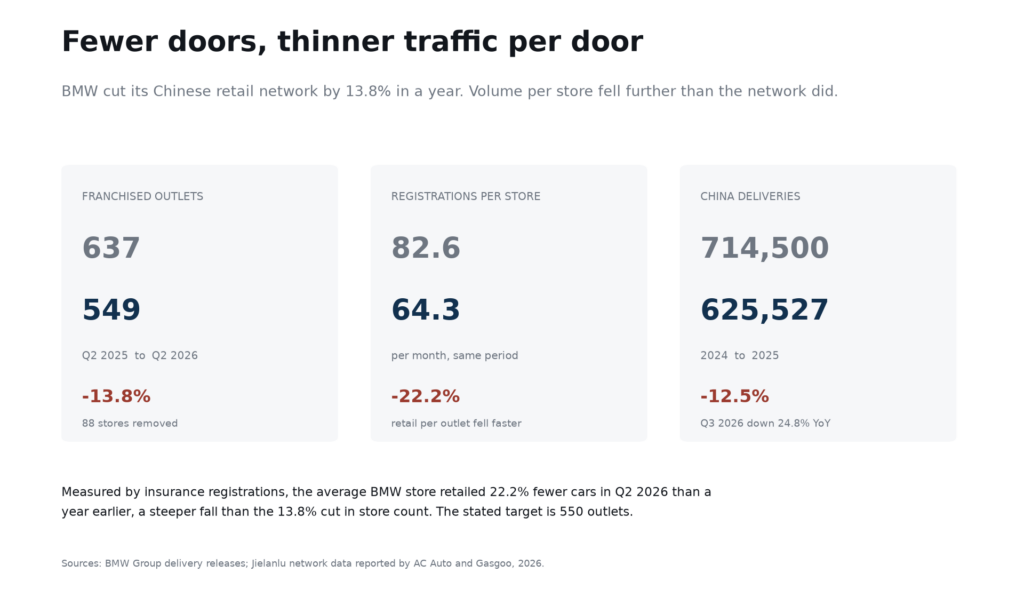
China is BMW’s largest single market and it has been shrinking for two straight years. BMW and MINI delivered 625,527 vehicles there in 2025, down 12.5%, with the fourth quarter down 15.9%. 2024 deliveries had already fallen 13.4%, to roughly 714,500. The slide continued into 2026: China deliveries dropped 24.8% year on year in the third quarter to 114,355 units, against a global decline of 6.3%. Nine-month group deliveries came to 1,707,799, down 4.9%.
The obvious response — copy NIO, build company-owned houses in shopping malls, sell direct — was never realistically available. BMW sells through franchised dealers, has held its 75% stake in the main Chinese joint venture only since 2022, and depends on a dealer body that has sunk its own capital into 4S facilities. Ripping that out mid-decline would have been a financial and political event, not a strategy.
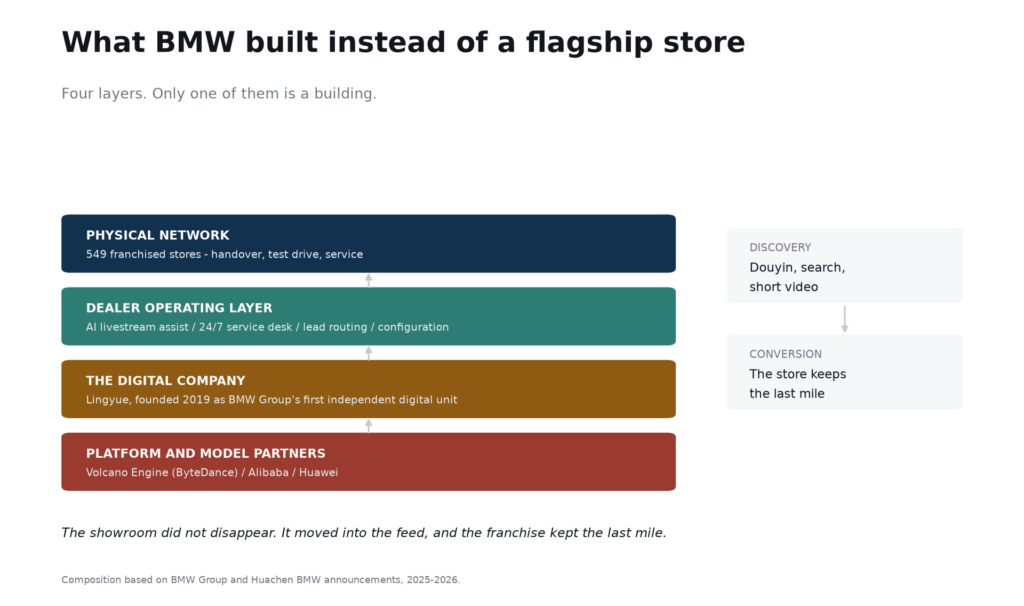
So BMW took the other option: keep the buildings, change what happens inside them, and put the top of the funnel somewhere it does not own.
Lingyue, and the case for building inside
The instrument for that was Lingyue, a wholly owned subsidiary of BMW Brilliance founded in 2019 and described by the group as its first independent digital business unit anywhere in the world. The timing matters. Lingyue was building customer-data infrastructure four years before large models became commercially usable, and had worked with ByteDance on behavior-based marketing from 2019 and on linking ad spend, livestream interaction and lead flow from 2021.
By the time generative AI arrived, BMW already had an in-house team that knew where the data lived and who was allowed to touch it.
The Strategy: Four Moves on One Spine
The 360-degree full-chain AI strategy
In March 2025, BMW announced what it called a 360-degree, full-chain AI strategy, pushing AI into R&D, production, supply chain, product, service and operations. Within weeks it signed with Huawei on HarmonyOS-based in-car applications and with Alibaba on a BMW-specific AI engine.
Then, on 18 April 2025, Lingyue announced a partnership with Volcano Engine, ByteDance’s cloud and foundation-model arm, scoped specifically to marketing and service. BMW’s China chief executive described it as the first time the group’s AI strategy had reached the marketing function rather than the vehicle itself.
The sequence matters. BMW did not treat the showroom as a place to install screens. It treated the showroom as a data problem and went shopping for models, not hardware.
Livestream became the front door
The first deployment scenario was the livestream, and that choice is the whole strategy in miniature.
Platform scale explains why. By the end of 2025 there were more than 40,000 active automotive livestream accounts on Douyin, broadcasting an average of over three hours a day. During 2025, 267 livestream sessions in the auto category cleared more than 1 million yuan in gross merchandise value, a single brand peaked at 110 million yuan of paid GMV in one month, and one new-model launch converted 43 million yuan of paid GMV. Average dwell time in auto livestream rooms ran 21% above the platform’s own content benchmark.
The tool Lingyue built with Volcano Engine does three things inside that environment. It matches a viewer’s stated budget and use case to a configuration rather than to a model name, so the question “I have 300,000 yuan, what can I buy?” gets answered with a shortlist instead of a brochure. It filters what gets pushed at the viewer, so specifications and finance offers arrive roughly in proportion to relevance. And it hands the conversation to a 24/7 automated service desk that can act outside dealer opening hours — a gap the company had previously left open.
The configurator lives in someone else’s app
Follow the path a buyer now takes. They enter from a BMW account or a dealer account inside Douyin. The system matches the nearest franchised store, assembles a personalized configuration, and routes the inquiry to that store’s queue with the conversation history attached.
The strategic concession is easy to miss. BMW does not own the storefront. The configuration sits inside a platform whose algorithm decides who sees it. In exchange, the brand gets to be present at the moment the consideration set is being formed, which McKinsey’s data says is the moment that most reliably predicts a sale.
For a brand with 549 physical doors and no direct-sales channel, that is a reasonable trade. For a brand that could build its own retail, it would be a strange one.
The store survives as a handoff point
It is worth being precise about what the AI layer does not do.
BMW’s public disclosures center on livestream, automated service and dealer enablement. AR and VR test drives are a signature of the Chinese EV challengers far more than of BMW, and the group has not made them a headline part of its China program. No credible public data isolates virtual test-drive conversion for this brand, and any figure claiming a specific uplift should be read as vendor marketing.
What still requires a building: handover, a physical test drive, trade-in appraisal, finance signature, and the service relationship that generates most of a dealer’s remaining margin. The store’s job narrowed. It did not disappear.
The Operational Rebuild
The 650-to-550 arithmetic
BMW signaled a cut from roughly 650 outlets to a target of 550. Network data compiled by the consultancy Jielanlu and reported by AC Auto and Gasgoo shows 637 outlets in the second quarter of 2025 falling to 549 a year later — 88 stores, or 13.8%, removed in twelve months. Across BMW, Mercedes-Benz and FAW-Audi together, 258 outlets disappeared in the same window.
The cuts were not confined to marginal single-store operators. Authorizations were withdrawn from large dealer groups as well as individual sites, and several buildings that lost a premium franchise have since reopened under new-energy brands — a detail that matters, because it shows the physical asset was never the problem.
Retraining the floor
The harder change was human. A sales consultant whose job was to close now has to curate: read the configuration a customer already built, validate it, and convert a pre-sold visitor into a handover.
Speed sets the standard. Platform reporting from the same dealer conference put the online-influenced decision cycle at around 35 days, with close to 70% of buyers completing a purchase within two months, and merchants on the platform answering most inquiries within a minute. A lead that waits until the next morning is a lead that has already visited a competitor.
Three vendors, one data spine
BMW’s China AI stack now runs on Huawei for the in-car layer, Alibaba for a custom model engine, and ByteDance’s Volcano Engine for marketing and service. Three partners, three data governance regimes, one customer.
Keeping Lingyue as the layer above all three is how BMW answers the governance question, and it is probably the right call. It is also where the integration debt accumulates. Every additional partner adds a schema to reconcile and a commercial interest that does not perfectly align with the brand’s.
The Results
What the numbers show
Three figures, read together, tell the story better than any single metric.
The network shrank 13.8%. Volume per store, measured by insurance registrations, fell 22.2% over the same period, from 82.6 units a month to 64.3. China deliveries fell 12.5% in 2025 and then 24.8% in the third quarter of 2026.
If the AI layer were creating demand, per-store throughput would have risen as the network thinned. It did not. What the layer plausibly bought was cost and speed: fewer staffed hours spent on first response, faster configuration, and a dealer body that could answer at 11pm. Those are real gains. They are efficiency gains, not growth.
What the numbers do not show
Attribution here is genuinely hard, and any case study that claims otherwise is selling something.
BMW’s China decline coincides with three forces: a structural shift in the market, as new-energy retail penetration passed 50% during 2025; a three-year price war that left 81.9% of dealers selling below invoice; and a product cycle gap in the brand’s own electric lineup. Separating the effect of an AI marketing layer from those three is not possible with public data.
What can be said is narrower and more useful. The AI layer did not offset them. That is a modest claim, and it is the honest one.
The real test arrives with the product. BMW’s China-built new iX3, the first model on the Neue Klasse platform, is due to reach dealers from November 2026; the car has taken more than 100,000 orders in Europe in its first year. If a rebuilt funnel cannot convert a genuinely competitive product, the architecture was the wrong diagnosis. If it can, the 2025–2026 numbers will read in retrospect as the cost of getting the plumbing right before the product arrived.
Five Lessons for Global Auto Brands
1. Instrument the network you have before you rebuild it. BMW’s constraint was also its advantage. A franchised network of 549 stores run by independent dealers cannot be replaced in a downturn, but it can be given a shared brain. Most global brands are one integration project away from a materially better funnel.
2. Put the configuration where the consideration set forms, even if you do not own the room. Handing the storefront to a platform feels like a loss of control. Losing the shortlist entirely is worse.
3. Treat response time as a product feature. A 35-day decision cycle and minute-level response expectations are not marketing preferences. They are service-level requirements that no amount of brand equity compensates for.
4. Cutting stores is not the same as raising productivity. BMW removed 13.8% of its network and per-store volume fell 22.2%. Headcount reduction without demand recovery just concentrates the shortfall.
5. Budget for the integration debt. Three model vendors, three governance regimes, one customer record. The layer that reconciles them is the actual asset, and it is the part that is hardest to buy.
Conclusion
The instinct when China’s retail model changed was to assume the flagship store would save the brand. BMW’s 2025–2026 record suggests the opposite. The building was never the constraint; the delay between a customer forming an intention and a brand responding to it was. BMW attacked that delay with a livestream-first AI layer, a dealer routing system and 88 fewer stores, and it still lost volume, because marketing infrastructure cannot outrun a product cycle.
That is the case study’s real value. It puts a number on what an AI showroom can and cannot do. It can shorten the distance between interest and a configured, financed, appointment-booked lead. It cannot manufacture interest in a car the market has not yet decided it wants. Brands reading this in 2026 should plan accordingly: build the plumbing now, because the product is coming, and the plumbing is the slower of the two to install.
Summary
BMW’s China response to the collapse of the walk-in showroom was structural rather than theatrical. It founded a digital subsidiary in 2019, layered an AI marketing and service system over its franchise network from 2025, put its configuration tools inside Douyin where three in four buyers now make their decision, and cut 88 outlets on the way to a stated target of 550. Interaction economics improved; volume per store fell 22.2% and China deliveries fell 24.8% in the third quarter of 2026. The lesson for global auto brands is that AI showrooms are a routing and retention system, not a demand engine — necessary, insufficient, and best installed before the product cycle turns.