The Gravity of Commerce: Why No Chinese App Stays a Media App
In the West, apps stay in their lanes. Instagram is social, YouTube is video, Amazon is shopping. In China, that wall collapsed quietly: every app that owns attention eventually builds a store.
This isn’t scattered ambition. It’s one economic force — call it monetization gravity — expressing itself five times.
The convergence, in four numbers
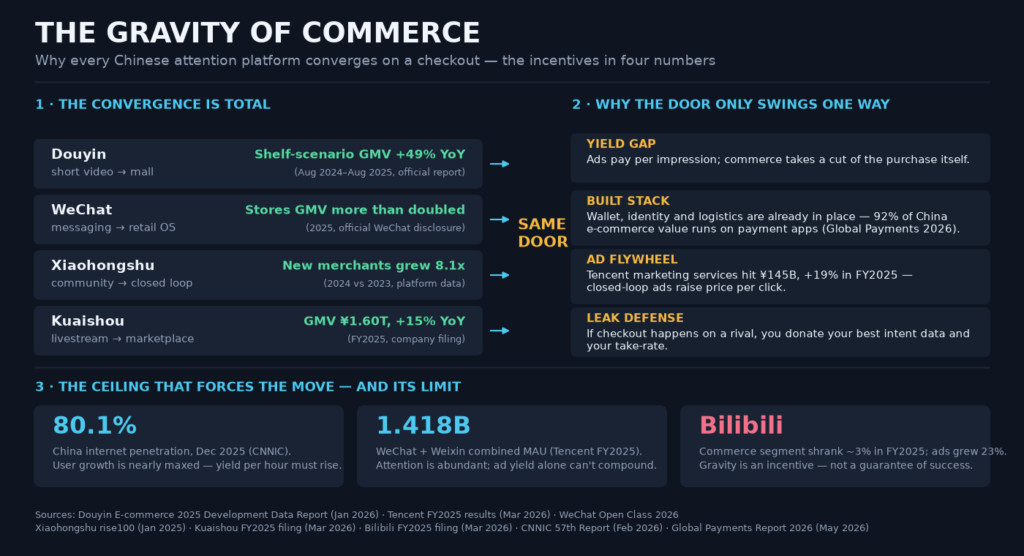
Douyin’s shelf-scenario GMV grew 49% year over year (Aug 2024–Aug 2025, per its official 2025 development report) — a video app now competing with Taobao on search-and-buy. WeChat Stores GMV more than doubled in 2025, per Tencent’s WeChat Open Class disclosure. Xiaohongshu, the seeding community, saw new merchants grow 8.1x in 2024 (platform data). Kuaishou closed FY2025 with ¥1.6 trillion in e-commerce GMV, up 15% (filings).
Why the door only swings one way
The yield gap. Advertising sells impressions cheaply. Commerce takes a cut of the transaction itself — an order of magnitude more per hour of high-intent attention. With China’s internet penetration at 80.1% (CNNIC, Dec 2025), user growth is nearly maxed out. Platforms must raise revenue per hour; commerce is the biggest lever left.
The stack is already built. Adding checkout in China is almost free at the margin: wallets, identity and logistics are in place. Payment apps carry 92% of e-commerce transaction value (Global Payments Report 2026) — the rails exist; the buy button is a feature flag.
The ad flywheel. Once purchase closes in-platform, merchants must advertise in-platform to win it. Tencent’s marketing services grew 19% to ¥145 billion in FY2025, lifted explicitly by closed-loop ads. Commerce doesn’t cannibalize advertising — it supercharges it.
Leak defense. If your feed creates demand but checkout happens on a rival marketplace, you donate your best intent data and your take-rate. Closing the loop is defensive before it’s offensive.
What it isn’t
It isn’t culture — users tolerate one app because bundled value earned the habit, not the reverse. And it isn’t guaranteed success: Bilibili’s commerce segment shrank about 3% in FY2025 while its ads grew 23%. Gravity describes the incentive, not the outcome. Every attention platform is pushed to try the door; only those with trust, wallet and supply walk through profitably.
For global marketers, this is a preview, not a quirk. Wherever payments, identity and trust consolidate under a feed — TikTok Shop, Instagram, YouTube — the same math applies. Every feed ends in a checkout. The only question is who owns it.