SpaceX Catches a Starship With the Tower for the First Time — but the Booster Got Away
Flight 15 delivered the milestone SpaceX has been chasing since 2024: an orbital-class upper stage, returned from space, plucked out of the air by the launch tower.
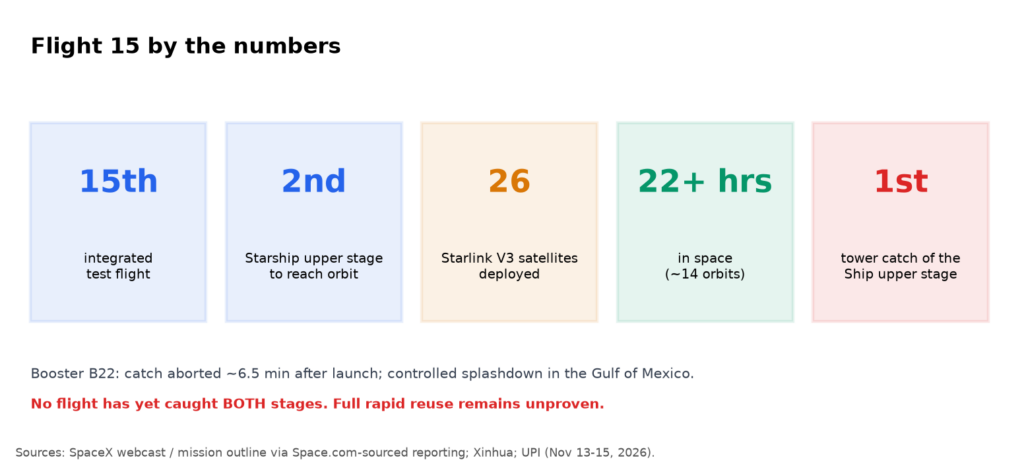
SpaceX’s Starship completed its 15th integrated test flight on Saturday, November 14, 2026 with the first-ever tower catch of the Ship upper stage — the vehicle that actually goes to orbit. After roughly 14 orbits and more than 22 hours in space, Ship 42 returned to Starbase in South Texas and was caught by the launch tower’s mechanical “chopstick” arms at about 3:20 p.m. CT, according to Xinhua. It was the second time a Starship upper stage has reached orbit and the first time one has come back to the tower.
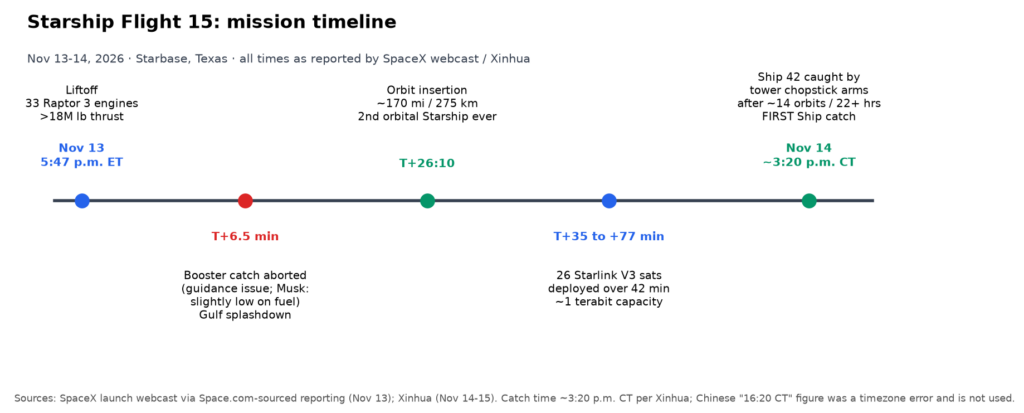
The flight was not a clean sweep. The Super Heavy booster’s planned catch was called off about six and a half minutes after liftoff, and the booster made a controlled splashdown in the Gulf of Mexico instead. SpaceX attributed the abort to a guidance issue; Elon Musk said on X that the booster was also slightly low on fuel. Both explanations can be true at once — a guidance anomaly during the return burn and a propellant margin that left no room to improvise.
What Flight 15 actually did
The stack lifted off Thursday, November 13 at 5:47 p.m. ET from Starbase, with the booster’s 33 Raptor 3 engines producing more than 18 million pounds of thrust. Hot-staging went nominally about two and a half minutes in. A second Ship burn of roughly 20 seconds parked the vehicle in low Earth orbit at about 170 miles (275 km) altitude, 26 minutes and 10 seconds after launch — “Starship now in orbit around Earth for the second time ever,” as SpaceX’s Dan Huot put it on the webcast. The first orbital insertion came on Flight 14, launched September 28.
Ship 42 also deployed 26 Starlink V3 satellites over a 42-minute span starting 35 minutes after launch — the second V3 batch to reach orbit. SpaceX’s mission outline says the batch adds a terabit of capacity to the constellation, equivalent to about ten Falcon 9 Starlink launches. Then came the part everyone was watching: a next-day return, a heat-shield pass through reentry, and the catch.
Why catching the Ship is the harder half
SpaceX has caught Super Heavy boosters with the tower before — three V1 boosters were recovered, two of them reflown. But the booster comes back minutes after launch, suborbital, with most of its energy still manageable. The Ship comes back from orbit, at orbital velocity, after a day in space, with a heat shield that has to survive the hardest part of the mission first. Catching it means the entire return chain — deorbit burn, reentry, flip, landing burn, tower handshake — worked end to end.
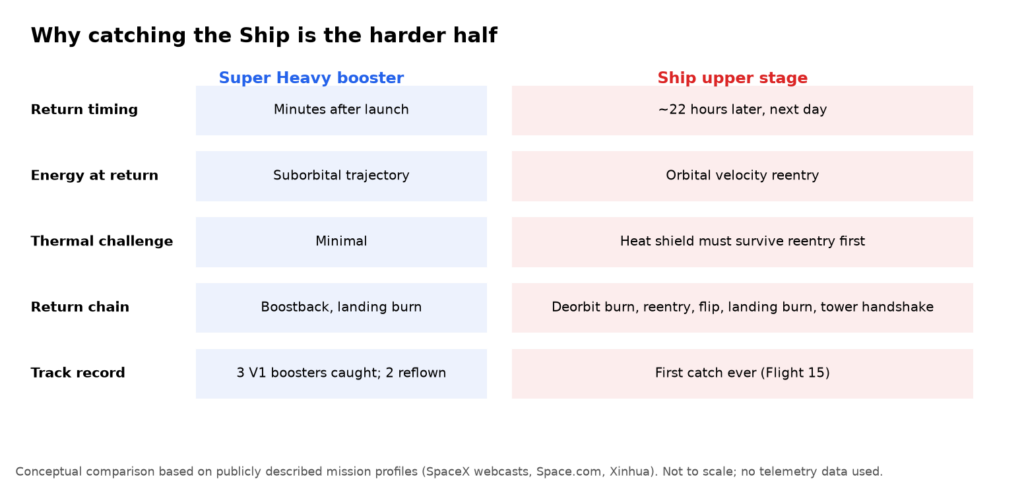
That is the prerequisite for the architecture SpaceX sells: both stages back at the tower, inspected, refueled and reflown on a timescale of hours rather than months. Flight 15 proved the Ship half. The booster abort is a reminder that the full loop is still unproven — no flight has yet caught both stages.
What to watch next
Three questions will define the next test cycle:
- The booster fix. Whether the guidance issue is a software margin problem or something structural in the V3 return profile will determine how quickly a double-catch attempt comes.
- Ship reuse. A caught Ship is only valuable if it can fly again. Reflight of a tower-caught upper stage would be the next genuine first.
- Cadence. The V3 Starlink deployment pipeline now depends on Starship flying repeatedly. One successful catch is a milestone; ten in a quarter is a business.
For the broader launch market, the signal is unchanged but sharper: full and rapid reuse of an orbital-class vehicle is no longer a rendering. It is an engineering checklist with one box left unticked.