The Compounding Asset Behind the 90-Day Plan: Why Learning Is the Only Marketing Output That Appreciates
Spend the same money, work the same hours, run the same number of campaigns — and still end the year with less to show for it than the team next door. Why? Because marketing has one asset that appreciates instead of depreciating, and most teams never bank it: learning.
The Asset Nobody Books
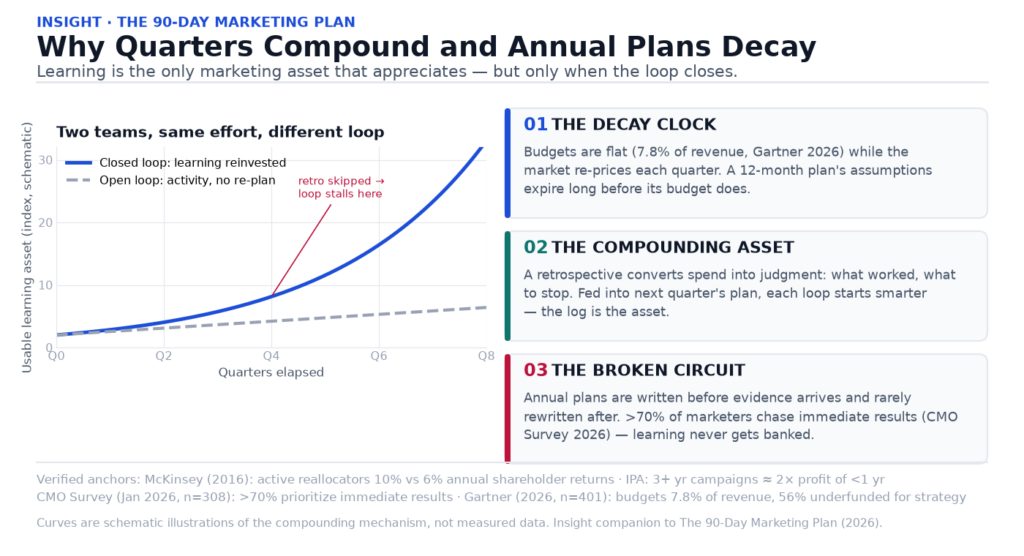
Every campaign produces two outputs. The first is the result — clicks, pipeline, revenue — and it gets spent or reported away within the quarter. The second is judgment: what worked, what to stop, which assumption broke. Judgment is the only output that gets more valuable over time, because it makes every future decision cheaper and sharper. But it only compounds under one condition: somebody writes it down and the next plan is built from it. Miss that step and the learning evaporates with the campaign. You didn’t run a loop; you ran an event.
Why the Annual Plan Structurally Cannot Compound
Here’s the mechanism. An annual plan is written before the evidence arrives — November assumptions about a market that will re-price, re-regulate and re-platform by spring. Gartner’s 2026 CMO Spend Survey found budgets pinned at 7.8% of revenue, flat since 2022, with 56% of CMOs saying they can’t fund their own strategy. In that environment, the plan’s assumptions expire long before its budget does. And because the plan is rarely rewritten mid-year, there is no scheduled moment when new evidence is forced into the system. The CMO Survey (January 2026) found more than 70% of marketers now prioritize immediate results over long-term gains — the telltale sign of a broken circuit: activity without reinvestment.
Why the Quarter Closes the Circuit
Ninety days works not because short is trendy, but because the horizon matches two clocks at once. It’s short enough that assumptions stay alive until the result lands — and long enough to contain a full plan-build-launch-learn cycle. The retrospective in weeks 11–12 is the deposit window: it converts spend into judgment, and the decision-log carries that judgment into next quarter’s plan. Each loop starts smarter than the last. That’s the whole trick. McKinsey’s reallocation research shows the payoff of treating resources as movable rather than fixed — active reallocators averaged 10% annual shareholder returns versus 6% for static ones — and the same logic applies to attention: a quarter is the smallest unit where moving resources and banking learning can happen in the same motion.
The Uncomfortable Implication
If learning is the compounding asset, then the most expensive line in your budget isn’t the failed campaign — it’s the skipped retrospective. A failed campaign with a logged lesson pays forward; a successful one whose lessons nobody captured is just noise you got lucky on. IPA’s effectiveness research makes the same point at campaign scale: investments sustained three-plus years earn roughly double the profit effects of sub-one-year bursts, because continuity lets effects accumulate. Quarters are how you buy continuity without buying fantasy. The annual plan tells you where to point. The loop is what makes the pointing worth anything.