The Front Door Was a Sticker: China’s QR Economy and the Case for Offline Accountability
In 2012, a Wall Street analyst could say the QR code was dead and be right about the facts on the ground. Roughly 14 million Americans had ever pointed a phone at one. Facebook and Google had already stopped pretending to care. The obituary wrote itself, and for about a decade nobody bothered to correct it.
Then China took the same black-and-white square, gave it a job, and turned it into the front door of the entire economy.
Here’s the part that usually gets lost. The QR code didn’t get smarter. It didn’t get prettier, and it definitely didn’t get more secure. What changed was the thing waiting on the other side of the scan. In the West, that thing was a website. In China, it was an account, a wallet and a Mini Program — in that order.
That difference is the whole story.
First, Let’s Kill a Bad Framing
The popular version of this tale goes: “The West rejected QR codes, China embraced them.” It’s tidy, it’s satisfying, and in 2026 it’s also wrong.
The West came back. eMarketer’s tracking put the number of US adult smartphone users scanning a code at least once a year at 99.5 million in 2025, with a forecast of roughly 102.6 million for 2026 — up from 83.4 million in 2022. Restaurants, stadiums, parking meters and airline boarding passes did the persuading. Apple put a reader into the iOS camera in 2017, which removed the single dumbest friction point in the entire experience, and the rest followed.
So no, the QR code is not a China-only phenomenon. But it is a China-only infrastructure.
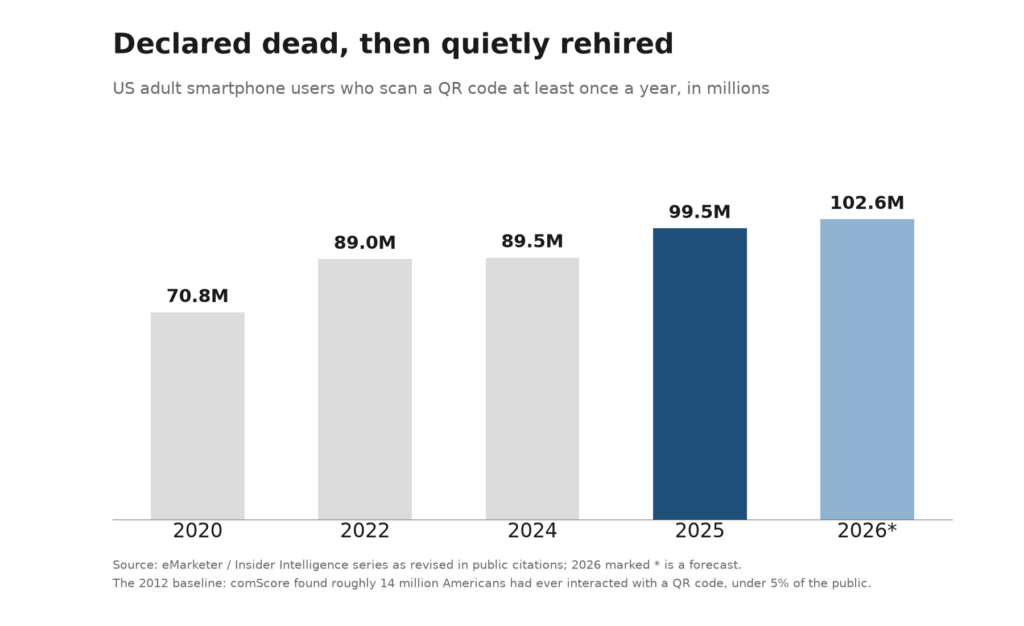
Read the shape of that curve next to China’s numbers and the difference stops being philosophical. In the US, QR scanning is a campaign behaviour — you scan because a specific surface asked you to, and then you stop. In China, scanning is a motor skill, executed dozens of times a week without a thought, the way you reach for a light switch.
That is a different organ, not a different opinion.
The Habit That Trained 1.1 Billion People
China’s internet population reached 1.125 billion by December 2025, with 80.1% penetration. Of those people, 1.017 billion — 90.3% of all netizens — are online payment users. The People’s Bank of China recorded 231.464 billion mobile payment transactions in 2025, worth RMB 571.97 trillion. Non-bank payment institutions moved another 13,254.45 billion online transactions.
Those are abstract numbers until you read the survey underneath them. The Payment & Clearing Association of China’s 2025 user survey, built on more than 26,000 valid responses, found that 88.5% of users pay by phone every single day — up 5.6 percentage points from the year before. And 77.6% of individual transactions are under RMB 100.
Sit with that for a second. The dominant use case isn’t a purchase. It’s a bus fare, a bowl of noodles, a parking meter, a shared bike. Small, boring, constant.
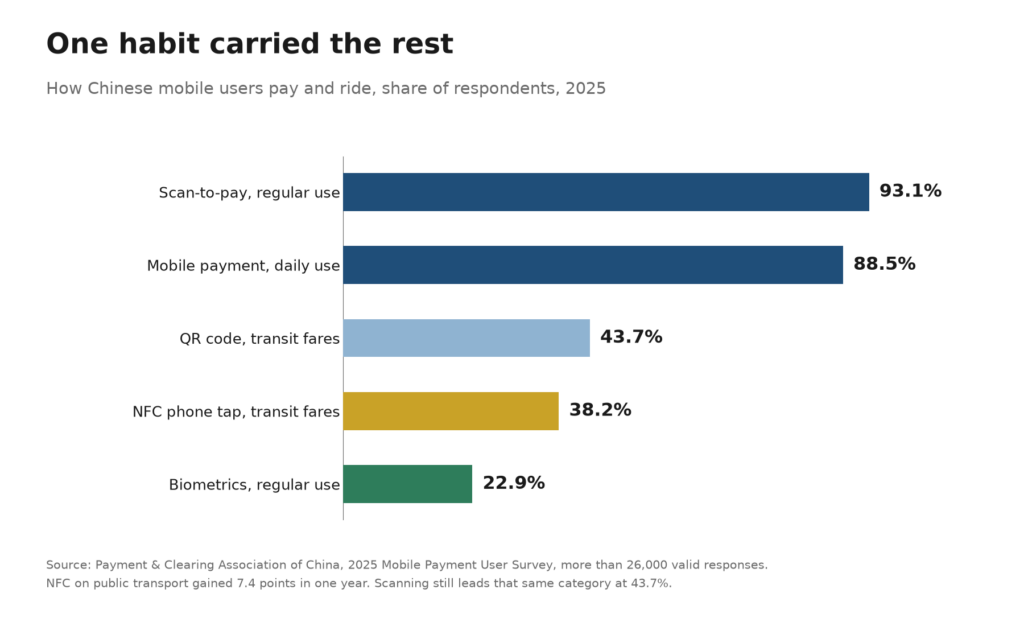
This is the flywheel nobody in the West could replicate. You don’t train a population to scan by running a clever billboard campaign. You train them by making scanning the only convenient way to buy lunch. Once that reflex exists, every menu, every package, every storefront sign, every delivery bag rides it for free.
The Chinese term for this whole layer is literally, “the economy on the code.” Tsinghua’s Global Industry Research Institute and Tencent’s social research centre tried to size it in 2020 and landed on RMB 8.58 trillion for 2019, supporting 26.01 million jobs. Treat that figure as an estimate with a wide error bar, because it is one. But the direction is not in dispute.
The Destination Problem
Ask why early Western QR campaigns failed and you’ll hear about clunky apps and missing scanners. True, but secondary. The real failure was the destination.
A 2012 QR code on a poster typically opened a full desktop website, on a 3G connection, on a 4-inch screen, with a login wall. You had spent eight seconds finding the code, framing it, waiting for the camera to lock — and your reward was a page that assumed you were sitting at a desk. Of course people stopped.
China solved the destination problem before it solved anything else. A scan doesn’t open a page. It opens a place you can act in.
WeChat and Weixin together reached 1.439 billion monthly active accounts by mid-2026. Inside that boundary sit Mini Programs: roughly 920 million daily users in 2025, more than RMB 3.5 trillion in e-commerce GMV, and transaction value growing over 70% year on year in the second half of the year. When you scan, you land in that. You don’t read — you order, book, pay, join, redeem.
That’s the difference between a link and a door.
What a Scan Actually Does
Strip away the marketing language and the Chinese QR does four jobs. They fire in sequence, and that sequence is the mechanism.
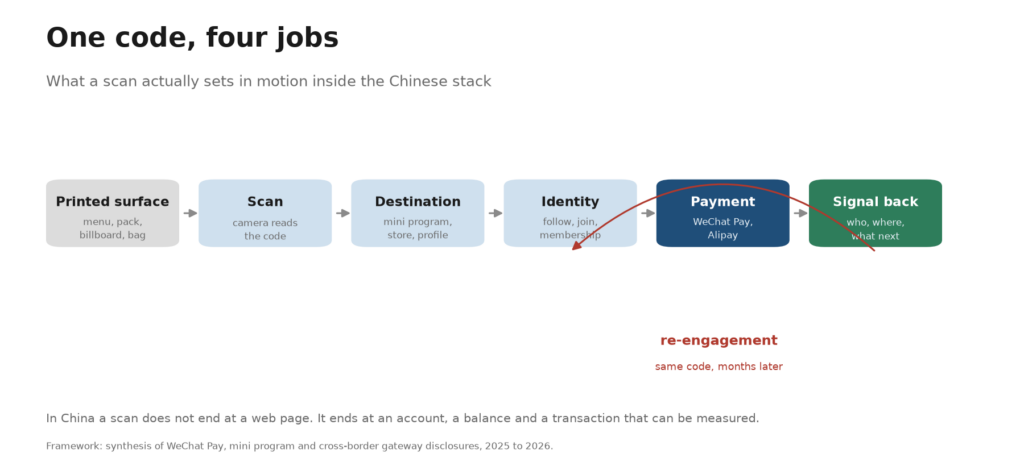
It pays. The code is the payment rail. No terminal, no dongle, no interchange negotiation with a bank. A sticker on acrylic is the entire point-of-sale hardware, which is why QR spread to the smallest merchants in China faster than card readers ever spread anywhere. A street vendor with a printed square is running the same transaction infrastructure as a shopping mall.
It enrols. The scan opens a Mini Program, an official account, a membership card, a group chat. Offline attention — a billboard you glanced at, a package you opened, a menu you picked up — becomes a stored relationship with a name attached. This is the step the West most consistently skipped. A US menu QR opens a PDF. A Chinese menu QR asks whether you’d like to join the store’s member list and get RMB 5 off, and about a third of the room says yes.
It measures. Because the code carries a channel identifier, a printed surface stops being a guess. You know who scanned, roughly where, at what hour, and what they did in the next ninety seconds. Print media, out-of-home, packaging, in-store signage — all of it becomes reportable in the same vocabulary as paid search. This is the quiet revolution. Not that the physical world got a link. That the physical world got an attribution model.
It re-engages. The account captured at step two can be messaged at step four — weeks later, with a coupon, a restock alert, a service reminder. The scan is not the end of a funnel. It’s the opening of a channel.
Read those four together and the strategic claim writes itself: a QR code does not convert offline traffic into online traffic. It converts anonymous foot traffic into an addressable asset.
Why the Economics Forced It
Here’s the unglamorous reason Chinese brands carpet every surface with codes: the arithmetic worked.
A merchant in Chengdu with a printed收款码 pays essentially nothing for acceptance infrastructure and gets settlement, reconciliation and a customer record. A brand printing codes on 400,000 delivery bags gets 400,000 measurable impressions and a capture rate it can actually report to a CFO. A retailer putting a code on a shelf edge can tell which aisle produced which membership signup.
Compare that to the Western default, where offline media is bought on reach and judged on vibes, and the gap isn’t technological. It’s accounting. China made the physical world legible, and legible things get budgets.
The cross-border numbers show the same logic escaping the border. A unified cross-border QR gateway went into trial operation at the end of July 2025 under the People’s Bank of China, with the Payment & Clearing Association and UnionPay operating it. By 11 September 2025 it had processed 1.981 million transactions worth RMB 427 million — a rounding error against domestic volume, but a structural signal: QR interoperability had been elevated from bilateral deal-making to national standards infrastructure. WeChat Pay now reaches 78 countries and 36 currencies. Mini Programs were used cross-border or overseas more than 5 billion times in 2025, across 100 countries and regions.
China holds more than 70% of the global QR payment market. That share is what happens when a payment format becomes a public utility instead of a product feature.
Now the Uncomfortable Part
If you only read the upside, you’ll build the wrong thing.
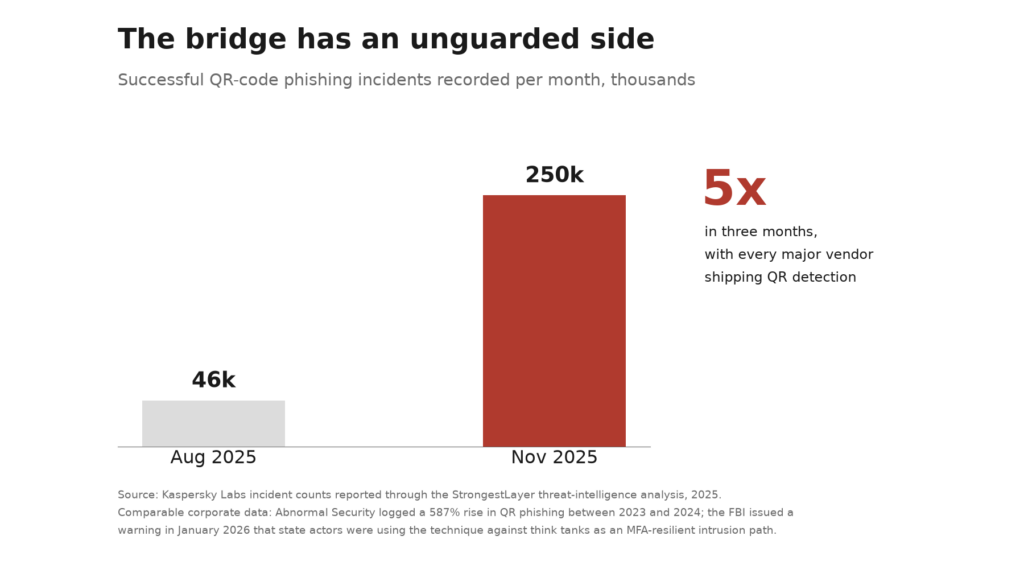
QR-code phishing — quishing — is the tax on ubiquity. Kaspersky’s incident tracking recorded successful attempts climbing from about 46,000 in August 2025 to 250,000 in November, a fivefold jump inside a single quarter. Abnormal Security logged a 587% increase between 2023 and 2024. By the fourth quarter of 2024, Check Point was attributing 11% of all phishing to QR codes, up from under 1% eighteen months earlier.
The mechanism explains the growth rate. A URL in an email body gets scanned, rewritten, sandboxed. A QR code is an image, and for years it sailed through gateways that inspected text and attachments. The scan then happens on a phone that no corporate DNS filter touches. In January 2026 the FBI warned that North Korean actors were using the technique against think tanks and government entities, describing quishing as an “MFA-resilient identity intrusion vector” — because the payload ends in session-token theft, not password theft.
China has the same wound, differently bandaged. In December 2025 the Ministry of Public Security issued a public warning about four categories of “fatal QR codes” — the free-gift code, the parcel rebate code, the personality-test code, the fake study-group code. The enforcement numbers behind that warning are not small: 6.48 billion fraud calls and messages intercepted in 2025, over 1.1 million fraudulent domains handled, warnings pushed on 27,000 fraudulent apps 41.05 million times. Police described QR-based distribution as a primary recruitment channel, with online diversion accounting for 66% of victim contact.
None of this argues against the QR. It argues against treating the QR as free.
The Fatigue Tax
There is a second, softer failure mode, and it’s the one Western marketers should worry about most.
When every surface carries a code, codes stop being noticed. The reflex that made the QR powerful is the same reflex that will dull it. A diner who has scanned four codes this week and landed on four dead ends doesn’t conclude “that brand had a bad landing page.” They conclude “QR codes are pointless.” The judgment is collective, and it is sticky.
So the value of a scan is inversely proportional to the number of disappointing scans that came before it. This is not a moral observation, it’s a budget one. Every dead-end code your category ships spends down a shared trust balance that your next campaign has to borrow against.
The rule that follows is brutally simple: if you cannot name what the customer gets in the first four seconds after the scan, do not print the code.
Where This Is Heading: The Code Becomes a Conversation
The most interesting shift in 2026 is that the destination is changing species. It used to be a page. Then it was a Mini Program. Now it’s increasingly an agent.
WeChat began grey-scale testing its native AI assistant, Xiaowei, in mid-2025 and expanded it through 2026. By August 2026 the company disclosed 16 separate entry points — chat threads, Moments, official account articles, photo editing, and yes, scan. Xiaowei runs on WeChat’s own WeLM rather than Tencent’s Hunyuan, and its distinguishing capability is not answering questions but executing tasks: calling Mini Programs, drafting messages, generating a small personal tool on request.
The strategic implication for a QR code is enormous. If the scan lands on an agent that can do things, then the printed surface is no longer a link to information. It’s a link to an action performed on your behalf. You scan a restaurant table code and say “same as last time, less ice” — and that’s the transaction.
That’s the end state the outline was pointing at: the physical world stops being something the phone looks at and becomes something the phone operates.
What Brands Should Actually Do
Five moves, in priority order.
1. Audit your surfaces before you print anything. List every physical touchpoint you own — packaging, receipts, signage, uniforms, delivery bags, service counters, event booths. Then ask which of them a customer would have a reason to scan. Most brands find that 20% of surfaces carry 80% of the plausible intent. Put codes there. Leave the rest alone.
2. Design the first four seconds. Not the landing page. The first four seconds. What is on screen, what is the offer, how many taps until the customer gets it. If the answer involves a phone number and a verification code, you’ve lost. The Chinese benchmark is that the scan resolves into value almost instantly — a menu, a coupon, a queue ticket, a payment sheet.
3. Capture identity, not sessions. A scan that produces an anonymous pageview is a scan you paid for and threw away. A scan that produces a membership, a follow, an opt-in, a saved preference is an asset that compounds. Build the capture step into the flow, and make the exchange honest — a real benefit for a real permission.
4. Instrument the loop, not the touch. One code per channel, per placement, per campaign, always. Then report scan → session → transaction → repeat, not just scan count. Your offline media plan should be able to defend itself in the same meeting where paid social defends itself. If it can’t, the codes were decoration.
5. Speed beats safety on the security question. Use dynamic codes so a compromised destination can be rerouted in minutes rather than reprinted in weeks. Verify domains visibly. Train staff to spot stickers pasted over your own codes — physical tampering is the attack vector nobody budgets for, and it has already emptied parking meters from Leeds to Houston.
What Travels, and What Doesn’t
Be honest about the transferability, because a lot of decks get this wrong.
The concept travels: give the physical world a measurable on-ramp, and offline media stops being a faith-based purchase. Any market can do that, and the US recovery in scanning volume proves the audience is willing.
The rails don’t travel automatically. China’s QR works because three things sit behind it — a payment habit trained on lunch, a super-app that hosts the destination, and an identity layer that makes the capture worth something. Remove any one and you get a code that scans cleanly and leads nowhere useful.
Which is precisely what the West had in 2012. And what a surprising number of brands still have in 2026, just with better cameras.
The Closing Argument
The QR code was never the innovation. It was a cheap, ugly, unglamorous optical bridge. What China built was the thing on the far side of the bridge — the wallet, the account, the Mini Program, the measurement layer — and then it wired every surface in the country to it.
That’s why the same square that got laughed out of a SXSW panel in 2012 became the most consequential piece of retail infrastructure in the world’s second-largest economy. Not because the technology improved. Because somebody finally gave the scan somewhere worth going.
The brands that understand this will treat every printed surface as an on-ramp to an owned relationship, and will measure it like they mean it. The brands that still think a QR code is a gimmick will keep leaving the physical world — and all the traffic standing in it — unplugged.
The bridge is free. The destination is the work.