What Personalization’s Best Data Actually Proves: The Trade-Off Is the Strategy
Read the first pair and you would approve the budget. Read the second pair and you would cancel it. They come from one study.
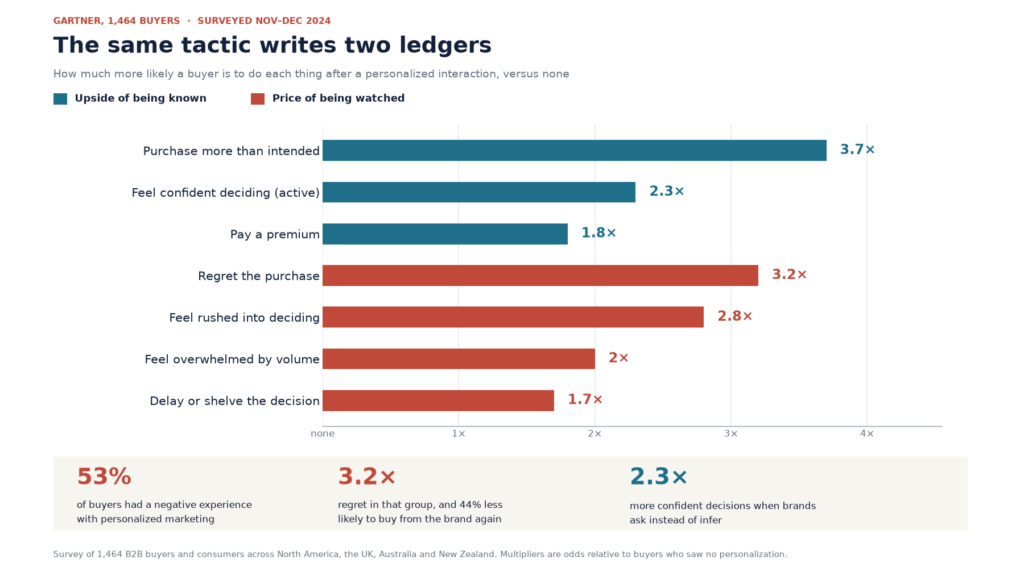
Gartner surveyed 1,464 B2B buyers and consumers across North America, the UK, Australia and New Zealand in late 2024. Buyers who met a personalized touch somewhere in their journey were 3.7 times more likely to buy more than they had planned, and 1.8 times more likely to pay a premium. That is the version of personalization that gets shown at the quarterly review.
The same survey found that 53% of buyers said personalization made their experience worse. That group was 3.2 times more likely to regret the purchase and 44% less likely to buy from the brand again. They also felt rushed (2.8×), overwhelmed by volume (2.0×), and were more likely to shelve the decision entirely (1.7×).
Nobody in that sample was confused or lying. The buyers who bought more and the buyers who felt handled are frequently the same people, in the same purchase, on the same day. What separates them is not the quality of the personalization. It is which side of the exchange they noticed.
That is the paradox, and it is not a bug in your stack.
What the paradox actually is
Personalization’s power comes from knowing the individual. Trust comes from respecting the individual. Knowing and respecting are not the same act, and at the margin they compete for the same square metre of the customer’s patience.
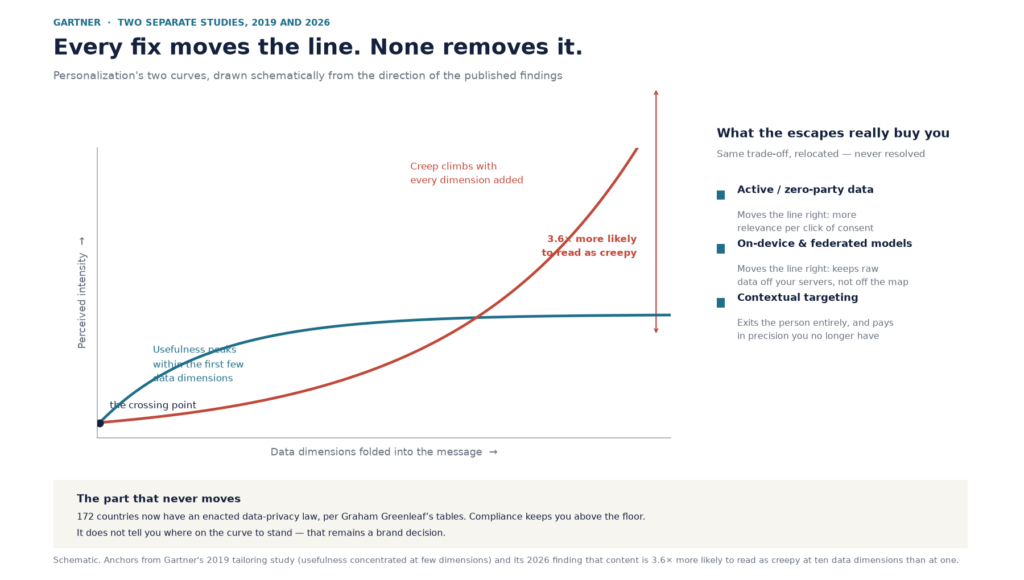
I call the operating fact here the creep curve: as relevance climbs, effectiveness and unease rise together, and at some point the second one starts growing faster than the first. Gartner’s own data makes this concrete. Content built on ten data dimensions is 3.6 times more likely to be read as creepy than content built on one. Not 3.6 times more relevant. 3.6 times more unnerving. The curve does not bend back down.
The demand side is not the problem
You might expect consumers to have soured on personalization. They haven’t. Qualtrics XM Institute surveyed more than 20,000 consumers across 14 countries and found 64% want companies to tailor experiences to their needs. Amperity’s 2026 study of 1,000 US adults found a comparable figure, with most respondents saying personalized experiences matter at least somewhat when choosing a brand.
Demand is healthy. Comfort is not. In the same Qualtrics work, only 41% believe the benefits of personalization justify the privacy cost, and 39% trust companies to handle their personal data responsibly. Thoughtspot’s survey of 4,800 consumers in the US and UK found 91% can name at least one personalization tactic they find intrusive, and three in four say retailers collect too much data.
So the paradox is not “people don’t want personalization.” It is “people want personalization from data they are comfortable with,” and that set is much smaller than the set of data you can technically access.
Why “solved” keeps getting announced
Every eighteen months someone announces the resolution. Zero-party data solved it. Contextual targeting solved it. On-device inference solved it. Federated learning solved it. Each announcement is sincere, and each is describing the same thing: a better position on the trade-off, marketed as an escape from it.
Hold that thought. We will come back to what those escapes actually buy.
Four reasons it cannot be solved
Reason one: personalization is an information problem, and information is the thing people want to withhold
You cannot personalize around what you do not know. Anything you do know about someone is, by definition, something they might not have wanted you to know. This is not a technology limitation waiting on better tooling — it is the shape of the problem. More knowledge of a person and more respect for that person’s boundaries draw on the same finite resource: their willingness to be seen.
Reason two: consent is a ladder, not a switch
Marketers talk about consent as if it were binary. Consumers experience it as a ranking, and the ranking is steep.
Qualtrics found 45% of consumers are comfortable with a company using purchase history to personalize, and 42% with website visits. Comfort collapses for social media posts (17%) and financial information (12%). That last number should sit on the wall of every growth team: 12%. Most personalization engines treat financial signals as a high-value feature. To the person on the other end, it is the second-least-acceptable input available.
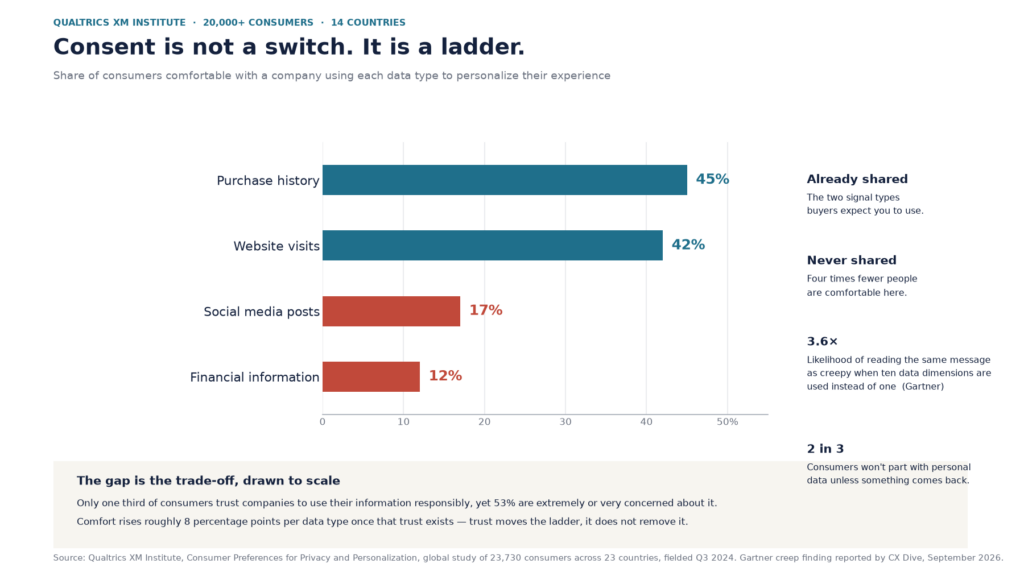
A consent record does not flatten this ladder. It just documents which rung you climbed. Gartner also found three in five consumers dislike handing over personal information unless something comes back to them — the exchange has to be visible, not merely lawful.
Reason three: the same data flips its meaning with context
This is the part most playbooks skip, and it is where the research gets genuinely interesting.
Aguirre and colleagues, writing in the Journal of Retailing, ran a field study plus three experiments on social-media-driven personalized advertising. When the firm collected information overtly, more personalization produced higher click-through intentions. When the firm collected the identical information covertly, the effect reversed. The data didn’t change. The sourcing did. The sign flipped.
Tami Kim, Kate Barasz and Leslie John pushed this further in the Journal of Consumer Research. They found that consumers judge information flows against offline social norms: information gathered within the site you are on is acceptable; information gathered across sites is not. Attributes you stated are acceptable; attributes the firm inferred are not.
Their sharpest result is a warning to anyone who thinks transparency is a universal solvent. Ad transparency backfires when it exposes an unacceptable flow, because it converts a vague suspicion into a specific, evidenced grievance. It only helps when the underlying flow was already acceptable — and only on a platform the consumer already trusts.
So the fourth practice in every personalization playbook — “just be transparent” — is conditional, not unconditional. Transparency about a cross-site inference does not earn trust. It confirms the thing they were worried about. Try this test on your own stack: can you describe, in one sentence, where each signal came from and who stated it? If not, transparency is only going to make the problem legible.
Reason four: regulation sets a floor, never a ceiling
Data-protection law now covers most of the planet. UNCTAD’s Global Cyberlaw Tracker puts legislation in place across 71% of the 194 economies it monitors; Graham Greenleaf’s academic tables count 172 countries with an enacted privacy law, drawing the line more generously. Either way, the floor is real and it is rising.
But a floor is not an answer. GDPR, CCPA and PIPL tell you what you may not do. They do not tell you where to stand. Compliance keeps you legal; it does not make the trade-off disappear, and it certainly does not tell you whether your particular audience will find a given message helpful or unnerving. The regulator sets the minimum. The customer sets the actual line, and moves it by category and by mood.
Why “fine” is the right word
Here is where the tone of this whole conversation should change.
Treating the paradox as unsolvable is not pessimism. It is a release of effort in the wrong direction. Marketing has spent a decade looking for the configuration where relevance and restraint stop competing. That configuration does not exist, which means the search is not merely expensive — it is a way of avoiding the actual work, which is getting good at the trade-off.
The moment you accept that, three useful things happen.
First, the trade-off becomes a strategy instead of a failure. Where a brand sits on the relevance-restraint spectrum is a positioning decision, as real as price or tone of voice. A privacy-forward brand and a personalization-forward brand are both coherent. What is incoherent is claiming to be both and hoping nobody checks.
Second, deliberate navigation becomes a competitive advantage, precisely because it is unglamorous. Anyone can buy a CDP. Very few brands can explain their data posture in a sentence a customer would accept.
Third, the asset you build is more durable than the edge you buy. A relevance advantage can be copied in a quarter. A reputation for restraint is slow, expensive to fake, and survives the next platform shift. There’s a reason “personalization isn’t the goal, relevance is” has become a talking point among customer-data vendors — even the people selling the tooling have stopped promising omniscience.
Navigating it: five practices
1. Pick your position on purpose
Write down where you sit. Are you the brand that remembers everything and says so, or the brand that asks little and respects the ask? Neither is wrong. Drifting between them is. The failure mode is not the wrong position — it is having no position and letting the tooling decide, which is how most brands end up at maximum data dimensions with minimum explanation.
2. Respect the creep line where it actually sits
The line is not universal; it is situational. Aggressive recommendation at checkout reads as service. The same logic applied to a health query or a debt problem reads as surveillance. Gartner’s finding that usefulness concentrates in the first few data dimensions is the most operationally useful fact in this entire literature: the marginal dimension buys you less relevance and more risk, every time. Ask what the minimum viable signal is. Everything past that is liability wearing a growth label.
3. Make the exchange legible, not confessional
There is a difference between explaining your data use and confessing it. Confession lists everything you have. Legibility explains why this message, right now, from this source — “because you bought this,” “because you told us your size,” “because you’re reading about this.” Gartner’s research on active personalization is the strongest version of this: when customers are asked rather than inferred, they find the experience less creepy and are 2.3 times more likely to complete a critical purchase decision with confidence.
Note what that does and does not do. It does not eliminate the trade-off. It converts an unexplained inference into an understood exchange. The paradox stays. The deception leaves.
4. Let trust be the tiebreaker
When relevance and restraint conflict — and they will — decide in advance that trust wins. A slightly less personalized experience the customer trusts beats a perfectly personalized one they resent. This sounds soft until you price the alternative: roughly 38% of customers say they will stop doing business with a company entirely if personalization feels creepy, and Gartner’s 2025 work found the negative-experience cohort 44% less likely to return.
5. Measure whether it felt respected
Most personalization dashboards can tell you lift and cannot tell you cost. Add the second column: opt-in and opt-out rates, preference-centre engagement, complaint volume, unsubscribe reasons, and the share of customers who say the experience felt written for them rather than about them.
There is a real precedent for this being the more predictive metric. Qualtrics’ 2026 consumer work found 86% of customers would share more personal data if organizations were clearer about how it is used and easier to control. The constraint is not appetite. It’s the visible absence of a reason.
The steelman, and where it leaks
Let me make the strongest case for the other side, because it deserves one.
The privacy-tech camp argues that federated learning, on-device inference, clean rooms and zero-party data genuinely improve the ratio — more relevance per unit of privacy surrendered. That is true, and it is worth money. But it is an improvement to the curve, not an exit from it. On-device inference keeps raw data off your servers. It does not stop you from building a sharper model of a person from what the device returns. Contextual targeting exits the person entirely, and pays for it in precision you no longer have. Every escape hatch relocates the line and sends you a bill in a different currency.
The industry ran this experiment at scale, by the way. Google announced third-party cookie deprecation in 2020, delayed it repeatedly, reversed in July 2024, abandoned the replacement prompt in April 2025, and by October 2025 had retired the remaining Privacy Sandbox APIs — Attribution Reporting, Topics, Protected Audience — for both Chrome and Android. The most heavily funded attempt to engineer a way out of the trade-off ended with the trade-off intact and the cookies still there. Meanwhile Safari and Firefox block third-party cookies by default anyway, so the effective floor already varies by browser. There was never one environment to solve for.
The “consumers don’t actually care” camp has a partial point too. Some people will trade privacy for value, cheerfully, and always have. But the creep curve and the consent ladder still bind. There is a ceiling to each person’s willingness, it differs per person, and it moves with context. Saying “consumers don’t care” is not a solution — it is an average masquerading as a policy.
The honest synthesis sits between them. The paradox can absolutely be improved. It cannot be eliminated. Every real win available to you is a navigation win, and the brands that understand this keep outperforming the ones still waiting for a vendor to hand them the answer.
What this means for the next two years
Two forces are about to make this harder, not easier.
The first is agentic buying. Gartner expects 60% of brands to use agentic AI for one-to-one interactions by 2028, with agents acting as persistent concierges across marketing, sales and support. An agent that personalizes continuously will generate more of both ledgers, faster, with less human judgment in the loop at exactly the moments judgment matters most. The constraint you build now — which dimensions are permitted, which inferences are off-limits — becomes the only thing standing between a considered exchange and an automated brand event.
The second is AI fatigue in the message itself. Gartner’s March 2026 survey of 1,500 US consumers found half would prefer to give their business to brands that keep generative AI out of customer-facing content, and separate 2026 consumer research found the share who say heavy AI use would reduce trust in a favourite brand doubled in a year. Personalization and generation are converging in the same pipeline. The audience is already separating them in their heads, and it is not giving the pipeline the benefit of the doubt.
The takeaway
The tension between relevance and restraint is structural. It will not be dissolved by the next privacy-preserving technology, the next regulation, or the next consent framework — and the decade-long search for a configuration that dissolves it has cost the industry a great deal of money and credibility.
What’s left, once you stop searching, is more interesting work. Decide where your brand stands. Find the minimum signal that is genuinely useful. Respect the line where the customer actually draws it, not where your segmentation model assumes. Explain the exchange in a sentence a real person would accept. And when relevance and trust collide — which they will, on a Tuesday, in a meeting where someone has a lift chart — let trust win.
The paradox is unsolvable. That was never the bad news. The bad news was thinking it wasn’t.