The Cost Was Never on the Marketing Report
Here is a sentence you have probably said in a budget meeting: our cost per lead went down. It is almost always true, and almost never good news. Across ninety days at 87 B2B SaaS companies, one group bought marketing-qualified leads at $262 each. Another paid $570. The first group looked as if it had won procurement. It had simply moved the invoice.
Cheap leads are not cheap. They are subsidised, and the subsidy is paid by sales in the only currency sales has: hours. That is why they survive every audit. The cost is real, but it lands on a different P&L line, in a different department, roughly one quarter later.
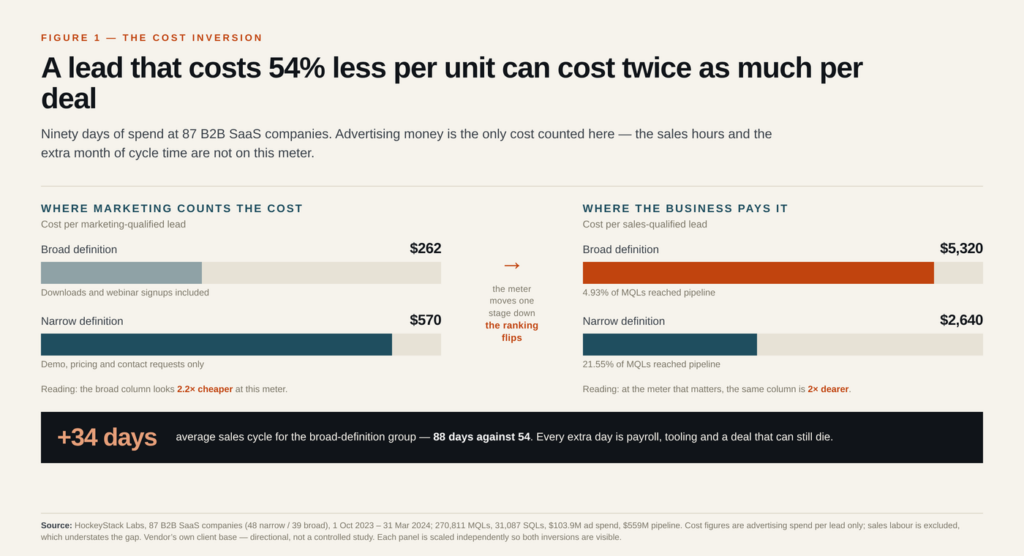
The arithmetic hides inside one definition. The broad group counted every form submission its CRM called an MQL: ebook downloads, webinar signups, hand-raisers alike. The narrow group counted only demo requests, pricing visits and contact forms. At the top of the funnel the broad group wins — $262 against $570 per lead, fifty-four percent cheaper, on 1.9 times the volume. One stage down, the ranking inverts. Of the cheap leads, 4.93% reached pipeline; of the expensive ones, 21.55% did. Cost per sales-qualified lead: $5,320 against $2,640. The lead that cost half as much per unit cost twice as much per deal.
That second meter omits the labour. Every one of those 164,000 low-intent leads had to be researched, called, followed up, disqualified and re-called next quarter. A seller’s week has little room in it. Salesforce’s seventh State of Sales, fielded August to September 2025 across 4,050 professionals in 22 countries, puts selling at about 40% of the week — and that figure counts prospecting, leaving roughly 22% for actual customer conversation. Every hour spent qualifying someone who downloaded a guide is an hour taken from a buyer who was waiting.
A quieter transfer runs alongside it. The broad group’s average sales cycle ran 88 days against 54. Thirty-four extra days of payroll, tooling and forecasting error. No dashboard reports cycle time as a marketing cost, because it is not one. It is just a cost.
None of this self-corrects, because the incentives point away from correction. Marketing is asked for lead volume at acceptable cost, and volume is the auditable word. Sales is asked for revenue it cannot produce from leads that will never buy, and cannot refuse the queue without looking uncooperative. For every individual, the rational move is to keep the pipeline full and let conversion be somebody else’s problem.
The fix is not discipline. It is a different meter. Score and pay on cost per sales-qualified lead, report hand-raisers and content downloads as separate rates, and the incentive repairs itself — because the number that was hiding the subsidy becomes the number on the slide.
Two caveats. This is one vendor’s client base, self-selected, over two quarters: directional, not a controlled trial. And the broad definition is not always wrong. In categories with long, self-directed research, content engagement is sometimes the only early signal that exists. The error is not counting downloads. It is billing them as intent.
The cheapest lead is not the one with the lowest cost per unit. It is the one whose total cost, including every hour it consumes after the form clears, is lowest. Most organisations cannot answer that, because they only ever built one meter.