Nobody Cut the Multicultural Budget Because the Data Changed
Somewhere in your media plan there is a line item called “general market.” It is usually the biggest line. It is also, increasingly, a fiction — a rounding error dressed up as a strategy, aimed at an audience that no longer exists in the proportions the word implies.
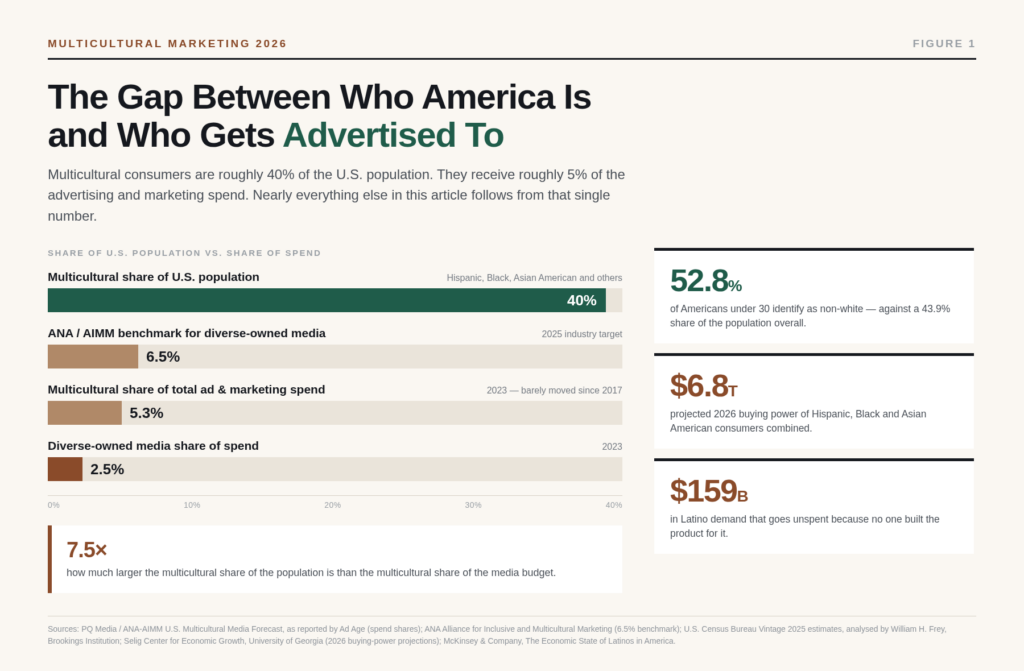
Here is the number that should end the argument before it starts. Multicultural consumers — Hispanic, Black, Asian American, and everyone else outside the non-Hispanic white majority — account for roughly 40% of the U.S. population. They account for about 5.3% of total advertising and marketing spend. Diverse-owned media gets 2.5%.
Sit with that ratio for a second. It is not a gap. It is a structural error, repeated annually, across an entire industry, by people who would never tolerate a 7.5x forecasting mistake anywhere else in the business.
The “general market” was a snapshot, not a baseline
Every media plan inherits an assumption it never audits: that there is a normal American consumer, and that everyone else is a variation on them. That assumption was defensible in 1990. It is not defensible now.
The 2020 Census marked a threshold nobody announced properly: for the first time, most Americans under 18 were people of color. Then the 2020–2025 estimates pushed it further. William Frey’s analysis for Brookings, using the Census Bureau’s Vintage 2025 data, found that 52.8% of Americans under 30 identify as non-white — against a 43.9% share of the total population. That is not a future cohort. That is the cohort currently entering its peak spending years, forming households, and choosing brands.
The “general market” isn’t shrinking because of immigration, either, which is the assumption doing most of the quiet work in 2025-era budget meetings. It’s shrinking because of births. Roughly 94% of Latinos under 18 are U.S.-born or the children of naturalized citizens. You cannot deport a demographic curve.
Where the growth is actually concentrated
Look at household formation, the leading indicator for almost every consumer category. In 2025, Hispanic households accounted for 92.6% of net new U.S. household formation — 1.09 million new households out of roughly 1.18 million nationally. If your growth model assumes new households look like the existing base, the model is wrong by almost the entire margin.
Then look at age. The median Hispanic American is about 31. The median white American is about 43. In category terms, one group is ten to twelve years from its peak earning window; the other is in it now and leaving. A brand that under-indexes with the younger cohort isn’t under-investing in a segment. It is under-investing in its own 2035 revenue.
The buying power is not a rounding error
Add up the three largest segments and you get something close to the GDP of a G7 economy. The Selig Center for Economic Growth projects Hispanic buying power at $2.8 trillion in 2026 — 12.1% of total U.S. buying power — and Black buying power at $2.10 trillion. Collage Group puts Asian American buying power near $1.9 trillion. Together, roughly $6.8 trillion. And the Hispanic figure is growing 32.1% between 2021 and 2026, against 23.2% for total U.S. buying power.
But here is the part most decks miss. Spending share still lags population share. NielsenIQ found Hispanic households are 19.5% of the population but 22% of consumer dollar spend — a positive gap, meaning they spend more per household than average. McKinsey found Latinos are about 18% of the population but only 11.4% of aggregate consumer spending, with roughly $159 billion in demand that goes unspent because nobody built the product for it.
Both numbers are true at once. That combination — high spend intensity, high unmet demand — is the signature of a market that is being served badly rather than served fully. Which is precisely what an under-competed window looks like.
Why the budget never arrives
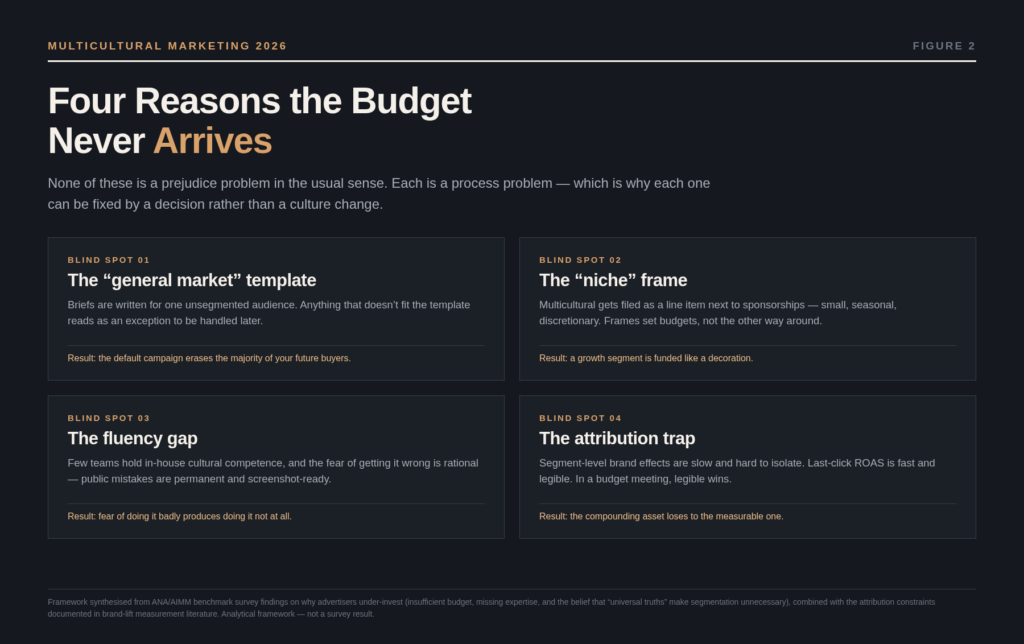
If the numbers are this lopsided, the interesting question isn’t whether to invest. It’s why intelligent people with good data keep not doing it. Four mechanisms, none of them a prejudice problem in the ordinary sense — all of them process problems that a decision can fix.
Blind spot one: the template
Briefs get written for one unsegmented audience because that’s how briefs have always been written. Anything that doesn’t fit the template becomes an exception, and exceptions get handled after the main campaign ships — which means never, or in a translation pass that flattens everything that made the segment worth reaching.
The template isn’t neutral. It encodes a specific cultural default and then calls that default “general.” The word does enormous work: it makes the largest, best-funded creative effort in the category into the one effort nobody has to justify.
Blind spot two: the niche frame
The ANA and AIMM have asked advertisers why they under-invest for years. The answers are mundane and revealing: not enough dollars, not enough bandwidth or expertise, and — the most telling one — the belief that “universal truths” make segmentation unnecessary.
That last answer is a framing problem wearing a research problem’s clothes. Once multicultural is filed next to sponsorships and heritage-month content — discretionary, seasonal, small — it gets funded like a decoration. Frames set budgets. Not the reverse.
Blind spot three: the fluency gap
Very few teams hold real in-house cultural competence for segments they don’t personally belong to. And the fear of getting it wrong is not irrational: public mistakes are permanent, screenshot-ready, and cost more than the campaign earned.
But look at what that fear actually produces. Fear of doing it badly becomes doing it not at all — and not at all is the only option with a guaranteed zero return. The calculation that says “we can’t risk it” is the one that guarantees the loss.
Blind spot four: the attribution trap
Segment-level brand effects are slow, cumulative, and hard to isolate in a dashboard. Last-click ROAS is fast, legible, and fits on a slide. In a budget meeting, legible beats true.
So the compounding asset — trust, preference, repeat purchase among a growing cohort — loses to the measurable one. Every quarter. The result is a portfolio that looks disciplined and is actually just short-term.
Authentic is not a vibe. It’s an operating model.
“Authenticity” has become the most abused word in marketing, which is a shame, because the underlying distinction is real and measurable.
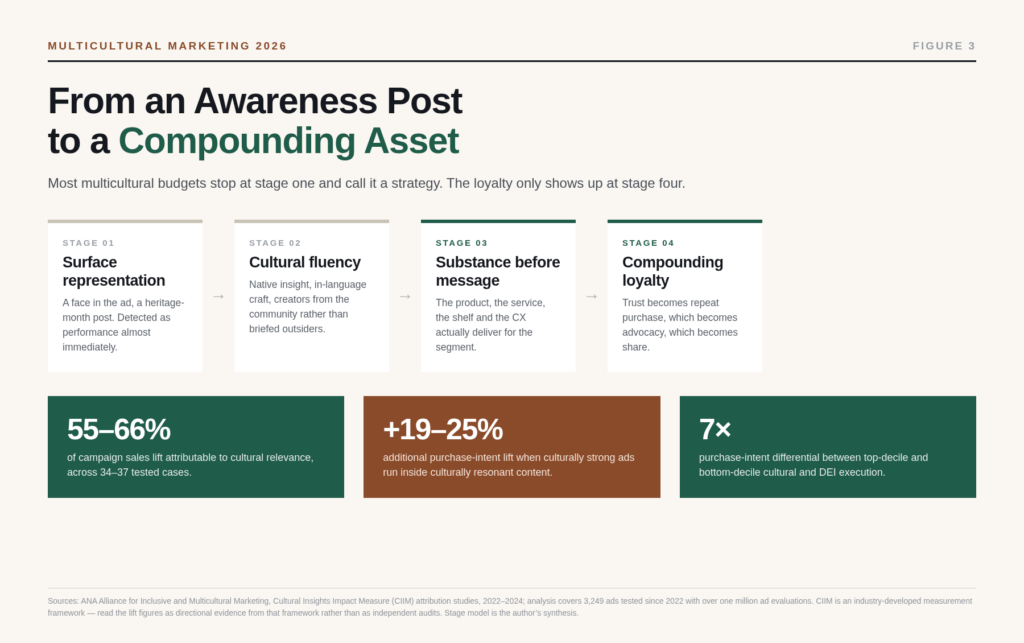
Tokenism is detected faster than it is produced
Put a diverse face in the ad, post something in February, move on. Consumers read this instantly. Kantar research for the Latino Donor Collaborative found 76% of Latinos aged 12–34 feel brands treat them as an afterthought — up from 71% in 2022 — and the Hispanic Marketing Council’s 2026 market guide repeats the same figure. That is not a perception gap you close with better casting.
Tokenism doesn’t just fail to build trust. It actively spends it, because it signals that the brand knows the audience exists and has decided not to bother.
Cultural fluency is an operations problem
The ANA/AIMM measurement work is the most useful evidence here, and it’s worth reading carefully rather than quoting loosely. Their Cultural Insights Impact Measure, built from 3,249 ads tested since 2022 with over a million ad evaluations, attributes 55–66% of campaign sales lift to cultural relevance. Culturally strong ads placed inside culturally resonant content lift purchase intent by an additional 19–25%, and brand trust by 21–44%. The spread between top-decile and bottom-decile execution is roughly 7x on purchase intent.
Read that as directional evidence from an industry-developed framework, not as an independent audit — AIMM has an obvious stake in the finding, and CIIM is its own instrument. But directional or not, the implication is uncomfortable for anyone treating this as creative taste: cultural fluency is not a garnish on top of strategy. It is a substantial share of what makes the strategy work.
Substance before message
The brands that get this right usually do something unglamorous first: they change the product, the service, the shelf, or the CX. Mead Johnson built Hispanic parents into campaigns from day one rather than translating finished work — and reported a 10-point recall lift plus 79% growth in community enrollment. The messaging followed the substance. That order matters, and it is the reverse of how most multicultural programs are commissioned.
The 2026 complication nobody wants to name
Here is where I have to depart from the standard inspirational version of this argument, because a piece that only cites growth numbers isn’t analysis — it’s a pitch.
The retreat is real
Through 2025 and into 2026, multicultural budgets came under genuine pressure. A preliminary review of newswire activity found qualified Hispanic and multicultural marketing announcements fell roughly 67% between the first eight months of 2024 and the same period in 2025. Brand investment in Hispanic-targeted media sits below 4% of budgets by some estimates. Several agencies have lost accounts; several brands have gone quiet and hoped nobody noticed.
They noticed. ThinkNow’s tracking, fielded from June 2025 through early 2026, found the share of Hispanic consumers reporting decreased trust in national brands rose from 28% to 32%. 57% had already changed where they shop or which brands they support — against 38% of non-Hispanic consumers. About 70% say they are actively watching how brands respond to events affecting their communities.
Silence isn’t neutral
This is the finding that should be taped to every CMO’s monitor. When ThinkNow asked Hispanic consumers how a brand that stays publicly quiet but keeps running inclusive marketing would be perceived, the answer came back split almost evenly between favorable and unfavorable. Among Spanish-dominant consumers, the skepticism was sharper still.
So “keep our heads down and let the creative do the talking” doesn’t read as prudence. It reads as absence. The brands that cut multicultural spend in 2025 didn’t exit a mature, contested market. They exited an underserved one, in front of an audience taking notes.
What to actually do
Re-plan around real demographics
Pull your actual customer file and segment it by the categories you’ve been avoiding. Then project it forward five years using Census cohort data rather than your historical mix. Most brands discover their “general market” campaign is aimed at a cohort that will be a minority of their future customers — and that their fastest-growing segment is currently their least-served one.
Budget it like growth, not like a value signal
Move multicultural from the discretionary line into the growth line, and fund it against the segment’s share of future revenue rather than its share of the org chart’s comfort. That is a CFO conversation, not a communications one — which is exactly why it survives a change in political weather.
Build fluency in-house and co-create outward
Hire the competence rather than renting it per campaign, and build the work with community partners, creators, and native cultural experts rather than about them. The insight has to come from inside the culture. When it’s outsourced to a generalist agency reading a syndicated report, you get the average of the segment, which is the one thing nobody in it recognizes.
Measure brand lift, and accept that it’s slow
Pair short-term ROAS with segment-level brand tracking — consideration, trust, recommendation — and hold it for four to eight quarters. Commit to the metric before the campaign ships, because the moment of truth is the budget meeting where someone asks why this line doesn’t perform like search. Have the answer ready: search harvests demand that brand building created.
The risks worth naming
Two honest caveats, because the version of this argument that ignores them is the version that gets quietly abandoned in eighteen months.
Multicultural is not monolithic, and treating it as one rebuilds the same trap. Black, Hispanic, Asian American, and every subgroup inside them differ in language, generation, region, category behavior, and media diet. PQ Media’s 2023–2027 forecast makes the point brutally: Hispanic media takes 68.3% of multicultural spend, Black media 28.8%, Asian American media 2.9%. A “multicultural campaign” that averages these together is just the general-market campaign with a different name.
The loyalty is conditional, which is what makes it valuable. Multicultural consumers aren’t more loyal by temperament. They’re more responsive to being seen — and correspondingly more responsive to being ignored or pandered to. Nielsen’s work gets at this precisely: Black audiences are digital trendsetters with outsized cultural influence, and their consumption patterns reliably surface in the mainstream months later. That influence, and the loyalty behind it, is earned per interaction. Which means it can also be lost per interaction.
The takeaway
The general market is not dead in the sense that no one buys anything. It is dead as a planning assumption — as a default that lets you skip the work of knowing who you’re actually talking to. The demographics have already moved; the budgets haven’t.
The brands that win the next decade will be the ones whose media plan resembles their customer file five years out rather than their category’s historical average. Not because it’s fairer. Because the other plan is aimed at a shrinking cohort and costs the same to run.