Half the Cart, None of the Wallet
It is a Saturday morning in a supermarket, and a nine-year-old is holding the list, not the wallet. She rejects one yoghurt because the purple one “tastes like birthday”, drags the trolley toward a brand she watched a boy her own age unbox on YouTube, then negotiates a cereal upgrade on the grounds that her friend’s house has it. Her mother pays. Her mother also decides, in the car park, which of those requests survive.
That trolley is the entire Gen Alpha marketing problem. They are already inside the purchase. They are not yet the purchaser. And nearly every credible dataset published in the past eighteen months says the same thing from a different angle: the money moves because a child asked, and it stops moving because an adult said no.
So the useful question is not “how do we reach a nine-year-old”. It is “what makes a nine-year-old’s request survive contact with a parent”. Everything below is an attempt to answer that with numbers instead of vibes.
What Gen Alpha actually is
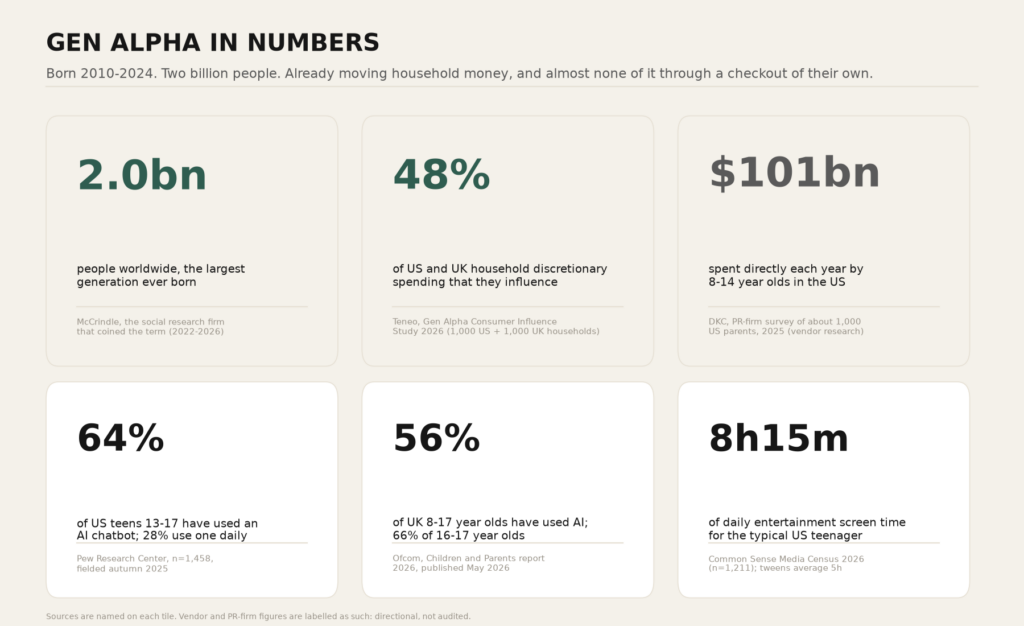
The label itself is a marketing artefact. Mark McCrindle, an Australian social researcher, coined it and fixed the boundaries at 2010 to 2024; his firm puts the cohort at roughly two billion people once the last of them are born, the largest generation in recorded history. Treat that as a reasonable working definition rather than a law of nature, because demographers still argue about where generations begin.
What matters commercially is not the boundary. It is three structural facts that no previous cohort shares.
Born into the answer, not the search
Gen Z grew up scrolling. Gen Alpha grows up asking. That is not a semantic upgrade; it changes what “discovery” means.
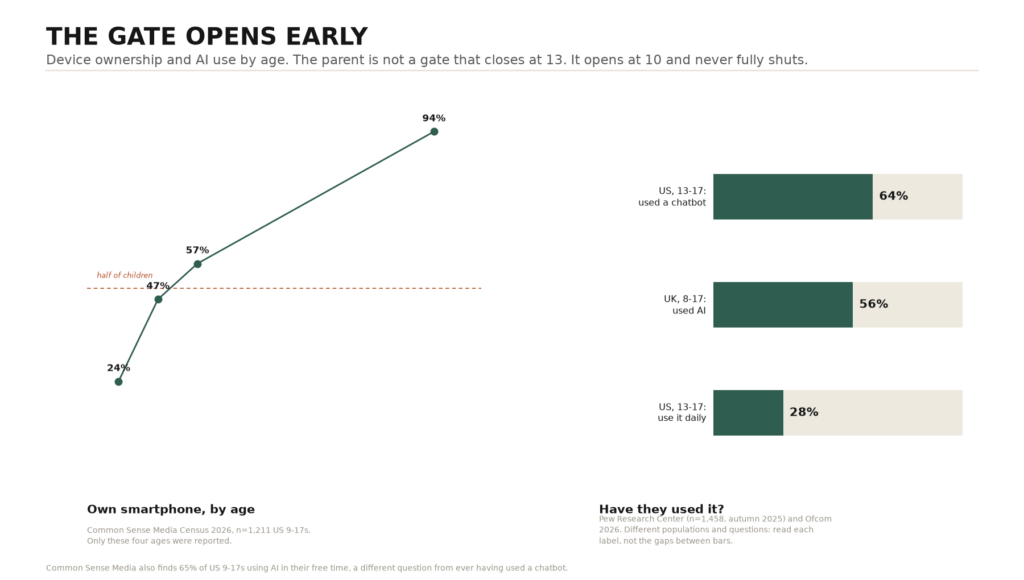
Pew Research Center surveyed 1,458 American teenagers aged 13 to 17 between late September and early October 2025, and published the results that December (with a deeper companion report in February 2026). Sixty-four percent had used an AI chatbot, and 28 percent used one daily. ChatGPT reached 59 percent, Gemini 23, Meta AI 20. Fifty-four percent had used a chatbot for schoolwork; 12 percent had used one for emotional support or advice.
Ofcom’s UK tracker, published in May 2026 on a sample of 5,008 parents and 3,426 children, found 56 percent of 8 to 17 year olds had used AI, rising to 66 percent of 16 and 17 year olds. One in ten of those users said they had used it “as someone to talk to or as a friend”. Forty-six percent of children who had read AI summaries in search results believed those summaries were always accurate.
Sit with that last number. Nearly half of the children who encounter an AI answer treat it as settled. If your brand is not inside that answer, you are not losing a click. You are losing a premise.
Usage is not affection
Here is the caveat that most Gen Alpha decks skip. Common Sense Media’s 2026 census, a nationally representative survey of 1,211 Americans aged 9 to 17 fielded in spring 2026, found that 65 percent of 9 to 17 year olds use AI in their free time, including 77 percent of teenagers. But only 11 percent of teenage AI users said they enjoy it “a lot”. Tweens were slightly warmer at 15 percent.
The gap between use and enjoyment is the widest of any medium Common Sense measured. Children use AI the way adults use a lift: because it is there and it works. That should temper any strategy built on the assumption that a cohort raised on chatbots will love your chatbot-powered campaign.
The same report supplies the timing data that should reorganise your media plan. Personal smartphone ownership nearly doubles between age nine (24 percent) and age ten (47 percent), crosses the halfway mark at eleven (57 percent), and reaches 94 percent by seventeen. Ofcom’s independent UK data says the same thing in a different accent: smartphone ownership jumps from 56 percent of ten year olds to 83 percent of eleven year olds, tracking the move to secondary school.
Two billion people, and the most regulated childhood in history
Gen Alpha is also the most racially and ethnically diverse cohort the United States has measured. In the 2020 Census, 52.7 percent of the under-18 population belonged to a racial or ethnic minority group, against 47.3 percent who were non-Hispanic white alone. Brookings’ analysis of the Census Bureau’s 2025 vintage estimates puts the under-30 population at 52.8 percent minority, with every single-year age band from zero to 29 now majority-minority.
And they are the first generation whose data was protected before they could read. That legal architecture is now fully switched on, and it is the subject of a later section, because it constrains more of your media plan than any creative decision will.
Where the money actually moves
Three estimates, three methodologies
Three research houses have published Gen Alpha spending estimates recently, and they do not agree, because they are not measuring the same thing.
Teneo, a CEO advisory firm with no media inventory to sell, interviewed 1,000 households each in the US and UK — children born between 2010 and 2014, plus their parents — between 29 October and 3 November 2025. It found Gen Alpha influences 48 percent of household discretionary spending: roughly 255 billion dollars in the US and 25 billion pounds in the UK.
DKC, a public relations firm, surveyed about 1,000 American parents of 8 to 14 year olds in mid-2025 and estimated 101 billion dollars of direct annual spending, 42 percent of household spending influenced (49 percent in households above 100,000 dollars), and an average of 67 dollars a week in a child’s own hands.
PwC, in a survey of 1,004 American children aged 7 to 14 and 1,009 parents fielded between 29 January and 13 February 2026, did not publish a spending total at all. It measured decision influence instead: 97 percent of children said they had at least some influence over clothing and accessories purchases, with 55 percent claiming “a lot”, and 94 percent of parents agreed.
Read all three with the right scepticism. DKC sells reputation services to brands that market to families; its figures come from parents reporting on children, not from children. Teneo’s sample covers only the oldest half of the cohort — children born 2010 to 2014 — which makes its 48 percent a floor, not a ceiling. PwC’s parent-child pairs are the strongest design of the three, because it can compare two reports of the same household, and that comparison is where the interesting error lives.
The category map your brief is missing
PwC’s category numbers are the ones worth pasting into a planning deck. Children most often buy food and drink themselves (72 percent), then toys (57 percent), then clothing (55 percent). Digital spending is not a side dish: 53 percent had bought apps or one-off downloads, 42 percent had made in-game purchases, 34 percent held subscriptions or passes.
Then the divergence that should worry every parent-facing brand. For clothing and accessories, 97 percent of children claimed influence and 94 percent of parents conceded it — near agreement. For skincare and beauty, 81 percent of children claimed influence and only 61 percent of parents acknowledged it. A 20-point gap.
PwC’s own reading is diplomatic: parents may under-count fast, digital purchases; children may conflate having an opinion with making a decision. Both are probably true. For a marketer, the gap is a diagnostic. Where parents and children disagree about who decided, attribution models will be wrong in a specific direction, and the child-shaped influence will look like an unexplained lift.
Why you cannot reach them directly
The gate opens at ten
There is a persistent fantasy in agency planning that a cohort becomes addressable at thirteen, when platforms nominally allow it. The data says the gate opens three years earlier and never fully closes.
Nineteen percent of UK three to five year olds have their own mobile phone, and 30 percent of six and seven year olds do. Thirty-seven percent of three to five year olds use social media, up from 29 percent a year earlier. At the other end, 94 percent of UK 8 to 17 year olds who go online on a phone say they operate under at least one restriction, imposed at school or at home. Restrictions are near-universal; so is the device.
Which produces the odd condition every brand now operates in: an audience that has the hardware, the habit and the vocabulary, and no legal capacity to consent. You are not marketing to them. You are marketing around them, in a room where an adult is present.
Pester power is a permission system
The industry phrase for this is pester power, which is both accurate and unhelpful, because it implies the child is the lever and the parent is the resistance. The research says something more structural. The parent is the purchase order, and the child is the specification.
Teneo asked Gen Alpha where they get information they trust. Eighty percent said their parents. Twenty-two percent said figures they see online. Twenty-nine percent trusted advertising from companies. That is not a mild preference; it is a hierarchy with a two-digit gap between first and second place.
And the gap behaves in a counter-intuitive way. In Teneo’s data, trust in company advertising rises by 11 percentage points between ages 11 and 15, while trust in people they see on social media falls by a point. Teneo’s own interpretation is that children become more confident in institutions they can verify and more sceptical of influencers they cannot.
Desire travels fast. Permission travels slow.
Put the two datasets side by side and the model writes itself.
PwC found that 61 percent of children said social media makes them want to buy something — ahead of peers at 56 percent, in-store browsing at 53 percent and television advertising at 48 percent. So the want is manufactured socially, at speed, inside feeds.
Teneo found 80 percent trust their parents and only 22 percent trust social sources. So the permission is granted domestically, at the speed of a family conversation.
Desire travels through the feed in seconds. Permission travels through the household in days. A campaign that generates desire but never arms the parent to approve it produces the most expensive thing in marketing: a request that dies in a car park.
The creator question
Two credible studies, opposite headlines
This is where the outline I was handed and the evidence parted company, so it deserves its own section rather than a footnote.
Teneo’s conclusion is blunt: Gen Alpha relies on family and friends rather than online influencers or digital communities when forming opinions and making spending decisions. Digital Voices, an influencer marketing agency, reports the opposite framing: that 49 percent of Gen Alpha trust influencer recommendations as much as those from family and friends, and that influencers rank second behind peers as a purchase influence — 25 percent against 28 percent for peers — in data it attributes to Kantar and Smarty Pants.
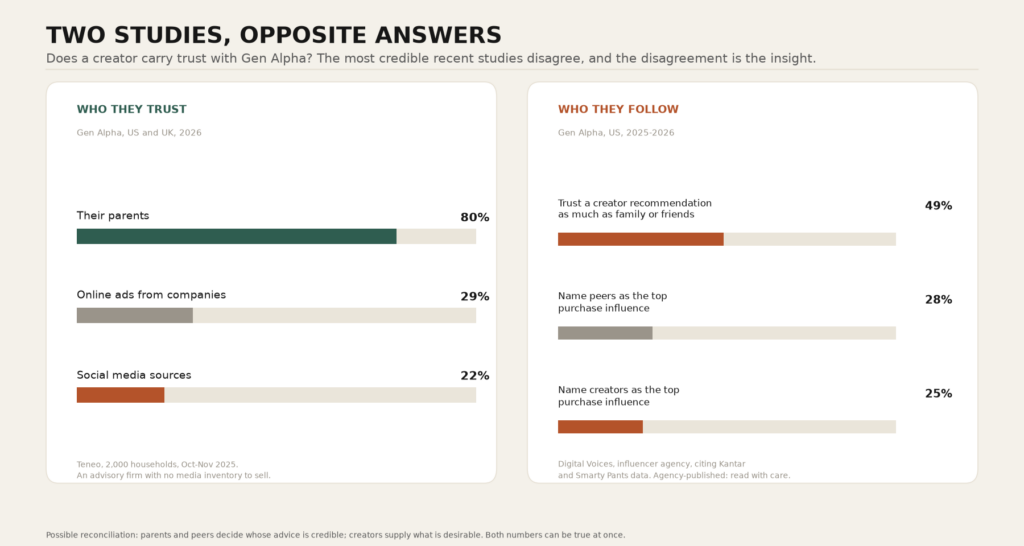
Both cannot be the headline, and neither is fraudulent. Three things explain the divergence.
First, the questions differ. “Where do you get trustworthy information” is not “whose recommendation would move you”. The first measures authority; the second measures desirability. Second, the samples differ: Teneo’s children were born 2010 to 2014, Digital Voices’ cited research spans wider ages, and the agency sells the channel it is measuring. Third, the magnitudes cannot be reconciled at all: PwC’s peer-influence figure is 56 percent, Digital Voices’ is 28 percent. Numbers that far apart are describing different constructs, not competing estimates of one construct.
What the conflict tells you to do
Treat creators as a desire channel, not an authority channel. That is not a downgrade; it is a job description.
A creator is very good at making a specific product feel necessary to a specific child. A creator is very bad at convincing a parent that the product is safe, worth its price, or appropriate for a nine-year-old. Instead of briefing creators to endorse, brief them to demonstrate — and then give the parent something to find when the request arrives. The audit trail matters: a landing page a parent can read in forty seconds, a review section written by adults, an ingredient or materials page with no marketing adjectives.
There is a second reason to lower the temperature on creator authority. A 2025 study in the European Journal of Communication, by Vizcaíno-Verdú, Feijoo and Sádaba, surveyed 1,055 Spanish teenagers and ran twelve focus groups, and concluded that teenagers regard influencers as “mannequins” — entertainment vessels lacking credibility as advertising. The cohort behind Gen Alpha is already fluent in that scepticism, and it is forming while Alpha watches.
The trust chain, rebuilt
The original framing — earn the parent, then the creators, then plant memory — survives contact with the data if you reorder the emphasis. Parents are not the first box to tick. They are the load-bearing wall.
Earn the parent’s permission, in writing
Teneo found that only 29 percent of Gen Alpha trust what they see in company advertising, and that the cohort prizes transparency over trendiness, honesty over hype. The operative word for a marketer is verifiable. Not warmer tone, not softer colours. Verifiable.
Practical translation: every claim a child will repeat at home needs a page that substantiates it. If a nine-year-old says “it has no sugar”, a parent will look. If the pack is ambiguous, the request dies and the brand takes a reputational hit in the one relationship that actually controls the money. Teneo also found 80 percent of Gen Alpha’s favourite brands overlap with those of their millennial parents — which suggests co-brand preference is transmitted at home, and that the parent is not a barrier to your brand so much as a distribution channel for it.
Buy context, not people
The compliance section explains why in legal terms; here is the commercial version. Behavioural targeting of under-13s is either forbidden or commercially radioactive, depending on jurisdiction. Contextual placement on child-directed inventory, creator content with proper disclosure, and retail media against category intent are the channels that survive.
This is not purely defensive. Contextual buying forces you to state what your product is for, which is the same discipline that makes an AI answer include you.
Plant memory early, harvest late
PwC’s most useful sentence is buried in its implications rather than its findings: children are forming product and brand preferences years before they have meaningful spending power of their own. Teneo observes the same mechanics from the other side — 71 percent of Gen Alpha parents say their children are ahead of where they were at the same age on brand maturity.
Here I have to puncture the outline’s optimism. The claim that early brand memory compounds into the adult customer of 2035 is plausible, widely repeated, and — as far as I can verify — not supported by any public longitudinal dataset that tracks children into adulthood and controls for income and category. The honest version is narrower: preference formation is observable and early, and the brand that is present at formation has an advantage that is difficult and expensive to reverse later. That is a reason to act. It is not a forecast you should put in a board deck with a compound annual growth rate attached.
Write for the assistant, not the banner
If a third of teenagers and half of UK 8 to 17 year olds are putting questions into a chatbot, and 46 percent of those who read AI search summaries believe them, then your content strategy has a new minimum viable unit: the answer-shaped paragraph.
Concretely, that means pages that state a fact in one sentence, attribute it, and survive being quoted out of context. Comparison tables that an assistant can lift. Definitions that do not begin with your brand name. It is the same discipline generative engine optimisation demands everywhere else; Gen Alpha just makes it non-optional, because they will never see your banner and they will absolutely see your sentence.
The compliance line
Twelve months that reset the market
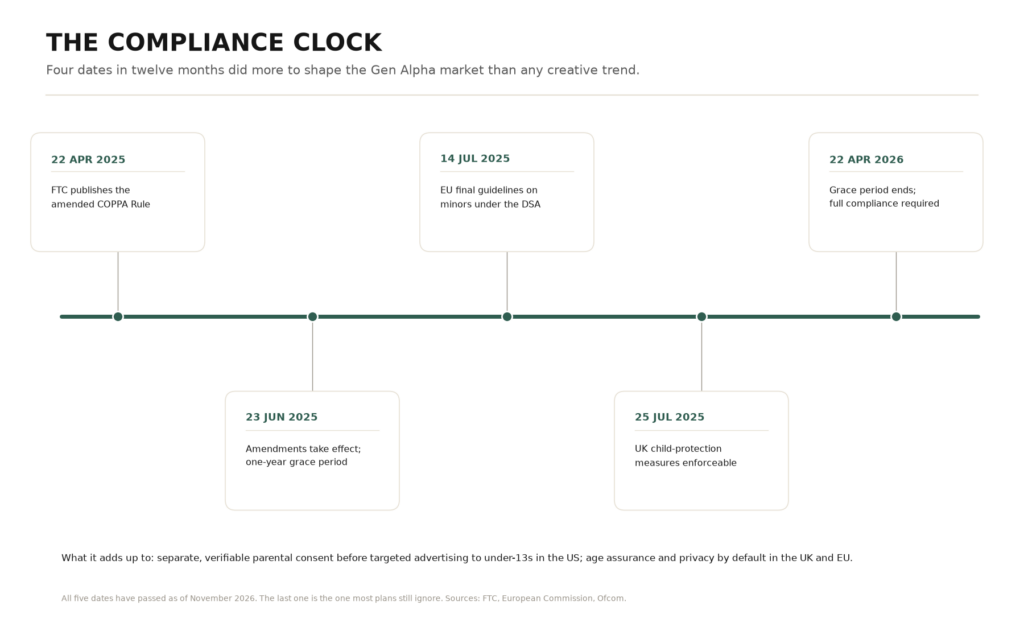
The Federal Trade Commission published its amended COPPA Rule on 22 April 2025, it took effect on 23 June 2025, and full compliance fell due on 22 April 2026. The substance is the part that changes briefs: operators must now obtain separate, verifiable parental consent before using children’s data for targeted advertising or non-integral third-party disclosure. The consent you collected to run the service does not cover the ad business.
In Europe, the Commission adopted its final guidelines on the protection of minors under Article 28 of the Digital Services Act on 14 July 2025 — privacy by default, recommender systems tuned away from harmful content, restrictions on addictive design features, and age assurance that is proportionate to risk. In the UK, Ofcom’s protection of children codes required in-scope services likely to be accessed by children to implement safety measures from 25 July 2025, with age assurance obligations attached.
Read together, these three regimes point in one direction: the age of quietly harvesting behavioural signal from a nine-year-old is over, and the replacement is consent architecture plus contextual relevance. If your 2026 plan still assumes lookalike modelling from child traffic, it is not aggressive. It is non-compliant.
The mistake that survives audits
The common error is treating “child-directed” as a content question — as long as the ad looks playful and the copy avoids hard selling, we are fine. It is a media-buying and data question. What you collect, where it flows, who you share it with, whether the consent is separate and verifiable, and whether age assurance actually works on your surface.
A second error is subtler and more expensive: assuming the platform’s age gate is your compliance programme. It is not. Ofcom found 37 percent of three to five year olds using social media on platforms whose minimum age is thirteen. Gates leak. Your obligations do not.
The ethical line sits inside the legal one
Marketing to minors is lawful within limits, and still easy to get wrong in ways that outlive a campaign. A brand that becomes the thing a child nagged a parent into buying, and that the parent resents, has purchased a customer and a reputational liability in the same transaction.
The test I would apply is not legal but documentary: could you hand a parent the brief and the media plan, and have them conclude that the child was respected? If the answer requires explaining, the answer is no.
The honest limits
Thin, vendor-heavy evidence
Almost every number in this article comes from a research house with a commercial interest in the category: McCrindle, Teneo, DKC, PwC, Digital Voices. The sample sizes are respectable — 1,000 to 5,000 — but the instruments are commercial, the questions are proprietary, and the reporting is often by parents rather than children. Pew, Ofcom and Common Sense Media are the exceptions, and even they rely on self-report from people whose self-report is unreliable by design. Children overclaim influence; parents under-count it; both do so systematically, as PwC’s 20-point skincare gap demonstrates.
The patience problem
Gen Alpha’s value accrues over a decade, and the people approving budgets are measured over a quarter. That mismatch has a predictable outcome: the cohort gets a small “test and learn” budget, the test produces no attributable revenue, and the learning is filed away. If you want the long-horizon asset, fund it as brand building with a named owner and a five-year review point, not as a performance line item that has to justify itself in ninety days.
What we still do not know
Whether early exposure converts into adult loyalty at scale is, genuinely, unresolved. Whether the enjoyment gap in AI usage persists as the tools improve is unresolved. Whether creator-led desire survives the compliance squeeze on child-directed inventory is unresolved. A strategy built on this cohort has to be run as a series of reversible bets, because the evidence base is directional, not decisive.
Conclusion: plant the memory, respect the gate
Gen Alpha is not a younger Gen Z, and it is not a direct market. It is a household with two decision-makers and one purchase order, where desire arrives through a creator and permission arrives through a parent, and where the child’s memory of your brand is being written years before their first card payment.
The winning brief in 2026 does not read “how do we reach a nine-year-old”. It reads: how do we become the brand that a nine-year-old can defend to a parent in one sentence, and that the same person still recognises at nineteen — without ever having tracked her.
Ask that question and most of the tactical noise disappears. Answer it honestly and you have something worth the wait.