Google is turning its in-house chips into a real Nvidia alternative
Google is done pretending it needs to beat Nvidia at the headline game.
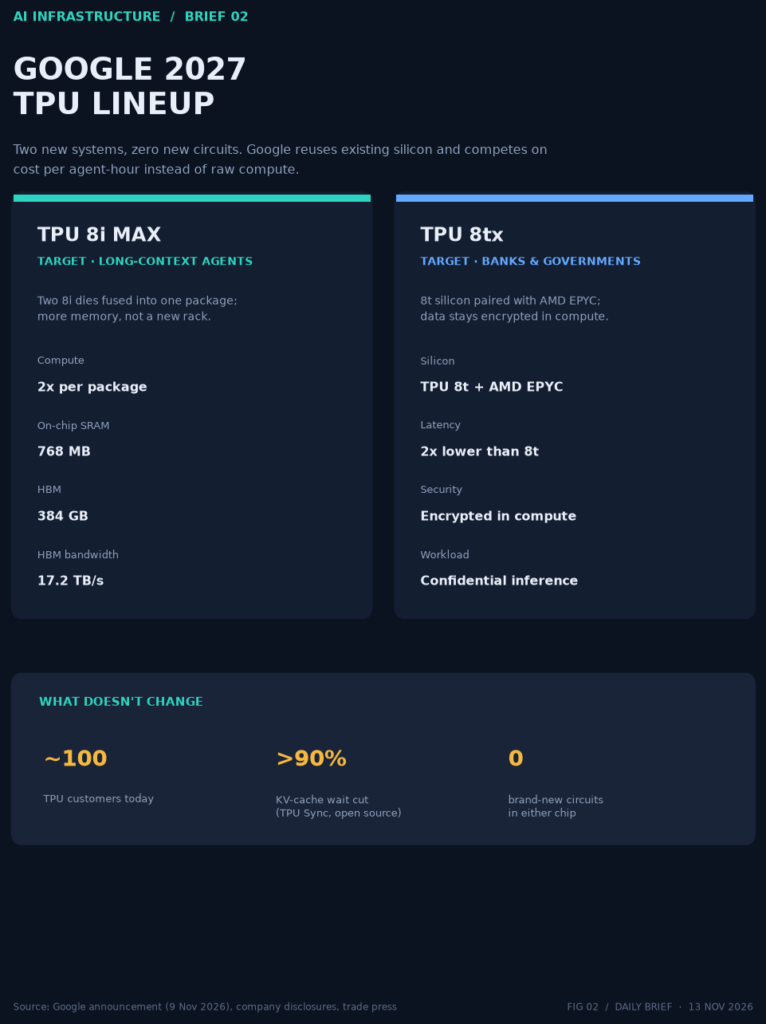
The company on November 9 added two more systems to its eighth-generation TPU lineup — the TPU 8tx and the TPU 8i Max — both aimed at customers in 2027. The quiet part said out loud: neither carries a single brand-new circuit. Google is reusing the silicon from the TPU 8t and 8i it shipped in April and reworking the packaging, memory and networking around it. Four TPU systems in twelve months is a pace Google has never kept before.
The strategy is visible in how the two chips split the work. The 8i Max crams two 8i chips into a single package, doubling compute, on-chip SRAM and HBM bandwidth — roughly 384 GB of HBM, 17.2 TB/s of bandwidth and 768 MB of SRAM — without taking up an extra rack slot. That’s aimed squarely at autonomous agents grinding for hours on million-token contexts, the kind of job where memory, not compute, is the bottleneck.
The 8tx plays a different game. It pairs the 8t silicon with AMD EPYC processors and keeps data encrypted through the entire computation, where normal systems decrypt it in memory. Google is pitching that to banks and governments that want to fine-tune models on sensitive data without moving it out of a secure environment.
The software tells you where Google thinks the real battle is. TPU Sync, released open source, turns chip memory, server memory, storage and networking into one pool and claims to cut waiting time by more than 90%. Agent Compute Engine suspends idle agents to save cost.
Google says its TPU business already has nearly 100 customers, from frontier AI labs to trading firms — a list that reportedly includes Apple and Meta. The unspoken message for anyone renting Nvidia GPUs: the expensive part of AI isn’t the model anymore; it’s the hours an agent spends running.