Google is pricing AI agents like it’s the point — because it is
Google shipped two very different things in two days, and together they explain where AI is heading faster than any single model launch.
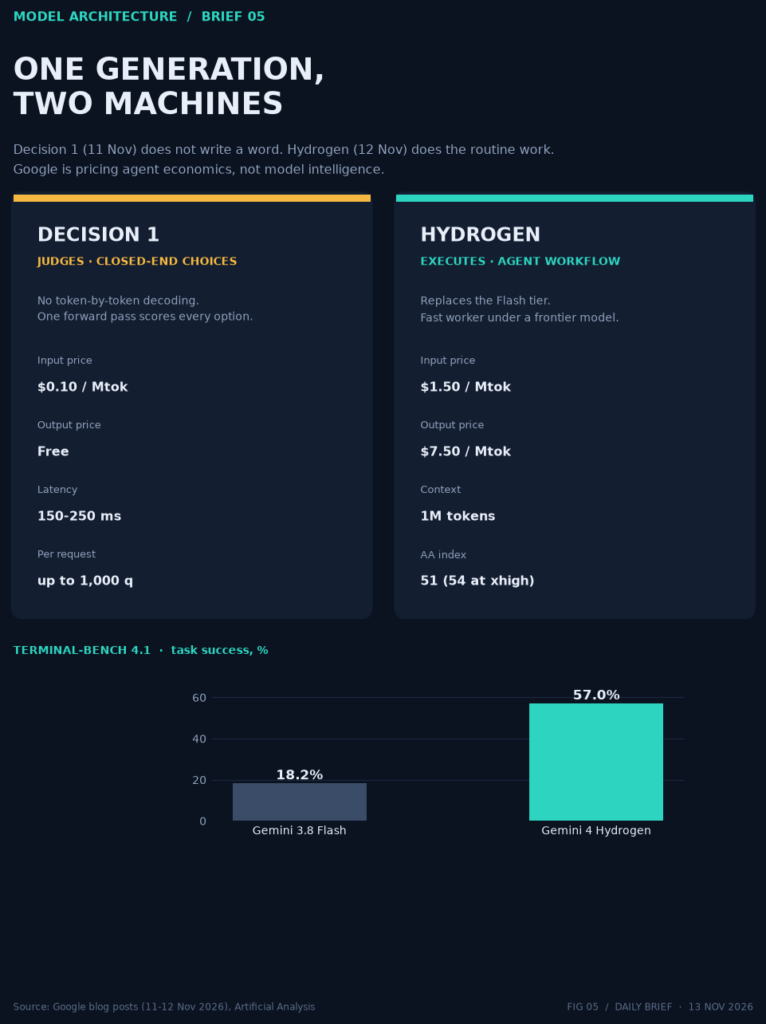
First came Gemini Decision 1 on November 11 — a model that, in Google’s own framing, does not generate text at all. It scores closed-end questions: yes/no, multiple choice with up to 255 options, or rubric-based grading. It handles up to 1,000 questions against a single shared input, across text, image, audio, video and PDF, in 150 to 250 milliseconds. Pricing is what will move adoption: $0.10 per million input tokens, and output is free — because there is no output to generate.
Then came Gemini 4 Hydrogen on November 12, the third Gemini 4 variant in three days. It’s the fast, cheap worker layer: $1.50 per million input and $7.50 per million output across a one-million-token context window. It scores 51 on the Artificial Analysis Intelligence Index at default thinking, edging past the pricier Argon, and nearly triples its predecessor on Terminal-Bench 4.1 — 57% versus 18.2% for 3.8 Flash — while running 2.5 times faster.
The point is the division of labor. Generative models decode one token at a time, which means every tiny routing decision — which tool to use, which model to escalate to, whether a tool result satisfies a condition — costs output tokens. Google’s answer: let a cheap, fast model do the judging, and let the expensive frontier model do the thinking. Hydrogen does the routine execution; Carbon and Argon handle the deep, long-horizon reasoning.
It’s a bet that the economics of agents, not the intelligence of any single model, is the real frontier. Which is exactly what the other four releases this week — from Anthropic, from Nvidia’s rivals, from everyone — keep circling.