China just turned AI compute into a consumer product
In the world’s biggest shopping festival, the breakout product of 2026 was invisible.
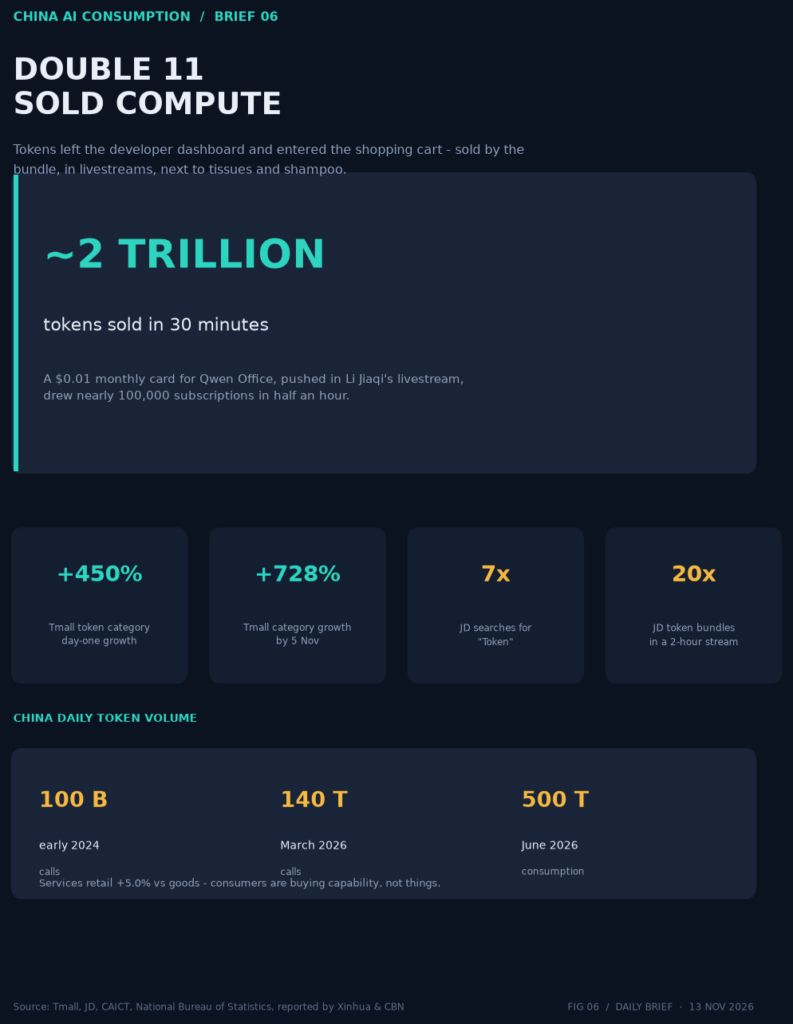
“Token” — the basic unit that large language models process, usually the stuff of developer invoices — landed on Chinese e-commerce shelves as a consumer good this Double 11. A live stream hosted by Li Jiaqi, the country’s most famous livestreamer, sold a $0.01 monthly subscription for Alibaba’s Qwen Office AI assistant: nearly 100,000 subscriptions in half an hour, worth roughly 2 trillion tokens. On JD.com, a two-hour AI livestream sold 20 times more token bundles than the prior period, and searches for the keyword “Token” jumped more than sevenfold.
The numbers behind the stunt are substantial. Alibaba’s Tmall said the Token category grew 450% on the first day of the sale and 728% by November 5, measured month over month. The China Academy of Information and Communications Technology put daily token consumption at 500 trillion by June 2026 — nearly four times the level at the end of 2025. Daily token calls in China went from 100 billion in early 2024 to more than 140 trillion by March 2026.
This is the story economists will reach for. Service retail sales grew 5.0% in the first three quarters, outpacing goods by a wide margin, and the token is the cleanest symbol of the shift: consumers buying “capability” rather than “things.” Big-model makers — Qwen, Zhipu, MiniMax, DeepSeek, Kimi — opened flagship stores on Tmall and competed on price like any other brand.
The healthy caveat is that this is part subsidy, part signal. Analysts from the Central University of Finance and Economics warn that token bundles are non-transferable, model-specific, and depreciating as prices fall — rent, don’t hoard. But the direction is hard to argue with. A resource once bought only by developers through API dashboards is now being sold like phone minutes. China’s AI market just had its first real consumer moment.