Your Return Policy Is a Media Buy — Price It Like One
Ship ten dresses. Watch eight come back. That is not a metaphor in Chinese e-commerce — it is a line item that several womenswear sellers now quote without flinching. And here is the strange part: most of them still make the sale. The return is not the failure of the transaction. It is the price of the transaction, paid later, booked somewhere else.
That “somewhere else” is the subject of this piece. China’s e-commerce did not build a returns policy. It built a returns culture — buy it, try it, send it back — and the culture runs on a second supply chain nobody puts on the growth slide. Reverse logistics. The pickups, the sorting halls, the grading benches, the resale channels, the write-offs. It behaves like a marketing cost because it buys conversion. It gets managed like an ops cost because that is where the invoice lands. That mismatch is the expensive part.
The trust engine was never free
Start with why the generosity exists. In a market where buyers cannot touch the product and sellers cannot prove the quality, a return window is the cheapest credibility a brand can buy. Free returns rank near the top of what Chinese shoppers check before they buy, and the same pattern shows up in Western data: the National Retail Federation and Happy Returns found that 82 percent of US shoppers treat free returns as a major consideration, and 71 percent say a bad returns experience makes them less likely to come back.
So the policy is not charity. It is risk reversal, and risk reversal converts. The 2024 implementation rules for China’s Consumer Protection Law made the seven-day no-reason return a statutory right with a matching duty of good faith — a detail worth remembering, because it means the rule was never designed to license unlimited use.
Then the incentives bent. Platforms competing for share turned generosity into a default, then a requirement. Freight insurance, launched around 2010 for a few cents a parcel, became a checkbox. When a buyer pays nothing to try, the cost of trying collapses to zero and the volume of trying explodes. Economic Daily reported in October 2026 that online womenswear returns sit at 50 to 60 percent, with live-commerce channels reaching 80 percent.
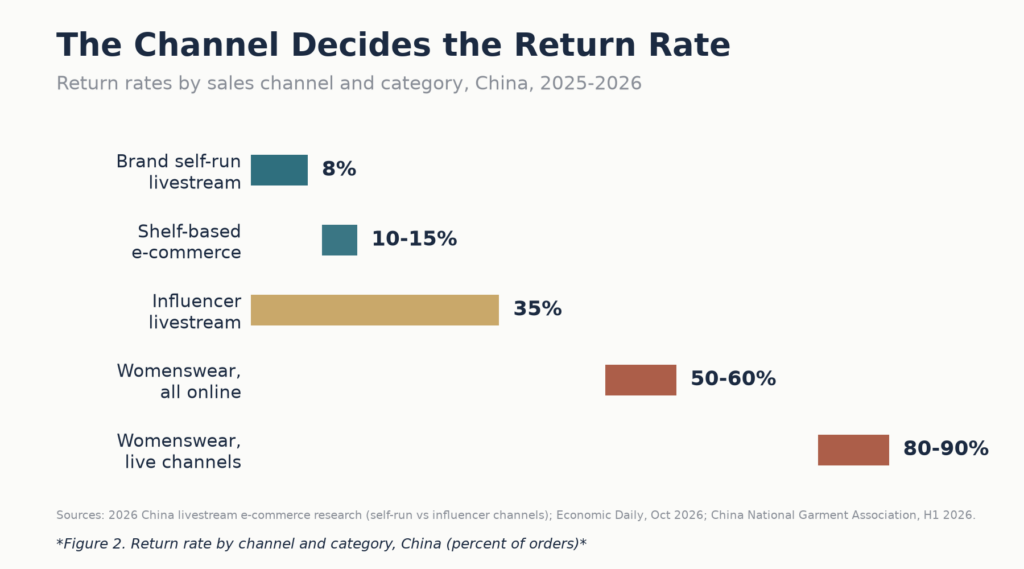
Look at that chart again, because the top two bars are the whole argument. A brand running its own livestream sees roughly 8 percent returns. The same brand’s product, sold through an influencer’s room, sees about 35 percent. Industry research published in 2026 puts that gap at 27 percentage points and traces it to one thing: where the decision happens. In a self-run room, the viewer already knows the brand and arrives to confirm price and stock. In an influencer room, the viewer arrives to be entertained, and the purchase is a reflex.
Same garment. Same warehouse. Different decision quality. Which means the return rate is not a product attribute at all. It is a media attribute.
What a return actually costs
Here is where most marketing budgets go quiet. A return is not one cost. It is a stack.
First, the pickup. Reverse parcels are scattered, small, and time-sensitive, so the cost per pickup runs two to three times a forward delivery, according to logistics-industry reporting on China’s returns economy. Second, the triage. Every parcel gets opened, checked, graded, and routed. Third, the disposition — restock, refurbish, liquidate, or scrap — and this is where the real damage sits, because a restocked item competes with new stock while a scrapped item takes the full cost. Fourth, the refund itself, plus the fraud layer on top.
The benchmarks are blunt. Pitney Bowes’ BOXpoll survey puts the cost of processing an online return at about 21 percent of the order’s value, across categories. For apparel, Coresight Research citing Optoro puts the figure at up to 66 percent of the item’s price once shipping, inspection, and markdowns pile on. Read that as a ceiling, not an average — but a ceiling that a lot of Chinese womenswear lives near.
The domestic number is cleaner and more useful. The China National Garment Association’s analysis of the first half of 2026 puts the all-in cost of a single womenswear return at roughly 16 yuan (about $2.20). At a 55 percent return rate, that is not a rounding error. It is a second cost of goods.
And the arithmetic gets ugly fast because marketing spend does not come back. A running brand spent 2.26 million yuan on one influencer livestream — slot fee, traffic spend, giveaway budget, commission. Buyers paid 578 million… no, 5.78 million yuan at checkout. Actual settled sales landed at 2.18 million. The return rate was 65.65 percent, and the brand booked a net loss of more than 800,000 yuan, with 86,500 yuan of that traceable to return handling alone, according to reporting by New Yellow River and Caibian. The slot fee was paid before the stream started. The commission was settled on realised sales. The returns went back to the brand’s warehouse.
Who ate the risk? The party that paid for the traffic.
The volume math nobody puts in the deck
Now scale it. China’s express network moved 1,989.5 billion parcels in 2025, up 13.6 percent, per the State Post Bureau. Inside that torrent, reverse parcels are the fast-growing segment. Fengchao Holdings’ IPO prospectus, citing China Post and CIC data, puts e-commerce reverse parcels at 3.6 billion in 2019, 8.2 billion in 2023, and a forecast 20.9 billion by 2028 — a 22.7 percent annual growth rate into 2023 and 20.7 percent projected through 2028, against 11.2 percent for forward parcels.
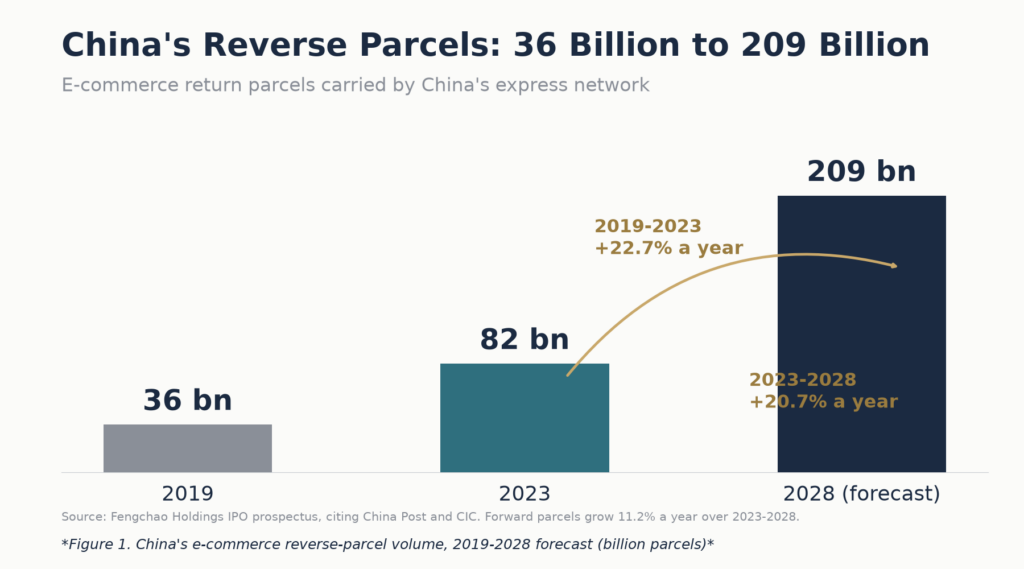
Read the crossing point. Forward volume is decelerating. Reverse volume is not. Every incremental parcel in the network is increasingly likely to be a parcel going backwards, and reverse parcels are the expensive ones to handle. That is why couriers who spent a decade fighting a price war suddenly found a margin: as one industry analysis put it, you do the forward trip once and the reverse trip once, and the second trip pays better.
It also explains a structural oddity. Fengchao built a business on the fact that consumers will walk a return to a locker themselves, which strips out the most expensive leg of the reverse chain — the door-to-door pickup. The company claims its model cuts the per-parcel cost of a reverse shipment by as much as 60 percent. Efficiency, in this market, is not a nicer truck. It is asking the customer to do the first mile.
The reclassification: this is marketing money
Here is the reframe that changes decisions. If the return policy is a conversion lever, then its cost is customer acquisition cost. Not logistics overhead. Not “fulfilment.” CAC.
Chinese practitioners have started saying this out loud. At the 2026 China Garment Association womenswear conference, one operator described buying two colours and three sizes of the same jacket, keeping one, and returning the rest — a 75 percent return rate on that order, 25 percent settlement — and argued the return cost was properly understood as the brand’s customer-acquisition spend, because the trial is what produced the trust. The association’s own analysis reaches the same place: high return rates are pushing womenswear firms into a “the more you sell, the more you lose” loop, and the ones treating returns as pure loss keep cutting quality to fund the gap, which pushes returns higher.
That loop is the tell. When you book a marketing cost as an ops cost, you optimise the wrong thing. You squeeze the warehouse, you slow the grading bench, you delay restocking — and every day a returned garment sits unprocessed, its resale value decays. Apparel has a selling window measured in weeks. A return that re-enters stock three weeks late has not been recovered. It has been warehoused.
The regulatory correction, and what it actually changed
For a few years the policy ratchet only turned one way. Then it reversed, quickly.
In April 2025, five major platforms — Taobao, JD, Pinduoduo, Douyin, Kuaishou — separately announced they would stop auto-approving post-delivery refund-only claims and hand the decision back to sellers. Then on 1 February 2026, a joint rule from the State Administration for Market Regulation and the Cyberspace Administration took effect that bars platforms from forcing merchants into refund-only obligations or forced freight insurance, using the careful phrase “force or effectively force.”
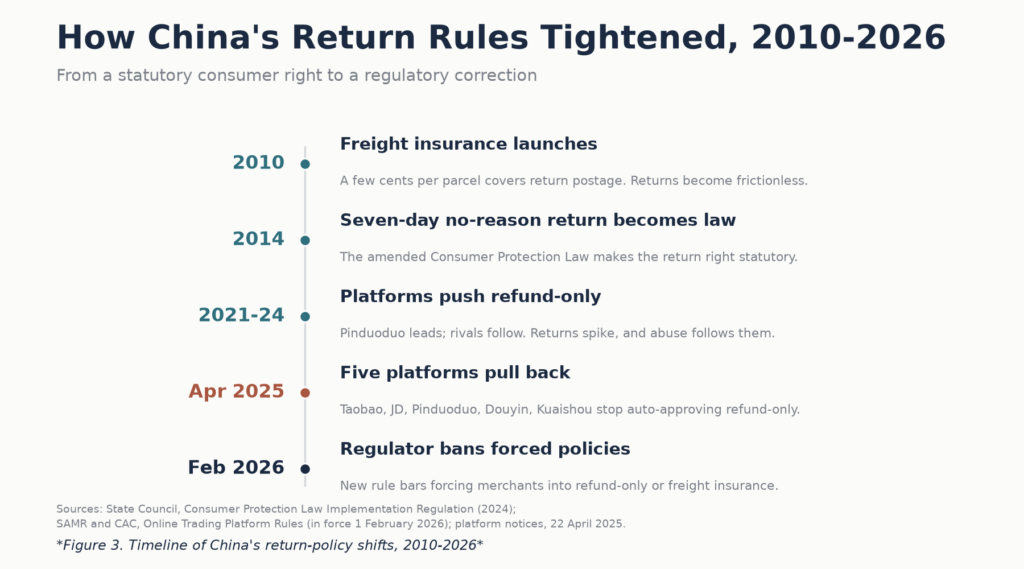
The direction matters more than the details. The regulator did not abolish returns. It separated two things that had been fused: the consumer’s right to return, and the platform’s right to make the merchant pay for a growth tactic. That distinction is the entire ballgame for a brand building a returns budget, because it means the generosity is now a choice with a price tag attached, not a toll.
Simultaneously, the tooling got smarter. Taobao’s Returns Protect programme, launched in September 2024, cut merchants’ return-handling costs by a reported 10 to 30 percent. In May 2026 it added an AI retention feature: on small-value orders, the platform’s own budget funds a partial refund so the buyer keeps the item and the return never happens. Walmart and Amazon have run versions of this for years — Walmart calls them Keep It rules, Amazon routes eligible items through returnless refunds — and roughly a third of US retailers now use some form of it.
The logic underneath is a single comparison, and it is worth writing on a whiteboard: compare the recoverable value of the returned unit against the incremental cost of getting it back. If a 40-yuan item costs 25 yuan to retrieve, grade, and repackage, and resells for 12, the return destroys value. Refund it, let the customer keep it, and book the difference as a marketing expense with a known size.
Where the returned goods actually go
The uncomfortable question in every returns meeting is the one nobody wants to answer: what happened to the eight dresses?
The optimistic answer is resale. And resale is real — a peer-reviewed study in the Journal of Management Sciences in China (2025, issue 12) worked with a fast-fashion apparel firm whose returned garments could be resold at a rate of 81 percent, and found that using return forecasts in inventory planning cut the firm’s costs by an average of 6.5 percent. That is a marketing-relevant number disguised as an operations number: if you can predict returns, you stop over-buying, and over-buying is what forces the discounting that erodes brand price integrity.
The pessimistic answer is destruction. And destruction just got expensive in Europe. Under the Ecodesign for Sustainable Products Regulation, large companies have been barred since 19 July 2026 from destroying unsold apparel, accessories, and footwear, with mid-sized firms following in 2030. The European Environment Agency estimates that 4 to 9 percent of textiles placed on the EU market are destroyed before ever being used — 264,000 to 594,000 tonnes a year — generating roughly 5.6 million tonnes of CO2, about Sweden’s entire net emissions in 2021. France alone is estimated to destroy €630 million of unsold goods annually; Germany discards close to 20 million returned items a year.
China has no equivalent ban, which means Chinese brands currently enjoy a cheaper escape hatch than their European competitors — and are exposed to the reputational version of the same bill the moment they sell into those markets. A brand that markets sustainability while scrapping its returns is not running a green story. It is running a green story with an audit trail.
Four moves that actually change the number
Price the policy like a media buy. Take your return rate, multiply by the all-in cost per return, and express the result as a percentage of revenue. Then compare it to your conversion lift from offering free returns. Most teams have never run this comparison, because the cost sits in a warehouse P&L and the lift sits in a marketing dashboard. Put them on the same page once and the argument ends.
Buy the channel, not just the reach. A 27-point return gap between self-run and influencer livestream is not a rounding difference; it is roughly a third of gross merchandise value evaporating in transit. If your influencer commission is settled on realised sales but your inventory risk is settled on shipped units, you have transferred the downside to yourself and the upside to the host. Renegotiate on settled revenue, or shift budget to rooms where the audience already knows you.
Make speed the metric. Recovery value decays with time, and it decays faster in fashion than almost anywhere else. Track days-from-receipt-to-resale, not just return rate. A warehouse that grades in 24 hours and a warehouse that grades in a week can post identical return rates and wildly different margins.
Mine the return ledger as product intelligence. A return reason is a message from a customer who paid to send it. Size confusion, colour mismatch, fabric feel, over-promised fit — each maps to a different fix, and each fix is cheaper than another round of traffic. The brands that treat returns as feedback get a compounding advantage; the brands that treat them as waste keep buying the same lesson.
The honest caveats
Generous returns do convert. The data on that is solid, and abandoning the policy to save the reverse-logistics line is usually a false economy — the US evidence shows merchants who charge restocking fees lose customers, with 37 percent of retailers reporting exactly that.
But “returns always pay” is not a universal law. For thin-margin, high-return categories, the reverse bill can exceed the trust gain. And the fraud layer is real and growing: the NRF puts fraudulent returns at about 9 percent of the total in the US, and Chinese authorities broke a freight-insurance fraud ring in 2025 that had extracted more than 3 million yuan by fabricating shipments and returns across a hundred storefronts.
One more caution, because it is the most common analytical error in this space. Blaming high return rates on serial returners is satisfying and mostly unsupported. There is no authoritative Chinese dataset that quantifies what share of returns come from “wear it once and send it back” behaviour. The frequently cited 42-percent-to-18-percent drop is a single merchant’s own figures after adding oversized tags. Meanwhile, the Jiangsu consumer council publicly attributed the problem mainly to merchants — weak size data, unrealistic imagery, no virtual fitting — rather than to consumer abuse. If you build a returns strategy on the abuse narrative, you will spend money on tags and ribbons and none on the product page that caused the return.
What this means
China’s return culture is a trust engine with a metered bill. The generosity works, and the volume it generates is now a structural feature of the network — eight billion reverse parcels becoming twenty, growing twice as fast as everything moving forward.
The brands that will run this profitably are not the ones that tighten their policies. They are the ones that finally book the cost where it belongs: as a marketing line with a known unit cost, a measured conversion lift, and a recovery target. The ones that keep it buried in the warehouse will keep converting on trust they are quietly losing money on — and will keep discovering the bill a quarter late, in a report nobody reads.