The Density Paradox: Why the Easiest Robot Deployment Was the Least Viable Business
For eight years, the autonomous delivery industry had a favourite proof point: the college campus.
It made sense. A campus is a closed map with private paths, a single client, no municipal permitting, and thousands of hungry people inside a ten-minute walk. Starship built its reputation there, and by the mid-2020s those little white boxes were as much a fixture of university life as the dining hall.
Then, in June 2026, Starship wound the whole thing down and moved more than 1,200 robots into city grocery work. Amazon had already killed Scout in 2022. Nuro cut roughly 30% of staff and stopped building vehicles altogether.
The obvious reading is that the technology failed. That reading is wrong. The robots worked. The market didn’t.
The three variables nobody priced in
Strip away the novelty and an autonomous fleet is a fixed-cost asset. Robots, charging bays, remote operators, mapping, and insurance all get paid whether or not anyone orders. Everything else is arithmetic: how much revenue each delivery carries, how many deliveries each robot completes per day, and how many days per year it can work.
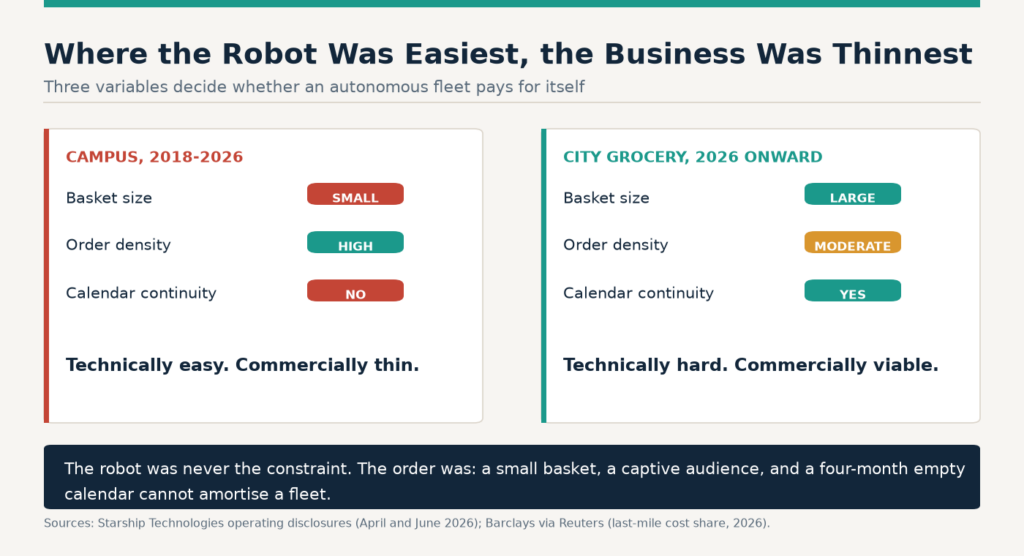
Three variables, then. Basket size. Order density. Calendar continuity.
A campus wins spectacularly on the second one and loses on the other two. Students order constantly, but they order a burrito and a Red Bull, not a week of groceries. A $9 basket cannot absorb the amortised cost of a machine that has to be bought, maintained, insured and supervised. And a campus empties. Winter break, summer, reading week, the long tail of exam periods. You are paying for a fleet that spends roughly a third of the year parked.
City grocery inverts every term of that equation. The map is harder, the regulation is worse, the pedestrians are less forgiving. But a grocery basket is large, orders run all year, and the same robot that delivered a burrito now carries eighty dollars of shopping. That is the difference between a demo that delights and a route that pays.
The inversion, stated plainly
Here is the pattern worth remembering: in this category, technical ease and commercial viability run in opposite directions.
The properties that made a campus easy — a closed map, private paths, one client, no regulator — are the same properties that capped revenue. Every constraint you remove to simplify deployment is usually a constraint that was also holding up the price.
That is why the industry’s most impressive demos kept happening in the places it could least afford to stay. The campus was never a market. It was a data-acquisition strategy wearing a business model’s clothes. Twenty-two million autonomous kilometres and ten million deliveries bought something genuinely valuable: a training set no competitor could replicate. It just wasn’t revenue.
What this means if you are the one buying
Most brands encountering delivery robots now are not operators, they are customers of one. Which makes this a diligence question, not a robotics question.
Ask your vendor how many deliveries a single robot completes per day, and what the average basket value is on those routes. Ask what happens to fleet utilisation in the quiet season. Ask whether the deployment geography was chosen because it is easy to operate or because it is dense enough to pay.
If the answer is “it’s a great pilot campus,” you have your answer about the business.
The robot was never the constraint. The order was.