AI Copyright in Marketing: The Ownership Vacuum at the Center of Your Campaign
Your team generated a hero visual in forty minutes. It ran across three markets, beat the control by nine percent, and a competitor quietly lifted it for their own campaign six weeks later.
You send the letter. Their lawyer writes back two words: prove it.
And that’s the moment the campaign stops being a marketing success story and starts being a copyright problem. Because here’s the thing nobody puts in the onboarding deck — generating an ad is not the same as owning one. The model drew it. That doesn’t mean you did.
The uncomfortable arithmetic of a free image
Let’s start with the number that should worry you most: 73 percent of marketers worldwide now use generative AI for visual, image, or video production. Only 41 percent use it for testing and optimization. That’s from a WARC and TikTok survey of 400 marketers across the UK, US, Australia, and Brazil, fielded in May 2026.
Read that gap again. We are producing vastly more AI-assisted creative than we are measuring. Which means most teams are shipping assets whose ownership status they have never once checked.
Now the second number. In the same study, 88 percent of marketers said AI had increased their creative output. Fewer than half — 45 percent — said the quality was significantly better.
So: more output, similar quality, and almost no one auditing the rights layer. That is not a productivity story. That is a liability story with a good soundtrack.
What “no human, no copyright” actually means
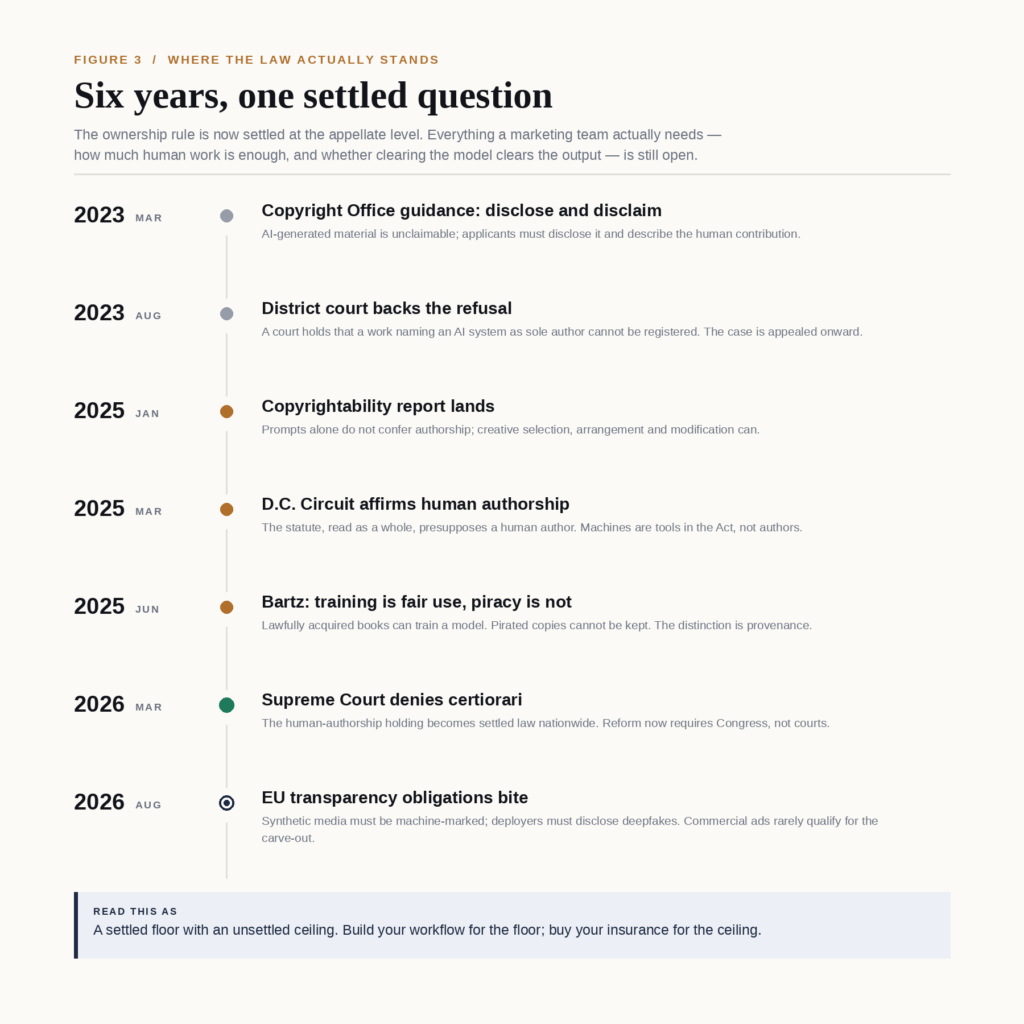
US copyright has a bedrock rule, and it is not subtle. A work must be authored by a human being. In March 2025, the D.C. Circuit said so plainly in Thaler v. Perlmutter, reading the Copyright Act as a whole and concluding that authors must be humans, not machines. On 2 March 2026, the Supreme Court declined to hear the appeal.
That’s it. That’s the settled part. It is now the law of the land at the appellate level, and any change will have to come from Congress, not from a clever argument in a district court.
The practical consequence lands harder than the legal headline. If a work has no human author, it has no owner. Under US law it enters the public domain the moment it’s created. Not “weakly protected.” Not “protected but hard to enforce.” Unprotected.
Which means a competitor can take your ad and you have no federal copyright claim against them. You can’t register it, because there’s nothing registrable. You can’t sue for statutory damages, because you have no registration. You can, in the bleakest reading, watch your own campaign get republished under someone else’s logo and have remarkably little to say about it.
That’s the ownership vacuum. It is not a theory. It’s a default state, and it’s the one your workflow lands in by accident.
The prompt trap: why 600 prompts didn’t save Jason Allen
Here’s where a lot of teams get their hopes up. Surely the effort counts, right? Surely the craft counts?
Jason Allen would like a word. He used more than 600 iterative prompts in Midjourney to produce Théâtre D’opéra Spatial, which won first place at the Colorado State Fair. The Copyright Office refused registration three times. He sued. As of late 2026, that case — Allen v. Perlmutter, in the District of Colorado — is still awaiting a ruling.
The Office’s position is bracing in its clarity. Prompts are ideas or instructions, not authorship. The system, not the user, supplies the expressive detail that viewers actually see. And time, effort, and iteration do not substitute for human creation. The Office called the sweat-of-the-brow argument what it is: a theory the Supreme Court rejected in Feist back in 1991.
One detail from that dispute is worth pinning to your studio wall. The Office told Allen he could have registered his post-generation edits while disclaiming the AI-generated portions. He declined. The middle door was open the whole time.
That’s the whole lesson compressed into one sentence: the door isn’t shut. You just have to walk through the right one, and you have to bring evidence.
One ad, two property regimes
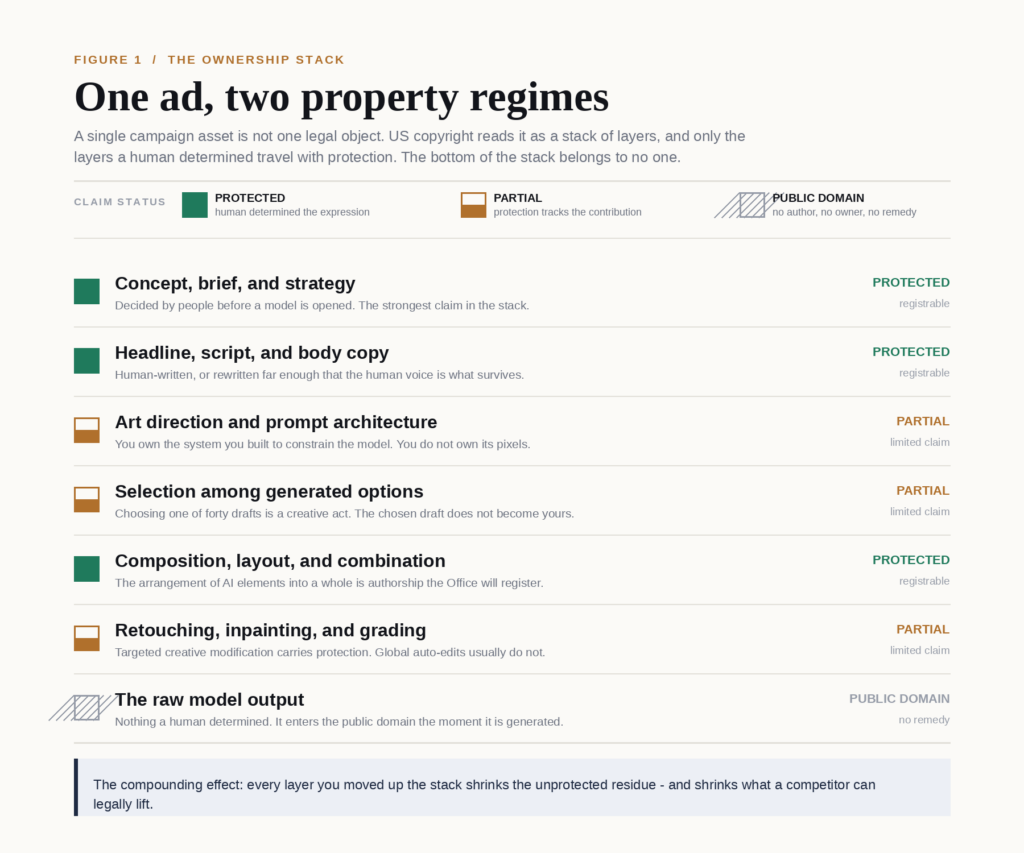
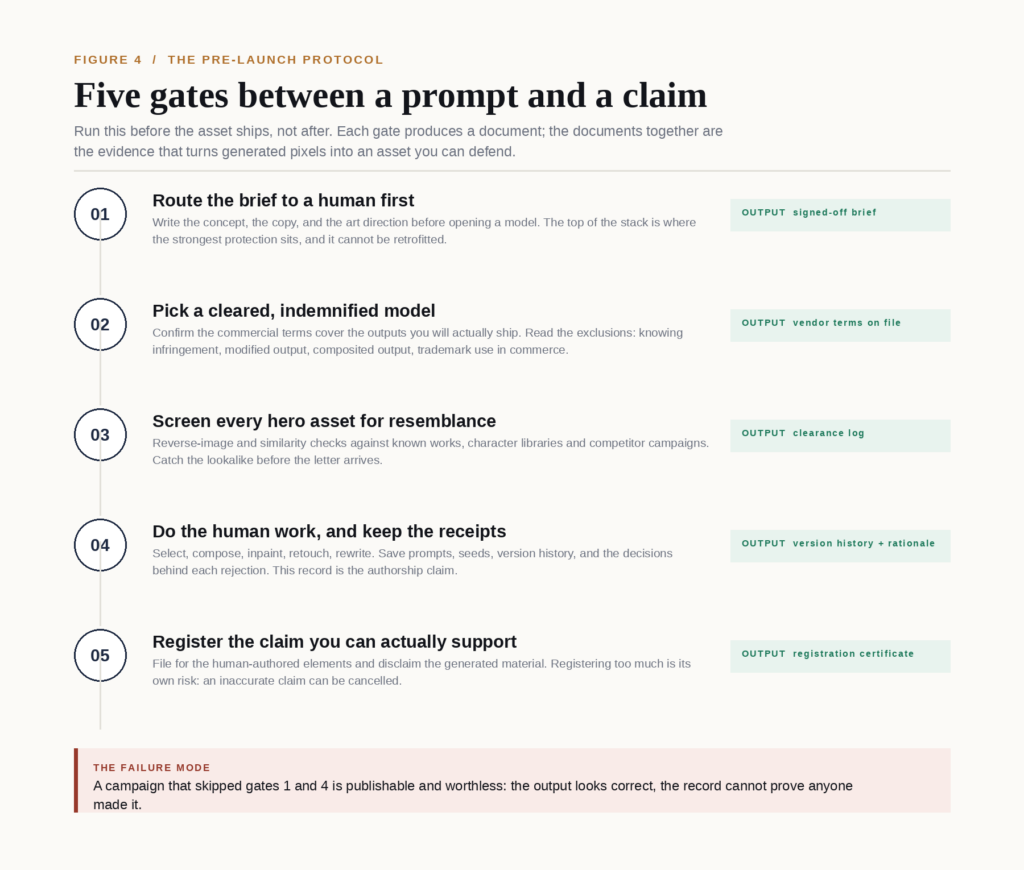
Look at the top of that stack. Concept, brief, strategy, headline, layout. All decided by people, usually before anyone opens a browser tab with a model in it. That’s where your strongest claim sits, and it’s also the layer most teams rush through because the model is right there and impatient.
Look at the bottom. The raw generated pixels. That’s the part you paid for in compute and own not at all.
Where you can actually plant a flag
The Copyright Office has been consistent about this for three years, and the January 2025 report on copyrightability — the second part of its AI study — put it in language you can hand to a legal team: human authorship remains a bedrock requirement, and works entirely generated by AI are not copyrightable.
But the same report built a road out. Three routes, roughly.
Selection and arrangement. If a human creatively selects or arranges AI-generated material so that the resulting work as a whole constitutes an original work of authorship, that arrangement is protectable. This is the Zarya of the Dawn logic, and it’s the logic behind the first image the Office actually registered with substantial AI content: A Single Piece of American Cheese, registered on 30 January 2025. Its creator picked one of three generated options, then reworked it through roughly 35 rounds of inpainting. The registration covers the selection, coordination, and arrangement. The machine’s pixels were disclaimed.
Substantial modification. If you take generated material and modify it to a degree that itself meets the originality standard, the modifications are yours.
Expressive inputs. If you feed a copyrightable work of your own into the tool and it remains perceptible in the output, you can claim that perceptible expression — with protection analogous to a derivative work.
Notice what all three have in common. None of them are about how hard you tried. They’re about whether a human determined the expressive result, and whether you can prove it.
And notice what the Office rejected: sui generis protection for AI output. It looked at proposals to create a new right for machine-generated works and said no, concluding existing law was adequate and that a new right could flood the market with low-quality content.
The paperwork is the asset
Here’s the operational bit that separates a policy from a posture.
Since March 2023, applicants have a duty to disclose AI-generated content that is more than de minimis and to describe the human contribution. On the standard application, that means using the Limitation of Claim section, naming the AI material under Material Excluded, and describing what the human actually contributed in the Author Created field.
Get this wrong in the other direction — claim the whole file as your own original work — and you’re not being aggressive. You’re creating a cancellable registration. The Office can cancel it. A court can disregard it. Either outcome is worse than having filed a narrower, honest claim.
The Invoke registration is instructive for a second reason beyond the legal rule. The Office could see the human decisions because the company captured the build as it happened, region by region, and could show it. Documentation wasn’t a nice-to-have. It was the evidence.
The other side of the ledger
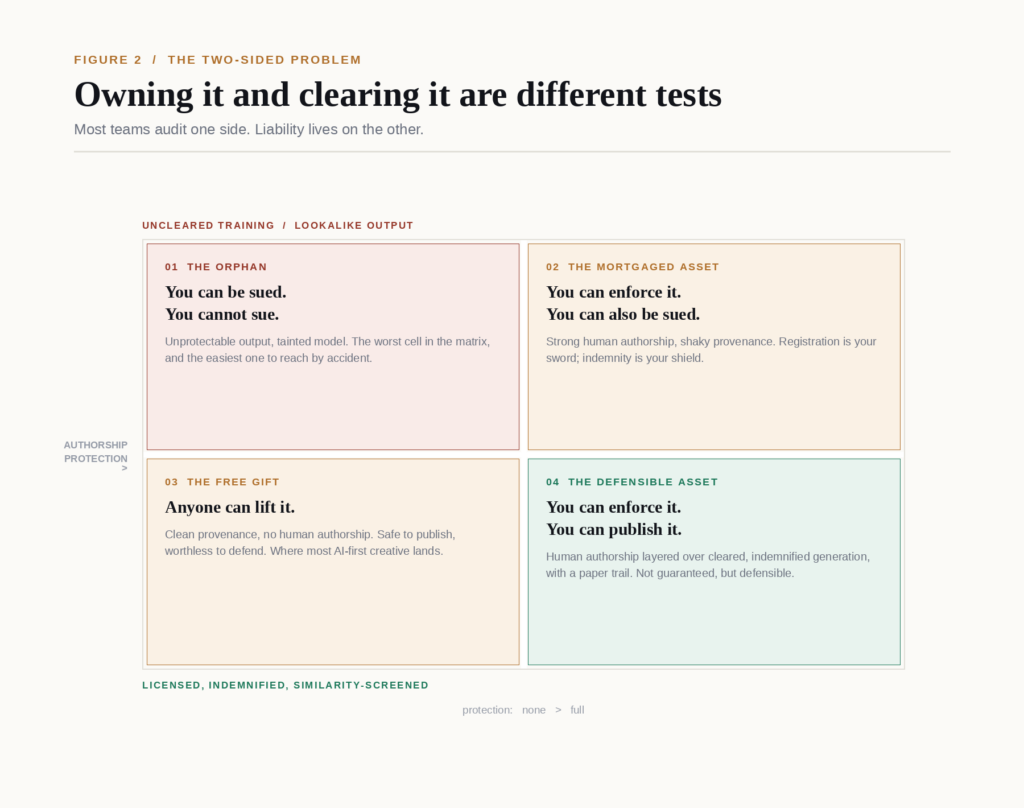
So far we’ve talked about whether you can stop someone copying you. That’s half the problem. The other half is whether you’re the one copying.
These are genuinely separate questions, and confusing them is the most common mistake I see in brand-side AI governance. You can have a beautifully authored, perfectly registered asset that infringes. You can have a clean, licensed, indemnified output that nobody owns.
What Bartz actually decided
In June 2025, Judge William Alsup handed down a split decision in Bartz v. Anthropic that the industry has been misreading ever since.
The win: training a model on lawfully acquired books was “exceedingly transformative” and protected by fair use. The loss: downloading millions of books from LibGen and PirLiMi — pirate libraries — and retaining copies to build a central library was not.
Anthropic settled for $1.5 billion. The Northern District of California granted final approval on 20 July 2026, describing it as the largest copyright class action settlement in history, covering roughly 482,000 works at about $3,000 per work.
Now the part that matters to a marketing department, and it is not the dollar figure.
The release is narrow. It covers past acquisition and copying of the works on the list, up to the point before any AI output. It explicitly does not release claims based on allegedly infringing model outputs. And it doesn’t cover future conduct after 25 August 2025. Anthropic also had to destroy the pirated source files.
So the settlement didn’t answer the question marketers actually care about. It answered the input question and left the output question live.
And the appellate picture is messier than the headlines suggest. On 29 September 2026, the Third Circuit decided Thomson Reuters v. Ross Intelligence, holding that using Westlaw headnotes to train a competing legal research tool was not fair use — the first US appellate ruling on AI training. That court stressed that the use served the same purpose as the original product and that a licensing market for training data is developing fast. It expressly left generative AI open.
The takeaway isn’t “training is fair use.” The takeaway is that training is a fact-dependent defence, and “we assumed the model was fine” is not a fact pattern that ages well.
Weights aren’t copies. Watermarks are trademarks.
In the UK, Getty Images v. Stability AI produced something genuinely interesting in November 2025, even though it resolved less than it appeared to.
Getty had withdrawn its primary training claim mid-trial — the training happened outside the UK. That left secondary infringement: was the model itself an “infringing copy” imported into Britain?
The High Court said no. Expert evidence showed the model stores statistical associations and weights, not images. The weight file was about 3.44 GB against a training dataset of roughly 220 TB. It cannot possibly contain the pixels, and the court reasoned accordingly.
Then Getty won a narrow, slightly awkward consolation prize: some early Stable Diffusion outputs reproduced Getty and iStock watermarks, and that was trademark infringement under the Trade Marks Act. Limited, historic, fact-specific — and enough for Getty to get permission to appeal the copyright point in December 2025.
For marketers, both halves matter. The copyright half says the model isn’t a warehouse of stolen pictures, which is reassuring. The trademark half says that if your output carries someone else’s brand mark, you have a different and much more expensive problem.
The output problem is the one that will bite you
Which brings us to the case that should be on every brand’s radar: Disney Enterprises v. Midjourney.
Disney and Universal sued in June 2025 over a “bottomless pit of plagiarism.” Warner Bros. Discovery joined in September 2025, seeking up to $150,000 per infringed work. Discovery has been grinding through 2026, with a magistrate judge limiting the studios’ disclosure obligations in June to consumer-facing AI tools and Midjourney pushing back.
Midjourney’s defence will sound familiar. Training is transformative. The model learns statistical relationships, not copies. And, pointedly, the studios are themselves exploring AI internally — which Midjourney argues bears on market harm, safeguards, and equitable defences.
The studios’ lawyer called it a fishing expedition. Maybe. But the structural point survives regardless of who wins discovery: even if training is ultimately fair use, outputs that closely resemble protected characters can generate independent liability. Training legality and output legality are two different questions, and the output question is the one sitting in your campaign folder.
That’s why “prompt for originality, never for a named artist” isn’t a stylistic preference. “In the style of [living illustrator]” is a derivative-work red flag you typed yourself, and it’s sitting in your prompt log.
Six years, one settled question
The EU wrinkle: disclosure is not ownership
If you run campaigns in Europe, there’s a second regulatory axis that has nothing to do with who owns the asset and everything to do with whether you can legally publish it.
Article 50 of the EU AI Act took effect on 2 August 2026. Providers of generative systems must apply machine-readable marks to synthetic output. Deployers — the brands actually putting content in front of people — must disclose deepfakes.
And the European Commission’s implementation guidelines stretch “deepfake” further than most US marketers assume. It isn’t only face-swapping. It covers AI-generated depictions of objects, places, and people that would falsely appear authentic. The guidelines give a marketing example directly: an AI-generated image of a product in an ad or on packaging that makes the product look more appealing or higher-quality than it really is lands in deepfake territory and needs disclosure. An AI-generated background behind a real, unaltered product generally doesn’t.
The artistic carve-out exists but is narrow, and the guidance is blunt that commercial content rarely qualifies. Where content is exclusively commercial and recognisable as such, the lighter regime doesn’t apply. A realistic synthetic influencer testing a real sponsored product is explicitly given as a case that does not benefit from it.
One more useful clarification: whether you’re the “deployer” depends on control, not on who you hired. Engaging an agency doesn’t automatically make you the deployer. But if the brand decides whether AI is used, how it’s used, or controls the output, it likely is. Contracts can allocate the work. They can’t reassign the legal category.
The side door nobody’s watching
Copyright isn’t the only rights regime in play, and for marketing it may not even be the most dangerous one.
The NO FAKES Act — formally the Nurture Originals, Foster Art, and Keep Entertainment Safe Act of 2026 — advanced unanimously out of the Senate Judiciary Committee on 18 June 2026. It isn’t law yet. It would create a federal property right in every individual’s voice and visual likeness, licensable but not assignable during life, with statutory damages in the $5,000 to $25,000 range per violative replica and a notice-and-takedown framework modelled on the DMCA.
Note the scope. Not celebrities. Not performers. Every individual, living or dead. If your campaign features a synthetic presenter, an AI avatar, a generated face that happens to resemble someone, or a cloned voice, you are in the blast radius of a bill that has bipartisan support and has already cleared committee.
Eight states — Tennessee, California, Illinois, New York, Utah, Arkansas, Montana, and Washington — already have digital replica statutes on the books. The federal bill wouldn’t preempt causes of action that existed as of 2 January 2025. So the patchwork stays, and it stacks.
The five gates
The honest caveats
I’d be selling you something if I pretended this was tidy. It isn’t.
The doctrine is still moving. Allen v. Perlmutter hasn’t been decided. The Getty appeal is live. The OpenAI MDL’s fair use question is unresolved. The OpenAI and Midjourney output cases are in discovery. You are building a workflow on top of a floor that is solid and a ceiling that is being poured while you stand under it. Re-check at each campaign milestone, not once a year.
Indemnity is narrower than the sales deck. Every major provider now offers commercial IP indemnity on paid tiers — but read the exclusions, because they are written for you specifically. Coverage typically doesn’t apply if you knew an output was likely infringing, if you modified or combined the output, if you used a free or consumer tier, or if the claim is a trademark claim arising from your use in commerce. A campaign is use in commerce by definition. Compositing a generated background behind a product shot is combining. The moment you finish the asset, you may have stepped outside the cover.
Also: “commercially safe” and “copyrightable” are different promises. Adobe can say Firefly output is safe for commercial use and still tell you plainly that you may not own it outright, because ownership depends on local law. Both statements are true simultaneously. Read them as two separate questions.
And the over-correction is real. Refusing AI entirely doesn’t protect you; it just surrenders the speed and cost advantage while your competitors eat your testing budget. The answer was never abstinence. It’s disciplined use.
Own the human layer, audit the machine
Strip away the case names and here’s what’s left.
Generation is nearly free. Ownership was never part of the deal. US copyright gives protection to human expression, and most of what makes an ad good — the insight, the strategy, the line, the edit, the refusal to ship the fifth option — is human expression, sitting right there in your process, unprotected only because nobody wrote it down.
So write it down.
Front-load the human work. Treat the model as a component, not a finished work. Select, arrange, retouch, rewrite, and keep the receipts. Screen the hero assets for resemblance before launch, not after the letter. Buy indemnity and read its edges. Disclose where disclosure is mandatory, and don’t confuse disclosure with ownership.
Because an ad you can’t protect is an asset you don’t really own. You’re just renting it from a model that will happily make the same one for your competitor tomorrow.