Field Notes on a Free Redesign: The Gate Was a Price, Not a Rule
Every failed rebrand of the last two decades gets the same post-mortem: the company moved too fast, the research was thin, the agency oversold. Tropicana spent $35 million promoting a 2009 packaging overhaul, watched sales of Pure Premium fall about 20% in two months, and pulled the design before the quarter closed. Gap’s 2010 logo survived roughly a week. Both are filed as taste failures — as though someone simply had bad eyes.
They read more usefully as cost failures. And that distinction is the entire story of what AI changed.
A packaging overhaul was once expensive in a very particular way: it cost a fortune before anyone knew whether it was right. Those three elements — the straw, the horizontal logo, the orange — were not decoration. They happened to be the parts an entire aisle of shoppers used to find the product. The $35 million was not buying a new box. It was buying the discipline that forced twelve people to sit in a room and prove the change would not break recognition.
Nothing in that process was efficient. That was the point.
Now follow the money. Generative tools have pushed the marginal cost of a new direction, a new lockup, a new palette toward zero. A junior marketer can spin up forty variants by lunch. What used to be a quarterly decision with a budget attached is now an afternoon experiment nobody needs approval for. The friction did not just fall — the gate fell with it, because the gate was never a rule. It was a price.
So the mechanism is not that AI produces bad design. It is that AI removed the only thing that reliably made teams pause.
Why that pause mattered more than anyone admitted
Here is the finding that turns this from an anecdote into a system: the average distinctive asset is far weaker than the team that owns it believes.
The most cited benchmarks, pooled from hundreds of assets tested against thousands of consumers, put average Fame at about 26% — roughly a quarter of category buyers name your brand when shown the cue alone — against Uniqueness of about 54%. Which means most assets sit in the quadrant the Ehrenberg-Bass framework labels “Investment Potential”: well owned, barely known.
Now add the second finding, which is the uncomfortable one. When marketers’ own judgements were tested against consumer data, they systematically overestimated their assets. Two errors compounded. They over-read the effect of their own work, and they under-read what competitors were doing. So the assets that feel weakest, least lovable, most in need of a refresh are frequently the ones carrying memory the team cannot see.
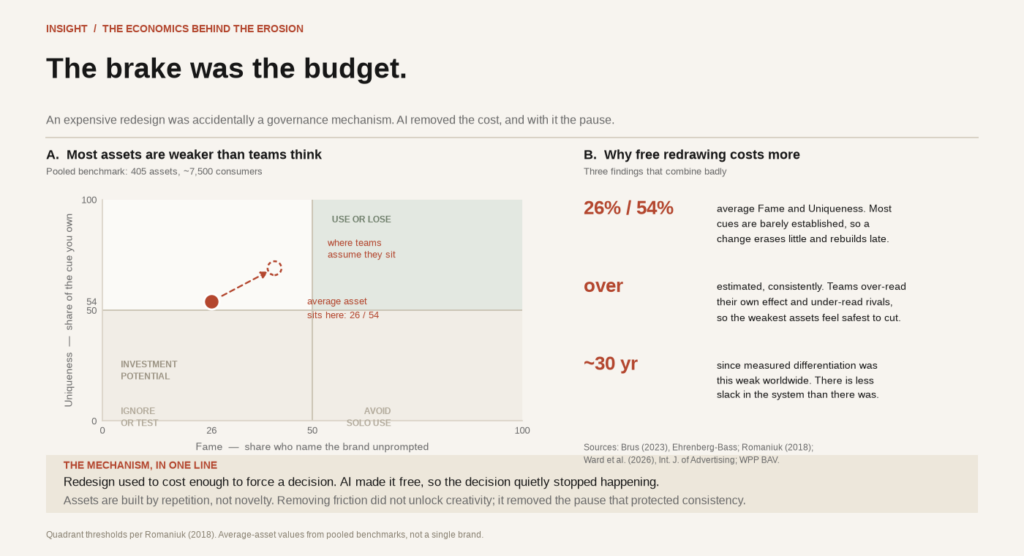
Put those together and the cheap-change problem stops being about quality and becomes about velocity applied to invisible equity. When a redesign cost real money, the budget bought you a review. When it costs nothing, the review evaporates, and the assets you are quietly overwriting are the ones you were least able to measure.
This is why the sameness arrives without anyone deciding to be generic. Nobody sets out to erase distinctiveness. They set out to refresh a logo they were tired of looking at, using a tool that made the refresh free, against an asset base whose strength nobody had actually measured.
The fix is not to make design expensive again. It is to rebuild the gate that the price used to provide — and to rebuild it out of measurement rather than money.