Who Was Actually Selling You the Metaverse: The Supply-Side Story of a 57% Collapse
There’s a version of this story that everyone already tells. Brands got burned, CFOs got strict, integrations were cheaper, so integrations won. That version is true and it explains almost nothing, because it treats the flip as a buyer’s decision.
It wasn’t only a buyer’s decision. It was also a supplier’s collapse. Once you look at who actually builds these things, the speed of the reset stops being mysterious.
The people selling you a world were not neutral
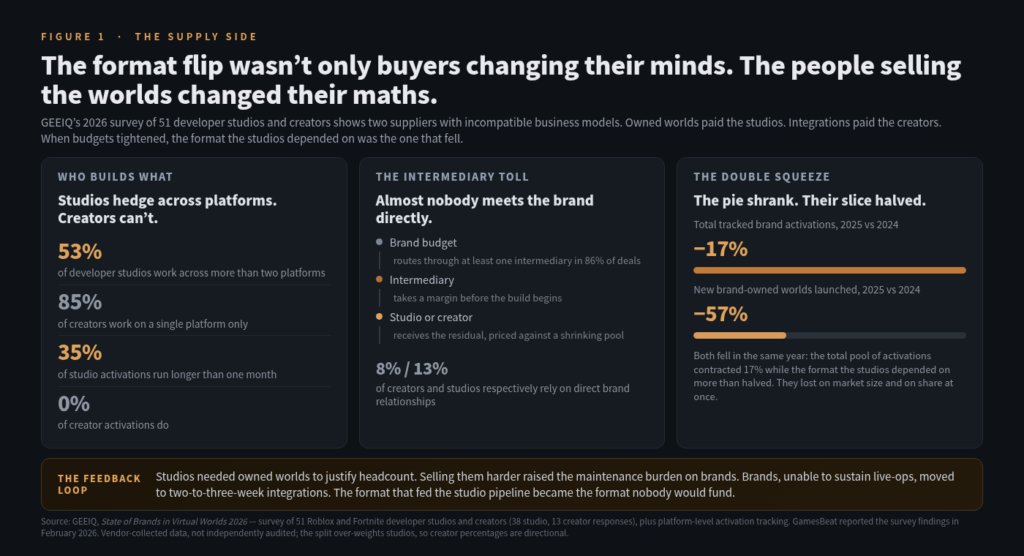
GEEIQ’s 2026 survey of 51 Roblox and Fortnite developer studios and creators is the most useful thing published on this subject, not because of its headline numbers but because of one split inside it. Fifty-three percent of developer studios work across more than two platforms. Eighty-five percent of creators work on exactly one.
That single difference determines what each side can afford to sell you.
A studio carries a payroll of 3D artists and producers. To keep them billable it needs projects with long tails, which is why 35% of studio activations run longer than a month, and why not one creator activation in the survey did. A creator owns a world with an audience already inside it. They cannot staff a nine-month build, and they don’t need to, because their inventory is a room that already has people in it.
So when brands went shopping, they weren’t choosing between two equally available formats. They were choosing between the format the studio needed to sell and the format the creator could actually deliver.
The margin that hides the real price
Here’s the part that should worry you. Eighty-six percent of developers and creators report working on brand activations through at least one intermediary. Only 13% of studios and 8% of creators rely on direct brand relationships.
Which means the price you see is a price after someone else has taken a cut, and the person doing the work priced their bid against what survived that cut. GEEIQ calls this the intermediary effect: margin capture without solving the market friction. You’re not paying for a world. You’re paying for a world plus a layer of people whose job is to sit in between.
The squeeze was simultaneous, not sequential
The mechanism gets obvious when you put two verified numbers side by side. In 2025, total tracked brand activations fell from 1,220 to 1,011, a 17% contraction. In the same year, new brand-owned worlds launched fell 57%.
The pool shrank by a sixth while the format the studios depended on lost more than half its volume. That is not a market rebalancing. That is a business model being pressed from both directions at once, and it explains why the flip happened faster than audience behaviour alone would predict. Studios couldn’t hold the line on market size or on share, so they stopped defending the format their own cost structure was built around.
And the loop closed: 31% of brands that ran an integration in 2025 had already built an owned world. They weren’t abandoning the channel. They had learned what ownership actually costs to keep alive, and there was a supplier waiting with a two-to-three-week alternative.
What this changes about your next brief
If you’re briefing an integration, you’re buying access to somebody’s inventory, and the intermediary in the middle has an interest in scope. If you’re briefing an owned world, ask who runs it in month eighteen, because the studio that builds it is optimised for the build, not the maintenance. The incentive to sell you the build is not the same incentive as keeping it interesting.
None of this makes the format decision for you. It just explains why the market tipped so hard, so fast: the supply side changed its maths before the demand side finished its argument.