Quantum Won’t Save Your CTR. Here’s What It Will Do.
Every few months, a deck lands in your inbox with a glowing qubit on the cover and one line underneath: quantum will rewrite marketing. The deck is usually nonsense, and it is expensive nonsense, because it asks for budget before it asks for a problem.
Then the backlash arrives, and it is just as lazy. Quantum is a 2040 thing. Ignore it. Except the backlash has a deadline attached, and if your company holds customer data with a ten-year shelf life, you may already be late. Not because a machine cracked anything. Because the migration takes longer than the warning does.
So here is the version I would defend in front of a CFO. Quantum computing is a specialised crane. It lifts loads a forklift cannot budge. It does not make your forklift faster. For marketing, the crane is mostly a post-2030 piece of equipment. And the two things worth doing about it are boring, cheap and overdue: migrate your encryption, and start writing down the problems classical machines cannot solve.
Two clocks, and only one of them is yours to wind
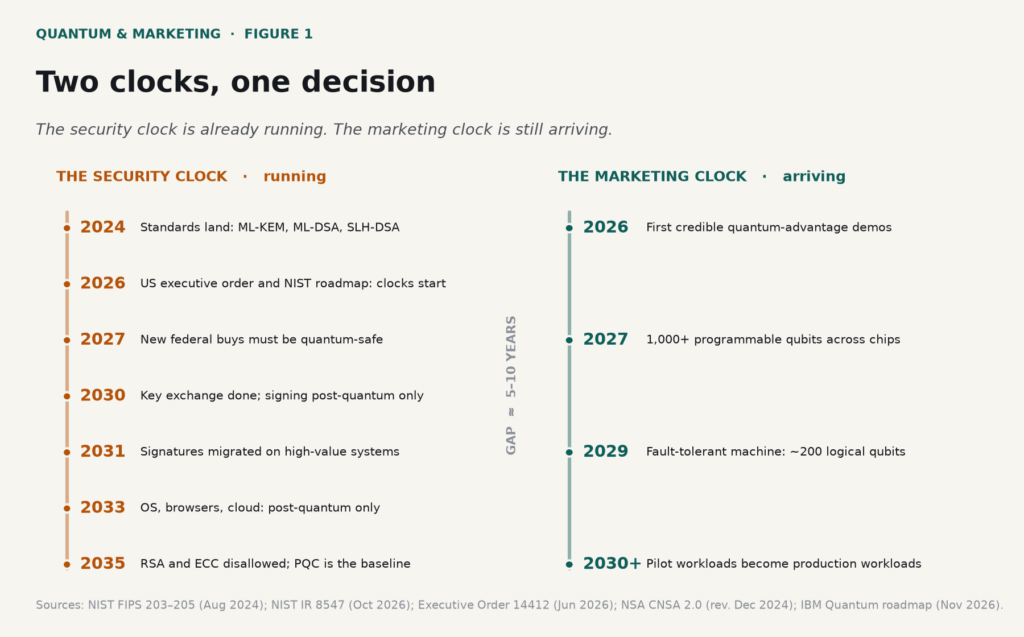
Look at that figure for a second. There are two vertical strips, and they are not the same clock.
The left strip is a compliance clock, and every date on it is already fixed. NIST published its first post-quantum standards in August 2024. In June 2026, Executive Order 14412 set hard federal deadlines: key establishment migrated by 31 December 2030, digital signatures by 31 December 2031, for high-value assets and high-impact systems. NIST’s final transition roadmap, published in late October 2026, keeps those dates and adds the phase-out schedule: today’s RSA, ECC and Diffie-Hellman are deprecated after 2030 and disallowed after 2035. The NSA’s CNSA 2.0 suite puts a procurement gate at 1 January 2027, code signing and network gear post-quantum-only by 2030, operating systems and browsers and cloud by 2033. The EU asks member states to begin deploying post-quantum encryption before the end of 2026. Google, Cloudflare and Microsoft have all pointed at 2029 for their own infrastructure.
The right strip is a capability clock, and none of it is a promise. IBM’s published roadmap says 2026 for the first credible demonstrations of quantum advantage, 2027 for a thousand-plus programmable qubits linked across chips, 2029 for Starling — a fault-tolerant machine of roughly 200 logical qubits running 100 million gates — and something past 2033 for a 2,000-qubit, billion-gate system. Every item on that strip is engineering, and engineering slips.
Here is the part that should make you sit up. The left strip is shorter than the right one, and the left one is the one your auditor will ask about. Most marketing teams have spent three years arguing about the right strip, where nothing is settled, and have not opened the left one, where everything is.
What a quantum computer actually is (a crane, not a forklift)
It is not faster. It is different.
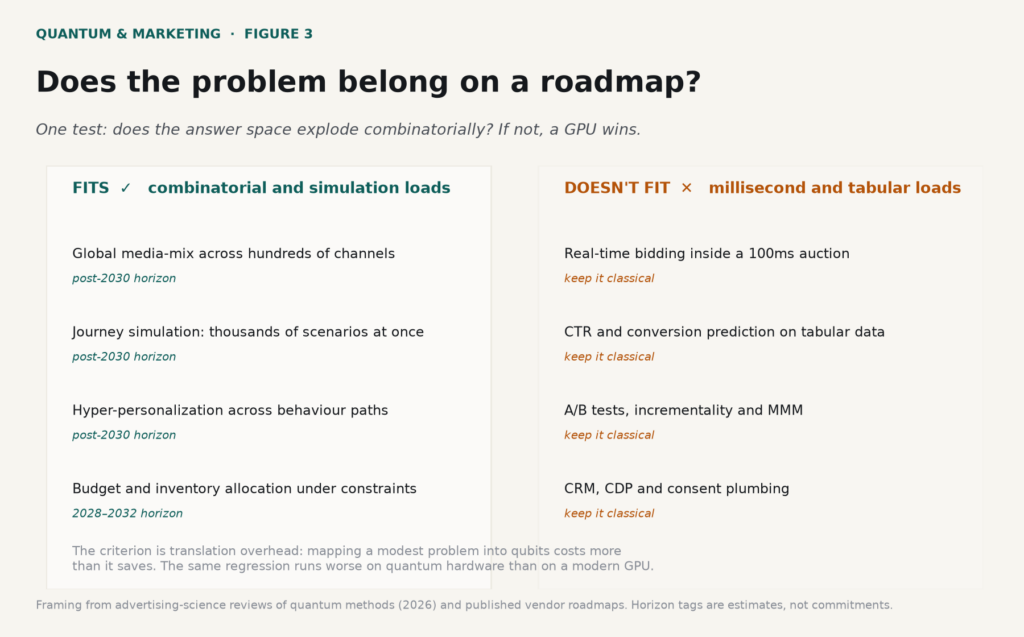
A quantum computer does not run your code at a higher clock speed. It exploits superposition and entanglement to explore certain state spaces in ways a classical machine cannot, and for most of the work marketing does, that advantage evaporates. A logistic regression predicting click-through rate has a modest parameter space and a smooth loss surface. Mapping it onto qubits requires encoding, transpilation, error mitigation and a readout — and the overhead is larger than the problem. You will get a worse answer, slower, on hardware that costs more.
The problems that fit share one shape: the number of plausible answers explodes so fast that classical machines resort to heuristics and hope. That is the crane’s job. Lifting what a forklift cannot budge.
NISQ: the hardware you can rent this afternoon
Today’s machines are what the field calls noisy intermediate-scale quantum, or NISQ. A few hundred physical qubits, error rates that make long circuits a gamble, and cloud access from IBM, D-Wave, Amazon and Azure that costs less than a seat of your martech stack. You do not need to own a quantum computer to learn what one is bad at. That is the entire point of the next two years, and almost nobody does it.
Three myths worth killing now
Myth one: quantum replaces your ad tech stack
No. Programmatic bidding resolves in under 100 milliseconds, and quantum hardware cannot yet prepare a state, run a circuit and read out a result inside that window. What quantum can eventually do is lift the combinatorial monsters: a global media-mix across hundreds of channels, markets, creative variants and contractual constraints; a supply allocation with a thousand interdependencies. Those jobs take supercomputers hours and get solved today by approximation. They are the first realistic advertising use case, and they arrive after the machine does.
Myth two: quantum solves privacy
This one is backwards, which is why it is dangerous. Quantum computing, specifically Shor’s algorithm, is the single biggest threat to the public-key cryptography protecting your customer data, payments and session traffic. The fix is not quantum hardware. The fix is post-quantum cryptography: new classical algorithms, standardised by NIST, adopted by your vendors, and mandated by governments on a fixed schedule. Quantum key distribution exists, is theoretically elegant, and remains too costly and too fiddly for the average advertising data pipeline. Do not let a vendor sell you a physics experiment when the job is a software migration.
Myth three: it is decades away, ignore it
Partly true for compute, false for consequence. Volkswagen ran a live quantum-annealing pilot in 2019, routing buses around Web Summit traffic in Lisbon against live data on a D-Wave processor — described by its authors as the first commercial application depending on live access to a quantum processor. It worked, it was narrow, and it proved the pattern: the machine is useful at the edges long before it is useful in the middle.
And the timeline is moving. Twenty-six quantum experts, surveyed annually by the Global Risk Institute and evolutionQ for their seventh report, now put the odds of a cryptographically relevant machine at 28–49% within ten years and 51–70% within fifteen. That is the highest ten-year estimate in the series’ history. Meanwhile, the resource estimates for the attack itself keep shrinking: from roughly 20 million noisy qubits for RSA-2048 in the late 2010s to under a million by 2025. Different papers, different assumptions, one direction.
The applications that survive contact with reality
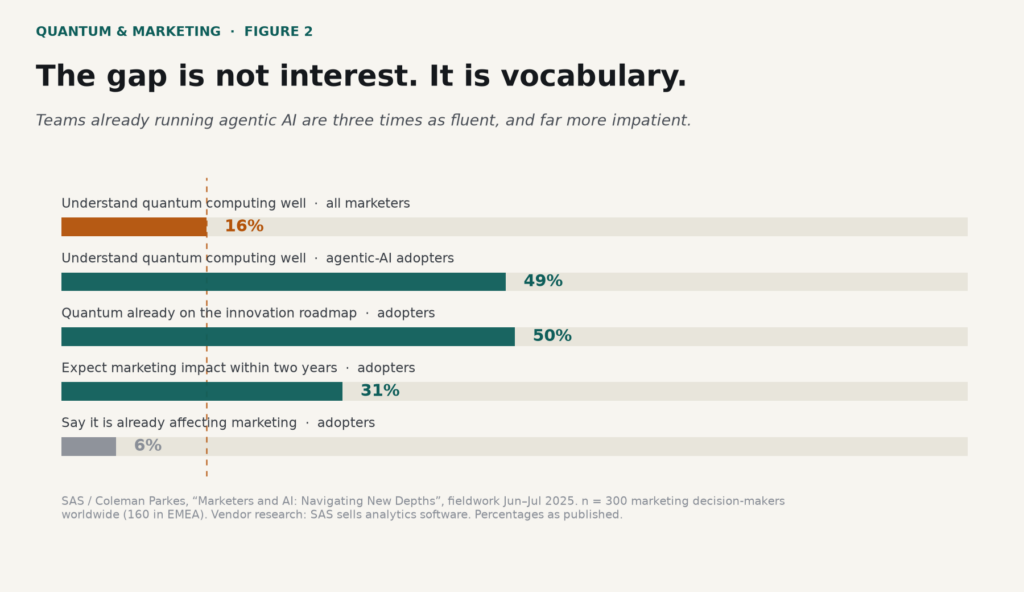
Look at the gap in that second figure. In a 300-organisation survey run by SAS and Coleman Parkes in mid-2025, 16% of marketers said they understood quantum computing well. Among teams already running agentic AI, it was 49%. Half of those adopters had already put quantum on their innovation roadmap. Thirty-one percent expected marketing impact within two years. Six percent said it was already happening.
That six percent are either early or optimistic, and I would like to see their demo. But the pattern is real: fluency with one wave predicts fluency with the next. Readiness compounds. Here is what that readiness is for.
Media-mix optimisation: the first honest use case
If you have ever watched a marketing-mix model flatten a hundred candidate channels into eight coefficients and a confidence interval, you already understand the problem. The true search space is combinatorial, the constraints are ugly, and the classical answer is a polite approximation. This is the application with the least romance and the most plausible commercial logic.
Journey simulation and digital twins
Insurers are the ones pushing hardest here: in the same survey, 69% of insurance marketers named real-time customer-journey simulation as their top quantum opportunity. The idea is to run thousands of path permutations simultaneously rather than sequentially, so a decision-maker sees the distribution of outcomes instead of a point forecast. Nielsen-style panel modelling, next-best-action trees and synthetic control groups all rhyme with this.
Hyper-personalisation at planetary scale
Sixty-seven percent of life-sciences marketers pointed here. The honest framing: it is not that personalisation needs a quantum brain. It is that the number of combinations — customer, context, creative, moment, constraint — grows faster than classical infrastructure can enumerate. True scale is post-2030. The behaviour you can start now is reducing the problem to something les mathematically absurd: fewer variables, cleaner labels, tighter measurement.
What your industry already says it wants
Banking went for advanced predictive analytics, 80%. Public sector leaned toward synthetic data generation at 29% and dynamic pricing at 27%. Small businesses expect more benefit from synthetic data than enterprises do, 20% against 11%, which is a lovely inversion: the constraint for them is not compute, it is having enough data to train anything at all.
Notice what nobody named: better ad targeting in the next auction. The market’s own wish list is about simulation and allocation, not speed.
Where this goes wrong, and where it has already gone wrong
The copy-paste failure. Early adopters took classical models, poured them into quantum simulators, and expected magic. What they got was a translation bill. Quantum algorithms need to be designed quantum-native, from the problem outward. If your plan is “port the Python script”, your plan is a case study in wasted budget.
The hardware rabbit hole. Some teams bought the physics: qubit coherence, cryogenics, custom calibration. None of it produced a marketing insight. The value sits in access and problem fit, not in owning a dilution refrigerator.
Dirty data, amplified. If your identities are fragmented, your consent states are messy and your decisioning is siloed, a faster optimiser optimises the mess. More compute on bad inputs produces confident nonsense at higher resolution. Fix the data before you borrow the crane.
The vendor selling a prefix. Anything sold to you today as a “quantum marketing platform” is almost certainly repackaging something classical. Ask for the specific combinatorial problem, the benchmark against a strong classical baseline, and the measured advantage in solution quality per unit of time. If the answer is a slide about the future, the answer is no.
The job with a real deadline: post-quantum cryptography
Why your data is the target
The harvest-now-decrypt-later strategy is not hypothetical. Encrypted traffic captured today can be stored and decrypted once a capable machine exists. Any data whose confidentiality must outlive that arrival date is exposed now, whether or not the machine ever gets built. For marketers, that list is longer than it looks: hashed identity graphs with re-identification risk, behavioural histories, health-adjacent purchase data, loyalty records, and every contract, creative asset and audience file sitting in a vendor’s bucket with a decade-long retention policy.
The dates that are already fixed
Three layers, all real. NIST’s technical schedule: FIPS 203, 204 and 205 define the algorithms; the transition roadmap deprecates legacy public-key algorithms after 2030 and disallows them after 2035. US federal policy: Executive Order 14412 gives high-value systems 2030 for key establishment and 2031 for signatures, with the broader 2035 target inherited from National Security Memorandum 10. Procurement reality: the NSA’s CNSA 2.0 makes quantum-safe the default for new national-security purchases from January 2027, and the same expectations flow into commercial contracts, security questionnaires and RFP language long before any statute names your company.
Private deadlines arrive through procurement, not legislation. That is the mechanism most marketing organisations miss, because they think compliance is legal’s problem until a vendor’s security addendum lands on their desk with an algorithm list attached.
The Mosca inequality, in plain language
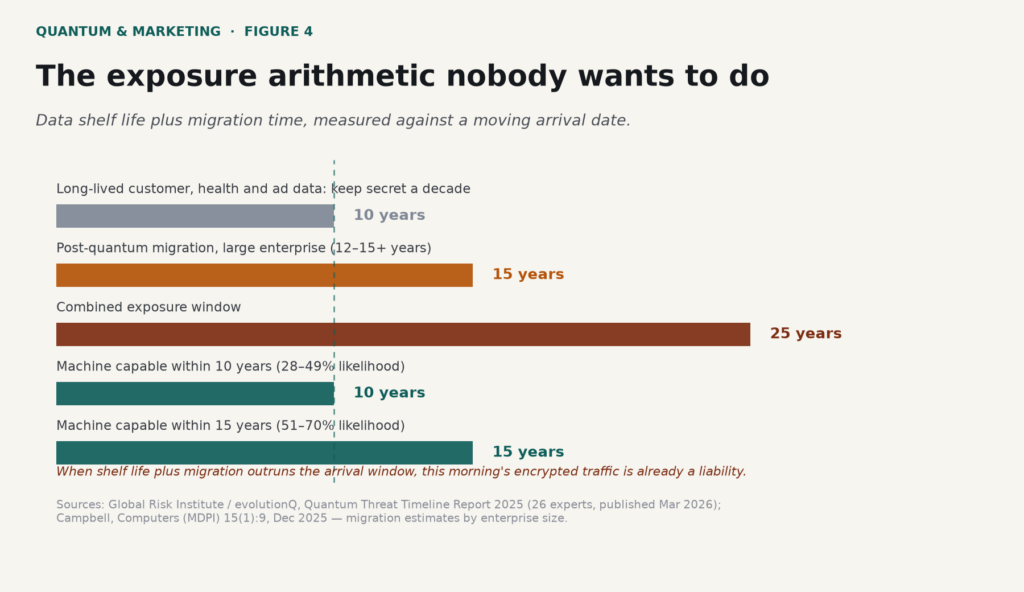
Michele Mosca’s framing is the only piece of quantum maths a marketer needs. If the number of years your data must stay secret, plus the number of years your migration will take, is greater than the number of years until a relevant machine exists, you are already exposed.
Peer-reviewed estimates for migration are brutal: five to seven years for a small enterprise, eight to twelve for a medium one, twelve to fifteen or more for a large one with global operations and operational technology in the estate. Add ten years of data sensitivity and you are at twenty-two years of exposure, against expert odds that give a meaningful probability to a machine inside ten.
What to do in the next four quarters
Inventory first: find every place RSA, ECC and Diffie-Hellman protect something, starting with long-lived sensitive data and third-party flows. Then crypto-agility: make sure your stack can swap algorithms without swapping vendors. Then hybrid deployment: classical plus post-quantum in parallel, so interoperability survives while resistance arrives. Then contracts: put the algorithm question into every renewal, because you inherit your vendors’ timelines whether you negotiate them or not. Skip quantum key distribution for advertising data. It is the wrong tool at the wrong price.
A ten-year plan that survives a budget review
2026–2027: inventory and literacy. Two deliverables, both cheap. A cryptographic map of your data flows, including the ones you do not own. And a literacy baseline: which of your analysts can explain why a combinatorial problem differs from a statistical one. You will discover that the second is rarer than the first.
2028–2030: the problem list and the first pilots. Write down five problems that classical machines handle badly: allocation under constraints, multi-touch attribution across walled gardens, journey simulation, creative sequencing at scale, price and promotion optimisation with cannibalisation effects. Rank them by value, not novelty. Pilot on rented hardware, benchmark against a strong classical solver, and publish the negative results internally, because a documented failure is worth more than an undocumented success.
2030+: production, if the crane arrives. By then the cryptography question is settled by regulation and your interest is in whether the optimisation problems you listed have become tractable. If they have, you will already have the problem definitions, the data hygiene and the talent to move. If they have not, you will have spent almost nothing and learned something real.
Five questions that separate a roadmap from a brochure
Ask any internal sponsor or external vendor: What is the specific combinatorial problem, expressed formally? What is the classical baseline, and what does it score? What is the measured advantage, in solution quality per unit of time, on hardware that exists today? What happens to this plan if fault tolerance slips five years? And who owns the cryptographic inventory while we wait?
Five answers, in writing. Most decks will not survive the third question.
The honest summary
Quantum computing will not save your click-through rate, and it will not replace the stack you already hate. It is a specialised instrument for combinatorial and simulation loads, and its marketing applications are mostly post-2030, arriving on a roadmap that has slipped before and will slip again.
But one quantum-adjacent task has a deadline you can already read on a government website, and it concerns the encryption around your customer data, not your media plan. Migrate that now. Write down the five problems classical machines cannot solve. Then wait, with a plan, for a crane you may never need to buy.