Your Customer Has a Digital Twin. The Segment Split Is Where It Lies
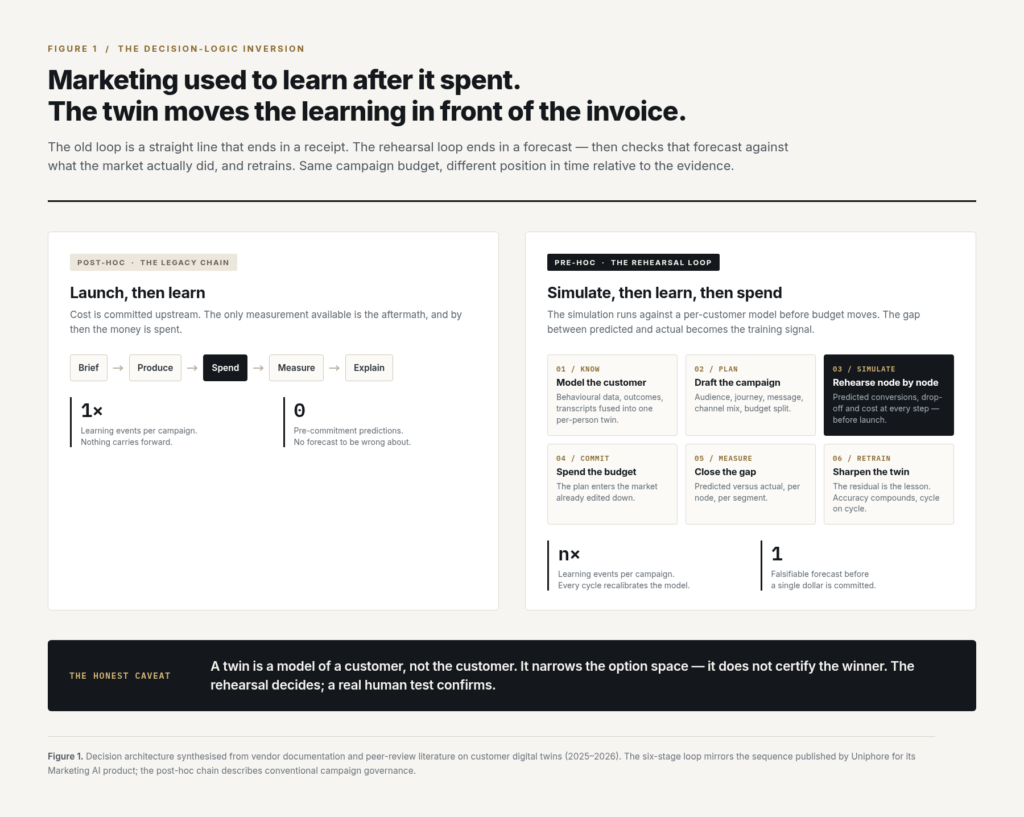
Marketing spent a century learning the same way: spend the money, watch what happens, explain it afterwards. The invoice always arrived before the lesson. That sequence was never a choice — it was a constraint of measurement. You could not know how a campaign would land until it landed.
Digital twins of customers break that constraint, and that is the whole story. Not personalisation. Not another dashboard. The change is that the learning event moves upstream of the spend.
Here is the part worth slowing down for. A twin is a model, not a person. It is very good at telling you what a plausible customer would say, and that is not the same as telling you what a customer will do. Everything interesting about this technology lives in that gap.
The Invoice Arrives Before the Learning Does
Think about how a campaign actually dies. Three concepts go into a room. Someone senior prefers the one with the cleaner line. It ships. Six weeks later the data comes back and the concept nobody loved outperformed the one everybody defended.
Nobody was lying. Nobody skipped the research. The research just happened too late to be useful, and the meeting where it could have mattered had already ended.
This is what the simulation layer attacks. Uniphore’s Marketing AI, launched in 2026, builds what it calls a living digital twin of each customer — a small language model fine-tuned on that individual’s behaviour — and runs campaign hypotheses against those models before budget moves. The output is predicted revenue, conversions and drop-off at every node of the journey. You walk into the budget review carrying a forecast instead of a hope.
Now, a forecast is only worth what its error rate says it is worth. Hold that thought. We will come back to it, and it is where most of this category quietly fails.
What a Customer Twin Actually Is (and Is Not)
A behavioural model, not a bigger persona
A persona is a description. A twin is a mechanism. The difference matters more than the vocabulary suggests.
A persona tells you who the customer is: thirty-four, urban, two children, mid-band income. Ask a language model to answer a survey as that person and you get something fluent and almost empty of signal, because demographics describe and twins simulate. The twin is built to reproduce how a segment evaluates alternatives — what they notice, what makes them hesitate, what they compare against, what finally moves them.
The research group at La Salle – Universitat Ramon Llull, led by Montserrat Peñarroya, put it cleanly: the point is not to foretell one individual’s behaviour, it is to let an organisation compare plausible scenarios before it commits resources.
Why small language models made this economically possible
For years, per-customer modelling was a nice idea with an impossible invoice attached. Running a frontier model per person per scenario costs more than the campaign it is meant to de-risk.
The workaround is architectural. A fine-tuned small model stores what it has learned as compact weights rather than reloading context into every query. Uniphore’s version runs at a fraction of frontier-LLM cost at enterprise scale, and the models are open-weight, deployable in cloud, on-premises or hybrid environments, so customer data never leaves the perimeter it is governed in.
That is the unglamorous reason this category exists now and did not exist four years ago. The economics changed. The idea did not.
The One Experiment That Actually Validated Something
Most of what you will read about twins is vendor material. One piece of evidence is not.
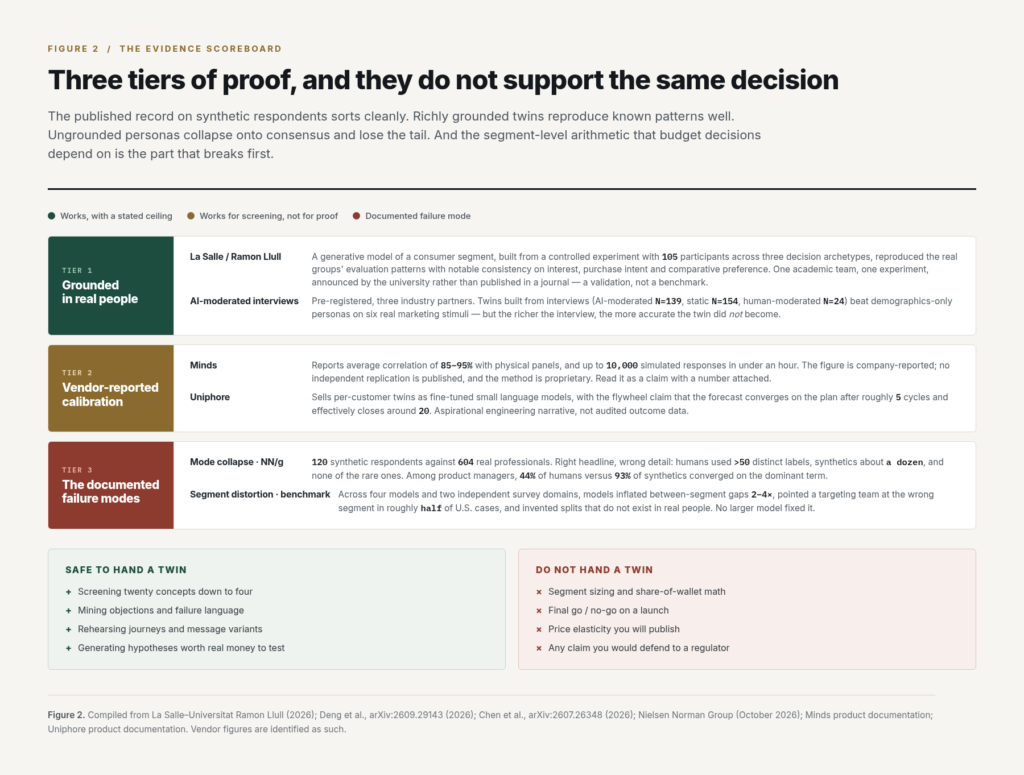
La Salle’s team ran a controlled experiment with 105 participants. They exposed real people to several versions of the same commercial proposition, varying persuasion and ease of use, then sorted the responses into three recurring decision archetypes: the Convinced, the Rational Observers, and the Disconnected Non-buyers. They built generative twins of those archetypes and put the twins in front of the same stimuli.
The twins reproduced the real groups’ evaluation patterns with notable consistency — strongest on interest, purchase intent and comparative preference.
Read that result for what it is. It is an institutional validation of a modelling approach: one academic team, one experiment, announced by the university rather than published in a journal. As of this writing no peer-reviewed article has surfaced. That makes it the best evidence available and still a single data point.
The same announcement mentions work in which teams using simulation methods cut customer-acquisition cost by up to half, by discarding weak strategies before they were funded. Treat that as a project report rather than a measurement. It indicates a direction. It does not establish a magnitude.
The Flywheel: Why the Second Forecast Beats the First
Simulation is not a one-shot transaction. It is a loop, and the loop is the actual product.
The sequence runs: model the customer, plan the campaign, rehearse it node by node, commit the budget, measure predicted against actual, retrain. The residual — the gap between what the twin said and what the market did — is the training signal.
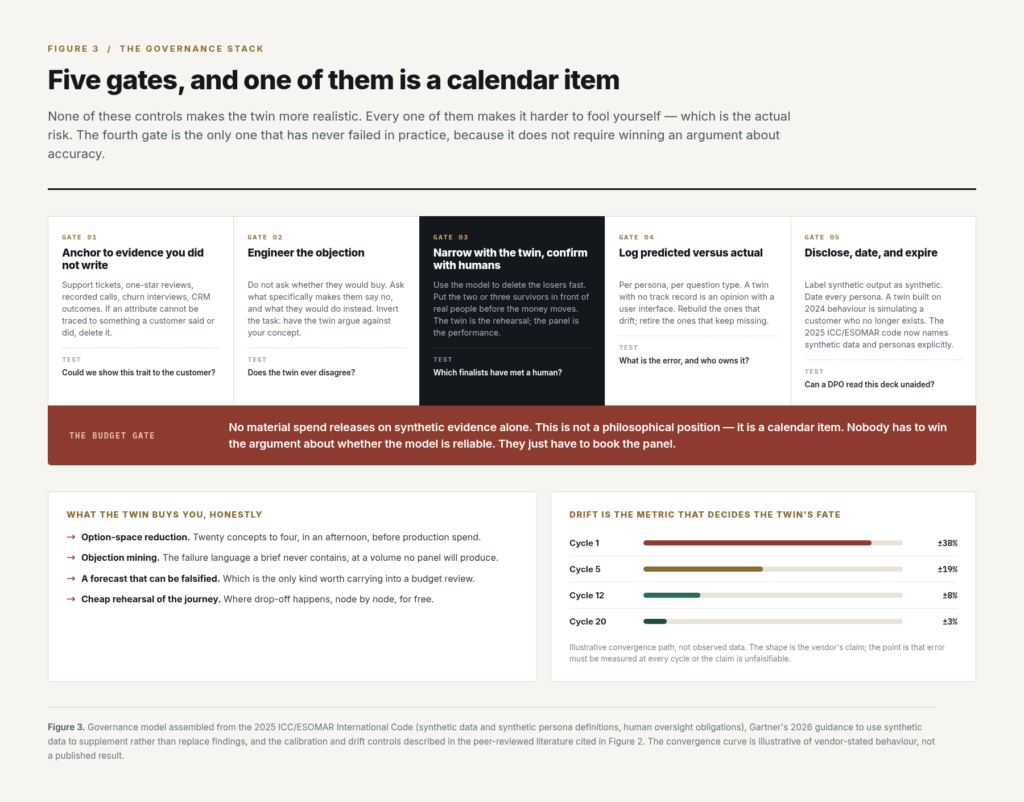
Uniphore describes convergence in plain terms. The first simulation is an informed prediction. After five cycles it is close to a reliable forecast. Around twenty, the gap has narrowed to where the forecast functions as the plan rather than an estimate clipped to it.
Whether twenty is the real number is unknowable from outside. What is knowable is the logic: a twin with no prediction log is an opinion with a user interface. The loop is what turns a simulation into an instrument, and skipping the measurement step is how teams end up trusting a model that has never been wrong because it has never been checked.
Four Places Twins Earn Their Keep
Pre-launch campaign rehearsal
Predict revenue, conversion and drop-off across the journey before committing budget. The real benefit is not the number. It is that the number can be wrong in a way you can detect, which is more than most media plans offer.
Concept and claim screening at machine speed
Minds, a synthetic research platform, runs calibrated persona panels and returns results in under an hour, scaling simulations to as many as ten thousand responses. Screening twenty concepts down to four in an afternoon is a genuine capability, and most of the practical value in this category sits right here.
Pricing and value-proposition exploration
Explore positioning and price reactions in simulation, then narrow the field before you run a real price test. Nobody enjoys discovering elasticity by watching a launch fail.
Risk discovery
The most underrated use. A twin surfaces the failure mode nobody thought to put in the plan — the objection that never appears in a brief, because the brief was written by people who already believe.
Where the Evidence Turns Against the Vendor Deck
Mode collapse: the tail is the finding
In October 2026, Nielsen Norman Group took one open-ended question from an earlier survey of 604 technology and design professionals and posed it to 120 synthetic respondents.
Both datasets reached the same headline conclusion, which is the part vendors quote. Then the detail: humans used more than fifty distinct labels. The synthetic panel collapsed onto roughly a dozen, and produced none of the rare ones. Among product managers, 44% of the real humans converged on the dominant term. Among synthetic product managers, 93% did.
The researchers call it mode collapse. The model reproduces the most common answer and deletes the long tail — and in marketing the long tail is frequently the finding. Campaigns do not fail because the average customer is lukewarm. They fail because a vocal fifteen percent hates something the average tolerates. That fifteen percent is exactly what gets smoothed away.
The segment arithmetic breaks first
This is the finding that should worry anyone who signs off on targeting.
A cross-domain benchmark published in 2026 tested four models from two families, spanning 8B parameters to frontier capability, against real human response data from the General Social Survey and the World Values Survey. Two failures replicated across every model and both domains. At the individual level, no model beat the strongest non-LLM baseline. And the models systematically over-determined demographics — treating identity as far more predictive of attitudes than it actually is among real people.
Then the decision-impact test: on a segment-targeting task, the models inflated between-segment gaps two to four times over, pointed a team at the wrong segment in roughly half of U.S. cases and most cross-cultural ones, and manufactured splits that do not exist. A larger model did not fix it. More capability made the confidence grow, not the calibration.
Novelty is the boundary condition
Twins interpolate. They do not extrapolate. Trained on what your customers have already done, a twin can model the next version of a familiar choice with real skill. It cannot model a category that does not exist yet, a proposition nobody has evaluated, or a price architecture the market has never seen.
The breakthrough idea is, by definition, the one the twin cannot predict. That is not a flaw to be engineered out. It is the boundary of the instrument.
The Governance Stack
Five controls. None of them makes the twin more realistic. All of them make it harder to fool yourself, which is the actual risk.
Anchor to evidence you did not write. Build from support tickets, one-star reviews, recorded sales calls, churn interviews, CRM outcomes. Never from a positioning document. If an attribute cannot be traced to something a customer actually said or did, delete it. Invented detail makes a twin more vivid and less true, and vividness is the vector.
Engineer the objection. Stop asking whether they would buy. Ask what specifically makes them say no, and what they would do instead. Better still, invert the task: have the twin argue against your concept. A twin asked for feedback produces a compliment. A twin instructed to find the fatal flaw produces a flaw.
Narrow with the twin, confirm with humans. Use the model to kill the losers cheaply and fast. Put the survivors in front of real people before the money moves. Gartner’s 2026 guidance points the same way: use synthetic data and digital twins to supplement findings, under strict privacy controls — not to replace them.
Log predicted versus actual, per persona, per question type. Twins that drift get rebuilt. Twins that keep missing get retired. Name the person who owns the error rate, because an unowned metric is decoration.
Disclose, date, and expire. Label synthetic output as synthetic. Date every persona, because one built on 2024 behaviour is simulating a customer who no longer exists in a category that has moved. This is no longer optional: the 2025 ICC/ESOMAR International Code introduced formal definitions of synthetic data and synthetic persona, requires human oversight, and places responsibility on the commissioning client for vendor compliance.
And the control that has never failed, because it requires nobody to win an argument: no material spend releases on synthetic evidence alone. That is not a philosophical position. It is a calendar item. Someone books the panel.
What This Changes About the Marketing Job
Two shifts, both already visible.
The first is that judgment moves earlier. If the option space collapses from twenty concepts to four before production, the expensive human skill is no longer producing volume. It is choosing well at the top of the funnel and reading a model’s uncertainty honestly.
The second is that measurement becomes a permanent function rather than a post-mortem. The team that tracks drift cycle after cycle builds something a competitor cannot copy quickly: a calibrated instrument with a track record. The team that buys the tool and never checks the error rate has purchased a faster way to be confidently wrong.
Gartner’s forecast puts a number on the adoption curve — by 2028, 60% of product marketing teams testing messages with synthetic customer personas, up from 5% in 2025. If that lands, the differentiator will not be access to the technology. It will be whether your version of it has been audited.
The Uncomfortable Question: Who Owns the Forecast?
Here is where I think most organisations will stumble, and it is not a technology problem.
Once a simulation sits in front of a budget decision, someone owns that number. If the campaign underperforms, did the marketer choose badly, or did the twin mislead? The accountability structure of most marketing departments was built for a world where the forecast came from a media agency’s spreadsheet and everyone understood it was a guess.
A forecast that looks like evidence changes the politics of failure. The governance answer — a named challenger with the standing to send findings back, and a hard gate before spend — sounds bureaucratic because it is. Bureaucracy is what keeps a plausible number from becoming an uncontested one.
Conclusion
Digital twins of customers are marketing’s simulation layer, and the shift they represent is real: rehearse the decision before you pay for it.
The science exists, thin but genuine. The products ship. The economics work, because per-customer small models finally cost less than the campaigns they inform. What does not exist yet is the discipline — and discipline is the whole game, because a twin is agreeable, articulate and cheap, and agreement from something that sounds like a customer is very hard to distinguish from a customer agreeing.
So use the twin to narrow, to mine objections, to rehearse the journey, to build a forecast you are willing to be wrong about in public. Then put the finalists in front of humans, log the gap, and do it again.
Simulate to decide. Test to confirm. The rehearsal saves the budget; the performance is the proof.