Marketing Pays for the Whole Stack and Uses Half of It — That’s the Consolidation Story
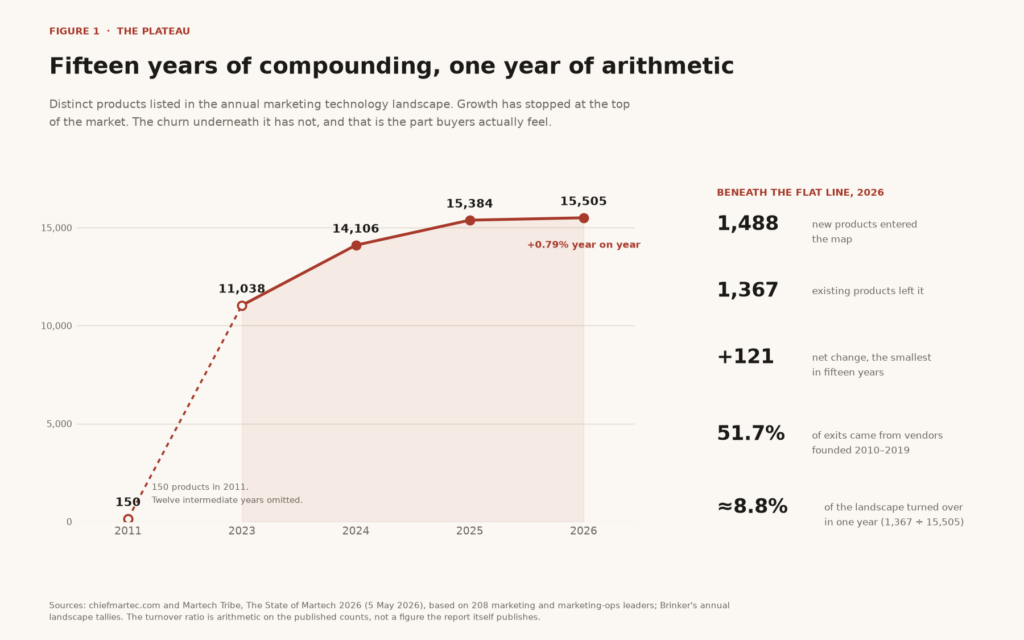
Something strange happened to marketing technology in 2026. For fifteen years, the industry’s annual census grew like a weed. This year it grew by 0.79%. One hundred and twenty-one products, added to a pile of fifteen thousand. That is not growth. That is a rounding error with a press release attached.
But here’s the thing — and this is where most of the commentary gets it wrong. Flat is not the story. Flat is the sound of a market reorganising itself while pretending nothing happened.
Underneath that placid headline, 1,488 products arrived and 1,367 left. Roughly one in eleven tools in your stack, statistically speaking, will not exist in the form you bought it by this time next year. You are not watching a market shrink. You are watching it churn, and churn is the mechanism by which consolidation actually arrives. Nobody sends you a memo. Your renewal just quietly isn’t there anymore.
So let’s talk about what’s really going on, why the tool-obsessed era is ending, and what you should do before the market makes the decision for you.
How We Talked Ourselves Into Fifteen Thousand Tools
Let me be fair to the people who built this mess. They weren’t stupid. They were responding to incentives.
The gold rush had a business model
Between roughly 2011 and 2022, capital was cheap and software margins were beautiful. Every narrow workflow that could be sliced off a marketing department became a company. A tool for subject lines. A tool for alt text. A tool for the pop-up on your checkout page. A tool for the tool that manages the other tools.
Each one was defensible in a pitch deck, because each one had a wedge. And each one got funded, because the wedge was real and the total addressable market looked enormous when you drew the circle generously enough.
Fifteen years later, the census — compiled annually by Scott Brinker with Frans Riemersma and published on 5 May 2026 — counts 15,505 distinct products. It started at 150. That is a hundredfold increase, and it happened faster than any marketing department’s ability to integrate it.
The buyer’s illusion
Here’s the trap. We mistook more tools for more capability.
It’s an easy mistake to make, because the purchase feels like progress. A new tool arrives with a demo that solves the exact problem you had on Tuesday. What the demo doesn’t show you is the eleventh integration you’ll now maintain, the fourth definition of “qualified lead” now circulating inside your company, or the analyst who will spend her Fridays reconciling two dashboards that disagree.
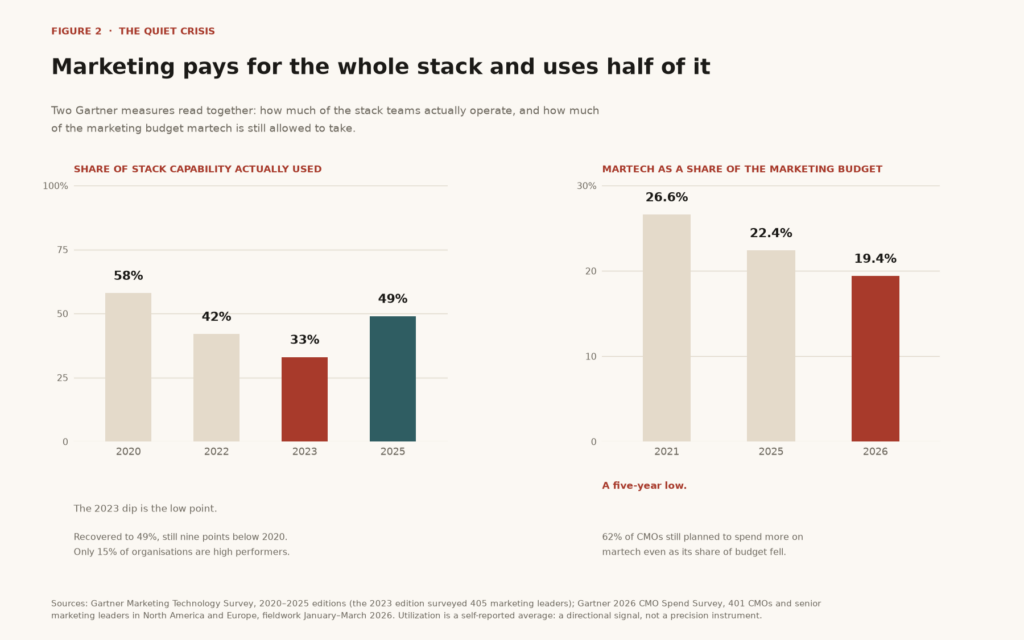
Gartner has been measuring the hangover for years. In 2020, marketing teams reported using 58% of their stack’s capability. By 2022 that was 42%. In 2023, surveying 405 marketing leaders, Gartner put it at 33% — and named the leading obstacle plainly: the complexity and sprawl of the ecosystem itself.
The number has since recovered to 49%, which everyone reported as good news. Read it again, though. Half of what you pay for does nothing. And only 15% of organisations qualify as high performers on getting value out of what they own.
What Actually Broke in 2026
Three forces converged. Any one of them alone would have been manageable. Together, they changed the arithmetic of buying software.
Budget: the pie didn’t grow, the slice shrank
Gartner’s 2026 CMO Spend Survey — 401 marketing leaders across North America and Europe, mostly at companies above a billion dollars in revenue, fieldwork between January and March — found marketing budgets flat at 7.8% of company revenue. That is 18% below where they sat four years earlier.
Inside that flat number, the martech slice fell to 19.4%. A five-year low. Down from 26.6% in 2021.
Now here’s the delicious contradiction: 62% of those same CMOs said they planned to spend more on marketing technology. Both things are true at once, and the resolution is uncomfortable. They intend to spend more, and they are being given less room to do it. Which means every renewal becomes a contest, and the tool that cannot defend its line item in a sentence loses.
Fifty-six percent said they lack the budget to deliver their 2026 strategy. Fifty-four percent lack the people. You cannot run a one-hundred-tool stack with a team that is short on headcount and short on patience.
The churn nobody priced in
The State of Martech 2026 report, drawing on 208 marketing and marketing-ops leaders, found that 51.7% of last year’s exits came from vendors founded between 2010 and 2019. That is not a bonfire of 2023-vintage AI wrappers. That is the first great SaaS generation being cycled out.
McKinsey’s 2025 martech research adds the operational half of the picture: 47% of decision-makers cite stack complexity and integration as their chief barrier, and 34% blame under-skilled teams. McKinsey interviewed roughly fifty senior marketing leaders at Fortune 500 companies. Not one of them could clearly articulate the ROI on their martech investment.
Sit with that for a second. Fifty senior leaders. Zero clean answers. If you can’t explain the return, you can’t defend the budget — and if you can’t defend the budget, you don’t get to keep the tool.
The AI-Native Platform Does the Work of Ten Tools
The supply side moved at the same time, and this is the part that genuinely changes the math.
For twenty years, the value of a martech product lived in its interface. You logged in, you clicked, you configured, you launched. The UI was the product. A point tool earned its keep by being slightly better at one screen than the suite was.
That logic collapses when the buyer is an agent.
Gartner’s July 2026 forecast puts up to $234 billion of enterprise application spending at risk from what it calls agentic arbitrage — agents completing tasks directly across systems, bypassing the interface entirely. That’s roughly 20% of enterprise SaaS spending by 2030. In the same body of research, Gartner expects 40% of enterprise applications to ship task-specific AI agents by the end of 2026, up from under 5% in 2025.
And the specific prediction that should keep point-tool founders awake: 35% of point-product SaaS will be replaced or absorbed into larger agent ecosystems by 2030.
Why the thin wrapper died first
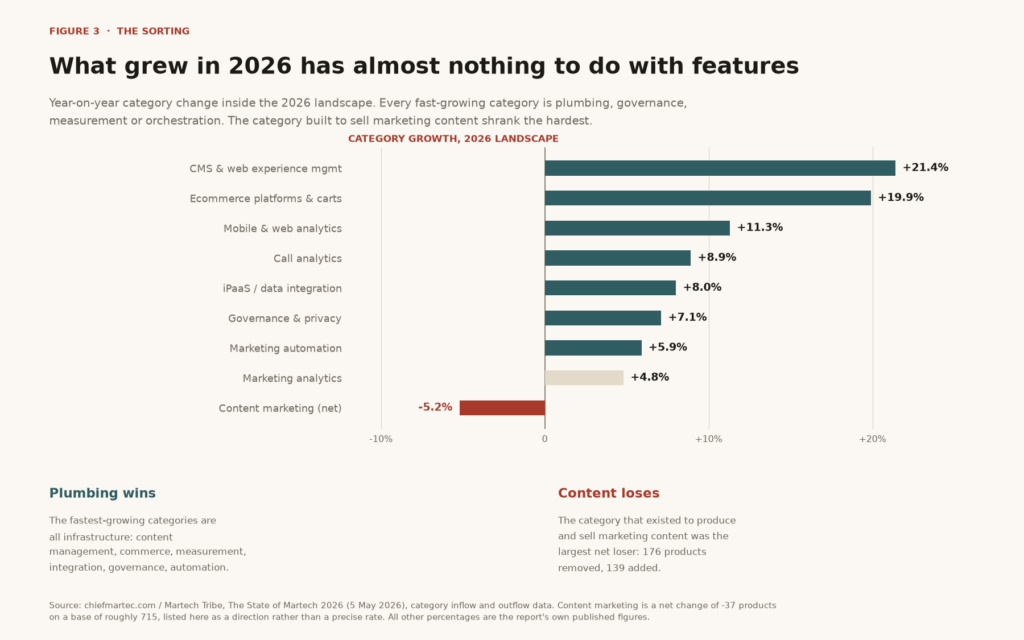
Look at which category bled hardest in 2026. Content marketing: 176 products removed against 139 added, the largest net contraction in the landscape. Brinker’s own explanation is refreshingly blunt. The major AI labs absorbed the function — “write me a blog post” is now table stakes in ChatGPT, Claude and Gemini. The suites embedded it into workflows people already lived in. And product-market fit turned out to be harder than anyone assumed, because generating content quickly and generating content that works are entirely different problems.
If your product was a prompt with a subscription attached, 2026 was a bad year for you.
The agent-readiness test nobody expected
Here’s a detail I find genuinely underrated. In May 2026, SaaStr published an API report card grading more than 140 B2B APIs on a single question: how safely can an autonomous agent authenticate, call, retry and stream against you without a human babysitting it?
The overall average landed around 71 out of 100. AI and LLM platforms scored 80.8. Marketing platforms averaged 63.6 — the widest gap between any two categories in the report. Of 57 marketing-relevant APIs, only five reached 80 or better. Marketo scored 50.
Marketing platforms scored worst on the dimension the report calls agent readiness: 6.1 out of 10. Sandbox environments. Machine-readable error messages. Idempotency that stops an agent creating forty thousand duplicate contacts when it retries a failed call.
This matters for a reason that has nothing to do with developer aesthetics. When agents become the primary user, the API is the product. A platform that’s hard for an agent to drive quietly caps what you can automate, no matter how good the roadmap slides look. Agent readiness just became a procurement criterion, and most of the stack fails it.
Integration Fatigue Became a Procurement Line Item
There’s a quieter driver, and I think it’s the one that will actually decide budgets.
Integration fatigue used to be a feeling. Now it’s a number.
MarTech’s 2025 State of Your Stack survey, fielded with Brinker and MarketingOps.com across 169 practitioners, found data integration cited by 65.7% of respondents as the top challenge in managing their stack. Not budget. Not skills. Plumbing.
And the plumbing is where the growth went. Every fast-growing category in the 2026 landscape is infrastructure wearing a marketing hat: CMS and web experience management up 21.4%, ecommerce platforms up 19.9%, mobile and web analytics up 11.3%, iPaaS and data integration up 8.0%, governance and privacy up 7.1%.
Notice what these have in common. They grow because AI is rewiring everything around them, not in spite of it. When agents act across systems, the connective tissue and the rules governing it become the scarce resource.
What Consolidation Actually Looks Like
Here’s where I part company with the doomier takes. Consolidation is not going to look like fifteen thousand tools becoming three. Gartner’s own research is a useful corrective: only 22% of organisations are reconsidering major systems like ERP and CRM, while 51% are reassessing point solutions. The core stays. The edges get eaten.
So what actually happens?
The long tail doesn’t die loudly. It stops being renewed.
This is the mechanism almost nobody describes correctly. A tool rarely gets cancelled in a dramatic meeting. What happens is quieter and more brutal: the champion leaves, the renewal comes up, nobody can articulate what it does that the CRM doesn’t, and the contract lapses.
That’s how 1,367 products disappeared in a single year while the total count barely moved. Consolidation at the buyer level shows up as churn at the vendor level.
The platform layer gets greedier
Salesforce’s Agentforce, HubSpot’s Breeze, Adobe’s agent orchestration layer, Microsoft Copilot embedded in the productivity suite people already pay for — these are not new products competing for a new budget line. They are the same vendors absorbing functions that used to require a separate login.
And the buying logic has inverted. When a CIO can unlock a capability inside a contract they’ve already signed, the standalone vendor’s entire go-to-market motion — a nine-month enterprise sales cycle against a fresh security review — becomes a liability rather than a moat.
Categories converge
Watch the boundaries dissolve. CRM absorbs marketing automation. Engagement platforms absorb individual channel tools. CDPs dissolve into a shared data layer rather than standing alone. Analytics and personalisation and orchestration stop being separate purchases and become one platform decision.
The single-function tool doesn’t disappear from the market. It disappears from the shortlist.
What Survives, and Why
Three kinds of vendor make it through.
The platform that owns context. Not just data — context. The accumulated operational memory of how a specific company does things. Gartner’s framing here is sharp: the most important clause in the next generation of software contracts is “who owns what the system learns from you?” If your corrections and exceptions are training a model your competitors also use, you’ve bought a subscription to your own disadvantage.
The specialist with a genuine moat. Deep vertical data, regulatory entanglement, workflow integration that took a decade to build. These get acquired at premiums rather than orphaned. There are fewer of them than the market currently assumes, though. Most “specialists” were specialists because the suite hadn’t bothered yet.
The new agentic layer. AI-native platforms that orchestrate across systems rather than replacing any one of them. Some of these are real. Gartner’s estimate is sobering: of the thousands of vendors marketing themselves as agentic, roughly 130 offer genuine agentic capability.
Five Moves to Make Before the Shakeout Decides for You
I’d rather you act than react. Here’s the playbook.
1. Audit for redundancy now, not at renewal. Take your five most expensive tools and ask, for each one: what decision does this change, who owns it, and what breaks if we turned it off tomorrow? That fourth question tends to be illuminating. Most teams find two or three cuts on the first pass.
2. Bias toward platforms when the capability is commoditised. Content generation, basic analytics, scheduling, enrichment, conversation intelligence — these are being absorbed in real time. Buying a specialist here is buying a migration project with a delay fuse.
3. Bias toward specialists when the moat is real. Identity resolution, incrementality measurement, regulated verticals, unusual attribution models. Pay for depth where depth is genuinely defensible.
4. De-risk against vendor mortality. Every point tool is a consolidation risk. Ask two questions before you sign: what’s their funding runway, and how portable is my data if they’re acquired and quietly sunset? The second one matters more.
5. Design for portability, not loyalty. The consolidation era rewards the marketer who can move. Keep customer data in a place you control — a warehouse you own, a schema you defined. Composable architecture isn’t a fashion; it’s insurance.
The Steelman: Maybe Best-of-Breed Was Right
I owe you the counterargument, because it’s stronger than consolidation cheerleaders admit.
The classic case: a specialist does its one thing better than a suite does it adequately. For fifteen years that was simply true, and it’s still true in pockets. A composable stack built on a shared data layer, with a handful of sharp tools bolted on where they earn it, will outperform a monolithic suite for a company with real data engineering capacity and genuinely non-standard workflows.
Gartner’s October 2026 analysis goes further than most consolidation narratives would like. It argues AI agents currently depend on the systems of record organisations are trying to escape — that for the next several years, AI is more likely to strengthen incumbent enterprise vendors than disrupt them. There are no viable AI-native providers that can replace a global ERP at scale. Institutional trust, procurement maturity and compliance posture are not features you can vibe-code in a quarter.
And the “consolidation kills innovation” objection is half right. Big platforms do stagnate. Roadmaps slow down. The acquisition graveyard is full of good products that died inside a bigger logo.
Here’s my honest synthesis. Consolidation doesn’t kill innovation; it relocates it. Innovation moves into the surviving platforms’ orchestration layers, into genuinely new agentic entrants, and into the homegrown builds that AI-assisted development has made feasible — the share of stacks containing custom-built platforms moved from 2% to 10% between 2024 and 2025, which is a remarkable jump.
What dies is the undifferentiated middle. The mush. The tool that was a prompt, the tool that was a feature waiting to be absorbed, the tool that survived on switching costs and nobody’s attention.
What I Think Actually Happens Next
Not three vendors. That’s a fantasy of tidiness.
What I expect: fewer destinations, anchored on a shared data layer, with a genuinely differentiated set of specialists surviving around the edges. Your stack gets smaller in the sense that matters — fewer logins, fewer integrations, fewer places where the truth can diverge.
And the shrinkage is good news, even though it will feel like loss. Fewer tools means less context-switching, cleaner data, fewer broken syncs at 2am, and a team that can finally go deep on the platform it already owns.
The marketers who come out of this well won’t be the ones who defended every subscription. They’ll be the ones who steered. Who looked at fifteen thousand tools and asked, sensibly, which eleven actually change a decision — and let the rest go.
That’s not a retreat from ambition. That’s what ambition looks like when it stops confusing activity with capability.