You Put an AI Track in the Ad. Who Owns It?
You needed a sixty-second bed for a brand film. No composer, no sync budget, and a deadline on Thursday. So you typed a mood into a generator, got something that sounded expensive, and dropped it under the cut. It worked. Nobody noticed. The client loved it.
Here is the uncomfortable part. In that transaction you acquired two things and only one of them was obvious. You acquired a file. You did not acquire a clearance. Those are different assets with different owners, and the gap between them is where this entire story lives.
The generative platform gave you a permission. It did not give you a warranty. And on 31 July 2026, a Munich court became the first anywhere to hold an AI music company liable for what its model absorbed and what it served back to users. That ruling is under appeal. It is also the first crack in the wall that advertising has been quietly leaning on.
So let me put the question plainly. If the track in your campaign turns out to be somebody else’s recording, rearranged beyond recognition but not beyond the reach of a fingerprint, whose problem is that? Right now, it is yours. This piece is about why, and what to do before the spot ships rather than after.
Why AI music feels safe, and what that feeling costs
A bespoke cue used to require a composer, a brief, a revision cycle, a sync licence and a fee. Now it requires a prompt. Timelines collapse from weeks to an afternoon, and a brand can afford a different cue for every cutdown and every market — something composer rates never allowed.
That is a genuine production win and I will not pretend otherwise. But two assumptions get bundled into it, and both are false.
The first is that the output is new. A diffusion model does not compose from nothing. It reconstructs from a latent space built out of what it was trained on. If the corpus was assembled without permission, the output carries a family resemblance to material that was never cleared for your use. You did not steal anything. You bought the downstream product of somebody else’s disputed ingestion.
The second is that the platform’s grant equals protection. Most generators do assign or license commercial rights in the outputs you download, and that is real. On a paid tier it is enough to place a track in a client deliverable without breaching the terms. What it does not do is reach the rights of the artists whose recordings trained the model, because those were never the platform’s to hand you.
The result is a strange asymmetry. AI music is most attractive exactly where the exposure is largest. A background bed on a podcast nobody watches is low risk. A brand anthem on national television is public, commercial, high-visibility use of a contested asset, and it invites the claim rather than hiding from it.
The legal landscape is three questions wearing one coat
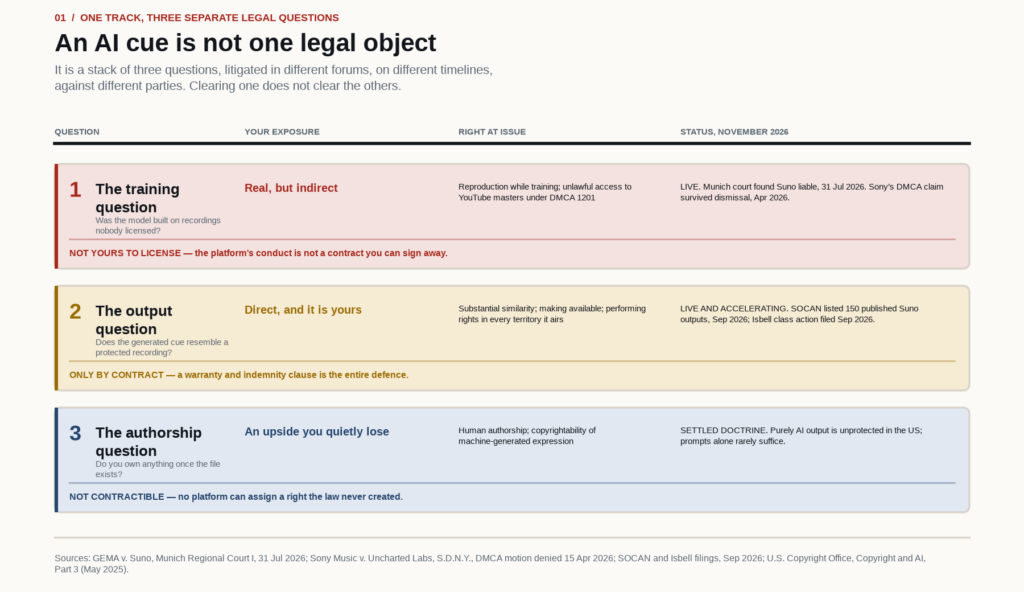
Most coverage conflates three separate disputes. They have different defendants, forums and timelines. Keeping them apart is the single most useful thing you can do before you brief a lawyer.
Question one: what did the model learn from?
On 24 June 2024, the RIAA, acting for Universal, Sony and Warner, filed coordinated suits against Suno and Udio alleging both had trained on copyrighted sound recordings at something close to industrial scale.
Nearly two years on, the record is uneven, and that unevenness matters more than any headline. In April 2026, Judge Alvin Hellerstein in the Southern District of New York refused to dismiss the labels’ anti-circumvention claim against Udio, holding that the plaintiffs had plausibly alleged YouTube’s rolling cipher regulates access to content and that Udio circumvented it. That is procedural, not a verdict on fair use, and it is narrow: the court said whether those measures are access controls needs a fuller record and left Udio free to renew the argument.
Then Udio did something remarkable. In its answer on 29 April 2026 it admitted obtaining audio data from YouTube for training and using yt-dlp to acquire some of it. It still argues the back end was quintessential fair use. But how the corpus was assembled is no longer in dispute, which is precisely where the DMCA claim lives.
Question two: does the output resemble something protected?
This is the strand that should worry a brand, because it is argued about the file rather than the model. It is also accelerating.
The Munich ruling on 31 July 2026 came in a case brought by GEMA over compositions including Forever Young and Mambo No. 5. The court found Suno liable, ordered disclosure of revenue, and left damages to be determined. Suno called the decision a mischaracterisation of how its technology works and said it is evaluating an appeal. Read the scope carefully: the court decided GEMA’s claims against Suno, not the liability of a subscriber who publishes an output. It did not answer your question. It narrowed the space in which your question can be dodged.
Then in September 2026, SOCAN, representing more than 200,000 songwriters, composers and publishers in Canada, sued Suno over 150 publicly available outputs. The detail that matters is how they were found: on Suno’s own Explore page, by anyone with a browser. That is not a sophisticated sting. It is evidence that a rights organisation can walk a public catalogue and come back with a hundred and fifty matches.
Question three: do you own anything once the file exists?
Here the law is not unsettled; it is simply unwelcome. The US Copyright Office’s 2025 report on generative AI training is careful about fair use and blunt about authorship: purely machine-generated material is not protected, and prompts alone generally do not supply enough human control. A prompt is a brief, not a composition.
The commercial consequence is easy to miss. Build a sonic identity on a track that cannot be owned, and you cannot stop a competitor generating the same thing — nor can the platform, which expressly warns that outputs may not be unique. You have not bought an asset. You have rented access to a sound.
The labels split, and the split is the story
In October 2025 Universal settled with Udio and signed licensing agreements, announcing a licensed platform for 2026 built on authorised music, with the existing product to continue inside a walled garden during the transition. In November, Warner settled with Udio, then settled with Suno in a partnership that also handed Suno the live-music platform Songkick.
Those deals were not just peace treaties. They were a template, and the template changed the product. Free-tier Suno audio stopped being downloadable. Paid tiers picked up monthly caps. The word ownership retreated from the marketing and became a commercial-use grant, a narrower instrument.
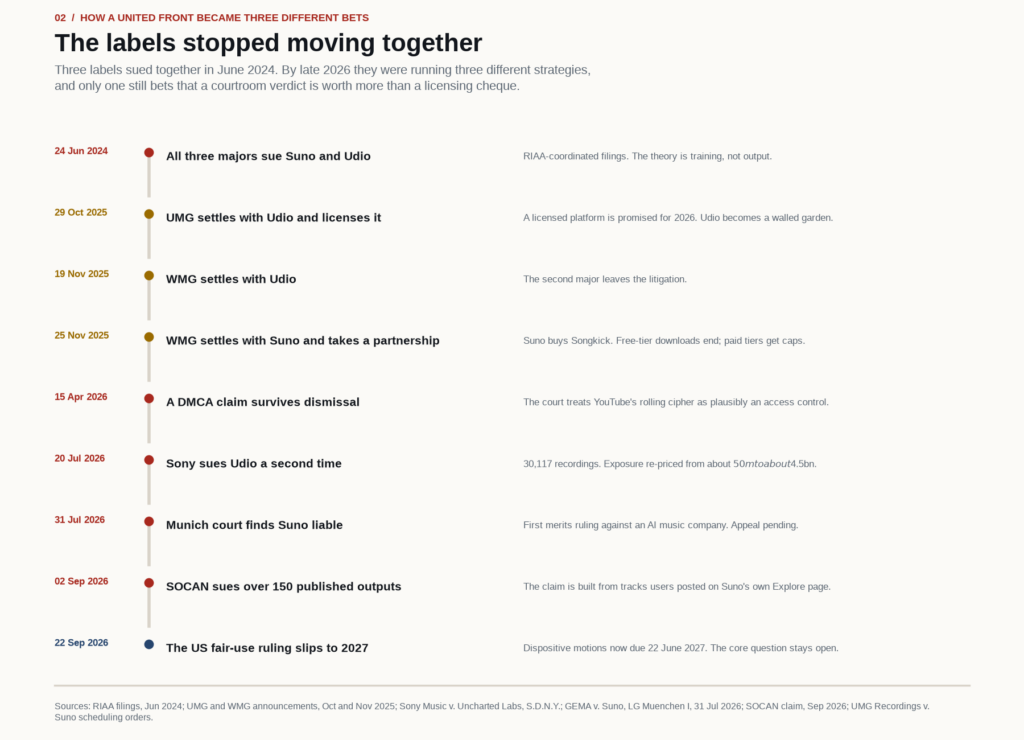
Sony went the other way. In July 2026 it filed a second suit against Udio covering 30,117 recordings, having been refused leave to bolt them onto the original case. The complaint is worth reading for its fair-use argument alone: if Udio paid Universal, Warner, Kobalt, Merlin, Believe and the publishers’ association to license the very inputs at issue, a market for those inputs plainly exists, and the fourth fair-use factor should reflect it. That is sharp, and it turns its rivals’ settlements into ammunition.
Meanwhile the central American question — whether training on unlicensed recordings is fair use — is still unanswered. After repeated extensions, dispositive motions in the Massachusetts case against Suno are due 22 June 2027. A merits ruling is not expected before the second half of that year. Anyone telling you the law is settled is telling you about a different case.
What the subscription actually signed
Now the part that decides your exposure, and it is a contract question before it is a copyright question.
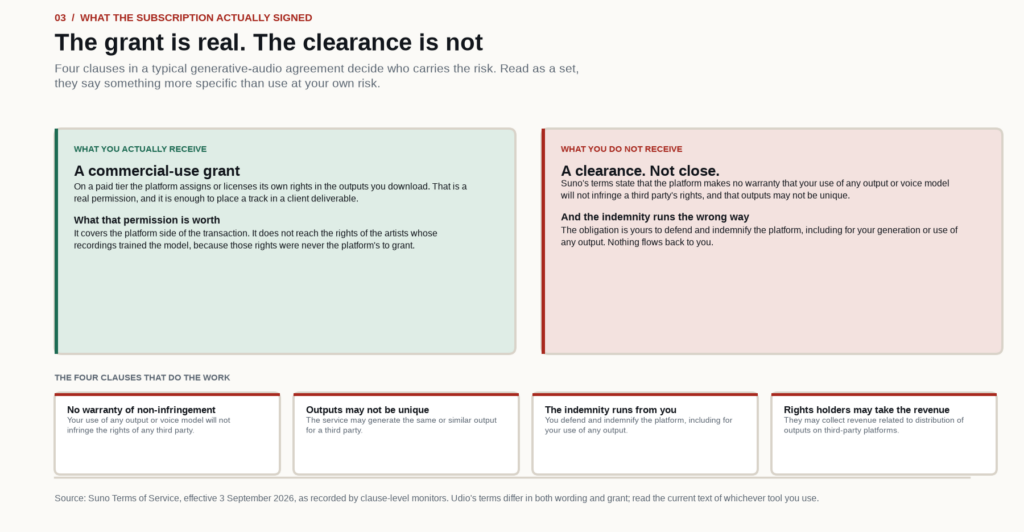
Suno’s terms, in the version effective 3 September 2026, are unusually clear if you read the clauses as a set rather than one at a time. The platform makes no warranty that your use of any output or voice model will not infringe a third party’s rights. It warns that outputs may not be unique, because the service may produce the same or similar output for somebody else. The indemnity obligation is yours: you defend and indemnify the platform, including for your generation or use of any output. And it reserves that applicable rights holders may collect revenue related to distribution of outputs on third-party platforms.
Read those four together and they say something more specific than the usual use at your own risk. They anticipate the exact scenario where your released track earns money that belongs to somebody else, and they put that scenario on your side of the ledger.
This is not unique to Suno and it is not villainous. It is how nearly every generative service is drafted, and it is rational from the vendor’s side: the party that knows what the model memorised shifts the downstream risk to the party who cannot check — you. What is unusual is that the product actively encourages commercial monetisation while the contract declines to stand behind it.
Which brings us to the honest comparison. Production-music libraries do not ask you to indemnify them against your own use of their catalogue. They warrant the track is cleared and they stand behind the warranty. That warranty is the product. When a generator costs a tenth as much, part of the difference is efficiency and part is the warranty you just agreed to provide yourself.
The four checks that belong before the spot ships
I am not going to tell you to avoid AI music. For a large share of the work advertising actually produces, it is the correct tool. What follows separates a defensible use from an unpriced gamble.
Read the grant and the indemnity, not the headline. Marketing says you own the output. The contract says you own a commercial-use right and you indemnify the vendor. Have someone read the commercial-scope clause, the warranty disclaimer and the indemnity direction before the tool enters the workflow, not after the campaign is approved. No vendor indemnity means price the track as high-risk and plan accordingly.
Never prompt imitation. Naming a living artist, a specific song, or a recognisable style invites a derivative-work or lookalike claim, and it moves causation onto your prompt. The model’s filters check your input, not the audio that comes back. Keep prompts descriptive and anonymous.
Buy the licensed track for the hero spot. Split the portfolio deliberately. Generative audio for mockups, internal cuts, variant testing, long-tail social, functional background. For the brand anthem, the flagship film, the placement that will run eighteen months across nine markets, use a human-composed, sync-cleared, indemnified track. Certainty is worth the invoice. The cheapest cue can be the most expensive lawsuit.
Keep a paper trail you could hand to a lawyer. Record the prompt, model and version, date, tier, the terms in force at generation, and any screening you ran. If a claim arrives, provable diligence is not a complete defence but it is the difference between a brand that acted reasonably and one that typed something and hoped.
One free screening step: upload the finished track as a private YouTube video and stop at the checks stage. That runs a Content ID pass against a real fingerprint database before anything is public. Treat a clear result as the absence of a match today, not as a clearance, because manual claims and edits arrive later.
The risks nobody puts in the deck
There is a bias worth naming. Nothing catastrophic has happened to a brand yet over an AI music bed, and that absence feels like evidence. It is not. It is the absence of precedent, and the first large advertising judgment will price the category retroactively. If the German ruling survives appeal, expect the licensing market to harden and the cost advantage to compress.
Reputational exposure runs on a separate track. A brand sued over its soundtrack reads as the brand that took the song, win or lose. Legal outcomes take years; that headline takes an afternoon. For a category that spends heavily to be trusted, that asymmetry is worse than the damages.
Then there is term drift. Platforms change terms, sunset models, retire capabilities, and the Warner deal already narrowed user rights in ways that were not obvious at signing. A permission adequate at generation can be inadequate at renewal. Diarise the review.
The disclosure clock started in August
Copyright is not the only rulebook that changed this year. The EU AI Act’s transparency obligations under Article 50 became applicable on 2 August 2026, with administrative fines reaching €15 million or 3 per cent of worldwide turnover, whichever is higher.
Two duties land on the advertising workflow. Providers of generative systems must mark outputs in a machine-readable format so synthetic origin can be detected, with a transitional deadline of 2 December 2026 for systems already on the market. And deployers must disclose deepfake content, which the Act defines as AI-generated audio, image or video resembling existing persons, objects, places, entities or events that would falsely appear authentic. A generic instrumental bed is not a deepfake. A synthetic voice that sounds like a real presenter is. If your spot leans on the second, a label in the EU is now a legal requirement, and burying it in a footer will not satisfy the standard.
The economics underneath are moving too
The CISAC study, commissioned by the authors’ societies confederation and conducted by PMP Strategy, projects generative AI music outputs reaching an annual value of about €16 billion by 2028 — roughly 20 per cent of streaming platform revenue and about 60 per cent of music library revenue — while putting 24 per cent of music creators’ revenue at risk, an annual loss of about €4 billion. Accept the precision or not, the direction is unambiguous: the low-cost window is a phase, not a condition.
For supply-side scale, Deezer reported in April 2026 that fully AI-generated tracks were arriving at roughly 75,000 a day, about 44 per cent of daily uploads, while accounting for only 1 to 3 per cent of streams, with about 85 per cent of those streams detected as fraudulent. That is not an audience verdict. It is evidence that volume is cheap and attention is not — which is why a distinctive, cleared, owned track remains a competitive asset rather than a commodity input.
What this means for how you brief the work
The strategic read is simpler than the legal one. AI music does not remove the cost of music. It moves it from the production line to the risk register — from a line item somebody signs to a contingent liability nobody owns.
That relocation is the real change. A sync fee is visible, budgeted, approved. A liability is invisible until it is a letter. Teams under deadline pressure are structurally incapable of pricing the second thing correctly, which is why this decision should not sit with the person generating the track.
So split the decision. Let creative use generative audio freely where stakes are low and volume is high. Give the hero asset a different path: a named owner, a documented indemnity position, a licensed alternative on the table. And put the terms review on a calendar, because the documents you relied on will change.
The brand that does this is not being timid. It is buying what it wanted in the first place: a sound it controls, on a campaign it can defend, without a letter arriving eight months after the launch party.
That is the whole argument. The tool is fine. The paperwork is the product.
Conclusion
AI music for advertising is a genuine production breakthrough and an unpriced liability in the same file. The training disputes are live, the US merits question is now not expected before the second half of 2027, a German court has already found a platform liable, and the protection most brands assume they bought runs the opposite way. The promise that you own the output is a promise about the platform’s rights, not a warranty about the people whose work trained the model.
The discipline is not complicated, only inconvenient. Read the indemnity before the pricing. Never ask a model to imitate a living artist. Buy the licensed track where the campaign carries the brand. Keep the record proving how the file was made. Generative audio for the long tail; paid, cleared, warranted music for the hero.
Certainty costs money. So does its absence, and the second invoice arrives without a line item, at a time you do not choose.