Every Sidewalk Robot Is a Billboard. Most Are Unanswered Ones.
Somewhere around 7:40 on a wet Tuesday evening, a six-wheeled box the size of a suitcase stops outside your door, hums once, and opens its lid. You shuffle out in slippers. You take your groceries from a machine.
Most marketers have never once thought about that moment. That, increasingly, is the problem.
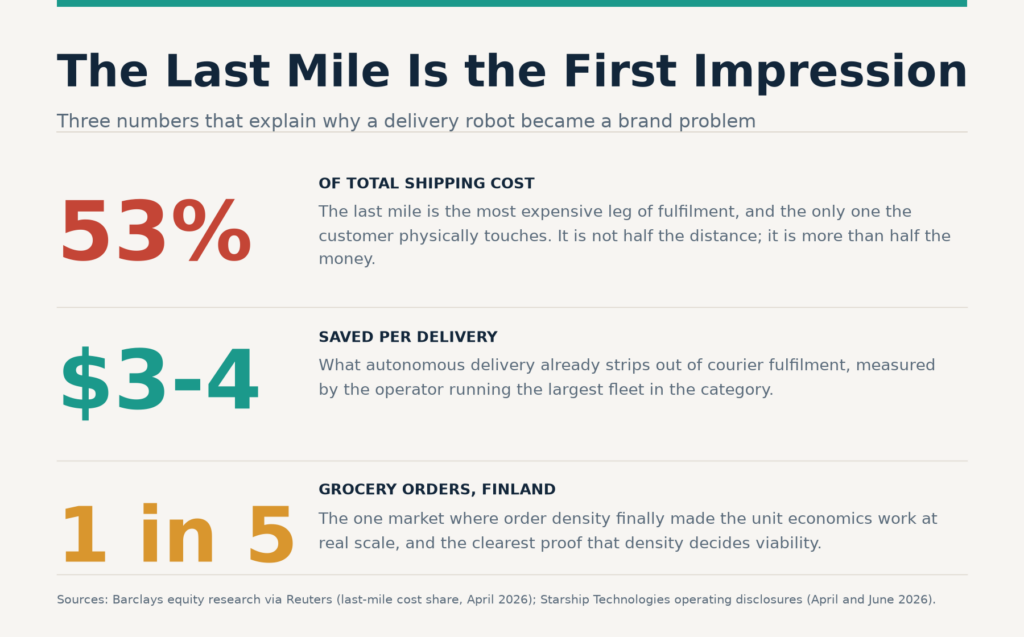
Because while nobody was watching, the delivery robot stopped being a demo and became a channel. Starship Technologies — the Estonian-American company that first put these machines on college quads back in 2018 — crossed ten million autonomous deliveries in April 2026. Its fleet runs more than 3,000 robots across roughly 300 locations in eight countries, and has covered over 22 million autonomous kilometres. In Finland, about one grocery delivery in five now arrives by robot.
That is not a pilot. That is infrastructure. And infrastructure carries your logo.
The 2026 correction nobody put in the press release
Read only the funding announcements and you would assume this category is still taking a victory lap. It is not. 2026 has been the year the arithmetic caught up with the ambition.
In June, Starship wound down its entire US university campus operation and redeployed more than 1,200 robots into grocery and hot-food delivery in cities across Europe and the United States. Amazon had already ended field tests for Scout back in October 2022, disbanding a team of roughly 400 people. Nuro cut about 30% of its staff, stopped building its own delivery vehicles, and repositioned itself as a licensor of its autonomy stack to automakers and mobility platforms.
Three retreats inside a single category. Read carelessly, that looks like an industry running out of road.
Read carefully, and it looks like something considerably more useful: a category finally admitting where it works.
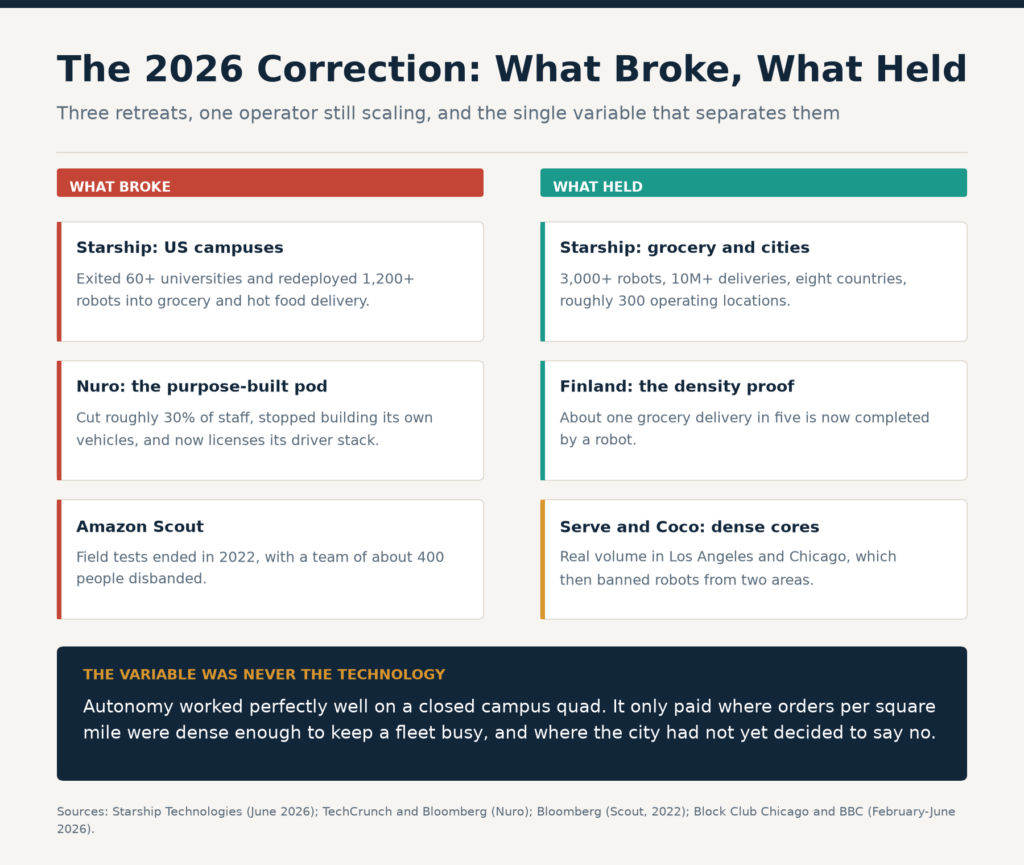
The distinction matters, because it separates a fad from a business. Every one of those exits was an economics decision rather than an engineering failure. The robots drove perfectly well. They simply drove well in places where nobody was willing to pay enough for the trip.
Density is the entire argument
Here is the uncomfortable arithmetic of e-commerce: the last mile eats 53% of total shipping cost. Not half the distance — that final leg is a rounding error geographically — but more than half the money. It is the most expensive, least efficient, most stubbornly human part of fulfilment.
Which is why the $3 to $4 per delivery that autonomous robots strip out is not a nice-to-have. It is the difference between delivery being a margin problem and delivery being a margin.
But that saving materialises under exactly one condition, and it is not technology. It is density.
A campus has it. Thousands of people, a handful of buildings, the same three restaurants, all inside a ten-minute walk. A dense urban core has it too. A suburban sprawl of cul-de-sacs and half-mile driveways does not, because the robot spends its battery crossing empty pavement between orders that one van could have batched in a single run.
This is why Finland works and a nationwide American rollout does not. Order density there is high enough that the fleet never idles, which is also the only condition under which Starship’s stated long-term target — roughly $1 per drop — survives contact with a spreadsheet.
So when you read a bullish market forecast, read the units. The broad autonomous last-mile market was valued around $24.6 billion in 2024 and is projected toward $199 billion by 2034, compounding at roughly 23% a year. The sidewalk-robot segment inside it is a far smaller number — low single-digit billions by the end of the decade. Both figures are real. They are not the same market, and conflating them is how people end up building strategy on a decimal point.
Your brand is now a machine with a lid
Here is the reframe most marketing teams have not made yet.
When a courier hands over a bag, the courier is a person your customer will never see again. When a robot arrives, the robot is your brand — physically, in three dimensions, at the one moment in the entire purchase when your customer is standing still and paying attention.
Every robot on a sidewalk is a billboard. That line gets quoted constantly, and it is true in a narrower sense than people usually mean. The billboard is not the logo on the chassis. The billboard is the behaviour. If the thing arrives on time, steers around a stroller without drama, opens on cue and gets the order right, you have just demonstrated competence in a way no landing page can. If it blocks a wheelchair ramp, sits frozen at a crossing for four minutes, or never shows up at all, your customer does not blame the robot company.
They blame you.
That is not sentiment; it is measurable. Delivery research keeps landing on the same finding — somewhere between 47% and 62% of consumers hold the retailer responsible when a delivery fails, with roughly half blaming retailer and carrier equally. The vendor’s failure arrives in your review section, under your name, with your star rating next to it.
And the stakes are brutally asymmetric. A good delivery keeps you in the running. A bad one closes the account. Around half of shoppers say they have stopped buying from a brand after a negative delivery experience. More than a third have abandoned a retailer permanently over a single late delivery. Among heavy shoppers — the ones placing eleven or more orders a month — that churn figure climbs past two-thirds.
Those are precisely the customers you can least afford to lose. They are also the ones with the shortest patience.
The novelty wears off; the cold fries do not
There is a second trap, subtler than bad economics.
Novelty is a loan you repay. Everyone loves the robot the first three times. By the fourth, it is a delivery. By the tenth, it is a delivery that was eight minutes late, and the charm has fully amortised. Campus surveys produce 97% approval ratings, and those numbers are probably honest — but campus populations are young, self-selected, and paying with a meal plan rather than a card.
The moment the novelty expires, the customer is left evaluating the same things they evaluate everywhere else: did it arrive, was it right, was it cold, and could I get help when it wasn’t. A robot that fails any of those does not generate delight. It generates a complaint with better lighting.
Convenience earns gratitude once. Reliability earns it repeatedly. Confusing the two is how a category mistakes a launch for a business.
The part where the category is genuinely losing
Now the awkward section. Walk over to Trustpilot and look up the market leader.
Starship sits below two stars out of five, on a listing the company has not claimed. The complaints cluster with almost suspicious consistency: orders cancelled after an hour of waiting, pricing errors, a support function that reads like an autoresponder with an attitude problem, and — repeatedly — the discovery that a missed delivery means the money stays with the company.
Compare that to the app stores, where the same company holds 4.8 on Apple and a clean 5 on Google Play. Both numbers can be true simultaneously. The app-store rating captures someone who installed an app and got a snack. Trustpilot captures someone whose dinner never came and who then tried to get help. Only the second group is telling you something the first group cannot.
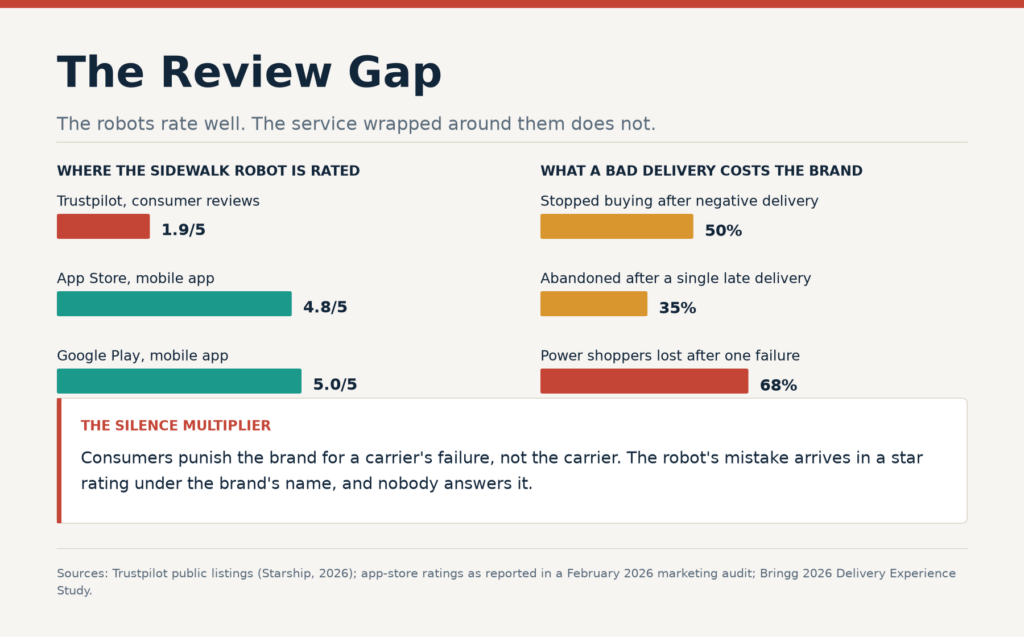
The silence makes everything worse. Check the review responses: there are none. Not on Trustpilot, not on the social pages, not in the app-store comments.
That is a decision, and it is the wrong one. Consumers punish non-response harder than they punish mistakes.
Worth correcting a statistic while we are here, because it circulates constantly. The familiar 73% figure — 73% of consumers switch to a competitor after bad experiences — is almost always quoted as “after one bad experience.” It is not. That number describes multiple bad experiences. The single-experience churn figure is closer to 32%, or roughly half in a delivery context specifically.
The correction changes the diagnosis in a useful way. Brands do not usually lose customers to one broken order. They lose them to a pattern, and to the silence that surrounds it.
One missed delivery is a service failure. A missed delivery plus an unanswered complaint is a brand decision.
Five disciplines for the doorstep
If the robot is the brand, the doorstep deserves the same design rigour you would apply to a checkout flow. Five moves, in rough order of impact.
1. Staff the escape hatch
Autonomy is a promise right up until it isn’t. The highest-leverage investment in this entire category is a reachable human who can fix a failed delivery in under a minute. Not a chatbot. Not a link to the terms of service. A person. Support is not the cost centre sitting behind the robot; it is the retention channel standing in front of it.
2. Answer the reviews in public
An unanswered one-star review is a billboard too, and it is the one your prospects actually read. Responding does not undo the bad order — it proves, to every future customer scanning that page, that a human is behind the machine. Most operators in this category have not worked that out, which means the bar is embarrassingly low and embarrassingly easy to clear.
3. Design the handoff, not just the route
The last ten metres are brand surface. Where does the robot stop? How long does the lid stay open? What does the notification say, and does it read like a company or like a parking meter? What happens when the customer isn’t home, and — the question that generates most of the anger — who eats the cost? That is a policy choice, not a technology constraint.
4. Deploy where the math works, and say so out loud
Forcing robots into geographies that break the economics does not merely lose money. It manufactures the bad experiences that poison the category for everyone else.
5. Measure the experience, not the autonomy rate
Percentage of miles driven without human intervention is an engineering metric, and it will never once appear in a customer’s decision. Track on-time rate, order accuracy, first-contact resolution, review sentiment and repeat purchase. Those are the numbers that predict whether the robot earns its route next quarter.
Three risks worth naming honestly
The regulatory floor moves ward by ward
This is not a national policy question; it is municipal, and it is decided by whoever shows up to the community meeting. Chicago banned robots from two small areas after residents of the First Ward voted 83% against expansion, and the city’s pilot cannot extend past May 2027 without council approval. Toronto has prohibited sidewalk robots since 2021. San Francisco restricts them to quieter corridors. Any market-entry plan assuming regulatory continuity is a plan built on sand.
The public is not uniformly charmed
Campus approval numbers are real but unrepresentative. City sidewalks are shared space, and the objections there are about accessibility and dignity, not novelty. A robot that forces a blind pedestrian into the road has not delivered a brand impression. It has delivered a grievance with a longer shelf life than the campaign.
You do not own the experience
Most brands deploying robots are renting the doorstep from a vendor. Operationally fine; reputationally hazardous. Contract for experience standards rather than delivery SLAs alone — response times, refund authority, review management, incident reporting. If it is not in the contract, it is not in the service.
What to do on Monday morning
Three things, in order.
Audit the actual doorstep. Order from your own brand through every delivery partner you use, and watch what happens when the order goes wrong rather than right. Most teams have never done this. It takes an afternoon and it will reorder your priorities by evening.
Fix the response layer. Pick the two review platforms where your category actually gets discussed, and put a named human on them with real authority to resolve. That single change moves brand perception more than any creative campaign you will run this quarter.
Rewrite the vendor conversation. Ask your delivery partners for their on-time rate, their first-contact resolution, and what they do with a one-star review. If they cannot answer, you have just located your risk.
The short version
Autonomous delivery in 2026 is a real business in narrow places, and a brand touchpoint almost nobody planned for. The retreats were about density, not capability. The customer experience is the weak link, and it is weak for reasons that have nothing to do with robotics: unanswered complaints, unfunded support, undefined handoffs.
The last mile is the first impression. The robot at your door is the closest thing your brand has to a handshake.
Give it a script, a support team, and someone who answers the reviews. Or accept that you have automated the exact moment your customer stops believing you.