Who Underwrites the Claim? Trust Signals in China and the West
I started this piece with a tidy thesis, the one most decks carry: China runs on a wall of proof, the West runs on brand authority, and a marketer just needs to speak the right dialect in each market. It reads well. It survives a conference slide. It does not survive contact with the numbers.
So this is a different article than the one outlined. Two markets that are usually described as opposites turn out to be running the same engine at different voltages, and the difference that actually matters is not consumer psychology at all. It is who stands behind the claim.
Stay with me, because the practical implication is more useful than the original thesis was.
Both markets are review markets. That is the boring part.
Start with scale, since scale is where the myth begins.
China ended 2025 with 15.97 trillion yuan in online retail and 937 million online shoppers, roughly 83% of its internet users. That is not a niche behaviour to be explained by cultural idiosyncrasy. It is the default retail channel for most of a country.
And in the West? BrightLocal’s 2025 survey of 1,026 US adults found that only 4% never read reviews. Everyone else does. The average shopper checks multiple platforms before committing.
So the premise that one market is review-obsessed and the other is brand-obsessed does not hold at the level of behaviour. Both are review-obsessed. What differs is the return on that obsession.
The trust paradox is the real story in the West
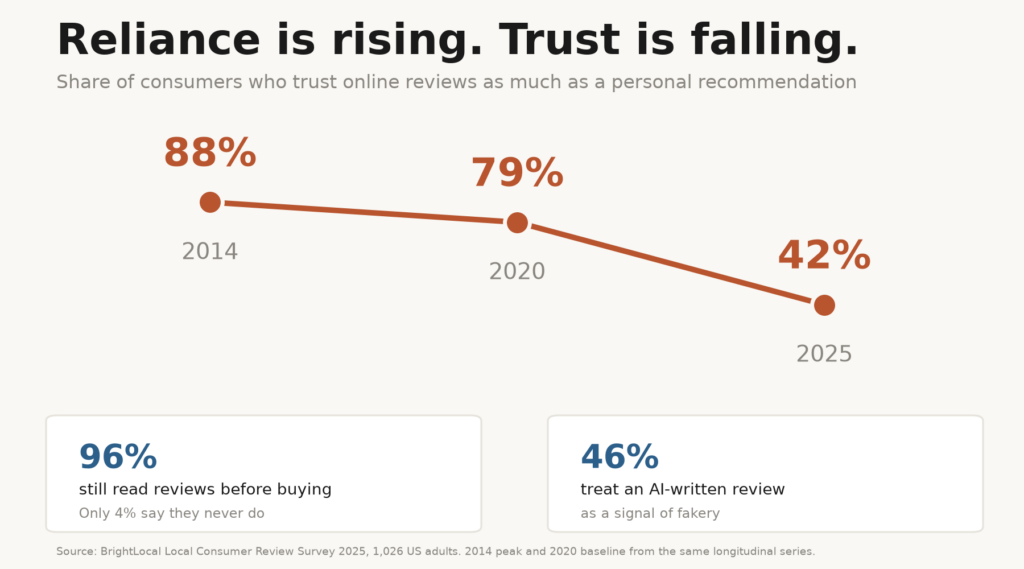
Here is the number I keep coming back to. In 2014, about 88% of consumers said they trusted online reviews as much as a recommendation from a friend. By 2020 that had slipped to 79%. By 2025 it was 42%.
Trust roughly halved in a decade while reliance went up. That is not a contradiction; it is a rational response to a market flooded with incentivised, templated and now AI-generated reviews. BrightLocal also found that 46% of consumers treat a review that reads as AI-written as a signal of fakery, not a convenience.
Read that again, because it inverts a common assumption. The more reviews a market produces, the less each one is worth, and the more buyers fall back on proxies they can verify: a retailer they know, a return policy they can use, a payment rail they trust.
Western buyers are not leaning on brand because they are lazy. They are leaning on brand because the review layer stopped being a reliable signal and became an advertising channel.
In China, the platform became the underwriter
China took a different route to the same problem, and this is where the outline’s framing needs rebuilding.
Faced with the same credibility collapse, Chinese e-commerce did not retreat to brand authority. It built platform-level verification and made the platform, not the brand, the guarantor. The mechanisms are now so standard that shoppers use them without thinking: the official flagship store distinction, the authenticity guarantee badge, the platform-backed return commitment, and as of 2025, a new store-level “authentic experience score” tied directly to search and recommendation weighting.
Official consumer guidance in China makes the hierarchy explicit. A 2025 shopping guide issued by a municipal market regulator tells buyers to prioritise the official flagship store for high-value goods, verify the business licence and product certification, compare unit prices across platforms, and then — this is the part that matters — read the negative and follow-up reviews, especially those with photos and video. Uniform five-star walls with identical copy are flagged as likely fabricated.
That is a remarkable inversion of the outline’s claim. In China, review volume at the extreme is treated as evidence of manipulation. What carries trust is specificity, recency and platform-backed provenance.
The volume myth, tested properly
How much does volume actually move a Chinese buyer? Less than the folklore suggests.
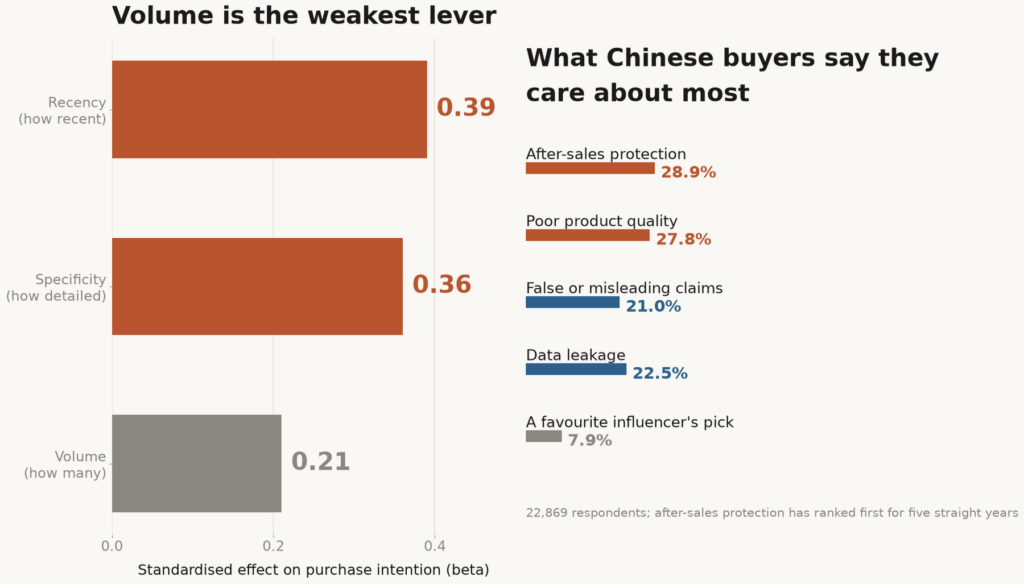
A 2025 study of 323 Taobao shoppers modelled three review attributes against purchase intention. Recency came first with a standardised coefficient of 0.39. Specificity followed at 0.36. Volume came last at 0.21. The author’s own conclusion was that review count needs to be balanced against quality and credibility rather than maximised.
I will flag the limitation honestly: 323 respondents, one platform, a convenience sample. It is directional evidence, not a verdict. But it points the same way as the official guidance and the market behaviour, and three weak signals agreeing is worth more than one strong claim.
Meanwhile, the West raised its volume floor, not lowered it
If the West were truly an authority market with light review expectations, you would expect Amazon’s recommendation systems to tolerate thin review histories. They do not.
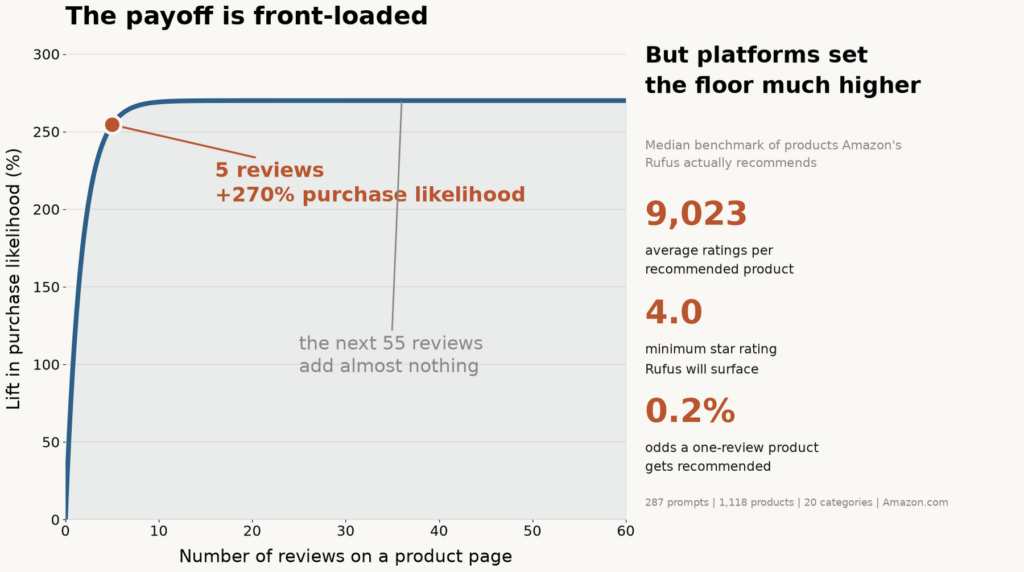
Profitero and Mars United analysed 287 prompts and 1,118 products surfaced by Amazon’s Rufus shopping assistant. The average recommended product carried 9,023 ratings. The average star rating was 4.5. A product with a single review had a 0.2% chance of being recommended.
Worse for the small brand: 98% of Amazon first-party unit sales come from products rated 4 stars or above. Lift a product from below 4.0 to 4.0-plus and sales rise an estimated 16%.
The five-review cliff is real, and it is universal
Now the good news, which applies in both markets.
Northwestern’s Spiegel Research Center, working across more than 100,000 SKUs, found that a product with five reviews is 270% more likely to be purchased than one with none. The curve is brutally front-loaded: almost all the gain arrives within the first ten reviews, and the marginal value of the fifty-first review is close to zero.
The same study found reviews matter more for expensive items (a 380% conversion lift versus 190% for cheap ones), that purchase likelihood peaks between 4.0 and 4.7 stars and then falls as ratings approach a perfect 5.0, and that verified-buyer badges add roughly 15%.
That last finding is worth sitting with. Perfection is suspicious. A 4.4 with volume reads as honest; a 5.0 with forty reviews reads as managed.
Detail beats volume, and the gap is large
If volume is the weakest lever, format is the strongest.
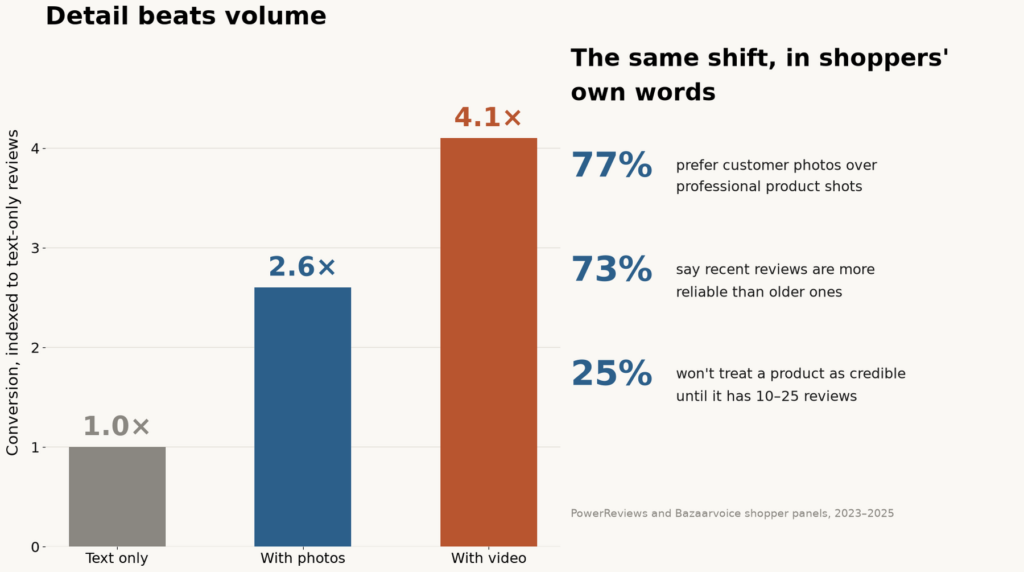
PowerReviews measured conversion against review type and found text-only reviews converting at a baseline of 1×, reviews with photos at 2.6×, and reviews with video at 4.1×. Separately, 25% of shoppers will not treat a product as credible until it has 10 to 25 reviews, and 73% say recent reviews are more reliable than older ones.
This is the single most portable insight in the whole comparison, because it holds in Shanghai and in Chicago.
The influencer signal is deflating in China
One more item the outline had backwards.
The draft assumed KOL and KOC endorsement is a heavily weighted trust signal in China. It was, once. It is now contracting.
The China Consumers Association’s 2025 survey, with 22,869 valid responses, found that only 7.9% of respondents cited a favourite influencer’s recommendation as a factor in their purchasing decisions. After-sales protection led at 28.9% and has held the top spot for five consecutive years.
Accenture’s 2025 China Consumer Survey, covering 5,000 respondents across tier-one to tier-five cities, found influencer and celebrity endorsement influence declining since 2021, while product substance, pricing and service rose. 46% said marketing content does not sway them; 22% said it actively repels them. 55% compare multiple brands even when they already have a favourite.
Chinese buyers are not becoming more credulous. They are becoming more forensic.
Then AI arrived and made fakery cheap
The reason all of this is happening at once is that the cost of manufacturing a convincing review collapsed.
China’s consumer authority flagged it directly in its 2025 rights-protection report: AI-synthesised presenters and fabricated product scenes are being used in livestreams, marketplace listings and social content, and current rules lag the technology. Separately, platforms reported a wave of shoppers using AI to generate fake product-defect images to claim refunds.
The West has the same problem and reached for law instead of guidance. Bazaarvoice’s December 2025 survey of more than 2,500 shoppers across the US, Europe, the Middle East and Asia-Pacific found that 92% consider it important to see verification from real customers alongside an AI recommendation, and 62% would trust an AI shopping tool more if it showed verified reviews and photos. Two thirds still would not check out directly through an AI interface.
Human evidence did not become less valuable when AI got good at writing. It became the only thing left that is expensive to fake.
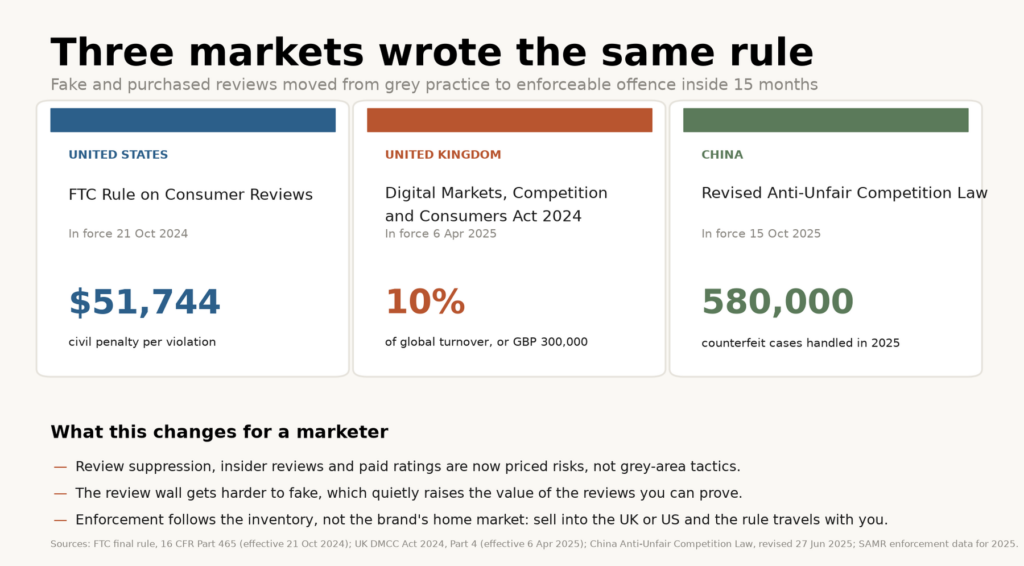
Three regulators wrote the same rule in fifteen months
This is the most underreported convergence in marketing right now.
The US FTC’s rule on consumer reviews and testimonials took effect in October 2024, banning fake reviews, purchased reviews, undisclosed insider reviews and review suppression, with civil penalties of up to $51,744 per violation. The UK’s Digital Markets, Competition and Consumers Act followed in April 2025, banning fake reviews outright and giving the competition authority power to fine up to 10% of global turnover. China’s revised Anti-Unfair Competition Law took effect in October 2025, explicitly prohibiting fabricated transactions and fabricated reviews, backed by a 2025 enforcement push that handled nearly 580,000 counterfeit and infringement cases.
So who actually underwrites the claim?
Here is the reframe I would defend in any room.
The axis is not proof versus authority. It is who carries the liability when the claim is wrong.
In China, the platform carries it. Flagship status, authenticity guarantees, experience scores and platform-mediated refunds all exist because the platform inserted itself as the guarantor between an unknown seller and a wary buyer. The 2025 cancellation of no-return refunds did not weaken that role; it rebalanced it, moving adjudication to merchants while formalising the rating system that buyers actually rely on.
In the West, the state and the payment rail carry it. Statutory return rights, card-network chargeback, enforceable advertising rules, and now direct fines for fake reviews. The brand matters, but it matters as the entity legally and commercially answerable, not as a halo.
Both systems are responses to the same failure: anonymous distance selling destroys the conditions for trust. They solved it with different guarantors. That is the whole comparison, and it is far more actionable than a cultural dichotomy.
What to do on Monday
Build to five, then build for detail. Five reviews is the cheapest conversion win available anywhere, in any market. Past ten, spend the marginal budget on photo and video capture, not on more text. A review with video converts at four times a text-only review; that is a better return than your next hundred plain ratings.
Stop buying review volume. Buy recency. Freshness outranks count in both markets, and algorithms compound it: reviews lift organic ranking, and rapid collection lifts it further. A steady trickle beats a launch-week spike that then goes stale.
Treat 4.4 as the target, not 5.0. Purchase likelihood peaks between 4.0 and 4.7 and declines toward perfection. A flawless wall reads as managed, and in China it is explicitly taught as a fabrication tell.
Prove provenance, not enthusiasm. Verified-buyer badges, post-purchase photos, follow-up reviews written after weeks of use. In a market where 46% of Western buyers screen for AI-written text and Chinese regulators warn about AI-fabricated defect images, the verifiable human is the scarce asset.
Localise the guarantor, not the adjective. Entering China, your leverage is flagship status, platform authenticity guarantees and the experience score. Entering the UK or US, your leverage is statutory-compliant returns, transparent review governance and a brand that can be held to account. Same evidence, different underwriter.
The takeaway
Trust is not culturally optional; it is structurally produced. China produced it by making the platform liable. The West produced it by making the state liable. Both then watched review volume stop being a signal, and both responded by raising the price of faking.
The marketers who win the next two years will not be the ones with the biggest review wall. They will be the ones whose reviews can survive being checked — by a shopper, by an algorithm, and increasingly by a regulator.