The Thirty-Fifth Problem: Why Chinese Ad Fines Never Match the Statute
Most models of advertising regulation assume one causal chain: the rule sets a price, the price sets behaviour, and the market calibrates. Fine the violator enough and the violation stops.
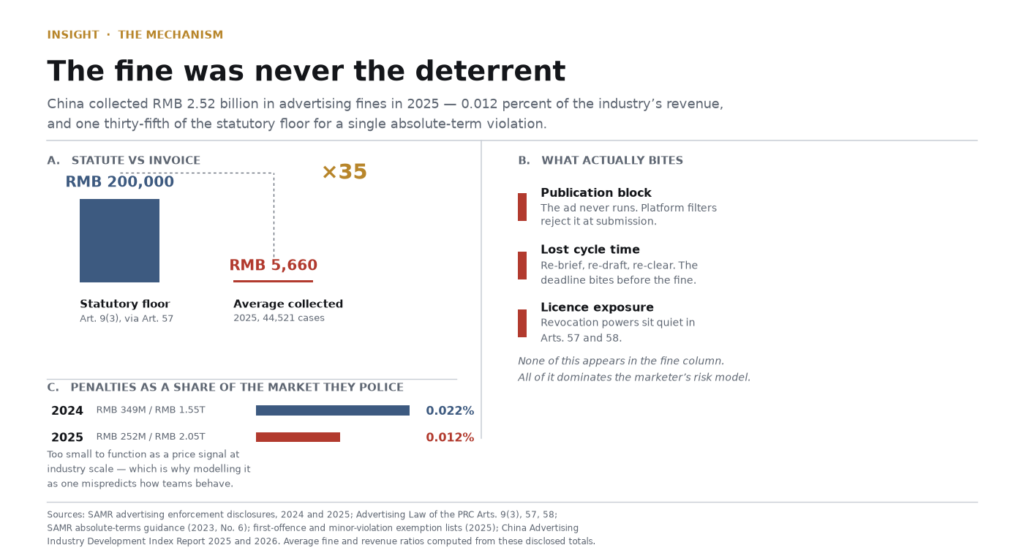
China’s numbers do not support that chain. In 2025, market regulators closed 44,521 advertising cases and collected RMB 252 million in fines. Divide one by the other and the average penalty per case is RMB 5,660. For an absolute-term violation — “best,” “number one,” “national-level” — the statutory floor under Article 9(3), penalised through Article 57, starts at RMB 200,000. The average invoice is one thirty-fifth of the floor the statute sets for a single offence.
Not a rounding difference: the enforcement doctrine itself, visible in one ratio.
What the ratio is really measuring
Set the penalties against the market they police and the picture gets stranger. Advertising revenue reached RMB 2.05 trillion in 2025. Fines were RMB 252 million — 0.012 percent of turnover, down from 0.022 percent in 2024. Over the same period case volume fell 5 percent, but the money fell 28 percent and the average penalty fell 24 percent.
So enforcement got cheaper while compliance culture got stricter. Most commentary reads a falling fine total as a softening regime. That reading has the mechanism backwards. Three shifts explain most of it: the 2023 SAMR guidance on absolute terms added a semantic test plus explicit safe harbours, narrowing what counts as a violation; the 2025 first-offence and minor-violation exemption lists gave frontline regulators a lawful route to warn instead of fine; and the 2025 revision of the Anti-Unfair Competition Law widened misleading-practice exposure to conduct aimed at other operators, opening a parallel route to the same conduct.
Each one increased discretion. None of them loosened the obligation on the advertiser.
Where the deterrence actually lives
If the fine is not the deterrent, what is? Three constraints that never appear in the penalty column:
Publication is the permission. A blocked ad does not run. For a product launch, a platform filter that rejects the creative at submission is not a cost — it is a cancelled quarter. No fine schedule replicates that.
Cycle time is the budget. Re-briefing, re-drafting and re-clearing consume the weeks that a launch plan cannot spare. A RMB 5,660 fine is a rounding error against a missed festival window.
Licence is the collateral. Revocation powers sit quietly in Articles 57 and 58. They are rarely used, which is precisely what makes them credible — an unused nuclear option shapes behaviour more than a frequently used parking ticket.
This is the inversion worth holding onto. In an ex-post regime, the fine is the price, and price is how the state speaks. In an ex-ante regime, the gate has already done the work before any penalty is contemplated, so the fine collapses into a residual — a bookkeeping entry for the cases that slipped past the filter.
Why this matters for anyone reading China from outside
Two practical consequences follow.
First, benchmarking Chinese compliance by fine severity keeps producing wrong predictions. A team that models RMB 200,000 as the expected cost of a superlative is modelling a risk it will rarely pay; what it actually carries is a rejected submission and a slipped deadline.
Second, the fine total is a lagging, partly decorative indicator of regulatory intent. Watch the guidance documents, the exemption lists and the platform submission rules instead. Those are where the constraint is written — and where the constraint is being rewritten right now.
The fine was never the deterrent. The fine is what remains after the deterrent has already worked.