A stronger case, a weaker artifact: the structural reason brand budgets keep shrinking
There is a version of this argument that gets made constantly and changes nothing. It goes: the evidence says brand building outperforms, so marketing leaders should defend their brand budgets more courageously. The audience nods, and the following quarter the brand line item gets trimmed again by exactly the same amount.
That failure is worth taking seriously, because it tells you the problem is not persuasion. Marketing leaders are not short of evidence. They are short of a format in which the evidence can compete.
Here is the mechanism, and it has four steps.
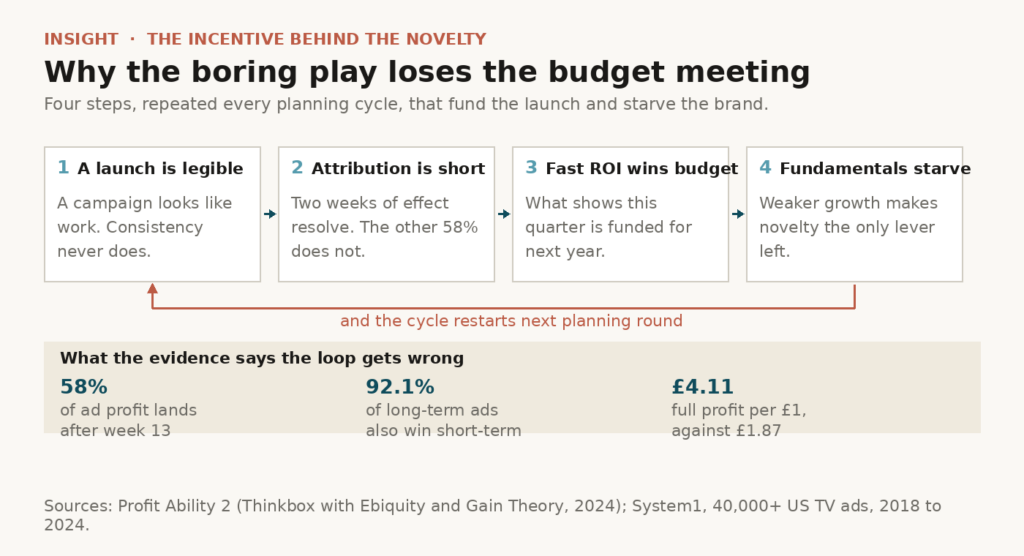
A new campaign photographs as work. There is a deck, a launch date, a set of assets, a spike in the dashboard. Twelve months of holding the same positioning photographs as nothing — it produces no artifact anyone can put on a slide. So the thing that looks like effort gets funded, and the thing that compounds gets treated as overhead.
Attribution then compounds the error. Dashboards resolve roughly two weeks of effect, while the majority of advertising profit arrives later. Profit Ability 2 puts 58 percent of it after week thirteen. A structure that only sees fourteen days will systematically conclude that brand spend did nothing, which is precisely what it concludes every year.
Then the finance logic takes over, and this is the step most leaders underestimate. Under real budget pressure, the defensible line survives and the indefensible one gets trimmed, regardless of what either one returns. In the latest Gartner CMO spend work, marketing budgets averaged 7.7 percent of revenue, and only 27 percent of CEOs and CFOs felt their CMO had exceeded expectations. Those are not conditions in which an unmeasurable request wins.
And so the loop closes. Brand investment thins out, growth gets harder to produce, and novelty becomes the only lever that still looks available — which restarts the cycle at the next planning round.
Gartner has a name for the result. Its survey of 426 senior marketing leaders found 84 percent of companies stuck in a brand “doom loop,” where underfunded measurement produces unclear impact, unclear impact breeds scepticism, and scepticism starves the next budget. Companies in that loop were half as likely to exceed growth targets. The same research predicts that by 2027, more than 40 percent of CMOs who push for larger brand budgets will lose influence with the C-suite for failing to demonstrate returns.
Read that prediction carefully, because it inverts the usual moral of the story. The punishment is not for spending on brand. It is for asking for brand money without a decision-ready account of what it did.
That reframes the fix. The exit from the loop is not a better argument about the long term. It is measurement that spans the window the money actually works over — reported the same way every quarter, whether the number flatters you or not. WARC’s work on the multiplier effect shows what happens at the other end: brands that moved from performance-only toward a combination improved returns, while brands that moved the opposite way saw median revenue ROI fall by around 40 percent.
The boring play keeps losing the budget meeting because it arrives with a stronger case and a weaker artifact. Fix the artifact.