Why Chinese and Western Ads Think Differently
Ask a Chinese marketer to write a headline and something quiet happens in the room. Not fear, exactly — more like muscle memory. The pause comes before the draft, not after it. By the time the words reach a client, they have already been trimmed twice: once for meaning, once for whatever the law will not permit meaning to say.
Ask a marketer in Chicago the same question and the pause arrives later, if it arrives at all. The instinct is to claim, to compare, to stake out the boldest defensible position and let the substantiation file catch up. Nobody in that room expects a regulator to read the draft before the audience does.
Both are reasonable professional reflexes. That is the strange part.
The thing regulation actually regulates
We usually talk about advertising law as a fence. Something on the outside, keeping the work inside a boundary. The metaphor is intuitive and almost entirely wrong, because it treats the rule as external to the creative act. In the two largest advertising markets on earth, the rule is not external. It is inside the sentence.
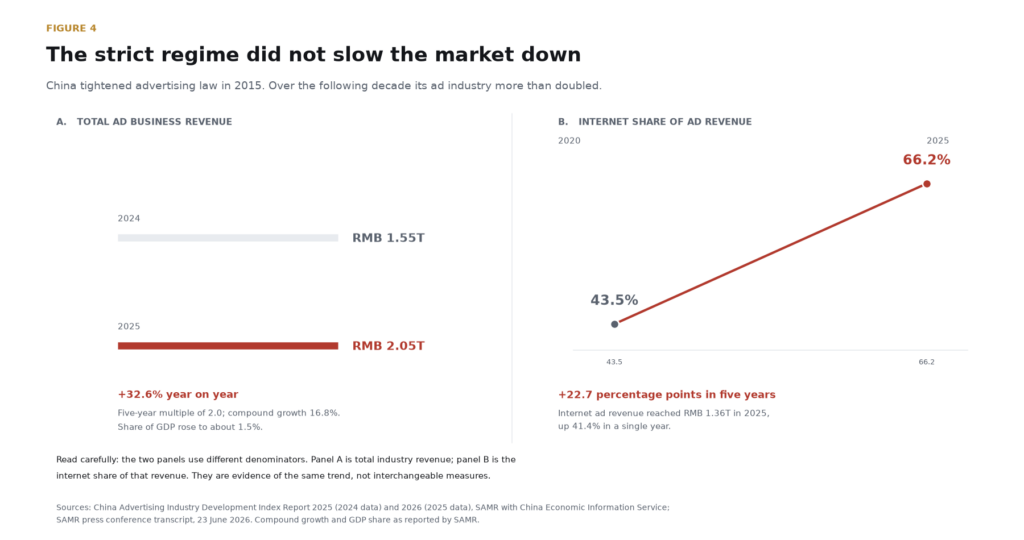
Consider the arithmetic. In 2025, China’s advertising business revenue passed RMB 2 trillion for the first time, reaching RMB 2.05 trillion — up 32.6 percent in a year, and roughly double the 2020 figure. Global ad spend, on WARC’s accounting, closed 2025 near USD 1.19 trillion. Two markets, two regulatory philosophies, both expanding at a pace that makes compliance sound like an obstacle nobody actually pays.
So the fence metaphor is not merely imprecise. It is empirically awkward. A market that screens every claim before publication and then doubles its industry in five years is not a market bent double under the weight of censorship. It is a market that has learned to do something else instead.
What the numbers refuse to say
The tempting reading — strict rules suppress commercial creativity — has no obvious evidence in the revenue line. The more defensible reading is duller and harder to market internally: regulation changes the shape of the work, not the volume of it. A market can be conservative in claim and wildly inventive in format, which is roughly what China’s looks like from the outside. Stripped of the superlative, the writer reaches for the demonstration.
Two philosophies, and why the difference is structural
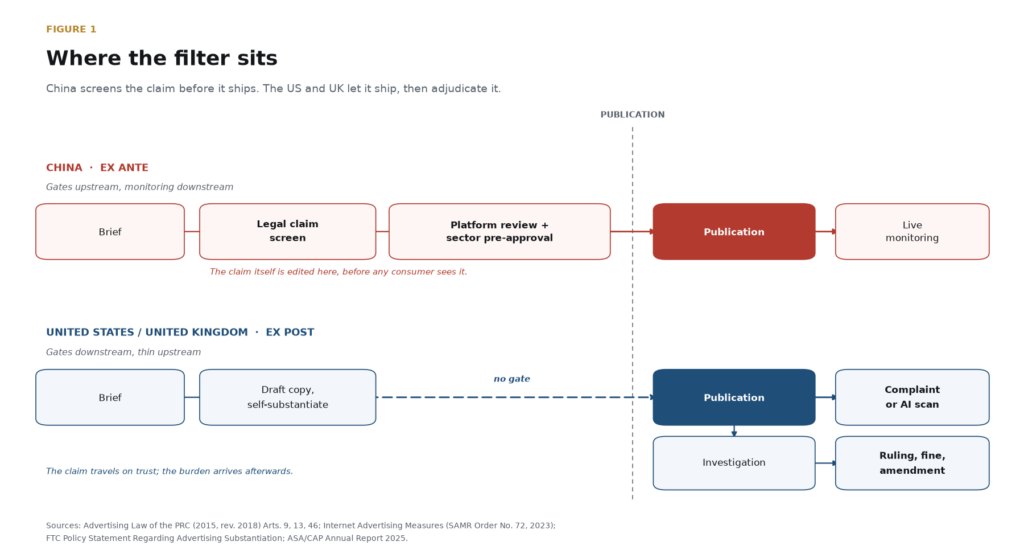
The distinction that matters is not strict versus lenient. Both regimes are strict. The distinction is temporal — where the filter sits relative to publication.
Ex ante: the sentence is screened
China’s Advertising Law prohibits, at Article 9(3), “national-level,” “highest-level,” “best,” and any term similar in meaning — a provision the State Administration for Market Regulation (SAMR) clarified in its 2023 enforcement guidance on absolute terms, which sets out the semantic test, the pointing test, and the narrow safe harbours. Article 46 requires pre-publication review of advertisements for medical services, drugs, medical devices, pesticides, veterinary drugs, and health foods, with the 2020 regulation extending the reviewed list to foods for special medical purposes. Article 13 bars disparagement of other operators’ goods or services. Article 28 defines false advertising. Articles 16 through 18 remove entire claim categories — efficacy guarantees, cure rates, comparisons against other drugs — from the medical and health-food space regardless of what the evidence shows.
Above the statute sits a layer of continuous moderation. The Internet Advertising Measures, in force since May 2023, require paid search and native advertising to be conspicuously labelled and forbid health-knowledge content from being used to slip medical advertisements through. In practice this is policed at scale. SAMR’s ten-year review records local regulators pushing platforms to revise more than 6,000 content-governance rules and to intercept over 200,000 non-compliant creative assets and product links.
The filter, in other words, runs before the audience does.
Ex post: the sentence is audited
The United States and United Kingdom have no pre-clearance gate for ordinary commercial claims. The FTC’s substantiation doctrine requires a reasonable basis before dissemination — the six Pfizer factors, the “competent and reliable evidence” standard for health claims — but the agency encounters the claim only after it has run. Britain’s ASA administers the CAP Code through complaints and, increasingly, through algorithmic scanning. The CMA’s powers under the Digital Markets, Competition and Consumers Act 2024, live since April 2025, allow direct enforcement and fines reaching 10 percent of global annual turnover — applied, always, to conduct already in market.
Line the two systems up and the difference is almost embarrassingly simple. One edits the sentence. The other audits it.
What the editing does to a writer
Here is where the cultural argument usually goes soft. Compliance-first cultures get described as “cautious,” Western ones as “bold,” and the analysis stops there, satisfied by adjectives. But caution is not a personality trait. It is a workflow outcome, and it can be traced.
China: a pre-filtered claim space
A Chinese writer works inside a claim space that has already been narrowed. The absolute superlative is gone before drafting begins, which means the boldest available move — “the best” — is unavailable at any price. What remains is comparative precision, specificity, and format. This is not a smaller canvas. It is a different one, and the work that fills it looks systematically different: less assertion and more demonstration, fewer adjectives and more numbers, less “why us” and more “here is what happened.”
The pressure shows up in the language. Chinese ad copy leans on verifiable constructions — a sales figure with a date attached, a grade certified under a national standard, a self-comparison within one product line. All of these are explicitly carved out by the 2023 guidance. A writer who internalises the safe harbours starts to think in them, and the resulting copy reads as documentary rather than promotional. That is not timidity. It is a different craft.
The West: a substantiation seatbelt
A Western writer works inside a claim space with no upper bound except later exposure. Puffery is legally sheltered in the US as non-actionable opinion — the fanciful statement no reasonable consumer would take literally. The shelter is generous but blurry, and practitioners are warned constantly that the line between puffery and a substantiable promise is not bright. The result is a culture that treats the aggressive claim as a legitimate opening move, with a substantiation file fastened like a seatbelt.
That culture has real advantages. It iterates faster, it differentiates harder, and it can afford provocation because the cost of provocation is deferred. It also has a characteristic failure mode: the claim that ships well and substantiates badly.
The cost didn’t disappear. It moved.
Second-order effects are where this gets interesting, because the two regimes do not diverge on how much compliance costs. They diverge on where the cost sits in the calendar.
Front-loaded versus back-loaded
In China, compliance is front-loaded. Legal review sits in the brief, not at the end. Claims are pre-cleared. The cost is paid in cycle time before publication — and paid again whenever an automated filter flags a term that human review already approved.
In the West, compliance is back-loaded. Teams ship faster and bolder; the cost arrives as investigation, consent order, or class action, sometimes years later, priced in legal reserves rather than calendar days.
Neither arrangement is efficient in the abstract. Front-loading buys certainty at the price of speed. Back-loading buys speed at the price of tail risk. What each regime produces is a practitioner who is good at a different thing: the Chinese marketer is excellent at the pre-mortem, the Western marketer at the post-mortem.
The tail risk is not theoretical
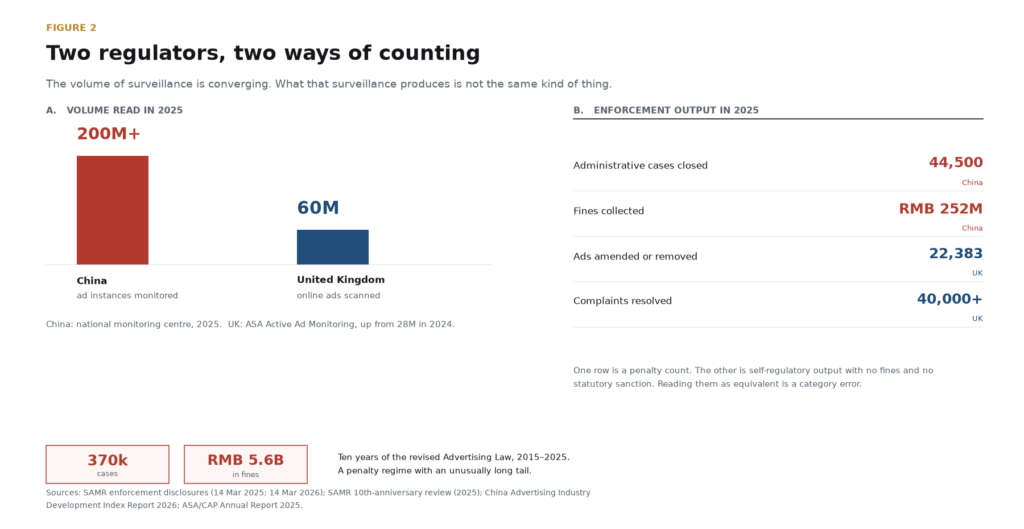
The deferred cost is easy to wave away until it lands. The FTC’s Operation AI Comply, launched in September 2024, ran straight through 2025 with cases against AI-washing and unsubstantiated earnings claims; Click Profit alone faced orders imposing more than USD 20 million in judgments over representations that its “AI-powered” storefronts would generate passive income. In Britain, the ASA’s 2025 annual report records nearly 60 million ads machine-scanned, over 40,000 complaints resolved about 25,397 ads, and 22,383 ads amended or removed — output generated largely by proactive surveillance rather than consumer complaint.
Read those two regimes side by side and the trap becomes visible. China closed 44,500 administrative advertising cases in 2025 and collected RMB 252 million in fines; the ASA amended or removed 22,383 ads and resolved 40,000-plus complaints in the same year. The numbers are similar in magnitude and completely different in kind. One is a penalty count. The other is self-regulatory output carrying no fine and no statutory sanction. Treating them as equivalent is a category error, and it is the category error most global decks commit.
The asymmetry nobody warns you about
There is a claim-ladder asymmetry that trips up global teams more reliably than any translation error. Take three sentences and walk them up the ladder.
The claim ladder, walked
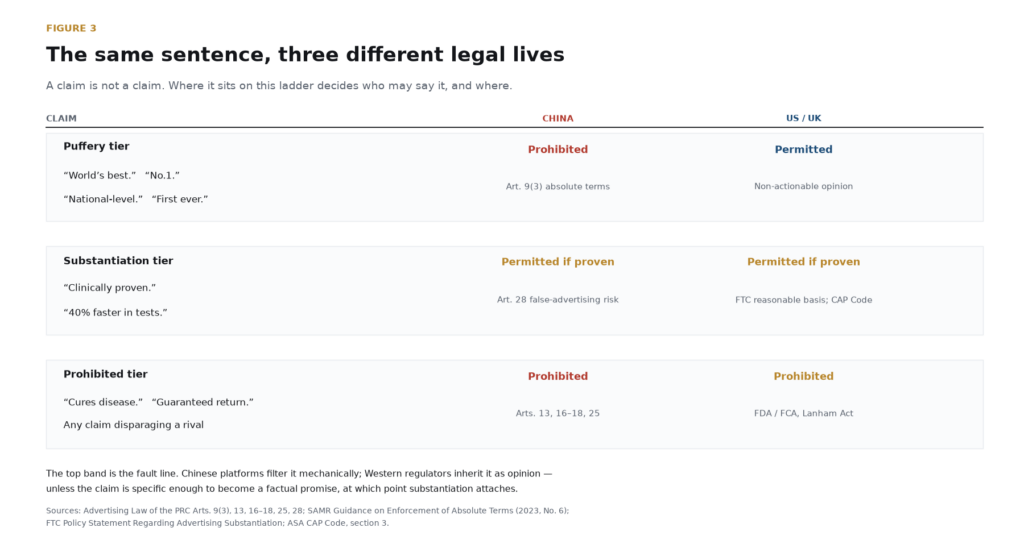
At the bottom, the prohibited tier is nearly identical across markets. “Cures disease.” “Guaranteed return.” “Our competitor’s product is defective.” All three are unlawful in China and in the US or UK — via Article 13, Articles 16 through 18 and Article 25 on one side, the FDA and FCA regimes, the Lanham Act and the CAP Code on the other. This band is not where global campaigns break.
In the middle, the substantiation tier is broadly aligned in principle. “Clinically proven.” “Forty percent faster in tests.” Both regimes demand evidence held before the claim runs — Article 28 exposure in China, the FTC’s reasonable-basis doctrine and the CAP Code’s substantiation rules in the West. The mechanics differ. The direction does not.
At the top, everything splits. “World’s best.” “Number one.” “National-level.” “First ever.” In China this is a documentary prohibition, enforced by regulators and, at scale, by platform filters. In the US and UK the same sentence is usually lawful, sheltered as opinion — unless it hardens into a specific factual promise a reasonable consumer would take literally, at which point substantiation attaches and the shelter evaporates.
The most dangerous sentence is the confident one
Which is why the riskiest line in a global campaign is rarely the obviously illegal one. It is the confident one. “The best CRM on the market” travels from a New York deck to a Shanghai creative review and becomes a legal violation in the second location without changing a syllable. Nobody lied. Nobody even exaggerated. The sentence simply changed jurisdiction, and jurisdiction is part of what a sentence means.
What this means if you write for both markets
The practical translation is less glamorous than the cultural argument, and considerably more useful.
Write the claim, don’t translate it
Rewrite, don’t translate. A single claim architecture cannot survive both regimes, because the top tier of one is the prohibited tier of the other. Regime-specific claim language is not a nice-to-have for global campaigns. It is the difference between launching and getting pulled.
Match the workflow to the regime
In China, legal belongs in the brief and pre-clearance belongs in the timeline. In the West you can move faster — but the substantiation file has to exist at the moment of publication, not the moment of investigation. The doctrine is prior substantiation. “We can prove it now” is not the same defence as “we could prove it then.”
Internalise the red lines as a list, not a principle
Principles generate debate in review meetings. Lists generate deletions. The Chinese list is concrete: superlatives, “number one,” “national-level,” unverified scientific or technical superiority, fabricated testimonials. But knowing the safe harbours matters just as much as knowing the prohibitions, because the safe harbours tell you where an aggressive claim can still legally live — self-comparison within one brand, grades certified under national or industry standards, awards granted under state rules, and time- and place-limited factual claims about sales, revenue or market share.
Design for the regime, don’t just comply with it
This is the part most global playbooks miss. A China-market campaign tends to be conservative in claim and adventurous in format — livestream, short video, interactive commerce. A Western campaign tends to be the reverse: adventurous in claim, conventional in format. Each market’s creative centre of gravity is a response to its legal centre of gravity, and the brands that win locally design to that centre rather than fighting it.
Track both rulebooks continuously
They move. China revised its Anti-Unfair Competition Law in 2025, effective 15 October, widening false-advertising exposure to misleading other operators as well as consumers, and extending commercial disparagement to “other operators” while expressly capturing those who instruct third parties to run smear campaigns. Britain’s DMCCA handed the CMA direct fining power. The FTC’s AI enforcement posture shifted from guidance to active casework. A single global compliance posture is now a lagging indicator wearing a policy’s clothes.
The reframe worth keeping
Here is the claim I would actually defend. Regulation is not downstream of culture in the way we usually assume. It sits downstream of values and upstream of behaviour, which makes it a transmission mechanism rather than a constraint. A society’s advertising rules encode what it fears — hype that misleads, or concentrated power that forecloses — and those rules then train an entire profession’s reflexes.
That has a consequence global marketers routinely underestimate: you cannot import one regulatory culture into the other. A Western marketer’s instinct to claim boldly, transplanted to Shanghai, is not confidence. It is liability. A Chinese marketer’s instinct toward safe, verifiable, carefully bounded language, transplanted to London, is not humility. It reads as weak differentiation — the brand that declined to say anything at all.
The people who win across both markets are not the ones with the best compliance checklist. They are bilingual in regulatory instinct. They know without looking it up that “best” is a factual assertion in one room and a legal hazard in the other; that speed is bought with tail risk in one market and paid for with cycle time in the other; that the creative frontier sits in a different place depending on where the filter is.
Regulation is not the fence around the playground. It is the shape of the playground — and the shape decides which games are even possible.
FAQ
Is China’s advertising law actually stricter than Western rules, or just differently timed?
Differently timed, mostly — but timing has teeth. Both regimes prohibit the same core harms: false claims, unsubstantiated efficacy, disparagement. What differs is when the state sees the claim. China screens absolute terms before publication at the platform level — automated filters reject the characters at submission — and requires administrative pre-approval for several regulated categories, including drugs, devices, health foods and foods for special medical purposes. The US and UK let ordinary claims run and adjudicate afterwards through the FTC, the ASA or the CMA. The Western substantive standard is not obviously lower. It is applied later, which changes the incentive structure for everyone holding the pen.
Why can a Chinese brand say “top-ranked” but not “number one”?
Because the prohibition targets meaning, not vocabulary. Article 9(3) bars “national-level,” “highest-level,” “best” and terms similar in meaning, and SAMR’s 2023 guidance confirms the test combines semantic proximity with whether the term points at the advertised product and could disadvantage a competitor. Ranked claims survive only when tied to a specific, verifiable time-and-place fact — sales volume, revenue or market share inside a defined window. That is why the compliant version sounds oddly bureaucratic. It is a citation, not a boast.
Does pre-publication review suppress creativity, or just redirect it?
Redirect it. The bold superlative is unavailable, so the work migrates toward demonstration: data, self-comparison within a product line, format innovation, testimonial structures that survive scrutiny. The observable pattern is a market conservative in claim and aggressive in format — livestream commerce, short video, interactive retail. Calling that “less creative” mistakes a change of register for a decline in output.
How much does the compliance tail really cost in the West?
Enough to matter at the top and unevenly at the bottom. The FTC’s AI enforcement programme produced multi-million-dollar settlements through 2025, and the UK’s DMCCA now permits fines up to 10 percent of global turnover with the CMA enforcing directly rather than through the courts. The distributional effect is the under-discussed part: large advertisers absorb a substantiation function as a line item, while smaller ones either over-comply into vagueness or under-comply into exposure.
What is the most common mistake global teams make?
Assuming a claim that cleared legal in one market is a claim. It isn’t. A claim is a legal object that exists differently in each jurisdiction, which is why “translate the campaign” fails and “rewrite the claim architecture per regime” works. The second most common mistake is treating compliance as a stage at the end of the process rather than a constraint on the first draft. In China that produces late rewrites and lost weeks. In the West it produces campaigns that ship without the file they will eventually be asked to produce.