335 vs 252: The Year the Metaverse Stopped Being a Property and Became a Channel
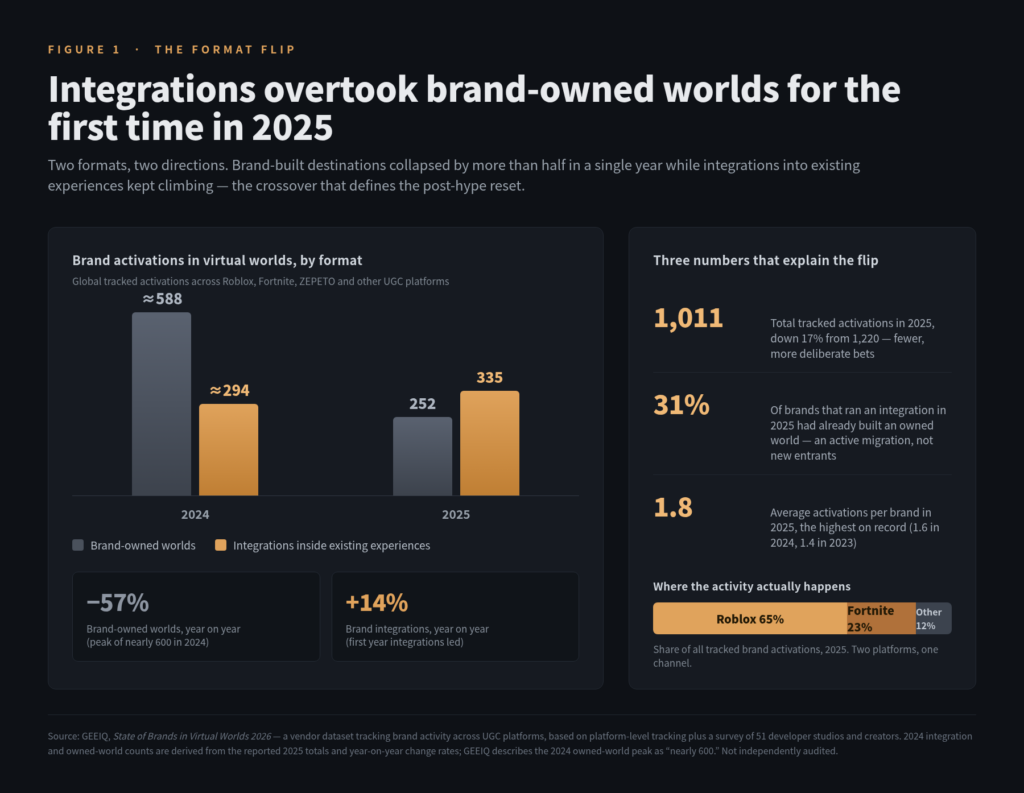
For four years the pitch was simple and seductive: build your own world, own your own destination, be the first brand with a place instead of a post. In 2025 that thesis finally got its audit, and it failed. Brand-owned worlds fell 57% year on year while integrations into worlds somebody else already ran grew 14%, and for the first time the number of integrations (335) beat the number of owned worlds (252).
The lesson is not that the metaverse died. It is narrower and more useful than that: the brand-owned world was the wrong product, bought for the wrong brief, measured with the wrong numbers. But there is a second lesson the hype cycle hasn’t absorbed yet — the platforms that survived are now correcting too. So the answer is not “pivot to Roblox.” It is to stop buying property in somebody else’s boom and start renting attention in somebody else’s community.
The Number That Ended the Argument
GEEIQ, a data platform that tracks brand activity across Roblox, Fortnite, ZEPETO and other user-generated platforms, published State of Brands in Virtual Worlds 2026 this February. Its headline finding is the cleanest inflection point the category has produced: in calendar 2025, brands launched 335 integrations inside existing experiences and 252 brand-owned worlds. Owned worlds fell 57% year on year. Integrations rose 14%.
One caveat before you build a deck on it: GEEIQ sells the measurement it reports, the figures are not independently audited, and later posts on its own blog have revised the integration count by a couple of units. Treat the direction as solid and the decimals as directional.
What the totals reveal
Here is the part most coverage skipped. Total tracked activations fell, from 1,220 in 2024 to 1,011 in 2025 — a 17% decline. This was not a category expanding. It was a category getting pickier, then reallocating what it spent.
Three numbers explain the reallocation. The owned-world count peaked at nearly 600 in 2024, then halved. Meanwhile 31% of the brands that ran an integration in 2025 had already built an owned world, which means these were experienced brands changing their minds, not newcomers arriving. And the average number of activations per brand hit 1.8, up from 1.6 in 2024 and 1.4 in 2023.
Read those together and you get a specific story: fewer brands showed up, the ones who did showed up more often, and they stopped building.
The Autopsy: Why Brand Worlds Failed
It is worth being precise about the failure, because “the metaverse was hype” is a lazy answer that teaches nothing. Four mechanisms did the work.
One: there was no reason to return
A branded world offers brand content. Players go to these platforms for friends and games. Those are different products, and no amount of production polish reconciles them. YouTube understood this a decade ago: you do not build a channel, you appear on other people’s channels where the audience already chose to be. Brands eventually reached the same conclusion about Roblox, which is why GEEIQ now describes the shift as treating UGC platforms more like YouTube and less like a social profile.
Two: the maintenance trap
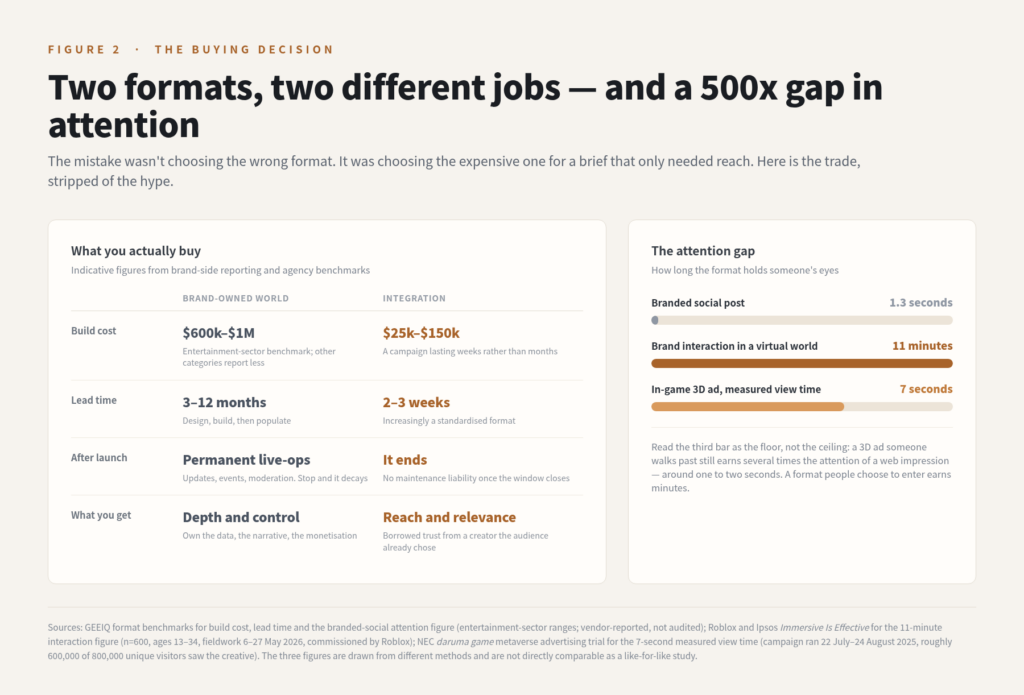
An owned world is not a campaign. It is a venue, and venues need programming. GEEIQ’s entertainment-sector benchmarks put a serious owned world at $600,000 to $1 million to build, with three to twelve months of lead time, and then permanent live operations to keep it from decaying. Most brands budgeted for the launch and not for the living.
Three: the metric that hid it
Launch-week visits are a vanity number, and they were the number everyone reported. The published attention benchmarks make the gap uncomfortable: a branded social post holds someone for about 1.3 seconds, while a brand interaction inside a virtual world averages around 11 minutes. That is a genuine advantage — but only if people come back. If the model counts arrivals, a world that got one visit from a million people looks identical to a world with a real community. It isn’t.
Four: the asset died with the platform
This is the one that hurt balance sheets. In March 2026, eMarketer reported that Meta had reversed a decision to kill Horizon Worlds on VR headsets, keeping existing worlds running “for the foreseeable future” while ending new VR development. The reversal changed nothing about sunk cost. As Paul DeMott, CTO at Helium SEO, put it in that report, for brands that invested in platform-specific experiences “those assets are close to a net loss.” Brands that built 3D assets as their own files were in “a completely different position.”
Meta has burned well over $80 billion on Reality Labs since 2020 by most estimates. The brands who built inside its walls got a fraction of that lesson at full price.
What Actually Survived — and What Didn’t
Now the part where the received wisdom breaks, including some of it in the original outline for this piece.
The three case studies everyone cites are not the three you think
Nike’s Nikeland is routinely held up as the template for brand success on Roblox. It launched in November 2021 and drew millions of visits. It also closed on 24 May 2024. Nikeland was not an integration that survived — it was the most famous brand-owned world in the world, and it was switched off. That makes it the strongest evidence for the opposite argument.
Wendy’s “Keeping Fortnite Fresh” is usually cited alongside it. That campaign ran in 2019, during Fortnite’s Food Fight mode, and it is a genuine masterclass — but read what it actually did. The brand entered an existing game as a player, spent nine hours smashing virtual freezers because frozen beef contradicted its product promise, and let players join in. Reported results: over 1.5 million minutes watched on Twitch, more than 250,000 live views, a 119% lift in social mentions, and eight Cannes Lions. It added play-value to somebody else’s world instead of building one. Note the year, though. This is a seven-year-old playbook, which tells you how little the industry learned from it.
Gucci is the third. Gucci Town on Roblox and Gucci Villa on ZEPETO were 2021–2022 activations, and Gucci later pulled back alongside most of luxury. The honest reading: these were brand-marketing experiments with real cultural value and no durable commercial model, run on a platform whose operator has now posted six consecutive years of operating losses. NAVER Z reported 54.9 billion won in 2025 revenue, down 14%, and a 45.6 billion won operating loss on a standalone basis, with roughly 100 billion won of support from parent NAVER across 2024 to 2026. ZEPETO is still live, with Korean press reporting 15 to 20 million monthly actives against a higher figure on its own site. But “still alive” and “a growth channel” are different claims.
What the data actually says survived
Integrations, and specifically entertainment IP doing both. GEEIQ tracked Universal’s Wicked franchise through three activations on Roblox in two years: an owned world to give the fandom somewhere to live around the first film, then integrations to buy reach for the second. Same IP, same platform, deliberately different formats, sequenced to the job.
Owned worlds did not die either. They narrowed. The most-visited persistent brand world in 2025 was Universal’s How to Train Your Dragon experience, ahead of the next by more than 30 million visits. Kids-and-family IP with weekly content slates still works. A one-off sneaker showroom never did.
The Integration Playbook
Four disciplines separate integrations that work from sponsored wallpaper.
Discipline one: go where the audience already is
Roblox and Fortnite absorbed 65% and 23% of all tracked brand activations in 2025 — 88% between them. That concentration is the point. You are not choosing a platform; you are choosing which community’s habits you want to borrow. And 74% of the 173 experiences that hosted integrations in 2025 did so for the first time, which means the supply of places to appear is widening well beyond the same handful of headline maps.
Discipline two: add play-value, not ad-value
The test is simple and brutal: if your brand disappeared from the experience, would the experience be worse? Wendy’s passed because smashing freezers was fun. A branded skin that changes nothing fails, no matter how good the render. GEEIQ’s benchmarks put integrations at $25,000 to $150,000 for a campaign lasting weeks — cheap enough to iterate, not cheap enough to skip the idea.
Discipline three: build portable assets
This is the discipline almost nobody practised in the first wave, and it is the one that protects you from the next platform reversal. A 3D item, a skin, an interactive product model built as your own file can move to AR filters, to a different game, to a store. A room built inside a platform that gets shut down cannot move anywhere.
Discipline four: measure the return, not the arrival
The measurable upside is real. Roblox and Ipsos ran Immersive Is Effective — 600 respondents aged 13 to 34 across Roblox, streaming and social users, fieldwork in May 2026 — finding that 52% of Roblox users spend more time attending to ads there than usual, 54% feel more engaged, and 63% remember the product information they saw, roughly 14 points better than streaming and social. A separate NEC field trial inside a Japanese Roblox game measured 7 seconds of average view time per user, against one to two seconds for standard web ads.
Be careful with those numbers. Roblox commissioned the Ipsos study, the samples are 200 per group, and the NEC trial ran for one month in one game. What they support is a direction: immersive formats buy attention that flat formats cannot. What they do not support is a return-on-investment figure. Which means your own measurement still has to be built — repeat play, dwell time, item adoption, and whether anyone came back in week six.
The Uncomfortable Part: The Platforms Are Also Correcting
Here is where this piece departs from the standard reset narrative. The temptation is to conclude that brand worlds failed but the platforms are fine, so the move is simply to reallocate toward Roblox and Fortnite.
The platforms are not fine. They are correcting.
Roblox’s third quarter of 2026, reported on 29 October: revenue up 16% to $1.572 billion, but bookings down 12% to $1.697 billion, average daily active users down 9% to 138 million, and engaged hours down 15% to roughly 34 billion. Management attributes the decline to a brutal comparison against an exceptional 2025 and points out that bookings are still up more than 50% on a two-year basis. Both things are true. The audience is enormous and it is shrinking.
Epic is in a similar spot. Fortnite still carries more than 75 million monthly players on Epic’s own count, but the company cut over 1,000 staff in March 2026, citing an engagement downturn that began in 2025, and raised V-Bucks prices by up to 25%. Creator-made islands now account for about 47% of playtime, up from 38% a year earlier, which is exactly why integrations work and exactly why the platform’s economics are shifting under everyone’s feet.
And the appetite is gone. Mediaocean’s 2026 outlook found 12% of global marketers now consider the metaverse an important trend. Generative AI sits at 70%. That is not a dip. That is a verdict on the word.
The strategic conclusion is uncomfortable but clarifying: the channel is real, the audience is real, and none of it is stable. Which is an argument for renting rather than owning, and for keeping your assets in a format you can carry out the door.
What This Means for Spatial and AI Worlds
Two technologies are about to re-run this experiment, and both will tempt brands into the same mistake.
Spatial computing has already run a version of it. Horizon Worlds was the brand-owned world thesis with a headset attached, and it cost Meta more than $80 billion to learn what the Roblox data was saying for free. The lesson transfers directly: do not build a brand headset destination. Build portable 3D assets and put them where people already are.
Generative AI is the more dangerous temptation, because it collapses the cost of building. When a world costs a prompt instead of a million dollars, “let’s build our own” becomes irresistible again, and it will be just as wrong. Cheap to build is not the same as worth visiting. If anything, collapsing production costs sharpen the audience question: when everyone can build a world, the scarce thing is not the world. It is the reason to show up.
The Brief Test: Four Questions
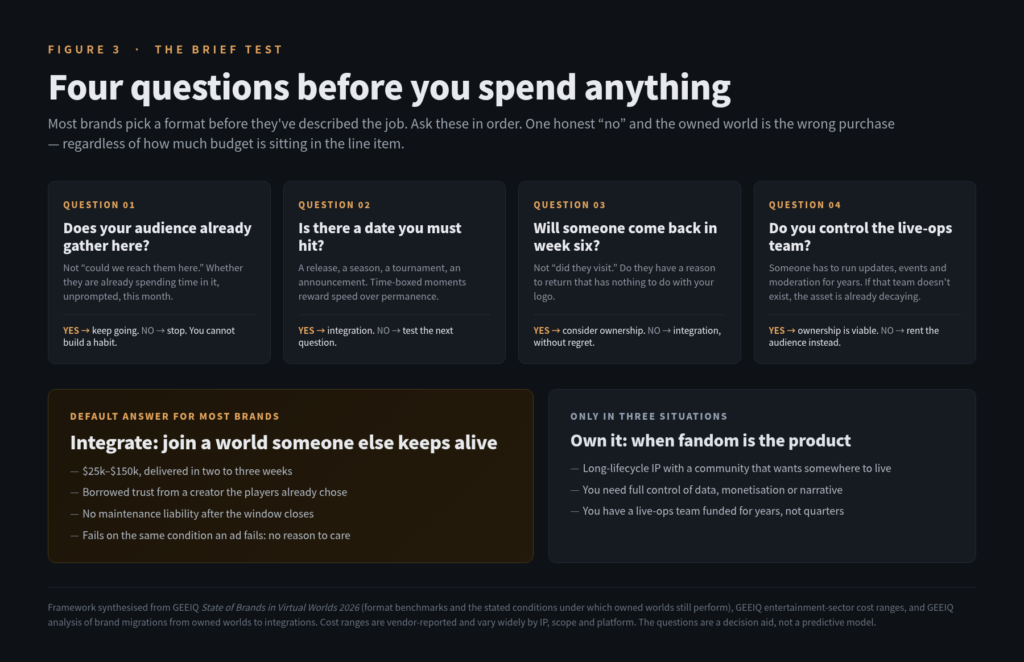
Before any budget moves, answer these in order. One honest no and the owned world is the wrong purchase.
Does your audience already gather there, unprompted, this month? Is there a date you must hit? Will someone come back in week six for reasons unrelated to your logo? Do you have a live-ops team funded for years rather than quarters?
Four yeses is rare. Three is a serious owned-world case. Two or fewer means integrate, and there is no shame in it. GEEIQ’s own analysis lists exactly three situations where ownership still wins: long-lifecycle IP with an active fandom, briefs that require full control of data or monetisation or narrative, and cases where the fandom itself is the product. Everything else is a campaign wearing a venue’s clothes.
Risks and Honest Caveats
The overcorrection. “The metaverse is dead” is wrong and expensive. 138 million daily users is not a graveyard. The format died; the channel did not.
Integrations are not free either. A lazy integration is a sponsored billboard with worse analytics. You still need an idea, and you still need to pay a creator who understands the room.
Platform dependence is real and getting worse. At 88% concentration, your integration strategy is a bet on two companies’ product decisions. The creator layer is squeezed too: 85% of creators and 87% of developer studios sign brand deals through intermediaries, not directly. Expect the middle to take its cut.
The audience fit problem. Roblox’s age-checked base is 29% adults globally and 37% in the US, and adults monetise better. That is a real shift. It is still not a B2B audience. If you sell enterprise software, none of this applies to you, and pretending otherwise is how budgets get wasted.
Conclusion
The first metaverse wave sold brands a category error: that a channel could be owned like a property. The 2025 numbers settled it — 335 integrations against 252 owned worlds, a 57% collapse in the build-your-own thesis, and a 17% decline in total activity that proves this was reallocation rather than growth.
What survived is smaller, cheaper and more honest: borrow a community’s attention, add something they would miss if you left, keep your assets in a format you can carry, and count returns instead of arrivals. The brands that failed were not badly executed. They were answering a question nobody had asked.