The Ad That Reads Your Mind Doesn’t Exist Yet. The Law Already Does.
The technology isn’t here yet. The rules are.
1. A pitch with no product behind it
Somewhere in a strategy deck right now, there’s a slide that says neuro-targeting. It has a brain on it. It probably has an arrow. And it is selling something that does not exist.
That’s worth saying plainly, because most writing on this subject either panics or advertises. The panic version says advertisers will soon read your thoughts. The advertising version says neuromarketing already works and you should buy it. Both are wrong in the same direction — they assume the capability arrived before the governance did.
It’s the reverse. The governance is arriving first.
UNESCO’s General Conference adopted the Recommendation on the Ethics of Neurotechnology on 11 November 2025, and it entered into force the next day. That was the first global normative instrument in this field. Five US states had already folded neural data into their privacy statutes by then. The European Union had banned a category of manipulative technique outright. And the actual consumer product — a headband that feeds your emotional state into an ad server in real time — is still nowhere on a shelf.
So this is a preview, not a playbook. The interesting question isn’t whether mind-reading ads are coming. It’s why regulators moved first, and what that tells you about the line you should draw now, before someone draws it for you.
2. What neuromarketing does today — and what it doesn’t
Let’s kill a myth with a number.
Nielsen’s ad-testing product runs a 32-sensor EEG cap that samples brain response roughly 500 times per second. A single fifteen-second ad execution generates about 6.24 million data points. The output isn’t a purchase prediction. It’s three curves: attention, emotional motivation, and memory activation, plotted second by second against a database of more than 10,000 ads.
That is genuinely useful, and it is genuinely not targeting. The subject is sitting in a lab, wearing a wet electrode cap, watching an ad they agreed to watch. Nobody is being served anything.
The valuable part is diagnostic. You find the four seconds where attention collapses. You find the moment the brand mark lands while memory is still active. You cut a thirty-second spot to fifteen without losing the response — a practice the industry has been doing for over a decade. It’s expensive, slow, and directional rather than deterministic.
The thing it cannot do is run inside a live auction. Lab EEG requires calibration, gel, quiet, and consent. None of those survive contact with a programmatic bid request.
Which is exactly why the consumer headband matters more than the surgical implant.
3. The hardware that actually changes the maths
Nobody is going to have a Neuralink fitted to see a shoe ad. Implants are clinical tools for paralysis and communication, and they’re regulated as medical devices, which means HIPAA-grade handling and institutional review.
The commercial vector is duller and far more consequential: earbuds, headbands, sleep masks, caps. Non-invasive, cheap, sold direct to consumer, and — critically — generally not classified as medical devices at all. Outside a clinical setting, a wellness headband is a consumer product. Consumer products don’t have to meet health-data standards.
That gap is not hypothetical. The wearable neurotech market was around $2.18 billion in 2025 and is forecast to reach roughly $5.34 billion by 2030. The narrower brain-computer-interface market sits near $1.27 billion today. Modest numbers by ad-tech standards, and growing at a rate that makes them worth watching.
Here’s the part that should concern a marketer more than the market size. Once a device is on someone’s head for eight hours a day, the data stops being a research artifact and becomes a stream. Streams get aggregated, resold, and combined with everything else you already know about a person. The question stops being can we measure this and becomes what did we just agree to do with it.
4. Four reasons neural data isn’t just “more personal data”
Most privacy arguments treat sensitivity as a dial. This data is more sensitive than that data, so turn the dial up. Neural data breaks that model, and it breaks it in four distinct ways.
It bypasses consent you thought you gave. A device can register states you never intended to disclose, because you can’t decide which neurons fire. Colorado’s legislature wrote this into the statute itself: even where someone consents to a narrow use, they’re “unlikely to be fully aware of the content or quantity of information they are sharing.”
It goes further than the requested purpose. An IEEE analysis of proposed Australian frameworks puts it cleanly — neurodata can expose cognitive states, intentions, or personal information “beyond what is specifically requested.” A click tells you what someone did. A neural signal tells you something about who they are while they did it.
It enables conditioning, not just targeting. Optimising content against a real-time emotional signal creates a feedback loop. Do that long enough and you’re no longer matching messages to preferences. You’re shaping the preferences. That’s the line between persuasion and something else, and it’s the line the EU drew in law.
And a breach can’t be undone. A leaked password gets rotated. A leaked neural profile — emotional baselines, cognitive patterns, indicators that correlate with health conditions — doesn’t reset. This is the argument that turns privacy into security, and it’s the one that gets boards to listen.
Put together, these four don’t add up to “neural data is sensitive.” They add up to neural data requiring a different rights framework, not a higher setting on the same one.
5. The regulatory clock is already running
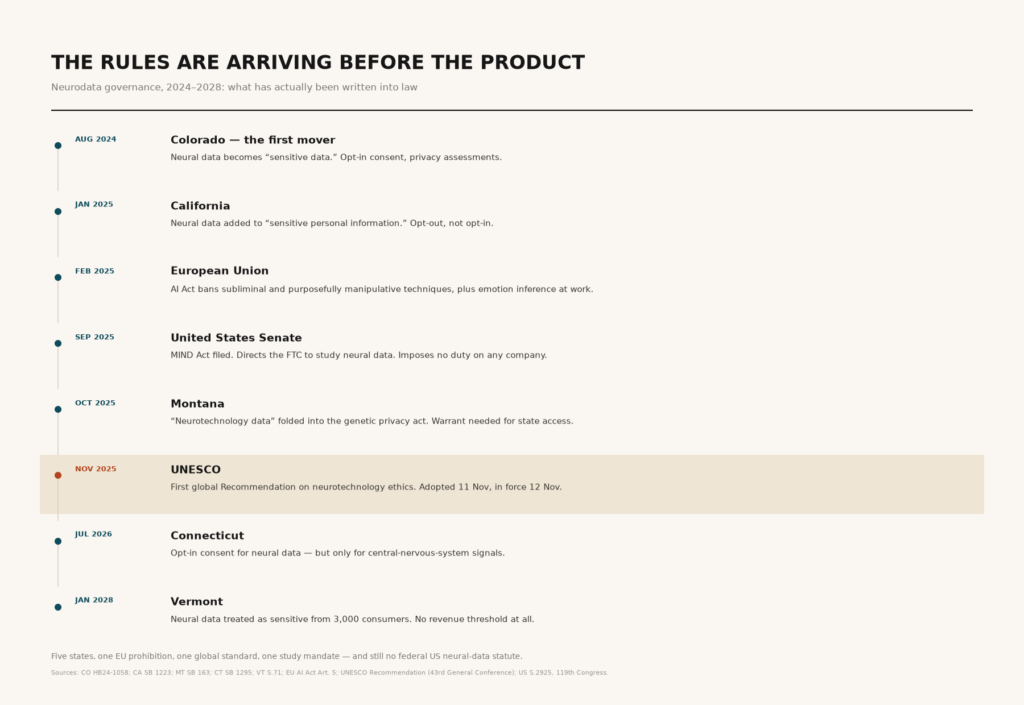
Look at that sequence and one thing stands out. Every entry is a data-protection instrument. Not one of them says advertising.
That’s the pattern worth internalising. Regulators didn’t write neuromarketing rules, because neuromarketing as a commercial practice doesn’t exist yet at scale. They wrote data rules, because consumer EEG devices do. The marketing constraint is a side effect of the privacy constraint — and side effects are harder to argue with, because nobody drafted them with you in mind.
6. Europe drew one hard line
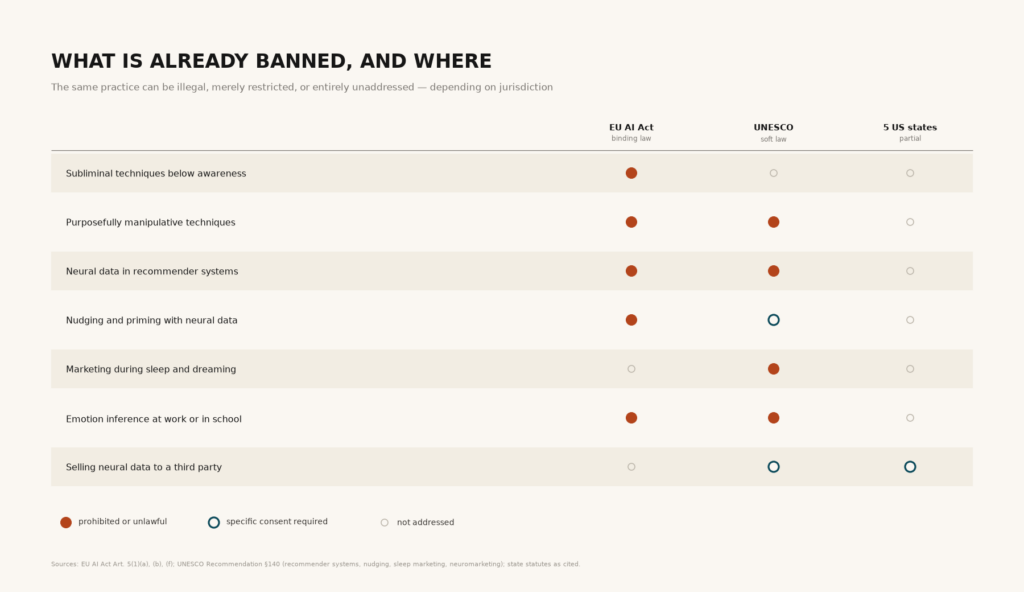
The EU AI Act has been in force since 2 February 2025, and Article 5 contains two prohibitions that land directly on this territory.
The first bans AI systems deploying subliminal techniques beyond a person’s consciousness, or purposefully manipulative or deceptive techniques, with the objective or effect of materially distorting behaviour in a way that causes significant harm. The Commission’s own guidance is explicit that the bar is high — all conditions must be met — and that personalising ads from stated preferences is “not inherently manipulative.”
Read that carefully, because it’s the most useful sentence in the whole regulatory corpus. Personalisation is fine. Manipulation below the threshold of awareness is not. The dividing line isn’t data volume or targeting precision. It’s whether the person could, in principle, notice and resist.
The second prohibition is narrower and sharper: AI systems inferring emotions in the workplace and in education are banned outright, outside medical or safety reasons.
Penalties reach €35 million or 7% of worldwide turnover, whichever is higher. That’s not a compliance line item. That’s a board-level number.
7. America wrote five small ones
The American approach is a patchwork, and the patches don’t line up.
Colorado got there first, in August 2024, defining neural data as a form of biological data — but only where it’s used or intended for identification. California followed in January 2025 with the strongest-sounding label and the weakest mechanism: neural data became sensitive personal information under the CCPA, which means a right to limit use, not a requirement to ask first. Montana, in October 2025, bolted neurotechnology data onto its genetic privacy act and added something none of the others have — a warrant requirement for government access. Connecticut, from July 2026, requires opt-in consent but only for central-nervous-system signals, which quietly excludes a lot. Vermont, effective January 2028, applies from 3,000 consumers with no revenue threshold at all, and treats neural data as sensitive with an opt-in default.
At the federal level? A study bill. The MIND Act, filed in September 2025, directs the FTC to examine neural-data governance, allocates $10 million, and requires a report to Congress within a year. It imposes no obligation on any company. That’s not a criticism of the bill — a study is a sensible first move. It’s just worth being clear that “Congress is acting” currently means “Congress is reading.”
And Chile, which outsiders often cite as the model, is genuinely further ahead: a 2021 constitutional amendment, and then in 2023 a Supreme Court ruling ordering a consumer EEG company to delete a user’s brain data. That’s the only place where a court has actually made someone delete something. Mexico’s constitutional initiative, by contrast, was presented in March 2026 and remains pending — it’s a proposal, not law, and shouldn’t be described otherwise.
8. The definitional trap
Here is the flaw nobody drafted around.
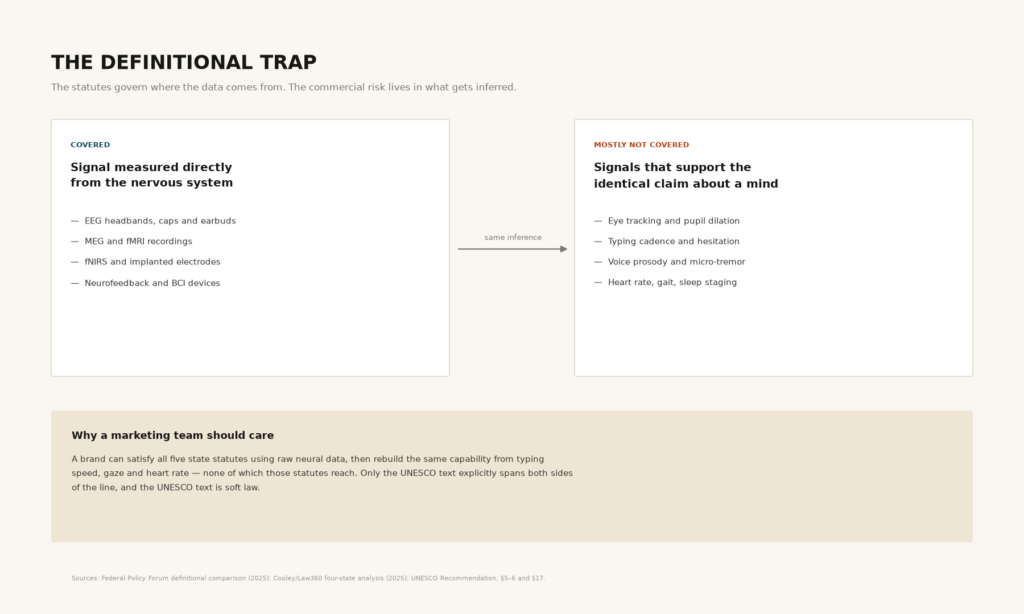
Every state statute defines neural data by its origin: information generated by measuring the activity of the nervous system. Reasonable. Intuitive. And porous.
Because you can reach the same conclusion about someone’s emotional state from pupil dilation, typing hesitation, vocal micro-tremor, heart-rate variability, gait, or how they sleep. None of that is a nervous-system measurement. All of it lands in the unprotected column. California even writes the exclusion in explicitly — information inferred from non-neural data is out of scope.
So a brand can comply perfectly with all five statutes while using raw EEG data, then rebuild functionally the same capability from a keyboard and a webcam. The compliance file looks clean. The inference engine is identical.
Only the UNESCO text spans both sides. Its definitions explicitly extend to “indirect neural data and non-neural data allowing mental states inferences” — eye tracking, typing dynamics, voice analysis, gait, skin conductance, facial emotion recognition — and its scope section applies the same principles across them. That is the most technically sophisticated thing in the entire corpus.
It’s also soft law. Non-binding. Advisory. Which is the whole problem in one sentence: the best-designed instrument has the least enforcement.
9. What the privacy policies actually promise
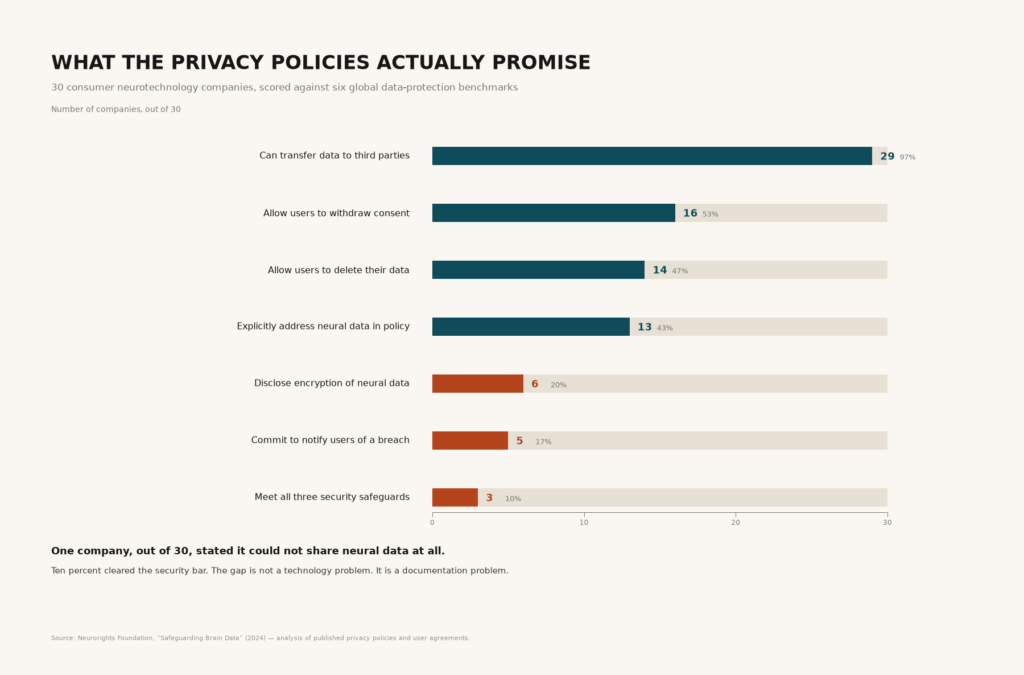
Now the ground truth, from the Neurorights Foundation’s 2024 audit of thirty consumer neurotechnology companies — the only systematic review of what these firms actually publish.
Twenty-nine of the thirty can transfer data to third parties. Sixteen let you withdraw consent. Fourteen let you delete anything. Thirteen mention neural data in their policies at all, which means the other seventeen are collecting brain signals under documents that never name the category. Six disclose encryption. Five commit to telling you if they’re breached. Three meet all three security safeguards.
One company, out of thirty, stated it could not share neural data.
This is the gap that matters, and it isn’t technological. It’s documentary. The devices work well enough to sell. The paperwork hasn’t caught up, and the paperwork is what regulators read first.
If you’re procuring a neurotechnology vendor for a research brief, that audit is your due-diligence checklist. Ask which of those seven questions your vendor answers in writing.
10. The workplace is the live test case
Forget advertising for a moment. The coercion problem already shipped, and it shipped somewhere else.
China has deployed EEG monitoring in operational settings since at least 2014 — sensors in caps and helmet brims, feeding emotional and fatigue states to supervisors, with reported use across factories, state utilities, and high-speed rail drivers on the Beijing–Shanghai line. Reported outcomes include workers sent home when a score dipped, and one state utility attributing a substantial profit increase to adjusted break scheduling.
You can argue about accuracy. Independent neuroscientists have been sceptical for years about reading emotional states from EEG outside a calibrated lab, and they’re right to be. But accuracy isn’t the point. The point is the power relationship. When your employer makes you wear the sensor, “consent” is a word doing very little work.
That’s why the EU’s workplace emotion-inference ban matters beyond Europe, and why UNESCO’s text explicitly targets workplace monitoring and profiling. Both are treating employment as the place where voluntary consent goes to die — which is the correct instinct, and the one most likely to be tested in court first.
Marketers should read this as an early warning. The same argument — they couldn’t really refuse — will be made about consumer devices bundled into services people need.
11. Three honest caveats
The hype is real, and it runs both ways. Reverse inference is the field’s chronic disease: a brain region lights up, so we conclude the person felt a specific emotion. Regions do many things. The stronger critique of neuromarketing isn’t that it’s sinister — it’s that parts of it are oversold, and overselling invites the wrong regulation. UNESCO’s own text tells member states to police fraudulent or misleading claims about what these devices can do, which is a rare instance of a regulator anticipating vendor exaggeration rather than chasing it.
Decoding is advancing, but under constraints. Recent MEG work has pushed non-invasive sentence decoding to around a 39% word error rate across nine subjects, each recorded for ten hours; earlier work identified the right three-second speech segment out of a thousand candidates about 41% of the time on average, and over 80% for the best participant. Impressive. Also: magnetically shielded rooms, per-subject training, and hours of calibration data per person. The distance between that and a live ad impression is not a gap that closes quietly.
The medical upside is the reason to be careful, not the reason to relax. Implants restoring speech to people with ALS are among the best things happening in this field. Over-regulating the category because advertising might misuse it would be a real harm to real patients. The tool is neutral. The targeting is the choice. Keep those separate or you’ll lose the argument with the people who matter.
12. Five commitments to make before you’re asked
You don’t need a neurotechnology budget to need a position. Here’s what holds up.
Treat neural data as the highest tier, not a high tier. Explicit, granular, separately obtained, revocable. Never bundled into terms of service. Never inferred as a substitute for asked. And if you’re relying on an inference rather than a measurement, say so in the consent flow.
Refuse subconscious conditioning as a design goal. Optimising creative against attention and memory is research. Optimising delivery against real-time emotional state to build a response loop is conditioning. Persuasion is legitimate. Conditioning isn’t. Write that sentence into your creative brief template and you’ll be surprised how often it gets tested.
Purpose-limit ruthlessly. Data collected for a lab study does not become ad-targeting material because it’s technically available. The Chilean case turned on precisely this: consent to record for one purpose was held not to be consent for another. That reasoning will travel.
Assume the database gets attacked. UNESCO’s text calls for uniform cybersecurity standards, security-by-design, encryption, and red-teaming. Only 20% of the audited companies even mention encryption. Being in that 20% is a procurement advantage right now and a legal necessity soon.
Build a real exit. Not a settings page four menus deep. Users need to know when neural data is in play and leave without losing the product. UNESCO’s recommendation goes further than most companies will like: multifunction devices must let users disable neuro-features while keeping the basic function working. That’s the design standard to aim at.
The line you draw is the one that sticks
Here’s the uncomfortable asymmetry. The technology is early enough that no one can prove harm at scale, which means the industry’s preferred defence — show me the damage — will keep working for a while. But the rules are being written now, by people who won’t wait for the damage.
UNESCO’s recommendation isn’t binding, and it won’t be enforced by anyone. That’s exactly why it matters: soft law that later becomes the template for hard law. The 2021 AI ethics recommendation is the obvious precedent, and the EU AI Act is what happened next.
So the calculation is simple. Brands that engage with this now shape the definitions — what counts as neural data, what counts as manipulation, where the inference line sits. Brands that wait get defined. And the definition will be written by someone who has never had to ship a campaign.
The mind is the last private space left. Nobody has successfully monetised it yet. The only thing that’s certain is that the first brand to try will be remembered for trying, and not in the way its CMO hoped.
Draw the line before it’s drawn for you. That’s not ethics as restraint. That’s ethics as competitive positioning.