AI Is Building Apps Faster Than Anyone Can Market Them. Liftoff Wants That Job.
The mobile ad company is pitching Wall Street on a simple thesis: AI is making apps faster than anyone can market them — and somebody has to.
Liftoff Mobile (NASDAQ: LFTO) reported third-quarter revenue of $238 million on November 12, 2026, up 32% year over year and $16 million above the top end of its own guidance. Net income came in at $87 million, reversing a $6 million loss a year earlier; adjusted EBITDA rose 45% to $145 million at a 61% margin; free cash flow more than tripled to $93 million. The stock jumped roughly 25% after the print and kept climbing — closing up 30.6% at $24.44 on Friday, its third straight day of gains.
It was the company’s twelfth consecutive quarter of revenue growth, and only its second quarterly earnings report as a public company. But the number that explains the story isn’t on the income statement. On the call, CEO Jeremy Bondy said new apps released in the Apple App Store in the first half of 2026 doubled versus the prior year to roughly 560,000 — a supply boom he attributes directly to AI coding tools lowering the barrier to building an app.
“Every new app is another business competing for attention, and every one of them needs to find new users,” Bondy said. “For Liftoff, that means more demand for user acquisition.”
Three tailwinds, one honest caveat
Liftoff’s pitch to investors rests on three AI-linked mechanisms:
- More apps, more acquisition demand. The 560,000 first-half figure is the headline evidence.
- Discovery is moving. AI answers questions without sending people to websites, which pushes businesses toward owning their own apps and direct customer relationships. Bondy also pointed to Apple’s iOS 27 tracking changes as another drag on the mobile web — a theme AppLovin echoed in its own earnings a week earlier.
- Cheaper intelligence. Liftoff’s Cortex prediction engine — which makes roughly a billion predictions per second about which ad to show, to whom, at what price — got better this quarter at valuing users who generate revenue by watching ads, while infrastructure costs keep falling as a share of revenue. CFO Tarek Kutrieh said there is “really no structural reason” to expect that decline to stop.
The caveat, stated by Bondy himself: AI apps were not yet a significant driver of Q3 results. The thesis is forward-looking; the quarter was carried by broader app-economy strength across social media, entertainment and finance, plus event-driven spikes (World Cup momentum, NFL season). More than half of advertiser revenue now comes from outside gaming — notable in a category where AppLovin, roughly 40 times Liftoff’s market cap, dominates.
The monetization gap is the real bull case
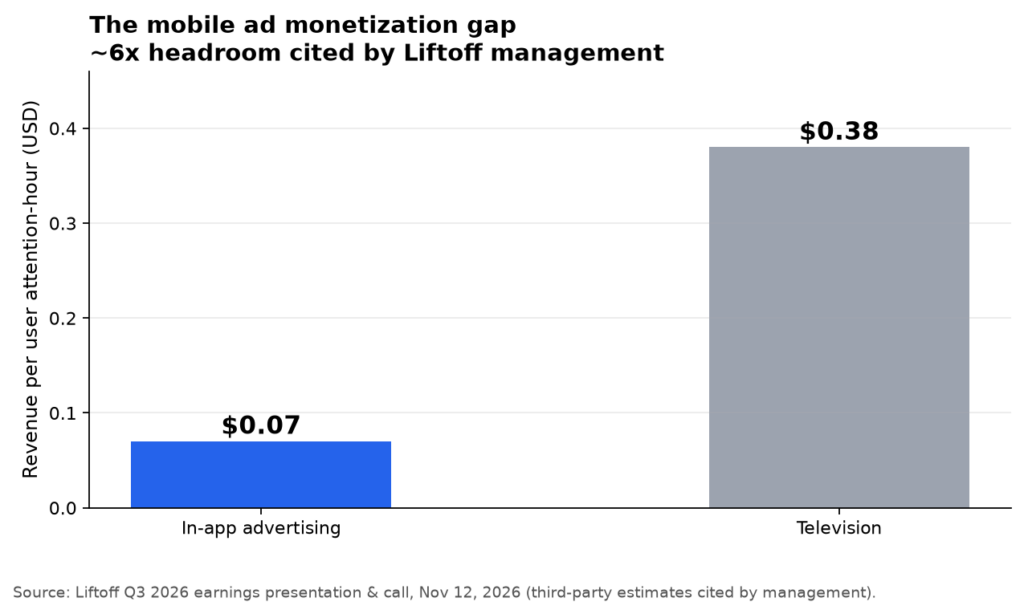
The most interesting number on the call was a comparison: third-party in-app advertising currently earns about $0.07 per user attention-hour, versus roughly $0.38 for television — a six-fold gap. If attention keeps shifting to apps while monetization per hour stays that far behind TV, the runway is structural, not cyclical. Management’s conclusion: “a long runway with room for multiple scaled high-growth players.”
Customer metrics support the durability argument: 396 customers spent more than $100,000 over the trailing twelve months, up from 362; existing customers contributed 55% of core advertising growth, new customers 45%. The company raised full-year guidance to $907–912 million in revenue (about 32–33% growth) and $547–551 million in adjusted EBITDA, with Q4 revenue guided to $244–249 million.
What could go wrong
Three risks are worth naming. Non-gaming verticals are more seasonal than gaming — Liftoff is surfing event waves rather than riding a predictable cycle. The 560,000-app figure is management’s citation of App Store data, and “more apps” does not automatically mean “more apps with acquisition budgets”; much of the AI-built long tail will never spend on ads. And the stock’s three-day surge prices in a lot of the thesis already — Wedbush raised its target to $29, but the November 30 shareholder lock-up expiration is a near-term supply event traders will watch.
Still, the quarter lands as one of the cleaner pieces of evidence for a specific claim: AI’s first measurable advertising boom may not be AI-generated ads at all. It may be the flood of AI-built apps that all need the same thing — users.