44% of Brands Run AI Agents. Only 19% Can Tell Their Ad Platform What Happened.
A new survey of 451 U.S. marketers finds the industry is deploying conversational AI faster than it can measure it — and the bidding algorithms are flying blind.
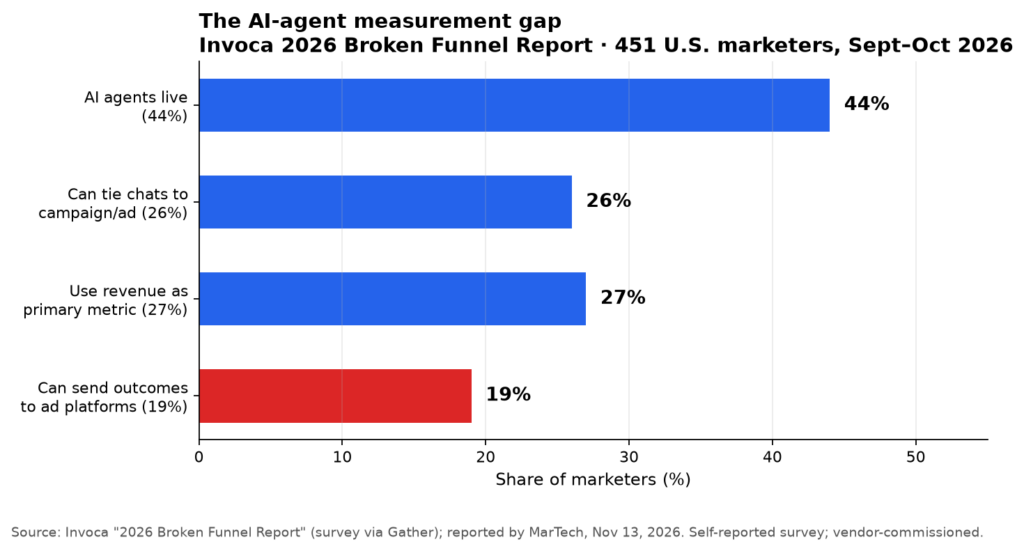
Forty-four percent of B2C marketers already have conversational AI agents live in at least one channel, and another 27% are piloting them. But only 19% of the brands running agents can reliably send the resulting conversion data back to their advertising platforms. That is the central finding of Invoca’s “2026 Broken Funnel Report,” based on a survey of 451 U.S. marketers at companies with 100 or more employees, conducted September 14–October 5, 2026.
The gap matters because Google and Meta optimize bids on the conversion signals advertisers send them. If an AI agent books an appointment or closes a sale but the ad platform never hears about it, the algorithm keeps optimizing for whatever it can see — a form fill, a chat started — and buys more of those. The agent looks busy. The budget learns nothing.
The funnel breaks in four places
The report maps where visibility dies:
- 74% of marketers cannot fully track a lead from first digital interaction through conversion.
- 56% lose attribution when a lead reaches a dealer, franchise or local branch — the single biggest break point.
- 46% lose it in text or chat handoffs; 40% on phone calls.
- Only 26% can tie an agent conversation back to the campaign, keyword or ad that produced it, and only 21% say they can both see and influence leads all the way through conversion.
The scorecards are equally telling. Only 27% of marketers running agents use revenue or booked outcomes as their primary measure. The rest grade agents on customer satisfaction (20%), qualified leads and conversation volume (16% each), containment, cost per contact — metrics that describe activity, not business. As Invoca CEO Gregg Johnson put it: “Too many consumer brands measure their AI agents like a help desk and expect them to perform like a sales team.”
There is a context problem too: only 27% say their agents can see and use the customer’s prior digital journey — the ad clicked, the pages visited, the cart contents. The most-requested capability, cited by 43%, is exactly that: tailoring the conversation to the buyer’s journey. An agent without that context treats a returning, half-decided prospect as a stranger.
The twist: AI is already winning the lead-quality argument
The same survey found that 44% of marketers say AI answer engines — ChatGPT, Claude, Gemini — produce their most qualified leads, ahead of Google Local Services Ads (40%), organic search (39%), paid social (37%) and paid search (36%). Eighty-six percent can identify at least some leads that began research in an AI answer engine.
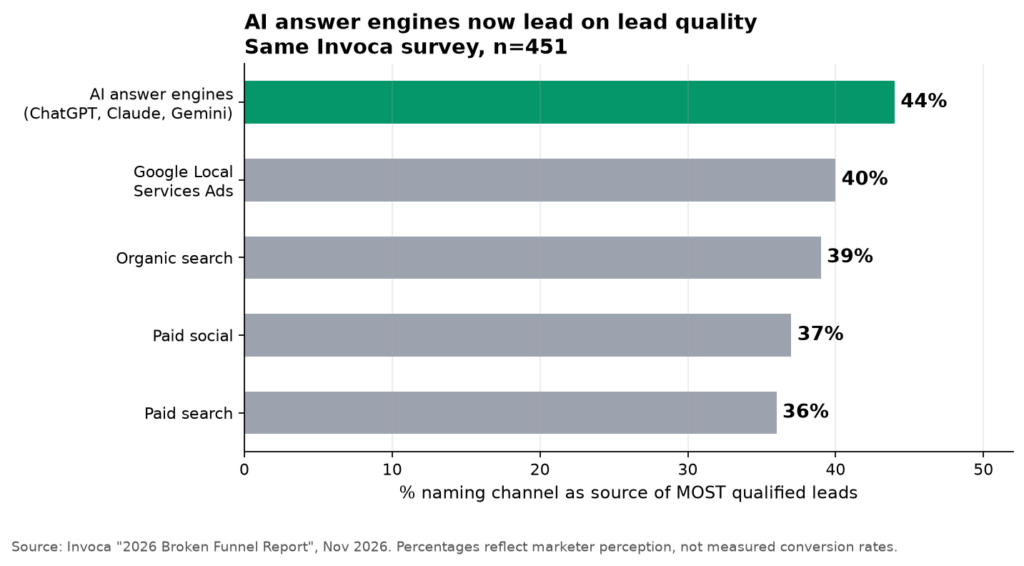
So the picture is awkward: AI is increasingly where good leads start, an AI agent increasingly handles the next conversation, and the sale increasingly happens somewhere the media system can’t see. Each step can look successful in isolation while the overall return on ad spend stays unexplained.
Read the numbers with the right caveats
This is vendor-commissioned research: Invoca sells precisely the remedy it describes — journey data for agents, conversation-to-campaign attribution, and outcome feeds back to ad platforms — and released matching products in October. Every figure is self-reported; the survey does not measure whether agent-handled leads actually convert better or worse than human-handled ones. The directional finding (deployment outpacing measurement) is credible and consistent with other attribution research; the precise percentages should be treated as one vendor’s snapshot, not industry census.
What to do with this on Monday
- Audit your outcome feed. List every conversion event your agents produce and check which ones actually reach Google/Meta. If the answer is “none,” your bidding is optimizing on proxies.
- Fix the handoff, not just the chat. The biggest attribution break is at the dealer/branch/local step. Offline conversion imports and CRM stitching matter more than another chatbot feature.
- Change the scorecard. Move the primary agent metric from satisfaction or containment to booked outcomes or revenue, even if the number is initially ugly.
- Give agents context. Passing the click-to-session journey into the conversation is the highest-demand capability in the survey — and a prerequisite for honest measurement.
The agent race has moved past deployment. The harder work is connecting what the agent knows, what the customer does next, and what actually produces revenue — and then telling the algorithm about it.