We Saved 47 Hours a Writer and Got Worse Results
Every content team I have looked at closely measures the wrong thing. They measure hours spent writing. Nobody measures hours spent waiting for someone else to say yes.
That gap explains a result that should not be possible. Over four years, the average blog post got roughly 50 minutes faster to write, AI adoption climbed past 92%, and the share of marketers reporting strong results fell from 26% to 13.9%. The industry saved about 47 hours per writer per year and got materially worse.
Here is the mechanism, and it is not a marketing opinion. It is queueing theory.
The nonlinear part nobody budgets for
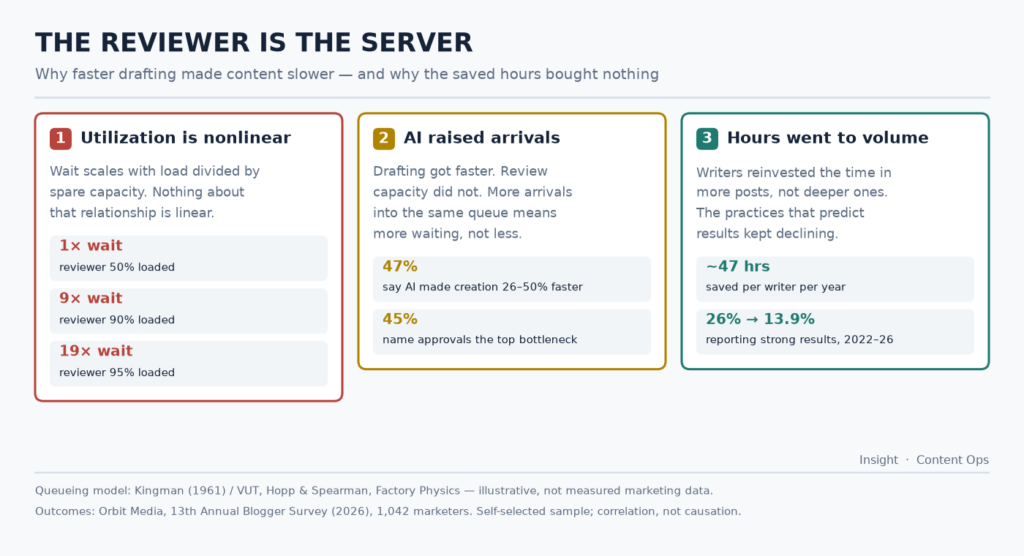
In Kingman’s approximation — the VUT equation in Hopp and Spearman’s Factory Physics — average wait scales with utilization divided by spare capacity. At 50% load, that term is 1. At 90%, it is 9. At 95%, it is 19.
Your reviewer is the server. And no headcount plan I have ever seen includes review capacity.
So when AI doubles drafting throughput, it does not double output. It raises the arrival rate into a queue whose service rate never changed. The reviewer crosses from comfortable to saturated, and wait time goes vertical. Little’s Law finishes the argument: work-in-progress equals throughput times cycle time. Push more in without pushing more out and cycle time simply grows.
The teams that got fastest at drafting often got slowest at publishing. That is not a paradox. That is arithmetic.
Where the saved hours actually went
This is the part that stings. Writers did not bank those 47 hours. They spent them on more posts.
Orbit’s thirteen-year data shows what declined instead: influencer collaboration fell from 25% of marketers in 2017 to 7%, and it remains the strongest predictor of strong results at 2.6× the benchmark. Formal human editing beats the benchmark by nearly 2×; AI-only editing falls below it. Original research improves the odds by about 50%.
Every practice that predicts performance is effortful, human and hard to copy. Every one of them lost ground while volume rose.
We removed the effort that was actually producing the return, and kept the effort that was already commoditized.
The incentive that locks it in
Why does nobody fix this? Because the metrics reward the wrong side of the queue. Drafting output is visible, countable and attributable to a person. Review latency is invisible, distributed and attributable to nobody. A writer who ships twelve posts looks productive. A director who approves nothing for nine days looks busy.
Stensul’s survey of 300+ US and UK practitioners found 44% cite heavier review as the top consequence of a campaign error. So each mistake adds a permanent approval layer, and the ratchet only turns one way.
The fix is not another tool. It is putting review capacity on the plan, naming one approver, and protecting the slow work on purpose.