The Bottleneck Was Never the Writing. It Was the Waiting.
You know this feeling. The writer handed in a genuinely good piece. The design was done. The SEO title was settled. And then the thing sat — in someone’s inbox, in a review thread, in a Slack channel where four people were tagged and none of them owned it.
When it finally went live, the news hook it was built around had already gone cold.
We tend to diagnose this as a talent problem or a tooling problem. It is neither. It is a queueing problem, and the distinction matters because you cannot hire your way out of a queue. Content ops is the discipline of treating idea-to-publish as an operating system with owners, deadlines and decision rights — rather than a series of favors you ask busy people for.
Here is the uncomfortable twist the latest data forces on us: fixing the queue is necessary, but speed alone will not save your content program. The teams that got faster over the past four years also got worse. Both things are true, and any honest playbook has to hold them at once.
Where the Pipeline Actually Bottlenecks
Ask a room of content leaders where work gets stuck and most will say drafting. The survey data says otherwise.
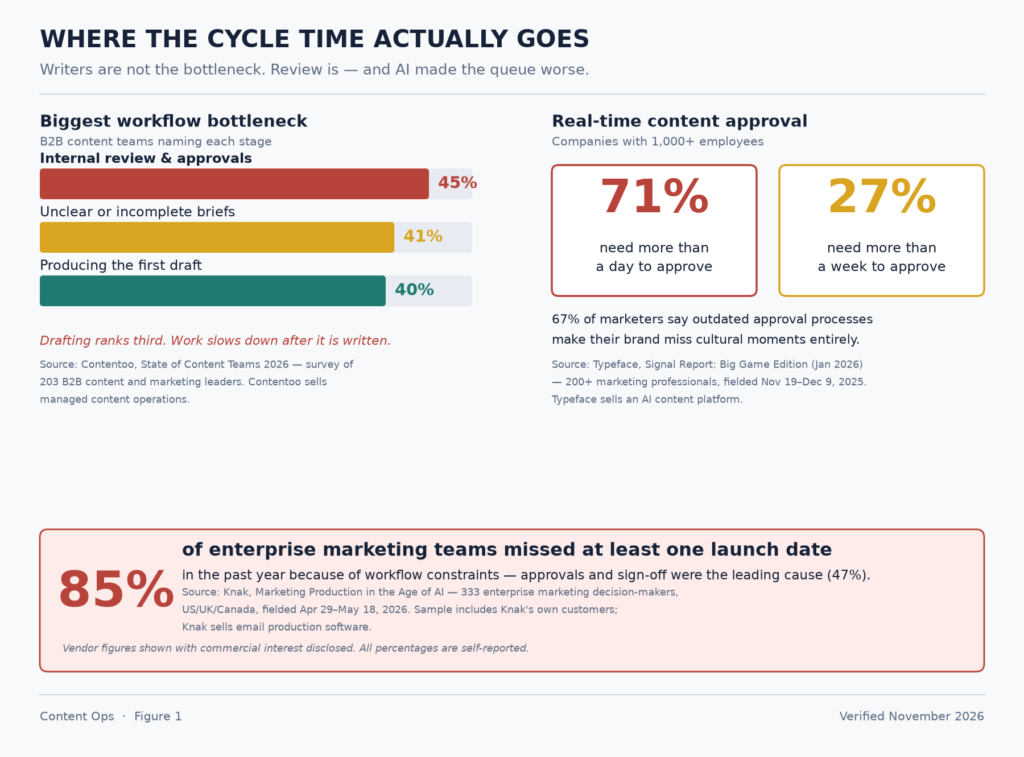
Contentoo’s State of Content Teams 2026 research asked 203 B2B content and marketing leaders to name their biggest workflow bottleneck. Internal review and approvals came first at 45%. Unclear briefs followed at 41%. Producing the first draft came third at 40%.
Read that ordering again. The stage everyone wants to automate is the stage that causes the least friction.
A caveat you should carry through this whole piece: Contentoo sells managed content operations, so a study concluding that operations is the problem is not disinterested. But the finding is corroborated independently, and the direction is consistent across every credible source I could verify.
Why Drafting Speed Stopped Mattering
Typeface’s Signal Report: Big Game Edition surveyed more than 200 marketing professionals between November 19 and December 9, 2025, at manager-to-VP level. Among companies with more than 1,000 employees, 71% need more than a day to approve quick-turn content, and 27% need more than a week. Overall, 67% say outdated review and approval processes cause their brand to miss cultural moments entirely.
Meanwhile 87% of those same marketers say AI helps them create content faster.
So we accelerated the fast part and left the slow part untouched. That is not a productivity gain. That is a longer line at the same closed window.
Knak’s Marketing Production in the Age of AI study put a price on it. Surveying 333 enterprise marketing decision-makers across the US, UK and Canada between April 29 and May 18, 2026, it found 85% of enterprise teams missed at least one campaign launch date in the previous year because of workflow constraints — with approvals and sign-off the leading cause at 47%. Knak sells email production software and its sample includes its own customers, so treat the magnitude with care. The mechanism still holds.
The Approver Math Nobody Does
Here is where I want to leave marketing surveys behind and borrow from operations science, because this part is not a matter of opinion.
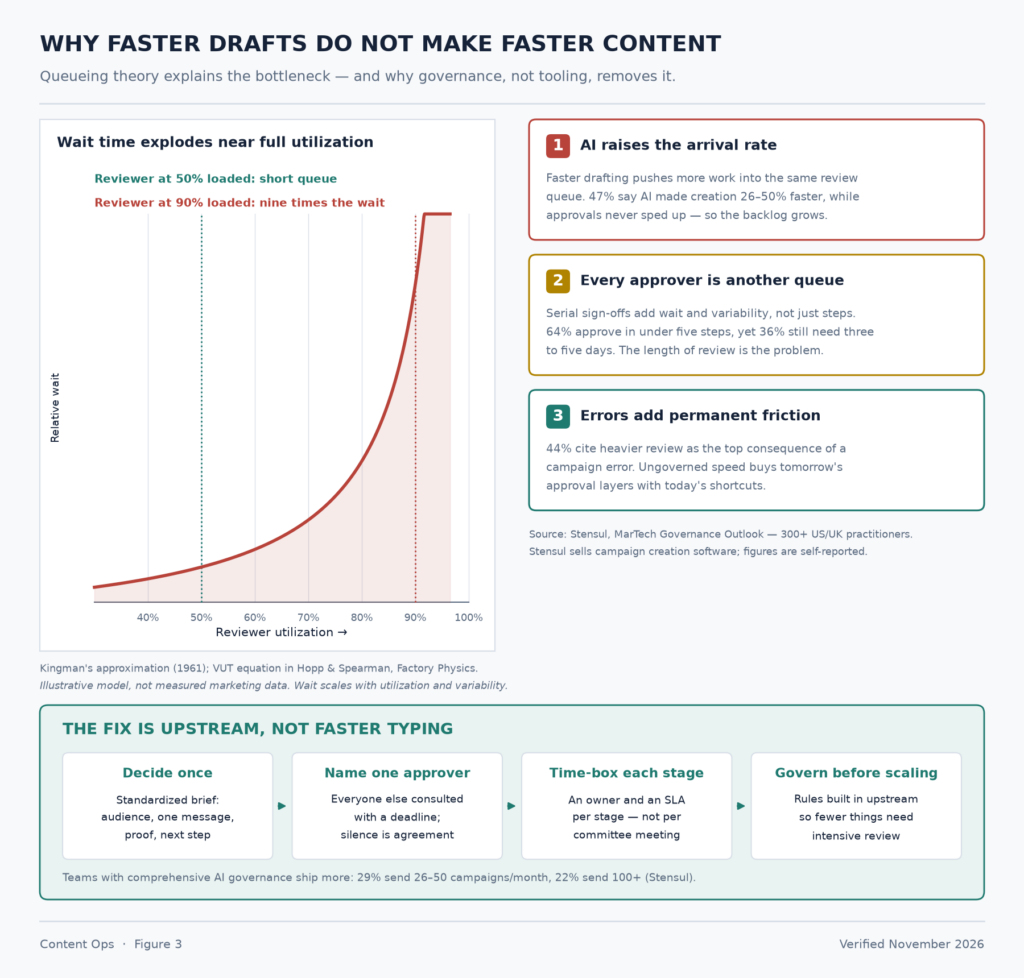
In queueing theory, Kingman’s approximation — later formalized as the VUT equation in Hopp and Spearman’s Factory Physics — describes average wait time as a function of three things: utilization, variability, and service time. The utilization term is the killer. Wait time scales roughly with ρ/(1−ρ), where ρ is how loaded the server is.
At 50% utilization, that term equals 1. At 90%, it equals 9. Approaching full load, it goes vertical.
Your reviewer is the server. And nobody ever puts review capacity on a headcount plan.
One more distinction worth naming, because it is where most teams misdiagnose themselves. There is working time and there is calendar time. Working time is the hours a human spends on the piece — the interview, the draft, the edit, the graphic. Calendar time is the days between the idea and the URL going live. Orbit measures the first. Your stakeholders experience the second. When a VP says content takes three weeks, she is not disputing that the writing took three hours and twenty minutes. She is telling you that nineteen days of queue are invisible on every dashboard you own.
This is why adding AI drafting makes things worse before it makes them better. Faster drafting raises the arrival rate into a queue whose service rate never changed. Little’s Law tells you the rest: work-in-progress equals throughput multiplied by cycle time. Push more in without pushing more out, and cycle time simply grows.
It also explains a finding that looks contradictory until you see it this way. Stensul’s MarTech Governance Outlook, a quantitative survey of more than 300 US and UK marketing practitioners, found that 64% of teams complete approvals in fewer than five steps — which sounds lean — yet 36% still need three to five days, and 23% run approval cycles longer than a week. The number of steps was never the issue. The wait inside each step was.
The Rework Loop That Compounds Against You
Stensul’s research surfaced something I have not seen discussed enough, and it deserves its own heading because it is the trap most speed initiatives fall into.
Among respondents, 44% said the most common consequence of a campaign error was increased scrutiny and heavier review processes. Meanwhile 53% of organizations lack comprehensive AI governance, and 44% say AI adoption has increased compliance or brand risk.
Trace the loop. You go faster without guardrails. Something ships wrong. Leadership responds by adding a reviewer. Now the pipeline is slower than when you started — and the next person who proposes cutting approvals sounds reckless.
Ungoverned speed does not buy you velocity. It borrows velocity at an interest rate paid in future approval layers.
The Speed Paradox: Faster and Worse
Now the part that should genuinely change your strategy.
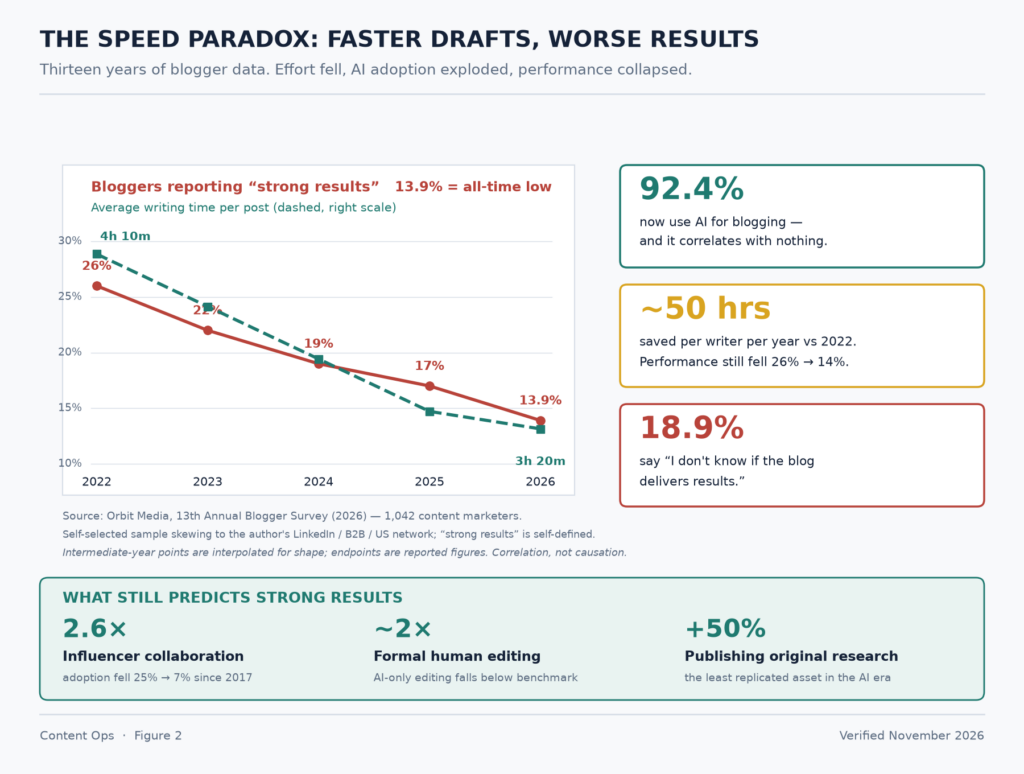
Orbit Media has run an annual blogger survey for thirteen years. The 2026 edition, covering 1,042 content marketers, reports that the average post now runs 1,312 words and takes 3 hours 20 minutes to write — down from a peak of 4 hours 10 minutes in 2022. The average writer saves roughly 50 hours a year versus 2022. AI use reached 92.4%.
And the share of marketers reporting strong results fell from 26% to 13.9% — an all-time low, about six points below the previous twelve-year floor. Another 18.9% now say they simply do not know whether their blog delivers results.
Orbit’s own conclusion is blunt: no way of using AI correlates with better results. Non-users were just as likely to report strong results as users, though non-users were more likely to report disappointing ones. AI has become table stakes, not an edge.
Two honesty notes. Orbit’s sample is self-selected and skews toward the author’s own LinkedIn, B2B and US network, and strong results is deliberately left for respondents to define. This is correlation, not causation. But thirteen years of consistent longitudinal tracking is far stronger evidence than the vendor benchmarks it contradicts.
Speaking of which — the widely circulated claim that publishing 16+ posts a month drives 3.5× the traffic traces back to a HubSpot analysis of its own customers from around 2015. It is correlational, self-referential and a decade old. I would not build a 2026 cadence strategy on it.
What Actually Still Predicts Performance
If speed is not the differentiator, what is? Orbit’s correlations point consistently toward the effortful, human, hard-to-copy work — and every one of those practices is in decline.
Influencer collaboration is the single strongest predictor in the dataset, beating the benchmark by 2.6×. Adoption collapsed from 25% of marketers in 2017 to 7% today. Formal human editing beats the benchmark by nearly 2×, while AI-only editing falls below it. Publishing original research improves the likelihood of strong results by roughly 50%.
Ann Handley’s response to that data is worth quoting in spirit: AI makes it trivially easy to remove effort, so we have to get much more discerning about which effort we remove.
That is the whole discipline in one sentence. Content ops is not about removing work. It is about removing the waiting while protecting the thinking.
Lever One: Decide Once, in the Brief
If unclear briefs are the second-biggest bottleneck at 41%, and poor briefs are the top driver of quality collapse — Contentoo found 56% cite incomplete briefs, versus just 7% blaming unedited AI — then the brief is your highest-leverage artifact.
A brief that works names four things and nothing more: the specific audience, the single message, the proof, and the one next step you want the reader to take.
Every decision you fail to make here resurfaces later as a revision round. That third-round question — wait, who is this actually for? — is not a writing failure. It is a deferred decision collecting interest.
Interestingly, teams already sense this. Contentoo found 46% use AI for briefs against only 21% for drafting. The instinct is right.
Lever Two: One Named Approver, Everyone Else Consulted
Replace the committee with a decision right. One person signs off against a written criterion. Everyone else is consulted with a deadline attached, and silence past that deadline counts as agreement — stated explicitly, in advance, in writing.
Typeface’s separate AI Speed Paradox research found 92% of marketing leaders say campaigns require ten or more stakeholders. Ten stakeholders is not a review process; it is a hostage situation.
Write the criterion down, too. Vague feedback is its own queue: make it more engaging is not a revision instruction, it is a request for another meeting. A usable criterion sounds like this — does the piece name one audience, make one claim, support it with evidence a skeptic would accept, and ask for one action? If yes, it ships. If no, the reviewer states which of the four failed. That turns taste into a test, and tests do not require a follow-up call.
The distinction to hold onto: consult widely, decide narrowly. Those are different activities and they should not share a deadline.
Lever Three: Time-Box Every Stage
Give each stage an owner and an SLA — draft, review, design, publish. A stage without a deadline is exactly where weeks quietly die.
And measure the right thing. Stensul found 47% of teams are now measured on time-to-market or campaign velocity. Fine — but measure calendar time from idea to publish, not hours worked. Those are different numbers, and only one of them contains the queue.
Lever Four: Govern Before You Scale
This is the lever most playbooks skip, and the data says it is the one that makes speed durable.
Stensul found that organizations with comprehensive AI governance consistently send higher campaign volumes: 29% send 26–50 campaigns a month and 22% send 100 or more. Governance did not constrain output. It enabled it — because fewer things needed correction, escalation or late-stage rescue.
Build the rules upstream. Pre-clear messaging territories, document tone with examples, define what genuinely needs legal eyes. Then review becomes a check against known criteria rather than a fresh negotiation every time.
Lever Five: Refresh on a Schedule, Not on Inspiration
Put published content on a recurring update cycle so what to work on next never has to be invented under pressure.
One integrity note: the famous claim that updating old posts roughly doubles organic traffic comes from a single HubSpot blog case study about its own site, circa 2015–16 — no control group, no external replication. Treat it as an anecdote that motivates a habit, not a benchmark you can forecast against. The habit is still worth having; the multiplier is not proven.
Risks and Honest Caveats
Speed without substance is the AI-slop spiral. Orbit’s data is the warning: an industry that got 50 hours faster per writer per year and cut its strong-results rate nearly in half. Protect original research and human editing as non-negotiable, even when they are the slowest steps.
Some content genuinely needs multiple sign-offs. Regulated claims, financial disclosures, brand-critical launches. The goal is right-sized review, not zero review. Cutting a legally required approver is not content ops; it is negligence with a framework attached.
Buying a tool relocates the bottleneck. CMI’s 15th annual B2B research with MarketingProfs found only 26% of marketers believe they have the right technology to manage content — down from 31% the year before — while 38% said they have the technology but are not using its potential, up from 30%. More software was not the answer.
A relentless cadence burns the team out. Typeface found 63% of marketers report burnout, and those with high burnout were 230% more likely to say their brand misses cultural moments. Speed must come from removing waste, never from adding hours.
What the Budget Data Says About Your Real Constraint
CMI and MarketingProfs’ 16th annual B2B research, fielded June 24 to August 14, 2026 with 1,229 global responses and 1,015 B2B marketers analyzed, asked where budgets would grow in 2026. AI-powered marketing tools led at 45%, followed by events and experiential at 33% and owned media at 32%. Human resources — salaries, training, development — came last at 9%. The study was sponsored by Storyblok, a headless CMS vendor.
That gap is your actual bottleneck, stated in dollars. Organizations are funding the machine that produces drafts and starving the humans who review, edit and decide.
Which is precisely the wrong direction given everything above. If review is the constraint and human editing is what predicts performance, then the highest-return line item in a 2026 content budget is a senior editor with decision authority — not another seat license.
How to Start on Monday
Map your real cycle time first. Time-stamp five recent pieces from idea to publish and split each into working time and waiting time. You will almost certainly find the bottleneck is not where the team assumed.
Then shorten the approval chain to one named person, write the criterion they judge against, and make silence-is-agreement explicit. Fix the brief template before you touch the tooling. Parallelize what genuinely can run in parallel — design and review can overlap; SEO and title work can precede the draft.
And protect one slow thing on purpose. Commission original research. Keep a human editor. Book the expert interview. Those are the steps that still separate 13.9% from everyone else.
The Takeaway
Content is slow because the pipeline queues it into oblivion, not because writing is slow — the survey evidence, the enterprise approval latencies and the mathematics of queueing all agree. Fix the brief, name one approver, time-box every stage, and govern before you scale.
But do not mistake velocity for strategy. The thirteen-year data is unambiguous: the industry got dramatically faster and materially worse, because it used the time it saved to abandon the practices that actually worked.
The bottleneck was never the writing. It was the waiting. Remove the waiting — and spend every hour you recover on the thinking that machines still cannot do for you.