Viant Bought Waymark for $20 Million. The Real Bet Is Turning CTV Creative From a Fixed Asset Into a Feed.
The DSP that owns attention data and household identity now owns an AI video factory — and it wants to copy Meta’s playbook on television.
Viant Technology (NASDAQ: DSP) used its third-quarter earnings call on Monday, November 9, 2026 to announce the close of its acquisition of Waymark, a generative-AI video ad platform, for $20 million in cash. The same call delivered a record quarter: revenue of $110.4 million, up 29% year over year, with CTV ad spend on the platform up nearly 40% and now more than half of total spend. The stock rose 9.3% in regular trading — then fell about 7% after hours, a reminder that the market is still deciding what Viant is becoming.
What it is becoming, in the Vanderhook brothers’ telling, is Meta for television. “Meta takes over all the media optimization and audience targeting, and then they just tell brands to produce as much creative as they possibly can,” COO Chris Vanderhook told AdExchanger. “That’s a big part of their success, and it’s something we’re looking to replicate.”
Why a $20 million deal is the interesting one
Waymark is not a frontier lab. Its software turns brand inputs — a URL, a few facts — into a finished video ad with script, visuals and voiceover in minutes. Local media sellers including Spectrum Reach, Comcast, NBCU, Fox and Gray already use it to produce spots for small advertisers. Viant CEO Tim Vanderhook’s claim is that removing production cost lets the number of CTV advertisers “scale from thousands to millions.”
The strategic logic is a stack, not a product. Viant spent the past two years buying the pieces: Iris.TV for content signals, TVision for attention measurement (closed May 1 for $40 million), and now Waymark for creative. The loop it describes: Household ID picks the audience, Iris matches the ad to what’s on screen, TVision measures whether anyone is watching, and Waymark generates fresh versions when attention decays. Chris Vanderhook calls it “the transformation of creative from a fixed asset into a dynamic asset.”
The attention data is the justification. On the call, Tim Vanderhook cited TVision panel figures: long-running ads — he named personal-injury spots — hold attention “sub 25%,” while fresh creative can push above 80%. In an AdExchanger interview he gave a concrete pair: one Morgan & Morgan ad that ran five years sits at 21% human attention; its newest ad is at 86%. The method behind those numbers was not disclosed, so treat them as vendor panel data, not peer-reviewed measurement — but the direction matches what every creative-fatigue study shows.
The Meta comparison cuts both ways
Meta’s model works because it owns the auction, the audience graph and the feedback loop, and advertisers respond by flooding it with creative. Viant owns none of the inventory — it is a buy-side platform — but it is assembling the same three ingredients on the open internet: identity, context, attention. If creative becomes cheap and variable enough, the optimization surface shifts from “which audience” to “which version for which audience in which context,” and the platform that can generate and measure versions fastest captures the value.
There is also a channel-conflict question analysts raised on the call: a self-serve creative tool for small businesses competes with the agencies serving Viant’s larger clients, and with MNTN, which launched its own QuickFrame AI in October 2025 and cut its 2026 revenue forecast by about 11% on November 4 amid sales-execution problems. Viant’s answer: Waymark goes to market through local media sellers first; enterprise customers will get it as an optional add-on. CFO Larry Madden was blunt about the financials — Waymark’s Q4 contribution is immaterial, and 2027 standalone revenue will “remain modest.” This is a bet, not an earnings line.
The quieter announcement: 41 skills inside ChatGPT
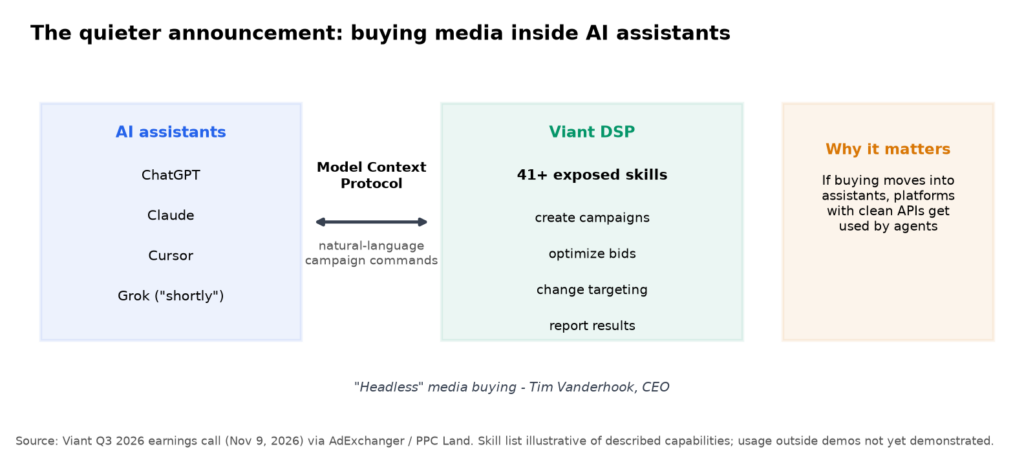
The same call disclosed something that may matter more long-term: Viant has enabled more than 41 DSP skills through the Model Context Protocol, letting advertisers create, optimize and change campaigns through natural language in ChatGPT, Claude and Cursor — with Grok “shortly.” Tim Vanderhook called it a “headless” approach. If media buying migrates into AI assistants, the platforms that expose clean, complete APIs become the ones agents actually use. Viant is volunteering early.
The risks are in the 10-Q, in plain language: generated content may be “inaccurate, misleading, deceptive, infringing or otherwise inappropriate,” and generative AI lowers the barrier to deepfakes and fabricated political advertising. Viant’s own executives conceded the disclosure problem — AI-generated humans in ads draw backlash, product-only creative draws less, and “proper disclosure will be so important” as the tools improve.
What to watch
Three things will show whether the stack works: whether Waymark-driven creative variation actually lifts TVision attention in live campaigns (not just panel anecdotes); whether local media sellers convert into a self-serve SMB channel at scale; and whether MCP-driven buying gains real usage outside demos. The $20 million price is small. The claim — that television advertising can run on the same creative-as-a-feed logic as social — is not.