Write It Down. Then Keep Rewriting It.
You’ve seen the binder. Maybe you helped write it. Forty pages of channel strategy, launch checklists, and brand voice rules, assembled during one heroic sprint, approved in a meeting, and then — silence. It lives in a shared drive now, next to the 2023 offsite photos. Nobody opens it. Nobody updates it. And when someone asks why the team keeps repeating the same mistake, the binder sits there, mute, like a witness who’s decided not to testify.
Here’s the uncomfortable truth: a marketing playbook fails the moment it’s finished. Not because the writing was bad. Because a playbook is a claim about how the market works, and the market refuses to hold still. The document you wrote last spring describes last spring’s market. The channels shifted. The algorithm changed. The buyer who used to answer email now asks an AI assistant to shortlist vendors. Your playbook didn’t get dumber. It got older.
This piece is about the fix, and the fix is almost embarrassingly simple. Every playbook gets a named owner and a scheduled re-review, and every review changes it against fresh evidence. That’s it. That’s the whole discipline. It’s also the discipline almost nobody follows — which is exactly why the teams that do follow it keep pulling ahead.
Why Static Playbooks Rot
The drift problem: your playbook is a photograph, not a map
A playbook encodes a moment. The channels that worked then. The tactics that converted then. The assumptions about your buyer that held true then. Reality moves on while the document stays perfectly, beautifully still.
And reality has been moving fast. In its Leadership Vision for 2026, Gartner argues that the digital channels most at risk from AI disruption are the ones with the highest historical spend and impact — search, display, social — and recommends that CMOs adopt a zero-based approach to channel strategy rather than assuming the past predicts the future. MarTech’s coverage of the report called it a zero-based channel shock: the foundations CMOs built their careers on are eroding, and the playbook written on top of those foundations erodes with them. If your channel mix section hasn’t been rewritten since generative AI started answering shopping questions, it isn’t a strategy anymore. It’s a memory.
The shelfware pattern
Unused marketing technology has a name: shelfware. Software you bought, installed, and never opened. Playbooks suffer the same fate, except the invoice was paid in writing time instead of license fees. A playbook nobody opens is a knowledge-retention asset with zero retention. You spent three weeks documenting how the team works, and the documentation now retains nothing, because knowledge that isn’t used, checked, and corrected decays into folklore.
Written by committee, read by no one
There’s a specific failure mode worth naming: the playbook produced once, as a project deliverable. It gets exactly the attention a one-time deliverable deserves — a launch announcement, a round of applause, and then none. The committee that wrote it disbands. The person who championed it moves to another initiative. The document becomes an orphan with a version number.
The reframe is this: a static playbook is a snapshot mistaken for a system. The system was never the document. The system is the loop of revisiting it.
The Hidden Bill: What Unrevisited Knowledge Costs
Rot sounds abstract until you see the invoice. Three research streams put numbers on it.
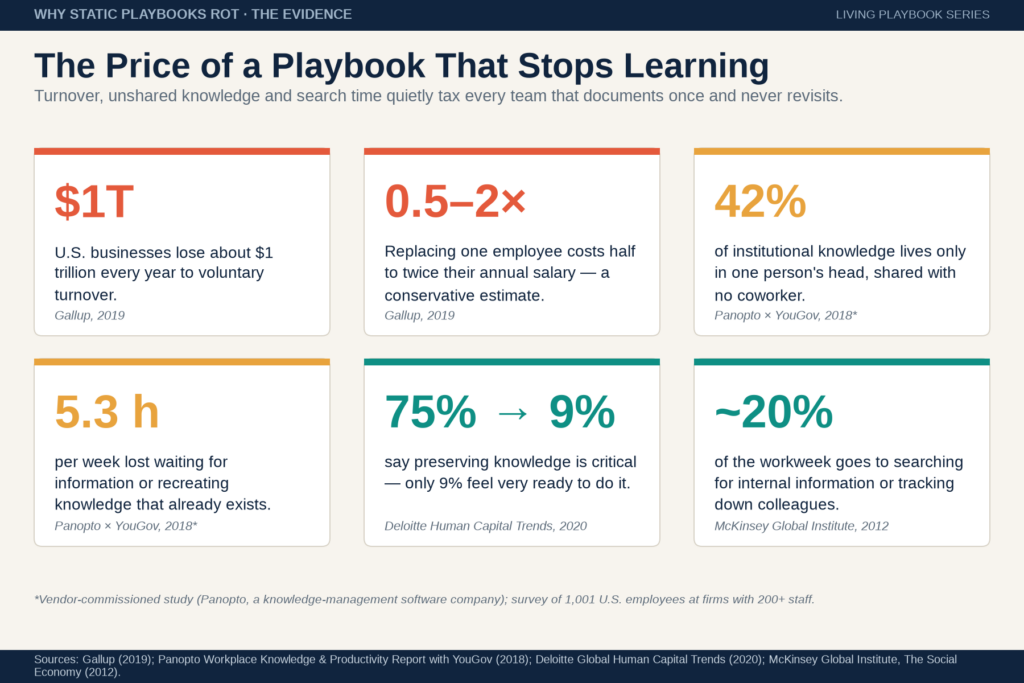
Start with turnover. Gallup estimates that U.S. businesses lose roughly $1 trillion a year to voluntary turnover, and that replacing one employee costs between one-half and two times that person’s annual salary — a conservative estimate, in Gallup’s own words. The federal data backs up the churn: the Bureau of Labor Statistics recorded about 38 million quits in 2025, an annualized quit rate near 24%. Every one of those exits walks out the door carrying knowledge. And Gallup’s 2024 research found that 42% of employees who left voluntarily said their manager or organization could have done something to prevent it. The knowledge loss wasn’t fate. It was maintenance nobody performed.
Now the knowledge itself. A workplace study by Panopto, conducted with YouGov, found that 42% of institutional knowledge is unique to the individual — it lives in one person’s head and is shared with no coworker. Six in ten employees said getting vital information from colleagues was difficult, very difficult, or nearly impossible. The average knowledge worker lost 5.3 hours a week waiting for information or recreating knowledge that already existed somewhere. One caveat in the spirit of honesty: Panopto sells knowledge-management software, so treat the dollar figures it derived from those findings — like the famous $47 million a year for large enterprises — as directional, not gospel. The underlying survey pattern, though, matches what every team lead already knows.
Even when knowledge is written down, finding it is its own tax. McKinsey Global Institute’s research on interaction workers — the high-skill knowledge workers, managers and professionals — found they spend nearly 20% of the workweek looking for internal information or tracking down colleagues who can help. Roughly a day a week, spent on archaeology instead of work. A stale, unowned playbook makes that worse: people stop trusting the document, so they stop searching it, so they ask around, so the knowledge stays personal, so the next resignation takes it away.
Deloitte’s Global Human Capital Trends research quantified the gap between knowing and doing: 75% of surveyed organizations said creating and preserving knowledge across evolving workforces was important or very important to their success over the next 12 to 18 months. Only 9% said they were very ready to do it. That’s one of the largest importance-versus-readiness gaps in the whole study. Your playbook problem is not a writing problem. It’s a readiness problem.
What “Living” Actually Means
Let’s define the term before anyone prints it on a slide. A living playbook meets three conditions. All three. Miss one and you own a static document in a nice frame.
Condition one: a named owner
Not “the marketing team.” A person. Someone whose job description, somewhere in the boring middle, includes keeping this document true. Ownership is the difference between a playbook and a PDF in a drive. Documents don’t maintain themselves, and committees don’t either — ask any committee.
Condition two: a scheduled re-review
The review lives on the calendar before anyone remembers to schedule it. Quarterly, tied to the retrospective. Or every 90 days, tied to the re-plan. The cadence matters more than the prose: a mediocre playbook reviewed quarterly beats a brilliant playbook never revisited, because revision is where the learning accumulates. Brilliance decays. Maintenance compounds.
Condition three: every review changes it against evidence
This is the condition teams skip, and it’s the one that does the work. The review isn’t a read-through with coffee. It’s a reconciliation: what did the playbook claim, what actually happened, and what changes as a result? Changes get made against data — last quarter’s results — not opinion. The playbook is a hypothesis that gets tested, not a decree that gets obeyed.
Put the three together and you get something bigger than documentation. You get the organization’s memory that learns — the difference between a team that repeats its first-year mistakes forever and a team that makes each mistake exactly once.
The Learning Loop Inside the Playbook
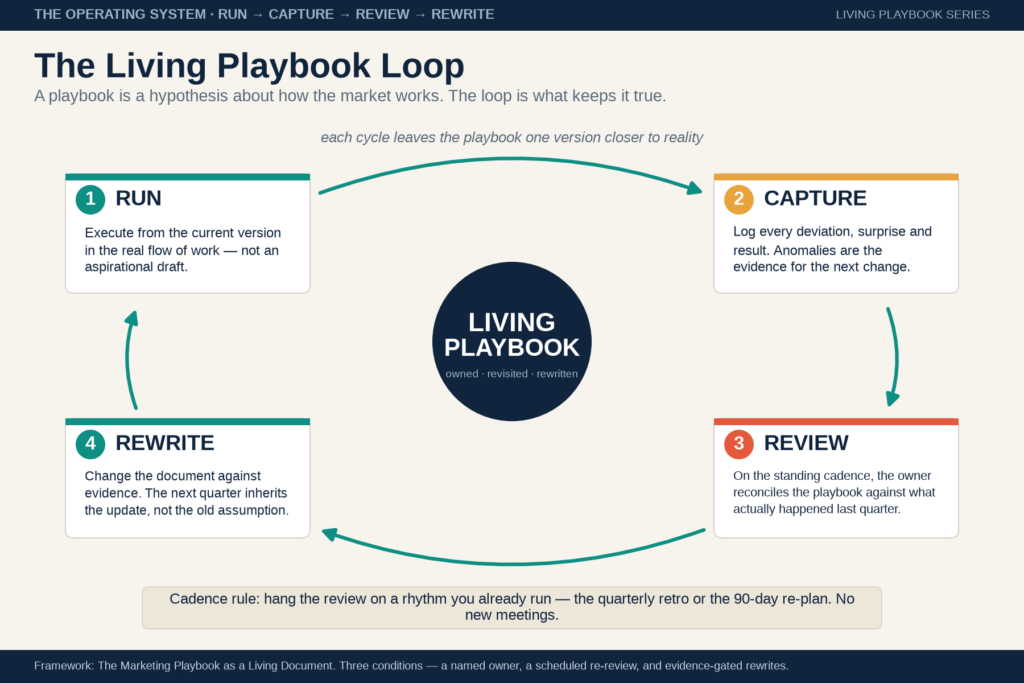
How does a document actually get smarter? Four moves, repeated.
Run
Execute from the current playbook. The working version, used in the actual flow of work — not the aspirational draft everyone nods at and nobody follows. If the team runs one process and documents another, you don’t have a living playbook. You have fiction with headings.
Capture
Log the anomalies. Every deviation, every surprise, every result that didn’t match the prediction goes into a decision log. That log is the raw material of the next review. A campaign that flopped despite following the checklist? Capture it. The subject-line pattern that beat the documented best practice three weeks running? Capture it. Anomalies are not embarrassments. They’re the evidence that a change is due.
Review
On the scheduled cadence, the owner reconciles the playbook against what actually happened. Where was it right? Where was it wrong? Where did the market move underneath it? This is a meeting with an agenda, not a vibe. The decision log supplies the agenda.
Rewrite
Update the document against the evidence, and let the next quarter inherit the update instead of the assumption. Keep a light changelog — what changed, when, why — so the playbook’s own history stays legible and last year’s arguments don’t get re-litigated every quarter.
The principle underneath all four moves: the playbook is never done. Each cycle leaves it one version closer to reality. That’s not a flaw in the system. That is the system.
The Evidence That Learning Compounds
If the loop sounds like a nice idea with no teeth, here are the teeth.
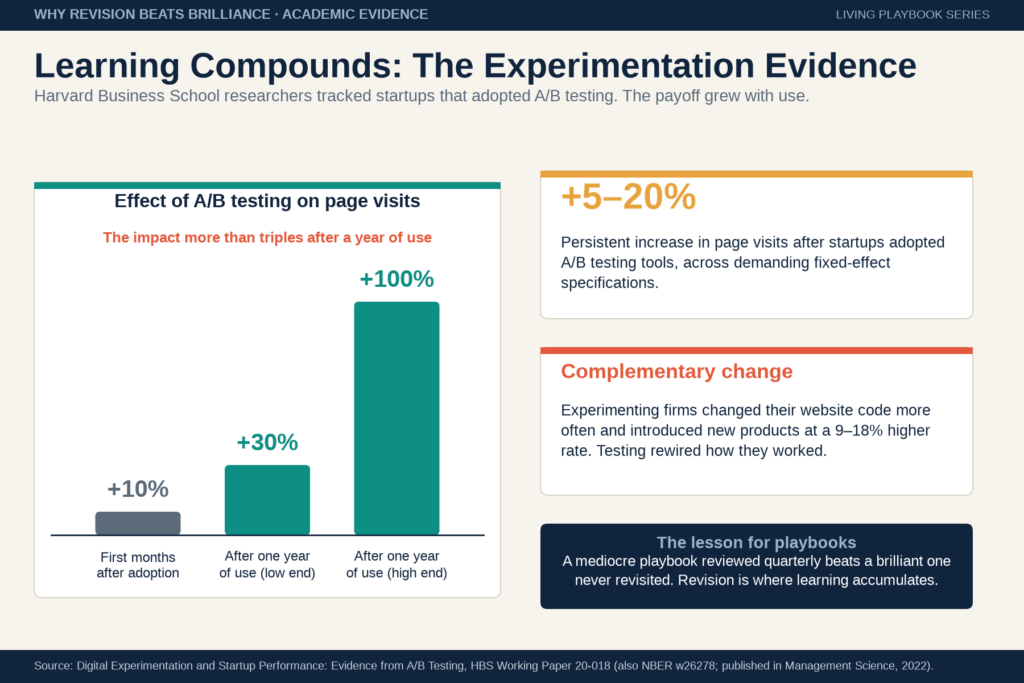
Harvard Business School researchers studied what happened when startups adopted A/B testing tools — the closest thing marketing has to a laboratory for the run-capture-review-rewrite loop. The findings, published as HBS Working Paper 20-018 and later in Management Science, are striking. Adoption was associated with a persistent 5–20% increase in page visits. But the number that should make you sit up: the impact of testing more than triples after a year of use. Roughly 10% in the first months; 30% to 100% after a year. The tool didn’t get better. The organization got better at learning from it.
The same firms didn’t just test more. They changed more. Experimenting startups modified their website code more frequently and introduced new products at a 9–18% higher rate than comparable firms. The discipline of evidence-gated change spilled over into everything else. That’s the compounding mechanism in one sentence: teams that institutionalize the loop don’t just improve one metric — they upgrade the speed at which they improve everything.
A playbook is the same technology, minus the software. Run, capture, review, rewrite. The first quarter’s review feels like overhead. The fourth quarter’s review is where your competitors’ best ideas go to die.
How to Make Your Playbooks Live: The Build Path
Four operating rules. You can implement all of them this week, and none of them requires new software.
Rule one: one named owner per playbook
Write the name in the document header. Owner: Priya. Last reviewed: October 12. Next review: January 9. When the owner leaves, the handoff includes the playbook the way it includes the passwords. No document lives without a person whose job includes it.
Rule two: tie the review to a rhythm you already run
Don’t invent a new meeting. Hang each playbook’s re-review off a standing cadence — the quarterly retrospective, the 90-day re-plan, the campaign post-mortem you already hold. New meetings die. Existing meetings absorb. The review that survives is the one that never needed its own calendar invite.
Rule three: gate every change on evidence
Every edit cites the result it responds to. “We changed the launch checklist because the March webinar launch missed the email sequence and lost 200 registrations” — that’s a living edit. “I think we should freshen up the tone” — that’s an opinion wearing a changelog. The evidence gate is what keeps the playbook a tested hypothesis instead of a mood board.
Rule four: version it like software
A light changelog at the bottom of the document. What changed, when, why, and which result triggered it. Three lines per revision is plenty. The changelog does two jobs: it makes the learning legible to new hires, and it stops the team from re-arguing settled questions every quarter. Software teams figured this out decades ago. Marketing keeps rediscovering it, one stale binder at a time.
Risks and Honest Caveats
A living playbook can fail in four specific ways. Knowing them is half the defense.
The churn-for-its-own-sake trap
Living does not mean rewriting constantly. A playbook that changes every week is noise, and the team stops trusting it — which is functionally identical to having no playbook. The cadence paces the change. Between reviews, the document is stable on purpose. Stability between reviews is what makes the reviews meaningful.
Version proliferation
Nothing kills a living document faster than competing copies. “The email playbook” versus “the new email playbook” versus “email playbook FINAL v3” is not a living system; it’s a custody dispute. One canonical version, clearly named, in one place. Every other copy gets archived or deleted. Ruthlessly.
The ownership vacuum
A living playbook with no owner is static again — the living property collapses the moment the named person leaves without a handoff. This is the failure mode most teams discover too late, usually during the first crisis after a departure. Build the handoff into the exit checklist, not into the eulogy.
The snapshot temptation
Under deadline pressure, teams regress: just write it up, print it, ship it, move on. The living discipline has to survive the busy season, or the playbook reverts to a history book by Q3. The test of a living playbook isn’t whether it gets reviewed in a calm quarter. It’s whether it gets reviewed in the quarter everything is on fire.
The Takeaway
A marketing playbook is a hypothesis about how the market works, and the market refuses to stay put. The only playbook worth having is a living one: owned by a named person, revisited on the standing cadence, rewritten against the evidence of what actually happened last quarter.
Static playbooks rot into “the way we used to do it.” Living playbooks compound into institutional memory that learns — and the research says the compounding is real, measurable, and larger than most teams expect. Assign the owner. Hang the review off the rhythm you already run. Gate every change on a result. Do that, and the playbook stops being a document you wrote and becomes a system that keeps you honest.
The binder on the shelf isn’t wrong about everything. It’s just wrong about today. Go fix the part that’s wrong, write down why, and put the next review on the calendar. That’s the whole job. It’s also the job that never ends — which, as we’ve established, is precisely the point.