Why the 73-Point Briefing Gap Survived Five Years of Better Tools
Why a 73-point disconnect survived five years of better tools, more data, and bigger budgets.
There is a number in marketing that should have been fixed by now. In 2021, the BetterBriefs Project surveyed more than 1,700 marketers and agency staff across 70-plus countries and found that 78% of marketers believed their briefs gave clear strategic direction. Only 5% of agencies agreed. Seventy-three points. Not a rounding error, not a cultural quirk — a canyon.
Five years later, the canyon is still there. The 2025 BetterIdeas Project, run with the IPA and the World Federation of Advertisers across 1,034 respondents in 54 countries, put the same question to a fresh sample and got the same answer: 78% versus 5%. Meanwhile the industry acquired more dashboards, more attribution, more AI, more MarTech than at any point in its history.
So why doesn’t it close? The usual explanation is skill — marketers can’t write briefs. That’s true but insufficient. Skills improve when someone is paid to improve them. This one doesn’t, because of how the incentives line up.
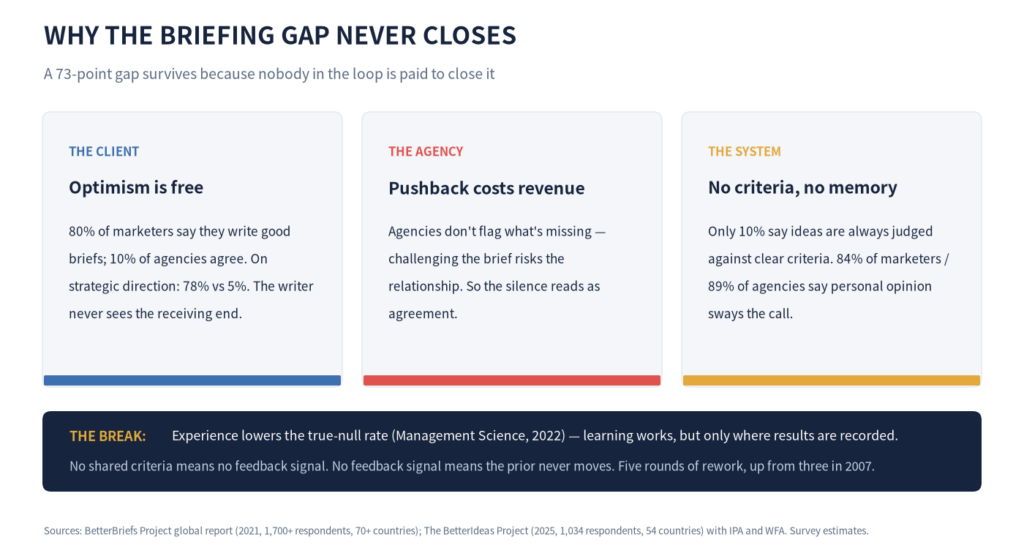
The client is rewarded for confidence, not accuracy. Nobody gets promoted for saying “I’m not sure who this is for.” A brief that sounds decisive reads as leadership, and the person writing it almost never sits in the room where it lands. The feedback loop is severed at the source. You cannot correct an error you never hear about.
The agency is punished for telling the truth. The founders of BetterBriefs diagnosed this precisely: agencies don’t push back on briefs that lack strategy or objectives, and they don’t flag what’s missing. Why would they? Challenging a client’s brief risks the relationship, and the relationship is the revenue. So silence gets misread as agreement, and the marketer’s confidence is confirmed by an absence of complaint. Both sides are behaving rationally. The system is what’s broken.
Nobody owns the criteria. Here is the finding that turns a complaint into a mechanism. In the 2025 study, only 10% of all respondents said ideas are always evaluated against clearly defined criteria. Just 15% of marketers and 23% of agencies said the brief is always used when evaluating ideas. And 84% of marketers and 89% of agencies admitted personal opinion heavily sways the decision.
Think about what that means for learning. If the verdict on the work is a matter of taste, the outcome carries no information about the brief. A campaign that succeeds tells you nothing about whether the brief was right; a campaign that fails tells you nothing either. There is no signal to learn from. The prior never moves.
That matters because we have direct evidence that experience can move it. In a 2022 Management Science study of nearly 5,000 tested effects, Berman and Van den Bulte found that roughly 70% of tested interventions were true nulls — and that more experienced experimenters achieved lower false-discovery rates partly through a lower rate of true nulls. Experience improved the quality of the ideas themselves. But that finding comes from A/B testing, a domain where every result is recorded against a pre-agreed metric. Creative development has no equivalent ledger. It has opinions, and opinions don’t compound.
The bill arrives quietly. The average number of rounds to a signed-off idea has gone from three, in IPA research from 2007, to five in 2025. Not because creatives got worse. Because nothing in the loop is obliged to remember.
The fix is not another template. It is naming a criterion before the work starts, and getting the person who can say no to agree to it in writing. That single act converts taste into signal — and signal is the only thing that has ever closed a gap like this.