Why Waste Gets Tenure: The Incentives Behind Your Zombie Marketing Budget
Open any mature marketing budget and you will find the same ghost: the sponsorship nobody can trace to a single lead, the martech seat last logged into in March, the agency retainer renewed because renewing it was easier than explaining it. Nobody chose these lines this year. They chose themselves, by surviving last year. Waste in marketing budgets is not an accident. It is an outcome — the predictable result of three mechanics that reward keeping money exactly where it is.
Mechanic one: the baseline is an anchor, not a decision
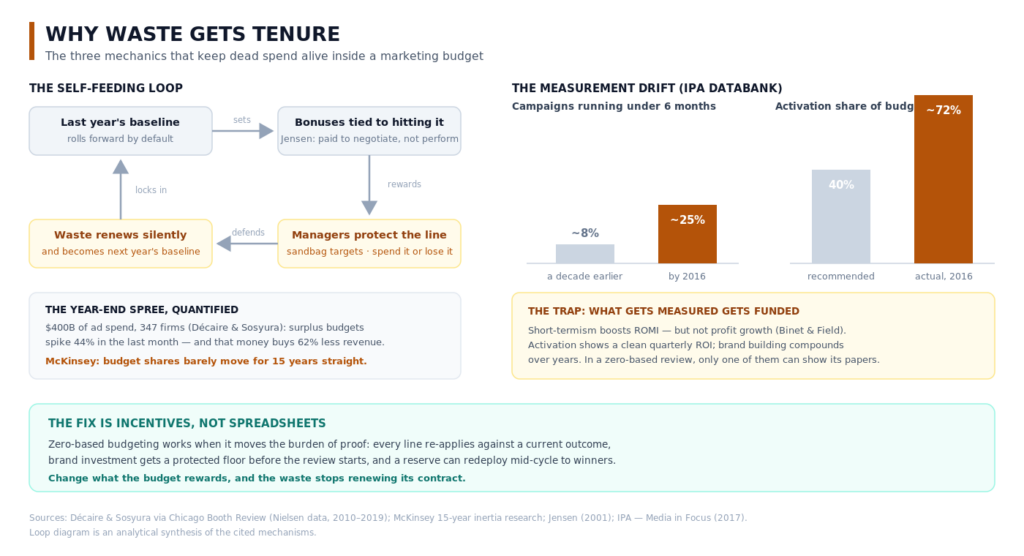
McKinsey’s decision-bias research tracked multi-business corporations across fifteen years and found a near-perfect correlation between a business unit’s share of the capital budget this year and its share the year before. Advertising budgets, the researchers note, suffer the same inertia. A decade and a half of market shifts, and the money barely moves. Last year’s number is not a starting point for discussion; it is the discussion’s center of gravity. Incremental budgeting treats history as evidence of value, when history is mostly evidence of history.
Mechanic two: the budget pays people to protect it
The economist Michael Jensen diagnosed this two decades ago: pay managers against negotiated budget targets and you pay them to negotiate, not to perform. In his 2001 Harvard Business Review article “Corporate Budgeting Is Broken — Let’s Fix It” (and the academic paper “Paying People to Lie”), he showed the two-stroke engine: managers lowball targets in the planning phase, then game the realization — and the system rewards the lie while punishing the honest forecast. Once a manager’s bonus and standing are tied to a budget line, cutting that line is not efficiency. It is self-harm. So the line gets defended with the energy of someone protecting a limb, and the defense always sounds reasonable: continuity, risk, institutional knowledge.
Mechanic three: measurement picks the winners before the debate starts
Here is where marketing gets its own special version of the problem. The IPA’s databank analysis by Les Binet and Peter Field (Media in Focus, 2017) found that short-termism boosts ROMI but not profit growth — and the drift is visible in the money itself. Campaigns running under six months rose from under 10% of cases to nearly 25%. On a budget-spend basis, activation took roughly 72% of spend in 2016 against a recommended 40%. Why? Because activation can show its papers: a clean, quarterly, last-click ROI. Brand building compounds over years and cannot produce a receipt on demand. Any budget review — zero-based included, unless you change the rules in advance — will systematically fund whatever can survive a spreadsheet interrogation.
The receipt: what “use it or lose it” actually buys
The clearest proof that this is an incentive problem, not a competence problem, comes from a study of $400 billion in advertising spend across 347 public companies (Décaire and Sosyura, using Nielsen data, 2010–2019). Managers sitting on a year-end surplus spiked spending 44% in the final month before budgets reset — because unspent money signals a smaller budget next year. And the rush had a price: projects funded with that last-month money generated 62% less revenue, were 39% less efficient, and cost 52% more to reach the same audience. The waste is not hiding in the budget. It is being manufactured, on schedule, by the budget’s own rules.
What this means for zero-based budgeting
This is why ZBB is best understood as an incentives intervention wearing a spreadsheet costume. Starting from zero breaks the anchor. Making every line re-apply breaks the automatic renewal. But the fix only holds if you also change what the process rewards: protect the brand floor before the review starts, or measurement will eat it; keep a redeployment reserve, or rigidity will replace one waste with another; run it periodically with an honest evidence standard, or teams will simply learn to dress activity up as outcomes. The budget stops being a museum not when you cut harder, but when you change what earning a line item means. Waste gets tenure because the system grants it. Rewriting the tenure rules is the whole job.