Why China’s AI Apps Hit Mass Adoption First — The Distribution Story
Ask a Western analyst why China’s AI apps exploded, and you’ll hear about models: cheaper training, faster iteration, DeepSeek’s benchmark moment. Neat story. Wrong story. The real engine was distribution — AI arrived inside habits people already had, on rails someone else had already built.
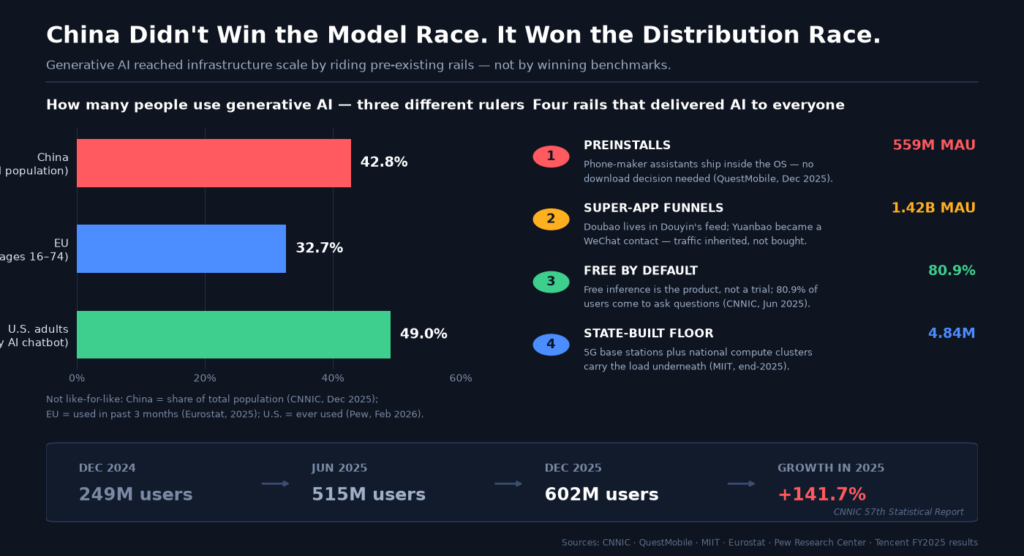
By December 2025, China counted 602 million generative-AI users — 42.8% of the entire population, up 141.7% in a year. That’s CNNIC, the state internet registry, whose 57th statistical report puts netizens at 1.125 billion. No Western market is close on that ruler: Eurostat found 32.7% of EU residents aged 16–74 had used generative AI in the previous three months of 2025, and Pew’s February 2026 survey put U.S. chatbot use at 49% of adults — ever tried, not regular use. Different yardsticks, sure. But only one country’s adoption curve looks like mobile payments, not productivity software.
Rail one: the phone already had it
QuestMobile, a commercial mobile-analytics firm that measures panel behavior rather than self-reported surveys, counted 559 million monthly actives on phone-maker AI assistants by December 2025 — Huawei, Xiaomi, OPPO, vivo and Honor ship assistants as system features. The AI is on the phone before the user wants it. In the West, trying an assistant is a decision. There, it’s a factory setting.
Rail two: traffic you inherit, not buy
Doubao didn’t hunt for installs; Douyin opened entry points for it inside the short-video feed — beside the like and share buttons — in early 2025 tests. Tencent went further: Yuanbao slipped into WeChat search in February 2025, and by April you could add it as a chat contact. WeChat ended 2025 with 1.418 billion monthly accounts, per Tencent’s annual results. When your funnel is a super-app, acquisition is plumbing.
Rail three: free is the product
CNNIC’s dedicated GenAI report — 515 million users by June 2025 — quotes its director attributing the surge partly to a free-by-default business model. Free isn’t a trial in China; it’s the offer. DeepSeek proved the demand side: 194 million monthly actives by March 2025 on word of mouth alone.
The twist everyone misses
DeepSeek won the news cycle; Doubao won the year. It overtook DeepSeek in August 2025 and never looked back — roughly 227 million monthly actives in December to DeepSeek’s 136 million, then 382 million by June 2026, per QuestMobile’s half-year report. Alibaba’s Qwen surged to 167 million on its own ecosystem rails while DeepSeek slid 20.3% year over year. The best-distributed app beats the best-benchmarked model. Every time.
The honest caveat: supply-push adoption retains worse where value is thin. Distribution decides who tries; usefulness decides who stays.
What marketers should do with this
First, compete for the answer, not the app: 80.9% of Chinese GenAI users come to ask questions, so answer-presence is already a mass-scale marketing surface. Second, ride existing rails — OEM assistants, super-app entry points — instead of building a branded AI destination nobody visits. Third, watch your own market: whoever owns the entry points, from OS assistants to carrier deals, will own the adoption curve. Intelligence sets the ceiling. Distribution sets the speed.