RMB 1,088 to Rent a Customer. RMB 30–60 to Keep One.
Hear “private domain” and most Western marketers picture WeChat groups — a cultural quirk. Wrong frame. Private domain is a rational response to a tax.
In China, every public touch is metered. iResearch’s 2025 private-domain e-commerce whitepaper puts public-domain customer acquisition at roughly RMB 1,088 per new customer, versus RMB 30–60 in private domain. Conversion follows the same logic: 0.37% public versus 6–10% private. The public figure is a marginal-cost estimate averaged from Taobao/Tmall’s FY2024 and JD’s CY2023 annual reports — directional, but the order of magnitude is the point.
Why does the rent keep rising? The grid is full. China had 1.125 billion netizens and 80.1% internet penetration by December 2025 (CNNIC). With roughly 974 million people already shopping online, platforms can’t grow wider — they monetize deeper. The same eyeballs get auctioned to more bidders.
And the tax isn’t just ads. A separate iResearch study, published in October 2026, estimates that in 2025, every RMB 100 of GMV on Douyin carried RMB 30–60 in full-chain merchant costs — advertising, commissions, and creator fees. Taobao/Tmall ran RMB 10–22; JD and WeChat e-commerce, RMB 6–20. Not all of it goes to the platform: the biggest slice of Douyin’s bill, RMB 18–48, is paid to creators and MCNs. The traffic supply chain itself charges rent, step by step.
The dependency trap is the tell. In a 2026 survey by the China International Electronic Commerce Center, 47.68% of brand merchants said traffic costs were too high, and 44.37% reported the stop-spending-and-sales-collapse pattern. Public traffic isn’t an asset you buy. It’s a subscription you can never cancel without losing the customers — because the platform, not the brand, holds the relationship.
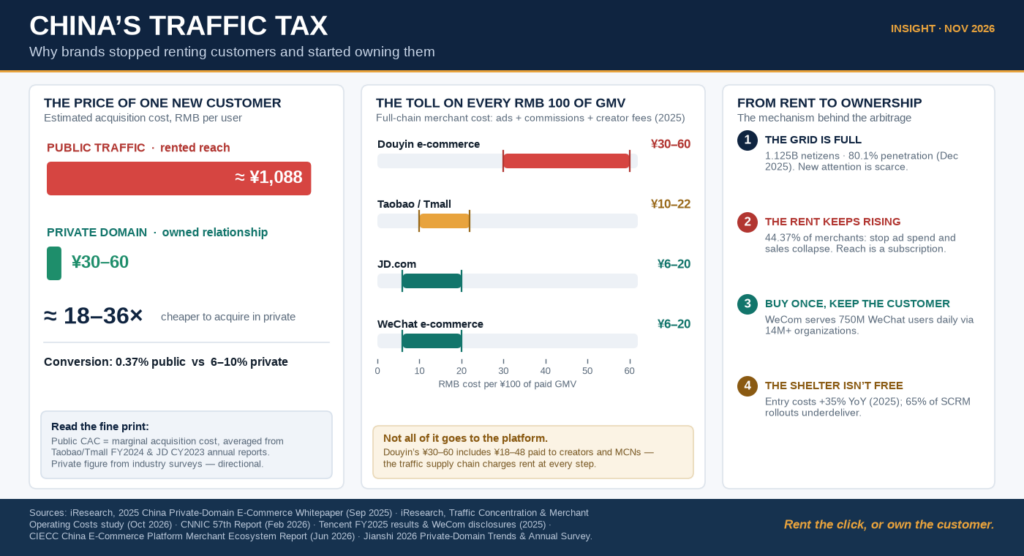
So Chinese brands did the arithmetic. Move the customer into WeCom, a mini-program membership, or a loyalty program once, and every later touch costs almost nothing. One acquisition payment replaces perpetual rent. That spread — 1,088 versus 30–60 — is the entire business case. The rails already exist: WeCom connects more than 14 million organizations and serves 750 million WeChat users daily. Nearly 90% of surveyed merchants now run private-domain programs, and iResearch sized the segment at RMB 2.3 trillion in 2024, forecasting above RMB 3 trillion for 2025.
The honest caveats: the shelter isn’t free. Jianshi’s 2026 annual survey found per-user entry costs up 35% year-over-year in 2025, 65% of SCRM deployments falling short of expectations, and user fatigue the top external challenge. Private domain is lower rent, not sovereignty — WeChat still writes the rules.
But the direction is unmistakable. The West has the same tax: rising paid CAC, platform-owned audiences, privacy walls. Its shelters are email, SMS, loyalty apps, subscriptions. Private domain isn’t a Chinese curiosity; it’s the owned-audience move, built market-wide because the rent level forced it. China just reached the toll booth first.