The End of Chinglish: How AI Rewrote Chinese Export Copy
A practical playbook for producing native-quality multilingual marketing copy at scale
For two decades, the quietest thing in global e-commerce was also the most damaging: the word that wasn’t quite right. A Chinese export brand could engineer a flawless product, nail a shipping lane from Shenzhen to Seattle, and still lose the sale because the description read like it had been run through a machine and then read by no one.
AI localization changes that equation. Not by making translation faster — that part is old news — but by replacing translation with something better. Chinese brands are now using generative AI to write in the target language from scratch, producing copy a native speaker would struggle to tell apart from their own. The marginal cost is close to zero. The ceiling on scale is gone. And for the first time, “made in China” no longer has to mean “sounds translated.”
This is not a story about a tool. It’s about a strategic bridge from “Chinese brand” to “global brand” — and it runs in both directions.
1. The Old Problem: Why Translation Failed Chinese Brands
Every Chinese brand that went global before about 2023 hit the same wall. The wall had a name — Chinglish — but that label undersells the real issue. The problem wasn’t just bad English. It was that “correct” English could still be bad English.
Machine translation is grammatically reliable now. A neural MT system will almost never produce a typo or a subject-verb disagreement. What it produces is something subtler and harder to fix: flat, literal copy that no native speaker would voluntarily write. The grammar checks out. The soul doesn’t.
That gap cost real money in four ways.
First, quality. Translated copy that is technically correct but culturally dead reads as “foreign,” and consumers convert that feeling into a judgment about product quality. The stakes here aren’t hypothetical. A 2020 CSA Research survey of 8,709 consumers across 29 countries found that 76% prefer to buy products when information is available in their own language, and 40% said they would never buy from a website in another language at all. A 2011 European Commission Eurobarometer survey is starker still: 90% of internet users preferred websites in their own language, and 42% said they never shopped online in another language.
Second, cost. Professional localization (a translator, a copywriter, a cultural reviewer) is priced per word, which makes it a fixed-cost line item that balloons across thousands of SKUs. A brand with 10,000 products simply couldn’t localize them all. Most never got past the top of the catalog.
Third, speed. Human localization takes days or weeks per piece. Chinese e-commerce doesn’t wait that long. Products launch, flash sales go live, and trends spike in hours. Copy became the bottleneck in a pipeline built for speed everywhere except at the language layer.
Fourth, trust. This was the expensive one. When copy sounds “translated,” consumers don’t just dislike it — they disbelieve the entire brand. And the research on error perception backs this up: a 2012 study in the Journal of Consumer Behaviour found that language errors in consumer reviews lowered perceptions of the review’s helpfulness. In adjacent fields, grammar errors have repeatedly been shown to drag down perceived credibility. One widely shared vendor analysis — a Grammarly study of 10,000 eHarmony profiles — found that profiles with just two spelling errors drew 14% fewer positive responses. The medium changes; the mechanism doesn’t.
The conclusion Chinese exporters eventually reached is simple: you can’t translate your way to sounding native. You have to generate your way there.
2. How AI Localization Works
The core mental shift is this: AI localization is not better translation. It’s writing in the target language, with the cultural context baked in from the start.
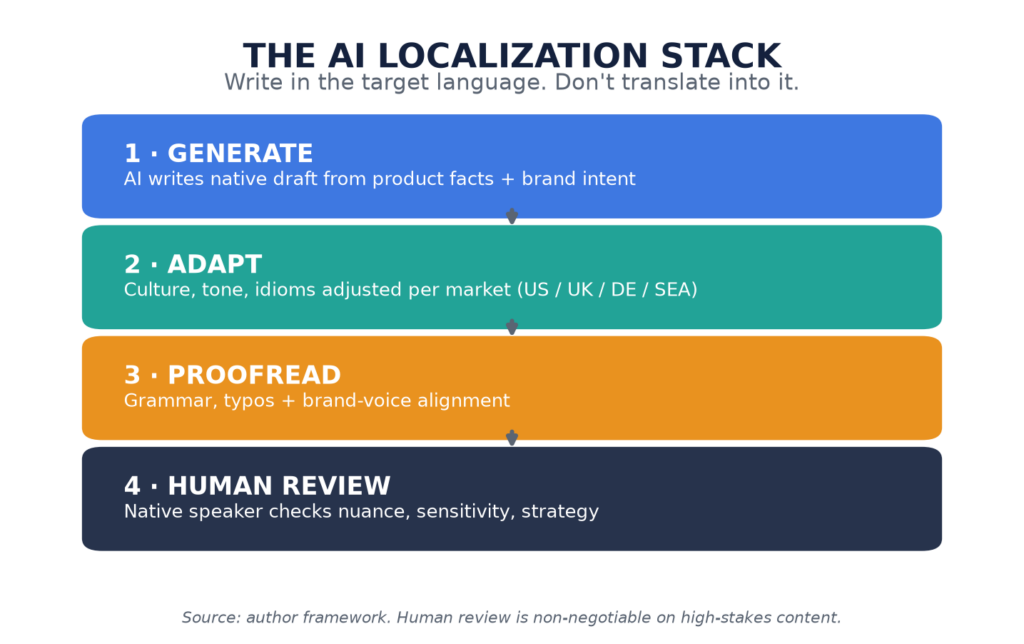
The working stack has four layers.
Layer 1 — AI generation. Instead of translating a Chinese sentence into English, the AI is prompted to write an English product description, a British social post, or a Southeast Asian ad caption from scratch, given the product facts and the brand’s intent. The output isn’t a converted version of anything — it’s a native draft.
Layer 2 — Cultural adaptation. The AI adjusts idioms, tone, humor, and references per market. The same product gets an American version (direct, benefit-led), a British version (understated, dry), a German version (specific, spec-driven), a Southeast Asian version (warmer, community-oriented). This is the step translation never did, and it’s the step that produces the “native” feel.
Layer 3 — Proofreading and brand-voice alignment. The AI checks grammar and typos, but the real value is consistency. Brand voice guidelines — tone, terminology, banned phrases — become constraints the AI applies to every output. The copy is both correct and on-brand.
Layer 4 — Human-in-the-loop review. A native speaker reviews the output for nuance, cultural sensitivity, and strategic fit. AI does the heavy lifting across thousands of items; a human does the final polish on the ones that matter most.
This stack is already running at industrial scale in China. In October 2024, Alibaba’s international arm reported that an early version of its translation model had served more than 500,000 merchants and translated over 100 million product listings, with an upgraded 15-language model launching alongside it. Whether or not a brand uses that specific tool, the architecture has become the default approach.
3. The Playbook: How Chinese Brands Deploy AI Localization
The brands doing this well follow a repeatable five-step playbook. None of it is exotic. What matters is doing all five.
1. Build a brand-voice prompt library. Before generating a single word, define the brand’s voice, tone, terminology, and forbidden phrases for each market. These become prompt constraints. A brand that skips this step gets generic AI copy — correct, but indistinguishable from every other brand.
2. Localize the catalog at scale. Product titles, descriptions, specifications, and marketing copy in multiple languages, generated simultaneously. The old economics made full-catalog localization impossible; the new economics make it a batch job. Hours, not weeks. Thousands of SKUs, not dozens.
3. Localize campaigns, not just copy decks. Campaign copy, social posts, and ad creative, generated per market with cultural adaptation built in. The same launch brief produces five market-native executions instead of one translated template.
4. Automate customer communication. Order confirmations, shipping updates, support responses, and post-purchase sequences in native-quality local language. This is where the volume is highest and where “translated” copy used to be most visibly bad.
5. Run the optimization loop. Track how AI-localized copy performs — CTR, conversion, return rates — and feed the data back into the prompts and models. Localization that gets measurably better with use is the end state. A 2024 case study presented at a conversion-optimization conference reported that a localized French customer journey lifted signup conversion by roughly 35%, from 9.5% to about 13%. It’s a vendor case study, not peer-reviewed literature, but it points the right direction.
4. Where AI Localization Wins — and Where Humans Still Run the Room
AI localization is genuinely excellent in three places.
High-volume, standardized content. Catalogs, specifications, FAQs, order communications. Any content where the writing is formulaic and the volume would make human localization absurdly expensive.
Speed-critical content. Daily promotional copy, real-time social posts, flash-sale announcements. Content that has a shelf life measured in hours, not weeks.
Multi-market scaling. Simultaneous localization into five, ten, fifteen languages at near-zero marginal cost. That combination was economically out of reach before.
But there are three places where the human stays essential, and honest brands won’t pretend otherwise.
High-stakes brand work. Flagship launches, brand manifestos, CEO communications. A single misstep here damages brand equity that takes years to rebuild. The AI drafts; a senior human owns it.
Culturally sensitive content. Humor, politics, social commentary. Cultural nuance is unforgiving, and AI’s blind spots (the subject of Section 6) are exactly where the damage lands.
Legal and compliance copy. Terms of service, disclaimers, regulatory disclosures. Precision is non-negotiable, and the cost of an error isn’t a lost sale; it’s liability.
The rule of thumb: AI owns volume and speed; humans own judgment and risk.
5. Why This Matters for Global Brands — in Both Directions
The most useful insight here is the reverse application. Western brands entering China have shipped “bad Chinese translation” for years and watched it quietly erode credibility. The same AI localization playbook run in reverse — AI writing native-quality Chinese from an English brief — solves that problem the same way it solved Chinglish.
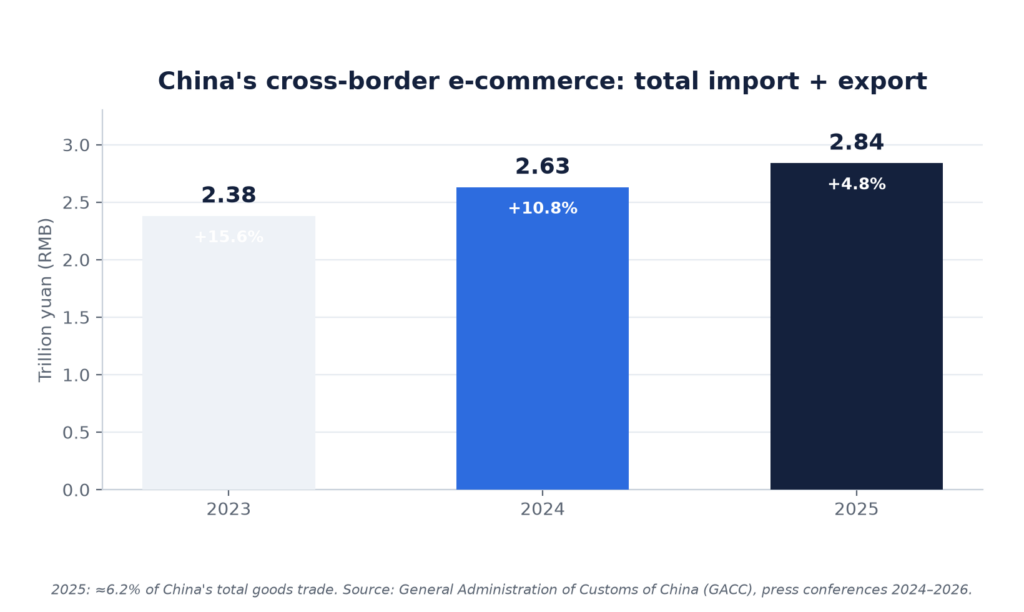
Consider the scale behind this. China’s cross-border e-commerce trade hit 2.63 trillion yuan in 2024, up 10.8% from the year before, with exports reaching 2.15 trillion yuan — the first time exports crossed the 2-trillion-yuan mark. By 2025, total cross-border e-commerce had risen to 2.84 trillion yuan, roughly 6.2% of the country’s goods trade. That’s an enormous volume of listings, campaigns, and customer touchpoints, all of which need language that sells.
And the language-services industry that used to do this work is itself being reshaped. Research firm Nimdzi estimated the global market at around $71.7 billion in 2024, growing 5.6%. The margin pressure inside that number is the real story: when AI can generate native-quality copy at near-zero marginal cost, the per-word economics that defined the industry for forty years stop making sense.
The competitive consequence is straightforward. A Chinese brand with AI-localized native-sounding English competes more credibly in a Western market. It raises the bar for everyone — including Western brands selling into China, who now face Chinese competitors with native-sounding English and a home-field advantage in Chinese. Localization is no longer a fixed-cost bottleneck. It’s a variable-cost capability that a brand of any size can switch on.
6. Risks & Honest Caveats
AI localization has real failure modes, and pretending otherwise would do the reader a disservice. Four risks matter most.
1. Hallucination. Generative AI produces grammatically perfect, factually confident — and sometimes wrong — copy. It can invent a specification, misstate a warranty, or claim a certification that doesn’t exist. Human verification isn’t a nice-to-have for accuracy; it’s the difference between a typo and a false claim. In customer-facing legal or product-spec content, an unverified AI output is a liability, not a saving.
2. Cultural blind spots. AI lacks lived cultural experience. It can miss subtle offense, deploy humor that doesn’t land, or frame something in a way that’s insensitive to a market it has only read about. This is precisely where the human reviewer stays non-negotiable.
3. Homogenization. This is the quiet risk. If every brand uses the same AI models with the same default voice, copy starts to sound the same, and brand differentiation gets harder, not easier. The brands that invest in proprietary voice prompts and fine-tuning keep a distinct sound; the ones that don’t blend into a beige sea of competent sameness.
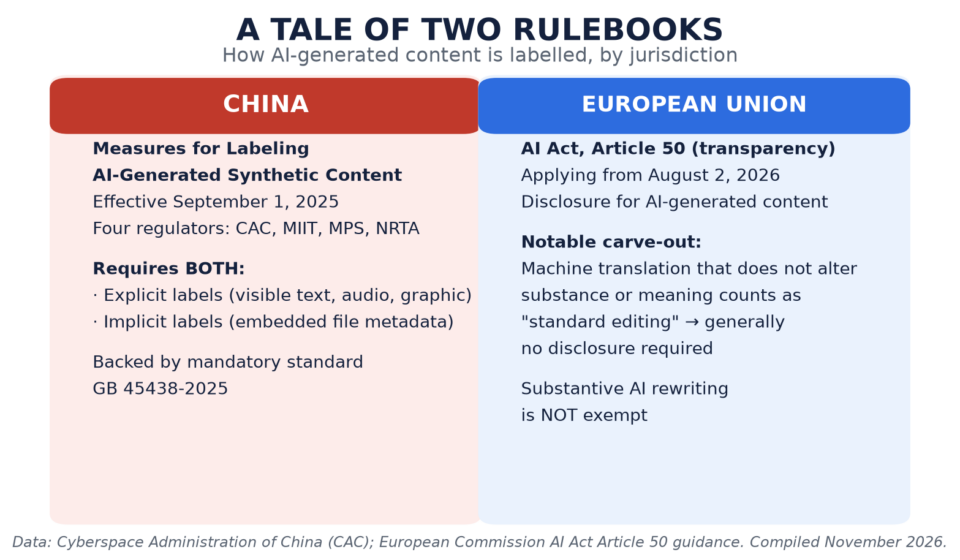
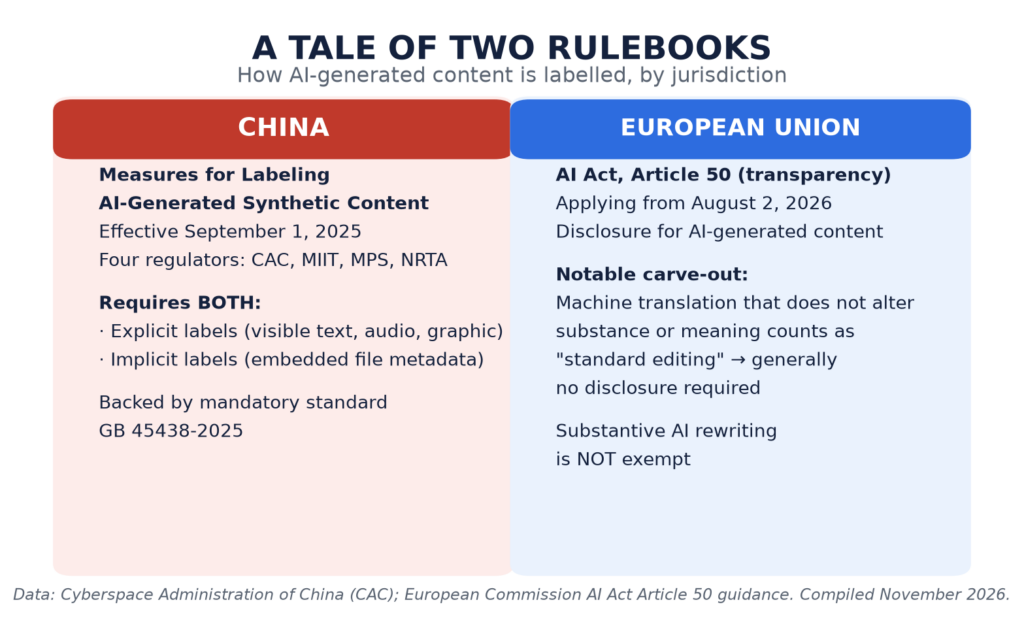
4. Consumer trust and disclosure. This one is being regulated right now, and it’s worth a moment because the rules aren’t symmetrical. China’s Measures for Labeling AI-Generated Synthetic Content took effect on September 1, 2025, requiring explicit and implicit labels on AI-generated content, backed by a mandatory national standard. In the EU, the AI Act’s transparency rules (Article 50) apply from August 2, 2026 — but the Commission’s guidance carves out a notable exception: machine translation that doesn’t alter the substance or meaning of content is treated as “standard editing” and generally doesn’t trigger the disclosure requirement. The nuance matters: a product description generated by AI may require a label, while the same content translated by AI may not. Disclosure practice will keep evolving, and brands that get ahead of it, rather than react to it, will be the ones consumers keep trusting.
7. Trends & Forward Look
Where this goes in the next two to three years is fairly legible.
Real-time localization. AI will localize a livestream in real time — a host speaking Chinese while native-English subtitles, product pages, and even voiceovers generate simultaneously. The latency problem that made live commerce hard to export is quietly disappearing.
Brand-voice-specific models. Brands will train or fine-tune proprietary AI on their own tone, style, and vocabulary, making localization truly brand-native rather than merely competent. This is the counter to homogenization.
Multimodal localization. AI will localize not just text but visual content — imagery, color, layout, cultural references — automatically. Localization expands from “words” to “everything the consumer sees.”
The strategic implication. AI localization is not a cost-cutting tool. It’s a strategic capability that turns language from a barrier into an advantage. The brands that treat it as a cost line item will save money and stay stuck. The brands that treat it as a growth lever will cross the language barrier first — and own the markets on the other side.
Conclusion
AI localization has done what decades of translation technology could not do. It has made native-quality, culturally adapted copy available to any brand, at scale, at near-zero marginal cost, in any number of markets.
For Chinese brands going global, it removes the quality tax that has hung over “made in China” since the first listing went live. For Western brands entering China, it solves the same problem in reverse. And for consumers everywhere, it resets what “native quality” even means.
This is not a tool. It’s a bridge. The brands that cross it first don’t just sound like they belong in a market — they belong there.