Why Personalization Finally Pays in a 1% Market
For twenty years, e-commerce ran on a forgiving equation. Put more people in front of more products, and revenue follows. The market grew fast enough that a merchant could be mediocre at conversion and still grow.
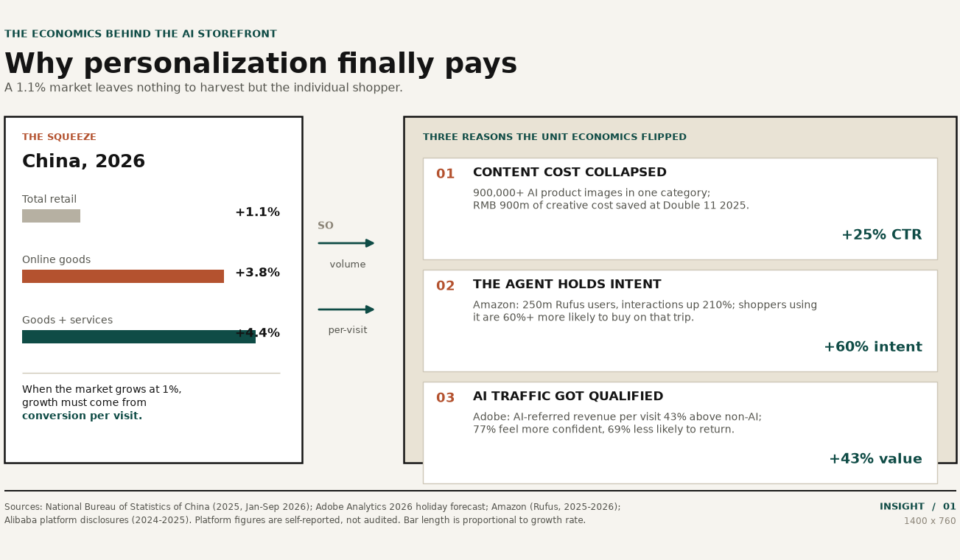
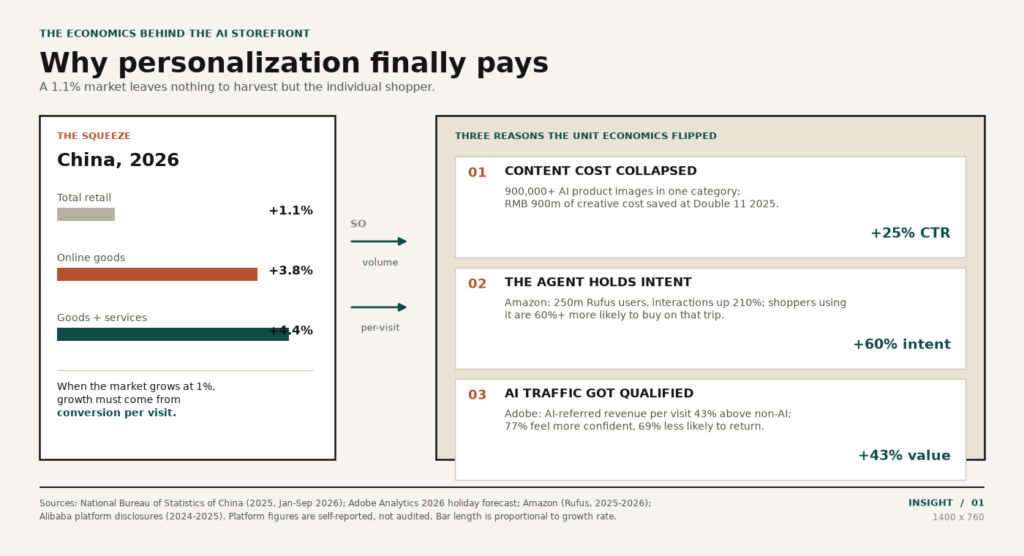
That equation quietly stopped working. In China, total retail sales of consumer goods grew just 1.1% year on year in the first nine months of 2026. Online retail of goods and services grew 4.4%. The gap looks like a win until you notice the arithmetic: when the whole market moves 1.1%, anything above that is share taken from someone else. There is no rising tide. Growth now has to be manufactured inside the visit itself.
That is the real reason AI storefronts arrived. Not because the models got creative. Because the unit economics changed.
The cost of a page fell through the floor
A product page is an expensive object to make: photography, copy, styling, layout, translation, review. Historically that cost forced a brutal compromise — one version of the page for everybody, with maybe three audience segments if the brand had budget. The page was a fixed asset, amortized across millions of visits.
Generative models turned it into a variable cost that approaches zero. Alibaba’s home-furnishing sellers had generated over 900,000 AI product images by April 2024, and those images were out-clicking the originals by 25%. At the 2025 Double 11 presale, its creative agent produced more than 50 million marketing assets for over two million merchants and, on the company’s own accounting, saved more than RMB 900 million in production costs.
Once a page costs almost nothing to produce, the rational number of pages is no longer one. It is one per shopper. The technology did not create the incentive. The incentive was always there; the cost was the only thing suppressing it.
The second driver is that the agent holds intent
Here is the part most coverage misses. A storefront that adapts to a visitor is only as good as the signal it reads. A static page guesses from a cookie. An AI agent is handed the question directly.
Amazon’s numbers make this concrete: more than 250 million customers used Rufus in a year, interactions rose 210%, and shoppers who use it are over 60% more likely to buy on that trip. Its auto-buy feature, which waits for a target price, saves customers an average of 20% per purchase. The agent is not personalizing a page — it is carrying the intent that used to evaporate between search and checkout.
That also explains Adobe’s reversal. Two years ago, AI-referred traffic was worth 128% less per visit than ordinary traffic. In the 2026 holiday forecast it generates 43% more revenue per visit, and Adobe expects that traffic to rise 130% year on year. Seventy-seven percent of AI-shopping users say they feel more confident buying; 69% say they are less likely to return the item. Same channel, opposite economics — because the question is now being asked inside the buying moment, not before it.
What actually changed
Three mechanisms, one conclusion. Content cost collapsed, so a thousand variants became cheaper than one. Intent moved from an inference into an explicit conversation, so the signal got cleaner. And a 1% market removed the option of growing by adding people.
None of this is a story about prettier pages. It is a story about where the margin went when volume stopped being free. The brands that understand this will invest in product data, asset rights and review gates. The ones that do not will keep A/B testing the color of a button on a page nobody sees twice.
Field note
Run one category through a generated-page pilot and the first thing that breaks is not the model. It is the catalog. Half the SKUs are missing attributes, a third of the images have unclear usage rights, and the “approved claims” list lives in someone’s inbox. The AI storefront does not fail at generation. It fails at everything that should have been governance five years ago. That is the unglamorous finding, and the one worth keeping.