The Short-Funnel Trap: Why China’s One-Tap Checkout Won’t Copy-Paste Abroad
Why China’s Conversion Funnels Are Shorter — and What Breaks When You Copy Them Abroad
In China, the distance between seeing something and paying for it is about the length of one heartbeat. You scroll a feed, tap a live stream, tap once more, and the money has left your account before you finish forming the thought “do I actually want this?” That is not exaggeration. It is the default setting of the infrastructure.
Now carry that same heartbeat into a Western market and watch what happens to it. The tap that used to end in a payment now ends in a dead end. A checkout page loads. It asks you to create an account. It asks for a shipping address it has never seen. It asks for a credit card number, and you pause, because you have never handed this site a card before. That single heartbeat just became a marathon run across four different apps, none of which talk to each other.
This article is about the gap between those two experiences — and why the first one cannot simply be copied into the second.
The Observation: Shorter by Default
China’s funnels are not shorter because Chinese consumers are more impulsive. That is the lazy explanation, and it is wrong. They are shorter because the steps have been engineered out of existence.
Look at the scale you are dealing with. China’s mobile internet reached 1.282 billion monthly active users in mid-2026, up 1.2% year over year, according to QuestMobile. The country counts 1.125 billion internet users and an 80.1% penetration rate, per CNNIC’s 57th Statistical Report. Digital consumption — the act of buying through digital channels — now involves 958 million people, or 85.3% of all internet users.
When nearly your entire population already lives inside a small handful of super-apps, the funnel does not have to pull people in from the outside. It only has to move them sideways, inside a single app, from content to payment in a few taps. That is the whole trick, and it is not a trick at all — it is structure.
What “Short” Actually Means in Steps
The word “short” hides the mechanism, so let me make it concrete.
In a classic Western funnel you have awareness, consideration, and conversion, and each stage lives in a different place. You meet the product on one platform, click through to a website, fill a cart — and then, statistically, you abandon it. Baymard Institute, which has spent over a decade testing checkout flows across the US and EU, puts the average documented cart abandonment rate at 70.22%.
Seventy percent. More than two out of every three carts never convert.
Now hold that against China. The 2025 livestream commerce white paper, produced by the State Administration for Market Regulation’s development research center together with the Chinese Academy of Social Sciences, reports that livestream commerce alone surpassed 5 trillion yuan in GMV in 2025 — roughly one-third of all online retail. A year earlier it already contributed 80% of e-commerce’s incremental growth.
This is a funnel where the “content” stage and the “checkout” stage occupy the same screen. You do not travel from discovery to purchase. You watch, you tap, you have bought. The gap that costs Western retailers 70% of their carts simply does not exist here, because there is no gap to fall into.
The Rails Under the Funnel
The reason the gap is gone is not a marketing trick. It is infrastructure. The payment, the identity, the address, and the trust are all installed in advance.
Think of a railway. A train in China does not travel faster because its passengers are more eager. It travels faster because the track is already laid. In the West, every purchase is a hand-laid track, built fresh each time: a new form, a new card entry, a new account, a fresh trust decision.
China’s super-apps laid the track years ago. Before you copy anything, understand this: you are not copying a funnel. You are copying a train and pretending the rails will appear underneath it.
Payment as a One-Tap Layer
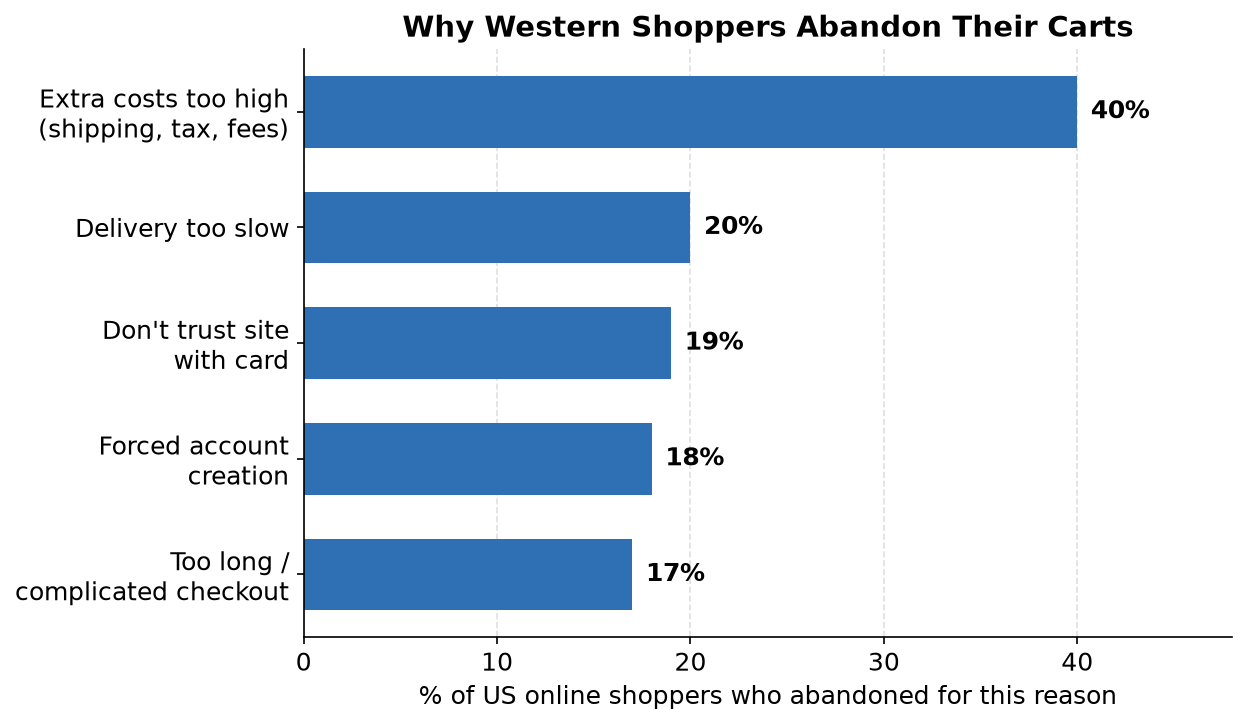
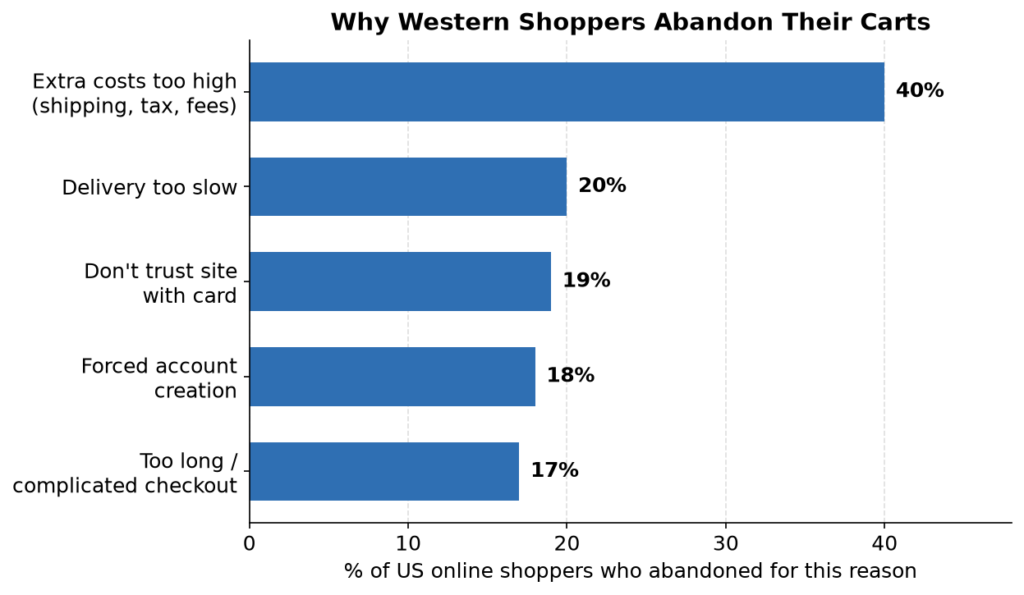
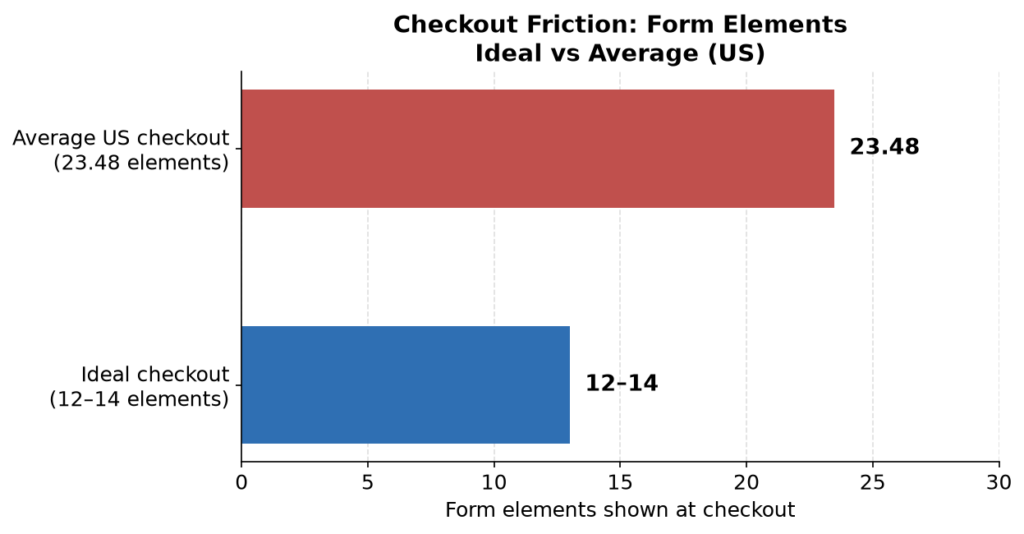
Here is the rails argument made concrete. In the West, checkout friction is documented down to the decimal point. Baymard found that 19% of US shoppers abandon because they do not trust the site with their card, 18% because the site forces them to create an account, and 17% because the checkout is simply too long. The average US checkout presents 23.48 form elements by default.
In China, payment is not a form. It is a fingerprint, a face scan, or a single confirmation inside an app where your identity and card already live. WeChat Pay and Alipay carry the transaction, and the two have even begun interoperating so that a code from one scans in the other. There is no “enter your card number.” There is no “trust this merchant.” That trust was settled years ago, at the platform level.
The result is a payment layer that behaves like a one-tap confirmation rather than a multi-step chore. That one design difference explains a large share of why a Chinese funnel can be three taps long while a Western one is twelve.
Social as the Discovery Engine
The second rail is social. In China, discovery does not begin on a search engine as a first resort. It begins in the feed, in the group chat, in the live stream.
The numbers make this tangible. QuestMobile counted 1.023 billion monthly active mini-program users in mid-2026, with WeChat’s mini-programs alone at 962 million. These are not separate destinations a user has to go find. They live inside WeChat, which is also the chat app, the payment app, and, increasingly, the operating system of daily life.
So when a product gets recommended in a group chat, the buyer is already inside the environment where they can open it, pay for it, and have it delivered — without ever leaving the app. Discovery and conversion share the same address.
Content as the Storefront
The third rail is content. In China, the storefront is a live stream or a short video, not a product detail page.
This is where the 5-trillion-yuan figure earns its place. Livestream commerce made up nearly a third of online retail in 2025, which means the “product page” that matters most in China is a person talking, demonstrating, and selling in real time, with the buy button overlaid directly on the video.
The audience for this is enormous — around 660 million people now watch and buy through livestreams, roughly six in ten internet users. That is not a niche channel. It is the mainstream storefront.
Content is not a top-of-funnel asset that hands off to a separate conversion layer. Content is the conversion layer. When content and checkout share the same surface, the handoff — the exact moment Western funnels leak users — never happens.
The Gap in the Numbers
Put the two markets side by side and the contrast is almost blunt.
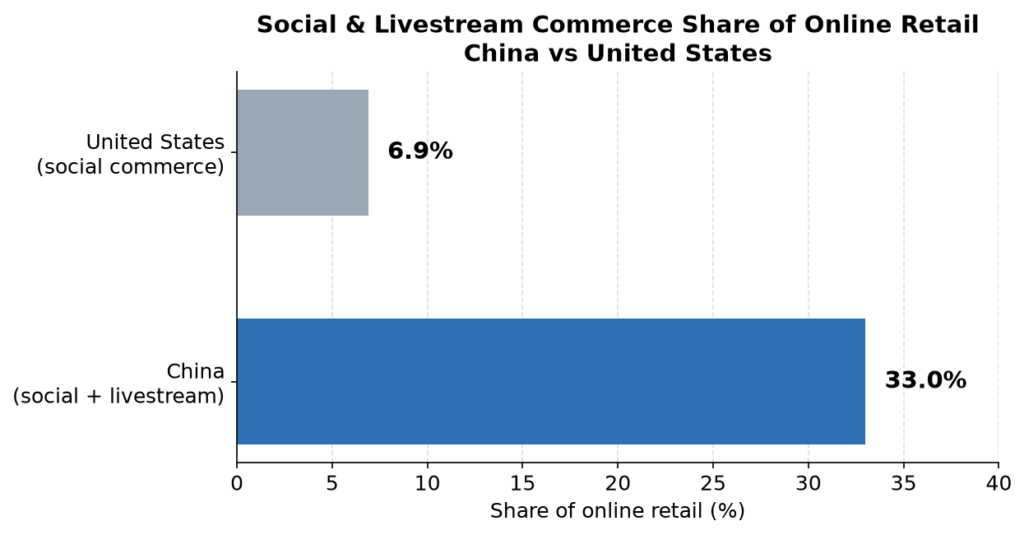
In China, social and livestream commerce represent roughly one-third of all online retail — on a base of 15.97 trillion yuan in national online retail sales in 2025, up 8.6% and the largest in the world for the thirteenth consecutive year, per the National Bureau of Statistics.
In the United States, social commerce is 6.9% of retail e-commerce, according to eMarketer, which projects it will reach only 9.3% by 2029. The whole category — globally — hit roughly $699 billion in 2024 and is on pace to cross $1 trillion by 2028, which sounds large until you remember that China’s livestream commerce alone cleared the equivalent figure in a single year.
The point is not that one market is “better.” It is that the two are running on different rails, and the ratio — one-third versus 6.9% — is the fingerprint of that difference.
Why It Cannot Be Lifted As-Is
At this point you may be thinking: fine, I will run a live stream with a buy button on my Western site. That is precisely the mistake this article exists to warn you about.
The live stream is not the mechanism. The rails are. A buy button on a video is trivial to copy. The part that matters is what happens after the tap: a payment layer that already knows the buyer, a social graph that already trusted the sender, and a fulfillment chain already absorbed into the same app.
Copy the button without the rails and you have not shortened your funnel. You have moved the same 70% abandonment rate into a smaller window, where it now hurts more because the buyer expected frictionless and got a form.
The Abroad Failure Modes
When Western teams try to transplant the short funnel, they tend to break in three predictable ways.
First, the payment gap. The tap leads to a checkout that asks for a card and an address the social platform never had. The buyer stalls. The 19% “I do not trust this site” abandonment and the 17% “checkout is too long” abandonment are both still fully intact.
Second, the account gap. Western social platforms are deliberately walled off from each other and from payment rails. The single sign-on that makes China frictionless does not exist across Meta, TikTok, and Shopify the way it does inside WeChat. Every hop reintroduces a form, and every form reintroduces the 18% “create an account” abandonment.
Third, the trust gap. China’s platforms absorbed trust at the platform level — you trust WeChat, so you trust the transaction inside it. In the West, trust is per-merchant and per-site, which is why so many first-time visitors stall at the checkout wall.
None of these are marketing problems. They are infrastructure problems, and no amount of funnel optimization will fix them.
What Transfers, What Doesn’t
So what actually survives the trip across the border?
What transfers is the insight that friction is the enemy of conversion, and that every extra step, form, and account request is a leak. That insight is universal.
What transfers is the tactic of collapsing discovery and purchase into a single surface — a shoppable video, an in-feed checkout, a one-tap payment. The tactic is portable even when the rails are not.
What does not transfer is the assumption that the rails will be waiting when you land. In China they are pre-built. Abroad, you build them yourself, market by market, platform by platform.
The lesson is not “do it like China.” The lesson is “know which part of what China does is the rail and which part is the train.”
A Rebuild Checklist for Non-China Markets
If you want the benefit of a short funnel without the inherited infrastructure, here is what you have to construct by hand.
Make payment feel native. Pre-fill what you can, remember the buyer across sessions, and offer the payment methods the market actually trusts. Every card field you remove is a leak you have plugged.
Collapse the account barrier. Guest checkout, social login, or a one-tap identity — the goal is to never ask a first-time buyer to build something before they are allowed to buy.
Shrink the checkout. Baymard’s testing shows an ideal checkout can run as short as 12 to 14 form elements. Most Western sites ship 23.48. That gap is pure, recoverable conversion.
Bring conversion into the content surface. A shoppable video or a one-tap buy on a social platform earns you part of the China effect, even when the payment layer underneath is still yours to build.
Measure the right thing — which is the next section.
Measuring Funnel Health Correctly
You cannot measure a short funnel with a long-funnel dashboard.
In the West, the standard is conversion rate from visit to purchase, and the 70.22% cart abandonment rate is the number everyone quotes. In China, the equivalent questions are different: how fast can a viewer go from seeing to paying, how many steps sit between the two, and what fraction of that journey stays inside a single app.
The single most useful metric for a short funnel is not conversion rate but steps-to-purchase and time-to-purchase. A funnel that converts 3% in twelve steps and one that converts 3% in three steps are not the same funnel, even when the dashboard prints the same number. The second one has far more headroom left to optimize.
The Strategic Takeaway
China’s funnels are short because the rails are built in. Payment, identity, social, and content are sealed inside the same app, so the buyer never has to cross a border between them. What Western observers read as consumer impulsiveness is mostly just the absence of friction.
Copy the tactic — collapse discovery and checkout, kill the account wall, make payment native — and you can claim a meaningful slice of the effect. Copy the tactic while assuming the rails will be there, and you will watch your 70% abandonment rate follow you into a shorter, more frustrating funnel.
The heartbeat only works when the track is already laid. If you want that heartbeat in another market, be ready to lay the track yourself.
Summary
China’s conversion funnels feel short because the infrastructure collapses what the West keeps separate. A super-app bundles payment, identity, social discovery, and content into one surface, so the buyer moves from seeing to paying in a few taps rather than crossing app boundaries. The numbers show the result: livestream commerce is roughly one-third of Chinese online retail, while US social commerce is 6.9% of retail e-commerce, and Western carts still abandon at a 70.22% average clip. The temptation is to copy the visible tactic — the live stream, the buy button — while leaving the rails behind. That fails predictably, at the payment gap, the account gap, and the trust gap. The fix is not to recreate WeChat. It is to rebuild the rails locally: native payment, a collapsed account wall, a shorter checkout, and conversion inside the content surface, then measure steps-to-purchase instead of raw conversion rate.
FAQ
Why are China’s conversion funnels shorter?
Because the steps are removed by infrastructure, not by consumer behavior. Payment, identity, social discovery, and content all sit inside the same super-app, so the buyer never crosses from one app to another to complete a purchase. The funnel is short because there is no gap in it to fall into.
Can I copy China’s funnel abroad?
You can copy the visible tactic — shoppable video, in-feed checkout, one-tap payment — but not the rails underneath it. The tactic transfers; the pre-built payment and identity layer does not. Expect to rebuild that layer yourself in each Western market.
What breaks when I try?
Three things. The payment gap (the tap leads to a checkout that asks for a card the platform never had), the account gap (forced registration stalls first-time buyers), and the trust gap (Western trust is per-site, not platform-level). Each one reintroduces the friction the short funnel was meant to erase.
Is it about payments or content?
Both, but payments matter more than people expect. Content shortens the top of the funnel by making the storefront a video. Payment shortens the bottom by making the checkout a single confirmation. In the West, Baymard attributes a large share of cart abandonment directly to checkout friction — long forms, card distrust, forced accounts — which is exactly what China’s native payment layer removes.
How do I measure a short funnel?
Stop leading with conversion rate. Measure steps-to-purchase and time-to-purchase instead. Two funnels that both convert 3% are not equal if one takes twelve steps and the other takes three. The shorter one has more optimization headroom, and that is where the real work happens.