The Discovery Shift: How Short Video, Notes, and AI Assistants Replaced the Search Box in China
Data vintage: December 2025 to June 2026 · Channel: China Data Tables · Markets: China, with a United States benchmark
Answer in one paragraph
Chinese consumers mostly meet a new brand inside a content feed, not inside a search box. Short video reaches 1.074 billion people, or 95.4 per cent of the country’s netizens. Lifestyle notes carry 800 million searches a day. AI assistants went from 142 million to 462 million monthly users between January 2025 and April 2026 on QuestMobile’s panel, and now rank among the most frequently opened apps in the country. Search still converts, but it has moved from the starting line to the confirmation step. No institution publishes a clean percentage split of first brand contact, so this table gives reach, intensity and direction instead of inventing a share.
Key figures in one block
- China internet users, December 2025: 1.125 billion, penetration 80.1 per cent, per CNNIC’s 57th statistical report released 5 February 2026.
- Short-video users: 1.074 billion, or 95.4 per cent of all netizens, same report.
- Online shopping users: 937 million, or 83.2 per cent of netizens, same report.
- Monthly time per mobile user, June 2026: 189.3 hours across 2,691 app sessions, per QuestMobile’s first-half 2026 mobile internet report.
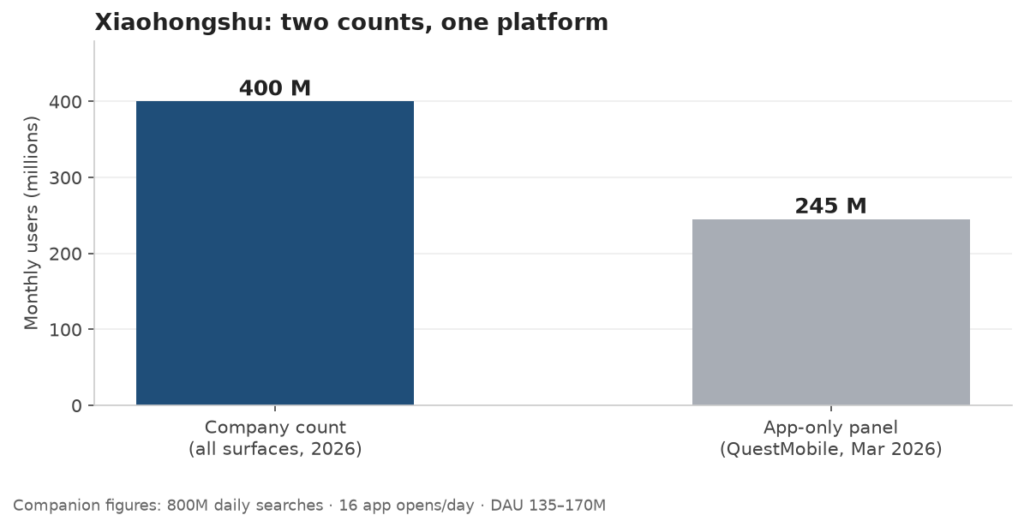
- Xiaohongshu: over 400 million monthly users, 800 million daily searches, 16 app opens per user per day, on the company’s own account reported in July 2026.
- Xiaohongshu on QuestMobile’s app-only panel: 245 million monthly users in March 2026, down 1 per cent year on year, the first decline since tracking began in 2020.
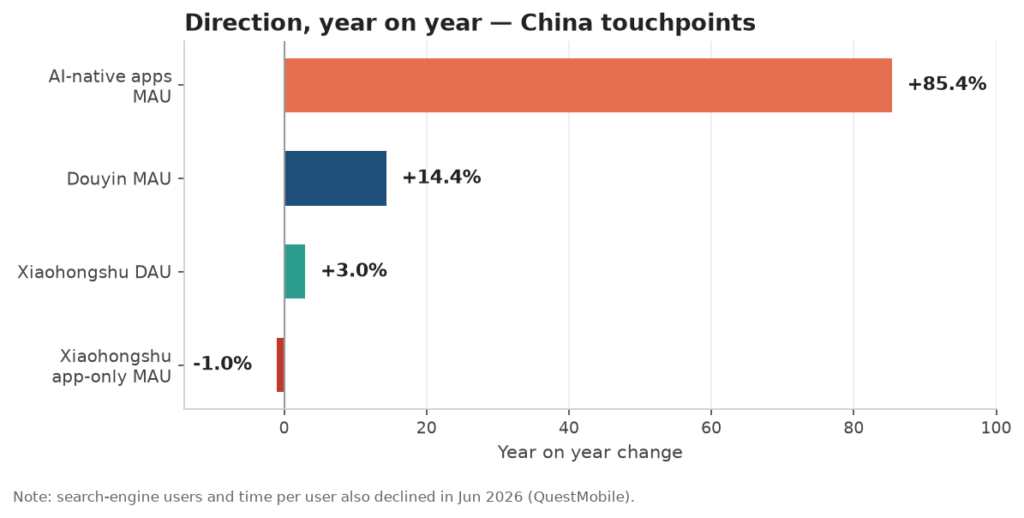
- AI-native apps in China, June 2026: 499 million monthly users, up 85.4 per cent year on year.
- AI-native app intensity: 92.7 sessions per user per month, the highest of any app class in QuestMobile’s panel.
- Search engines, June 2026: one of three app categories in China where both users and time per user fell year on year.
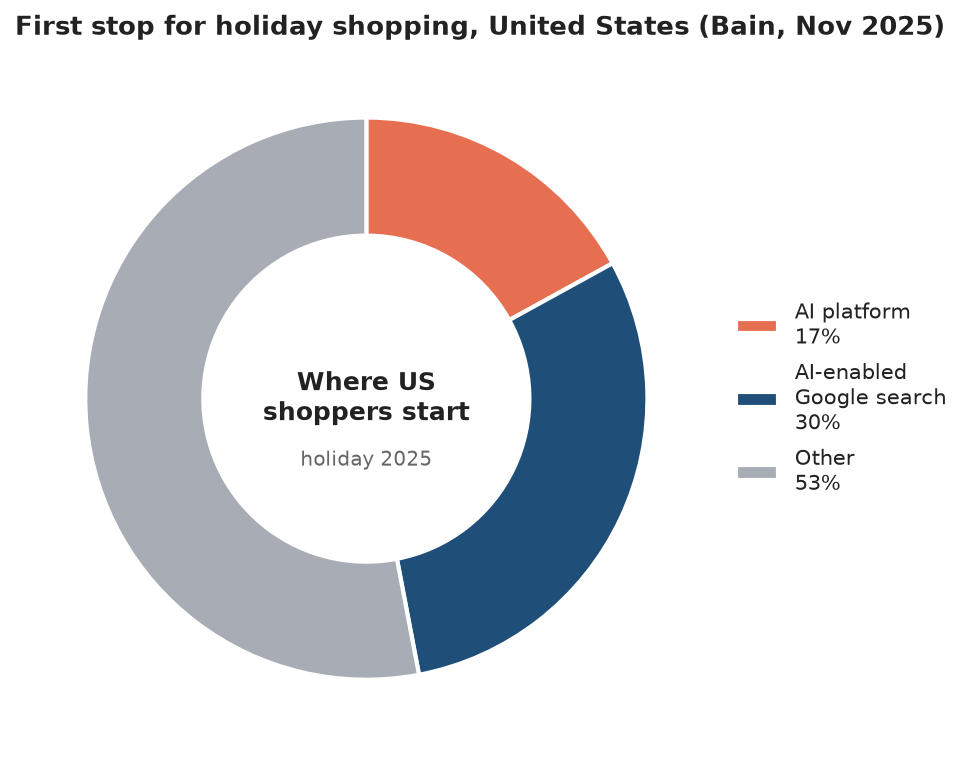
- United States, holiday 2025: 17 per cent of online shoppers start with an AI platform and 30 per cent with AI-enabled Google search, per Bain and Company.
- Generative AI traffic to US retail sites, holiday 2025: up 693.4 per cent year on year, per Adobe Analytics.
The figure that opens this section
1.074 billion. That is how many people in China watched short video in December 2025, on CNNIC’s count. Put it beside the online shopping population of 937 million and you have the structural fact this table is built on: roughly 137 million more people watch short video than shop online, and the watching population is the larger of the two by a wide margin.
That gap is where discovery happens. A person who is not yet shopping is still watching. A brand that only buys shopping inventory never meets her.
The question the brief asked, and the answer that is not a percentage
The brief for this table asked for share of discovery by touchpoint, with a trend line. That number does not exist, and pretending it does would produce the most quotable and least defensible line in the series.
Here is why. Discovery share would require a survey that asks a representative sample where they first heard of a named brand, then aggregates across brands. China publishes plenty of attitude surveys and plenty of platform panels. Nobody publishes a deduplicated, brand-level first-contact census. The platforms measure their own inventory. Research houses measure their own panels. Neither measures the moment a person notices something they were not looking for, because that moment has no click attached to it.
So the table does three things instead. It measures reach, which is how many people a touchpoint can put in front of an unfamiliar brand. It measures intensity, which is how often those people come back. And it measures direction, which is whether the touchpoint is gaining or losing ground. Those three are published. A share is not.
Three measures, and only three
Every figure below comes from one of three instrument types, and they do not substitute for each other.
Government census. CNNIC counts users by application, quarterly, on a sample of the national population. It is the only series that covers the whole country on one definition. It is slow and it is coarse.
Third-party panel. QuestMobile measures app activity across a device panel. It is fast, granular and consistent across platforms. It is an estimate, not an audit, and it sees apps better than it sees messaging or offline referral.
Platform disclosure. Douyin and Xiaohongshu publish selected operating metrics, usually at conferences or in creator reports. Useful, directional, and chosen by the seller.
Any sentence that mixes the three without saying which is which will be quoted out of context. The column notes below name the instrument for every row.
Table 1: reach and intensity, by touchpoint
| Touchpoint | Reach in China, latest published | Intensity | Direction, year on year | What it actually decides | Instrument |
|---|---|---|---|---|---|
| Short video (Douyin, Kuaishou, Channels) | 1.074 billion users; 92.6 per cent active penetration; Douyin alone at 1.009 billion monthly | 712 million daily users on 18 June 2026 | Douyin monthly users +14.4 per cent | Raw awareness, at the lowest cost per thousand | CNNIC, QuestMobile |
| Lifestyle notes (Xiaohongshu) | Over 400 million monthly on the company count; 245 million on the app-only panel | 800 million searches a day; 16 opens a day | App-only monthly users −1 per cent; daily users +3 per cent | Consideration: whether this product suits this person | Platform disclosure, QuestMobile |
| AI assistants | 499 million AI-native monthly users; 755 million reached through phone-maker assistants | 92.7 sessions per user per month | +85.4 per cent | The shortlist, the price check, the first recommendation | QuestMobile |
| Search engines | No clean user figure; category is in decline | Falling | Users and time per user both down | Confirmation of a name already heard | QuestMobile |
| Live commerce | About 18 per cent annual growth, 2024 to 2026 | Peaks sharply in campaign windows | Normalising from triple digits | Price conviction and the last mile to checkout | iResearch |
| Messaging and word of mouth | WeChat at 1.281 billion deduplicated users | Not separately measured | Flat | Referral, the push from someone the buyer knows | QuestMobile |
Reading the table: the short-video floor
Ninety-two point six per cent active penetration is not a marketing channel. It is the floor the country stands on.
Two consequences follow. First, reach is no longer scarce in China, so reach is no longer the thing to buy. Anyone can put an unfamiliar brand in front of a billion people by Thursday. What is scarce is being remembered on Friday. Second, the platform that owns the floor also owns the auction, and the auction prices creative volume. A brand that arrives with one polished film and no volume of honest material is bidding against sellers who ship daily.
The two penetration numbers are worth separating. CNNIC’s 95.4 per cent is users as a share of netizens. QuestMobile’s 92.6 per cent is active users as a share of device users. They sound identical and they are measuring different denominators. Use CNNIC to describe the country. Use QuestMobile to compare apps.
The lifestyle note: 400 million and 245 million
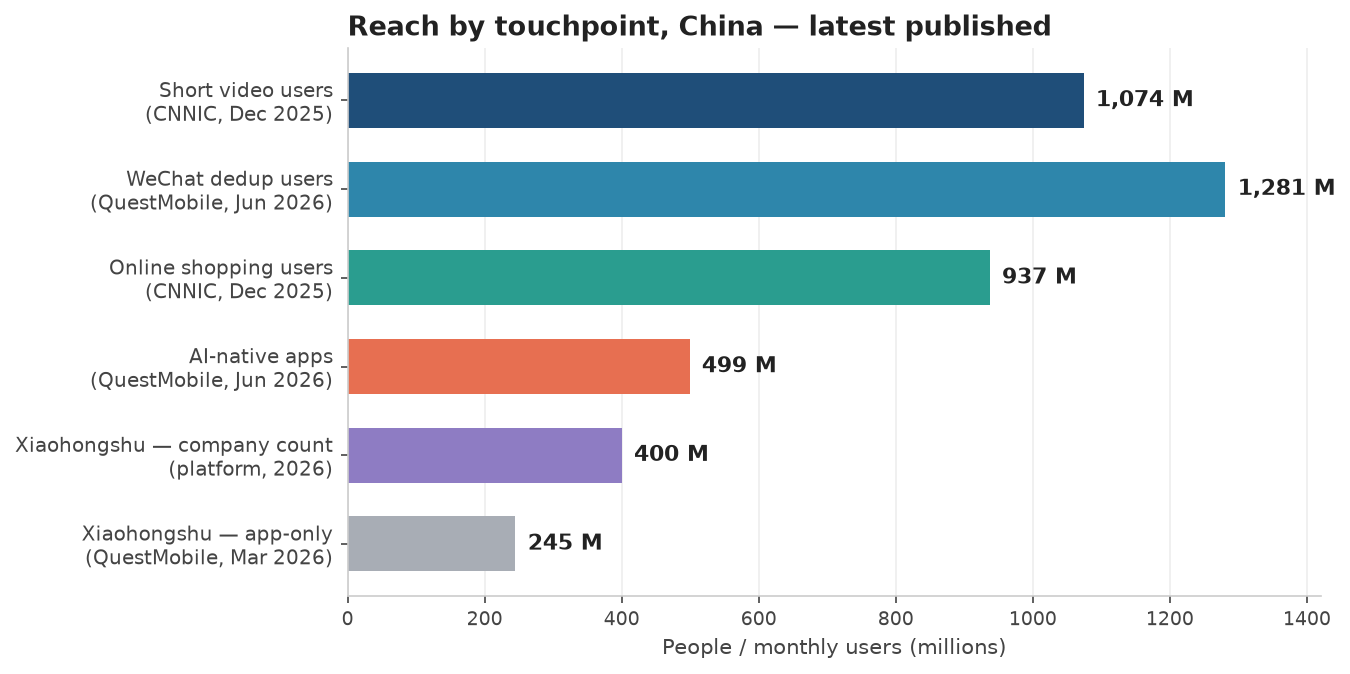
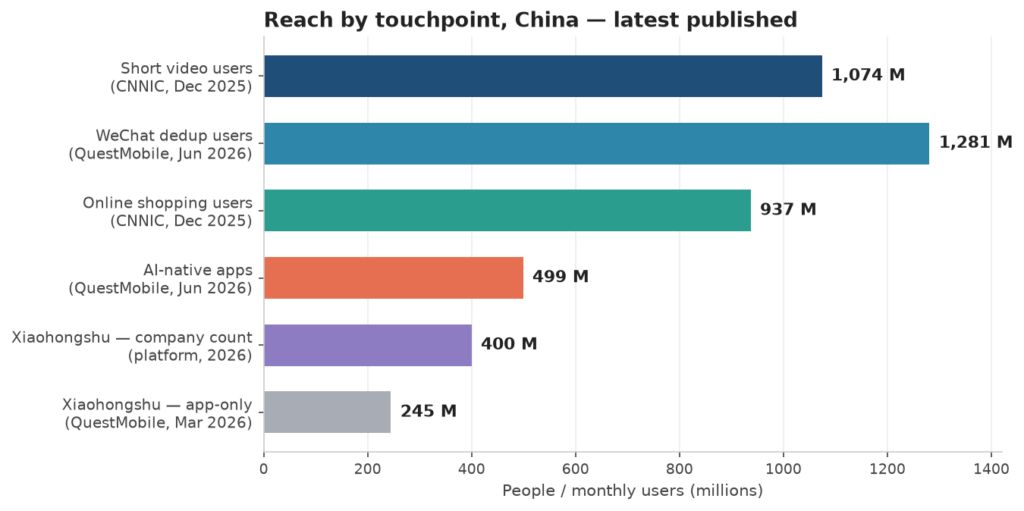
Two numbers circulate for Xiaohongshu and they differ by 155 million. Both are defensible and only one should appear in your deck.
The company’s figure, reported through Chinese business media in July 2026, is over 400 million monthly users, with daily users between 135 million and 170 million, 800 million searches a day and 16 app opens per user per day. That count covers a network of surfaces: the app, the web, mini programs and, since 2026, a television and PC push.
QuestMobile’s panel counts the app alone. On that basis Xiaohongshu had 245 million monthly users in March 2026, having started April 2024 at 208 million, and monthly users fell 1 per cent year on year in the latest reading, the first decline in six years of tracking, with daily users up 3 per cent and time per user down 4 per cent.
Read together, and the shape is clear. The surface is wider than the app. The app has stopped growing. The habit has not stopped, because the searches inside it keep rising.
That matters more than the headline, because the searches are the product. A platform whose users run 800 million searches a day is not a social network with a shopping tab. It is a decision engine with a feed attached.
Search did not die. It moved down the line.
QuestMobile’s June 2026 read puts search engines among three categories where both users and time per user dropped year on year, alongside forums and photo apps. That is a share loss, not a revenue collapse, and the two get confused constantly.
The mechanism is behavioural rather than commercial. A generic question now gets answered before a results page loads. What survives is the query with money attached: a model number, a warranty term, a dealer in a named city, a brand name someone heard in a feed.
Hence the phrase that keeps appearing in Chinese platform research: 种草 first, 拔草 later. Plant the idea, then pull it out. The search is the second half.
Globally the same migration is being counted in money rather than behaviour. WPP Media’s midyear 2026 forecast has traditional and generative search together at 21.8 per cent of global ad revenue, with generative search growing from USD 5.1 billion this year toward more than USD 100 billion by 2030.
Live commerce: discovery wearing a checkout’s clothes
Live commerce is the touchpoint most often miscategorised, because it looks like conversion and behaves like discovery.
The format works because attention, demonstration, price and payment sit on one screen, so the leakage between steps disappears. iResearch puts channel growth near 18 per cent a year across 2024 to 2026, which is normalisation rather than decline, and it is still several times the pace of overall online retail.
For a brand entering China, the consequence is planning arithmetic. A stream does not just close a sale. It introduces a product to people who arrived for the host, the discount or the drama. That introduction then gets confirmed later, in search and on the product page. Fund only the stream and you pay twice for the same customer.
Word of mouth has a surface, and it has a number
Word of mouth is the touchpoint every plan claims and no panel measures. The closest thing to a hard number is the size of the surface it travels on.
WeChat carried 1.281 billion deduplicated users in June 2026, the largest single surface in the country on QuestMobile’s enterprise measure. Nobody publishes what share of new-brand contact happens inside a one-to-one chat or a group, because that conversation is not instrumented. What is instrumented is the outcome: the branded search that follows a recommendation, and the code that gets scanned after it.
So treat messaging as the touchpoint with the highest trust and the lowest measurement. Budget for it. Do not expect the dashboard to prove it.
The AI assistant became a first contact point in 2026
This is the change that arrived between the last edition of this table and this one, and it is the one that alters the order of the funnel.
AI-native apps in China held 499 million monthly users in June 2026, up 85.4 per cent year on year, and grew by 150 million users in five months alone. Phone-makers’ built-in assistants reach 755 million, which means most Chinese smartphone users now carry an assistant they did not install.
The intensity figure is the one to remember. Ninety-two point seven sessions per user per month is the highest of any app class QuestMobile measures, which means the assistant is not a novelty tab. It is a habit.
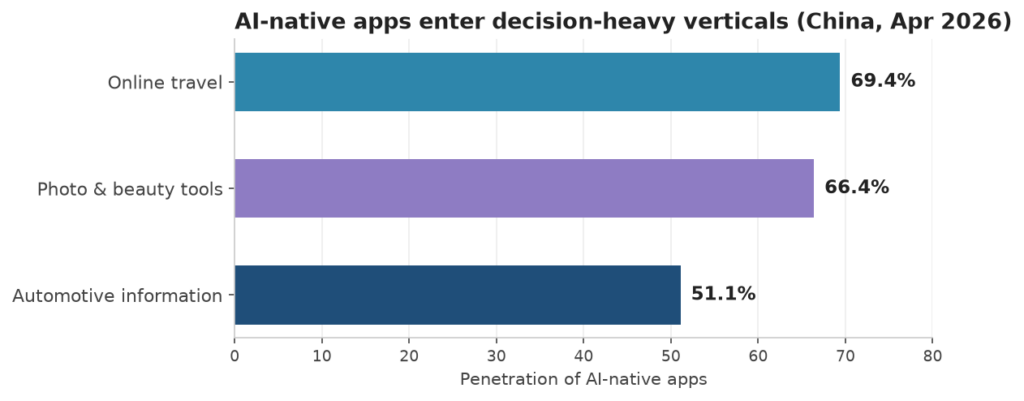
And it is moving into exactly the categories where a feed used to decide. By April 2026, AI-native apps had reached 69.4 per cent penetration in online travel, 66.4 per cent in photo and beauty tools, and 51.1 per cent in automotive information. Those three are the categories where purchase decisions carry the highest information cost, which is where a summarising assistant beats a scroll.
What the AI wave did to the top of the funnel
The same report records the effect from the other side. QuestMobile splits Chinese app categories into three states in the first half of 2026: gaining, restructuring and under pressure. Search sits in the third group. Travel guides and photo tools sit in the overlap between the assistant’s reach and the note platform’s core use.
There is also a supply-side effect, and it is less discussed. Lower cost of content production means more content, which means the feed gets noisier while the assistant gets cleaner. A summariser that reads fifty notes and returns three is a better product than a feed of fifty notes. That is the trade the top of the funnel is currently making.
Trust is the tax on discovery
Discovery platforms sell trust, and trust is the only input whose cost rises as the platform scales.
Chinese survey work reported in July 2026 found that 63 per cent of users who had drifted away from Xiaohongshu named too much false information as the reason, the top answer by a distance. The same reporting notes that the platform gives half its traffic to creators under a thousand followers, that brand invitations through its official creator marketplace reached 27 million in 2025, up 34 per cent, and that advertising supplied 76 per cent of its RMB 42 billion revenue in 2025.
That arithmetic explains the tension. The small creator is the asset, because a peer’s note transfers credibility that a studio asset cannot. The small creator is also the party whose commercialisation erodes that credibility fastest. Scale the monetisation and the asset depreciates.
For a planner the lesson is not moral, it is mechanical. A discovery budget that pays only for reach is buying a depreciating asset. One that pays for recurring, disclosed, specific content is buying the thing the platform actually sells.
Who writes the note matters more than who pays for it
QuestMobile’s first-half 2026 marketing read contains the most useful single disclosure in this section. Brand soft-advertising on Xiaohongshu clusters in the 5,000 to 100,000 follower tier, while on Bilibili it clusters above 500,000. The two platforms are being bought for different jobs.
On the note platform, brands are buying native feel and seeding efficiency, which only exists at small scale. On the long-form video platform, they are buying explanation and trust transfer, which only exists at large scale.
That is a budgeting rule, not a preference. Put seeding money where the credibility is granular. Put the argument where the audience is already persuaded enough to sit through it.
The United States benchmark: where shoppers actually start
The gap between the two markets is not in the behaviour. It is in the interface that holds the wallet.
Bain and Company’s November 2025 consumer work gives the closest thing to a published first-contact split, and it is for one occasion: the start of holiday shopping. Seventeen per cent of unique online shoppers said they would begin with an AI platform such as ChatGPT or Perplexity, and 30 per cent with Google search, which is now AI-enabled. That leaves about 53 per cent starting somewhere else, meaning a retailer site, a marketplace, social, email or a store.
Bain also found that 30 to 45 per cent of US consumers already use generative AI for product research and comparison, and that roughly half are unwilling to let an agent complete a purchase end to end. The distrust sits at the transaction, not at the recommendation.
Table 2: first contact, United States, holiday 2025
| First stop for holiday shopping | Share of unique online shoppers | Note |
|---|---|---|
| AI platform (ChatGPT, Perplexity and similar) | 17 per cent | Millennials 52 per cent, Gen Z 25 per cent |
| AI-enabled Google search | 30 per cent | Search is still the largest single door |
| Other: retailer site, marketplace, social, email, store | 53 per cent | Derived as the remainder |
| Consumers using generative AI for product research | 30 to 45 per cent | Range across the survey base |
| Unwilling to let an agent complete a purchase | About 50 per cent | Trust fails at checkout, not at advice |
A second dataset prices the shift rather than counting it. Adobe Analytics measured US holiday e-commerce at USD 257.8 billion for November and December 2025, up 6.8 per cent, with traffic to retail sites from generative AI tools up 693.4 per cent year on year. That traffic is still a small base. Adobe also recorded social media at 4.6 per cent of retail revenue, up 40.3 per cent year on year, and affiliates and partners, which include creators, at 20.4 per cent.
Compare the two markets and the difference is structural rather than cultural. In the United States, discovery and checkout live on different surfaces, so the assistant sits between them and gets counted as a referrer. In China, the feed, the note, the live room and the payment sit inside the same app, so discovery never leaves the building and never appears as referral traffic.
That is why a low AI-referral share in the United States and a 499 million-user assistant population in China are both true at the same time.
What this means for a plan
Budget discovery as the funnel, not as awareness. In China the touchpoint that meets the most people is also the touchpoint that decides whether the funnel continues. A plan that caps it at awareness spend has capped the only growing part.
Buy volume of specific, honest material. The feed prices creative throughput and the note platform prices native feel. One polished asset per quarter is a strategy for a market where attention was scarce.
Treat search as confirmation and defend the branded terms. Generic queries are migrating into assistants. Model numbers, warranty terms, local stock and brand names still convert, and they deserve a thinner, sharper budget than a 2024 plan allocated to them.
Write product facts for machines. If assistants are doing the shortlisting, structured specifications, price, availability and return terms matter more than taglines. A summariser can only recommend a product it can parse.
Instrument the save, not just the click. In-app searches, saves, shares and comment questions are the closest published proxies for intent formation. Last-click reports will keep telling you discovery does not work while your branded search volume doubles.
Keep the two Xiaohongshu numbers apart. Use the company count to describe a platform’s surface. Use the panel count to describe an app’s trajectory. Never put one in a chart with the other.
Summary
Chinese consumers meet new brands inside feeds, notes and now assistants, and the published data describes reach and intensity far better than it describes share. Short video covers 1.074 billion people, or 95.4 per cent of netizens. Xiaohongshu runs 800 million searches a day on a 400 million-user surface while its app-only monthly users fell 1 per cent. AI-native apps reached 499 million users and 92.7 sessions per user per month, and they now penetrate travel, beauty tools and automotive research at 69.4, 66.4 and 51.1 per cent. Search engines lost both users and time. Live commerce normalised near 18 per cent annual growth but still introduces products before it closes them. In the United States, 17 per cent of holiday shoppers start with an AI platform and 30 per cent with AI-enabled search, while generative AI referral traffic grew 693.4 per cent from a small base. The behaviour is converging. The interface is not.
Frequently asked questions
Is discovery really moving away from search in China?
It is moving off generic search and into feeds and assistants, while search keeps converting high-intent queries. QuestMobile recorded both users and time per user falling for the search engine category in June 2026. That is a share loss. It is not the disappearance of search, because branded and product-specific queries still carry the purchase.
Why do the two Xiaohongshu numbers differ by 155 million?
One counts a network of surfaces and comes from the company. The other counts the app alone and comes from a third-party device panel. Same platform, different denominators. The second is the only one that shows a trend, and that trend is flat to slightly down.
If AI assistants have 499 million users, why is AI referral traffic still under 1 per cent in the United States?
Because in the United States the assistant sits between the shopper and a separate retail site, so it registers as a referrer. In China the assistant, the feed and the payment often sit inside one app, so the same behaviour never appears in referral data. Low referral share is a plumbing artefact, not a measure of influence.
What should a brand measure if a discovery share does not exist?
Four things: save rate on note-type content, in-app search volume for the brand name inside the platform, branded search volume outside the platform, and the ratio between them. The first two mark intent formation. The last two show whether the formed intent survived the confirmation step.
Does live commerce belong in a discovery table or a conversion table?
Both, which is the point. The format compresses introduction, demonstration and payment into one screen, so a single session does the work of three funnel stages. Price it as discovery with a conversion tail, not as a performance channel with a content cost.