Anthropic Just Gave Wall Street Its First Real Look at AI Unit Economics
Anthropic Files for a Landmark IPO — $16.3 Billion in Half-Year Revenue and an 85% Gross Margin
Anthropic filed its S-1 registration statement with the US Securities and Exchange Commission on 26 October, taking the Claude maker one step closer to what could be the largest technology listing on record. The company plans to trade on the Nasdaq Global Select Market under the ticker ANT, with Goldman Sachs and Morgan Stanley leading a syndicate of more than twenty banks. Reported valuation discussions range from USD 1.5 trillion to USD 2 trillion — well above the USD 965 billion at which it raised capital in a May private round.
Revenue went vertical
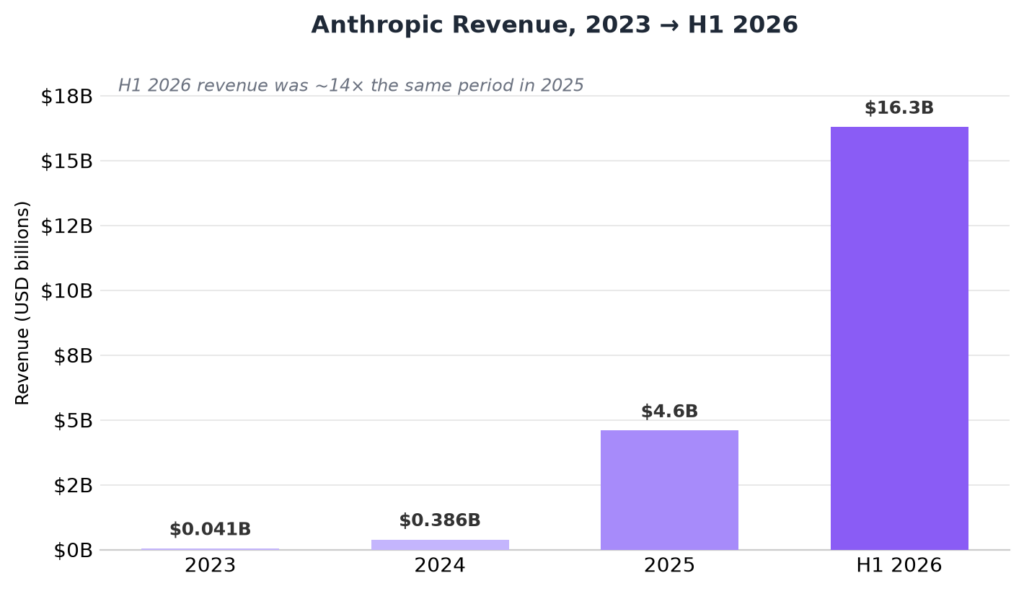
The top line is the story everyone will quote. Anthropic booked USD 16.286 billion in first-half 2026 revenue, up roughly fourteen times from the USD 1.163 billion it posted a year earlier. Put the arc in full: USD 41 million in 2023, USD 386 million in 2024, USD 4.585 billion in 2025, and now more than USD 16 billion in six months alone. The second quarter alone delivered USD 11.56 billion.
The line that changes the argument
Buried beneath the growth is the number that reframes the entire IPO debate. In the second quarter, Anthropic generated USD 974 million in operating profit — an operating margin near 8.4% and its first profitable quarter since it began disclosing results. Gross margin reached about 85%.
That is the first audited look at frontier-lab unit economics, and it matters enormously. An 85% gross margin with a profitable quarter proves that premium API pricing and enterprise subscriptions can work at frontier scale. It effectively caps how aggressively rivals can cut prices before they destroy their own model economics.
Reading the loss correctly
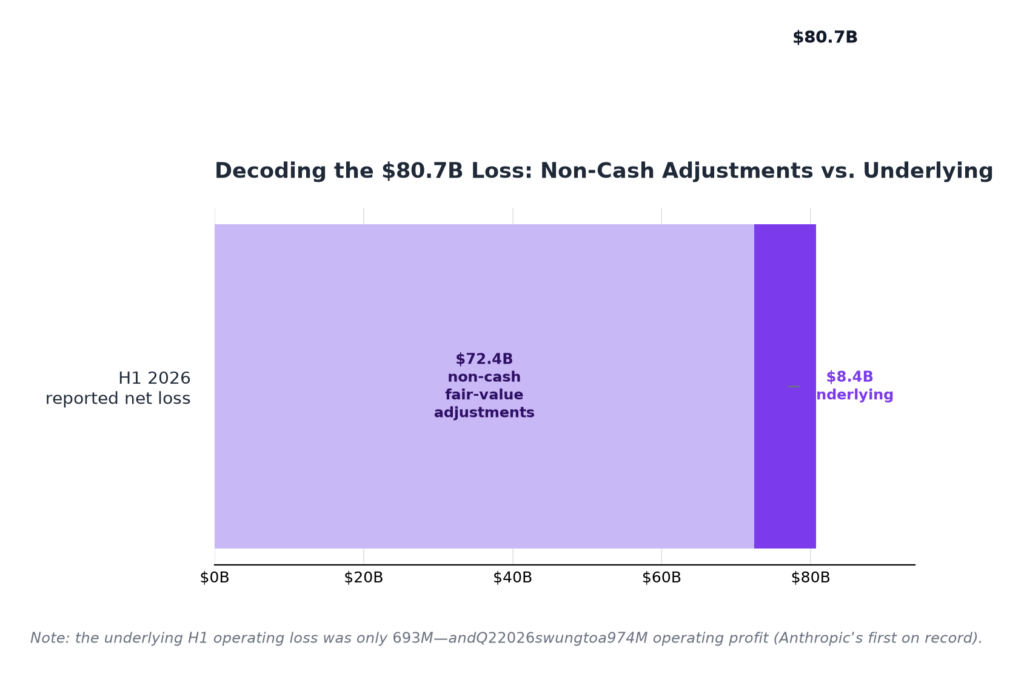
The headline figure looks alarming: a reported net loss of USD 80.748 billion for the half. But almost all of it is an accounting artifact. USD 72.388 billion came from non-cash fair-value adjustments, chiefly the rising value of Anthropic’s convertible notes as its own valuation climbed. Strip those out and the underlying loss is roughly USD 8.36 billion — and even that overstates the cash burn, because the underlying operating loss was only USD 693 million, while operating cash flow turned positive at USD 3.93 billion.
Customer quality is real, but so is concentration
The customer base is deepening fast. Annual accounts paying more than USD 100,000 grew from 950 to roughly 11,900, while more than 1,900 now pay over USD 1 million and about 250 pay over USD 10 million. Net revenue retention sits near 900% — existing customers now spend roughly nine times what they did a year earlier.
That strength deserves a caveat. Two unnamed customers together accounted for around 23% of first-half revenue, a concentration the company itself flags in its risk factors. The growth is remarkable; it is also, in part, hostage to a very small number of very large buyers.
Efficiency is the quiet engine
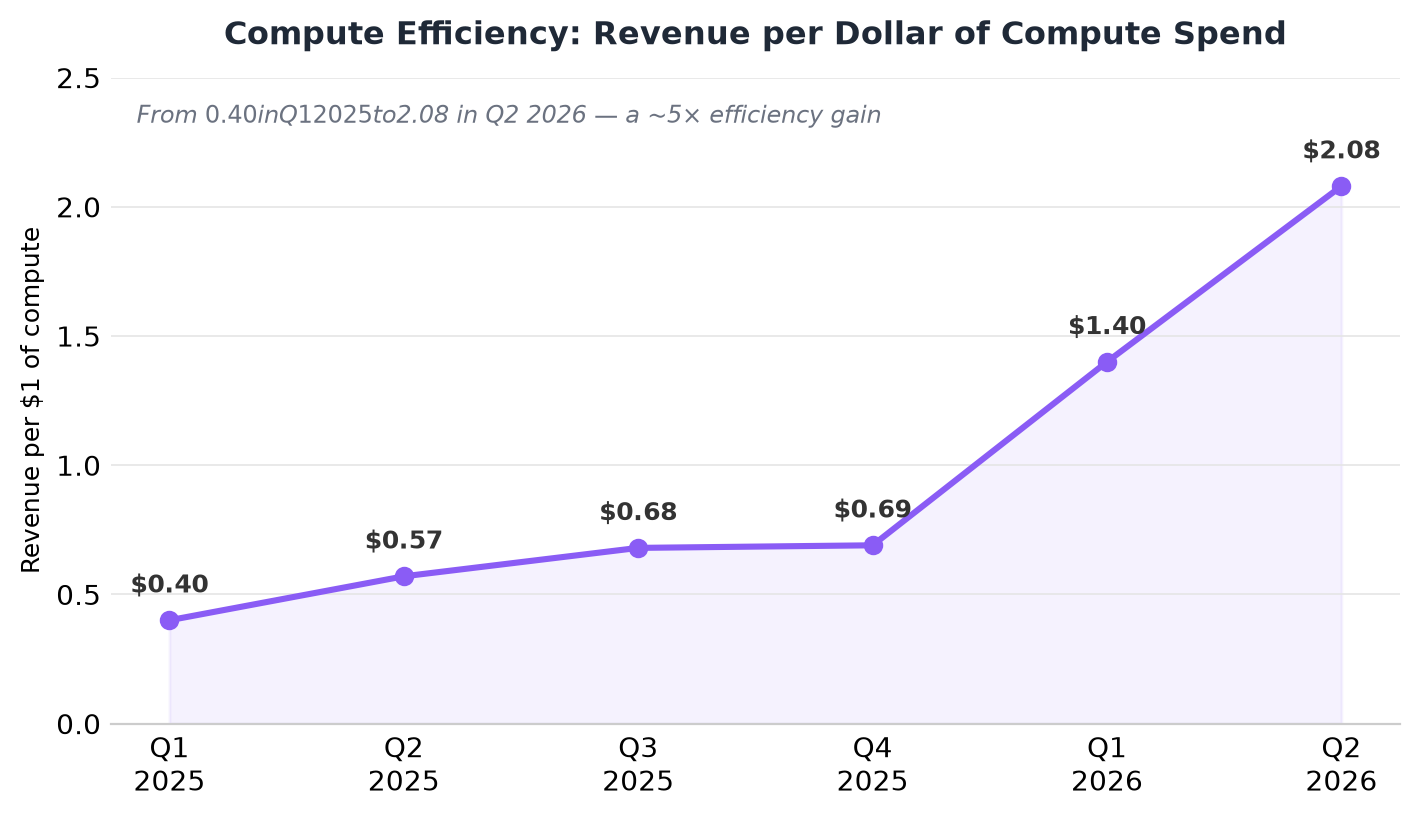
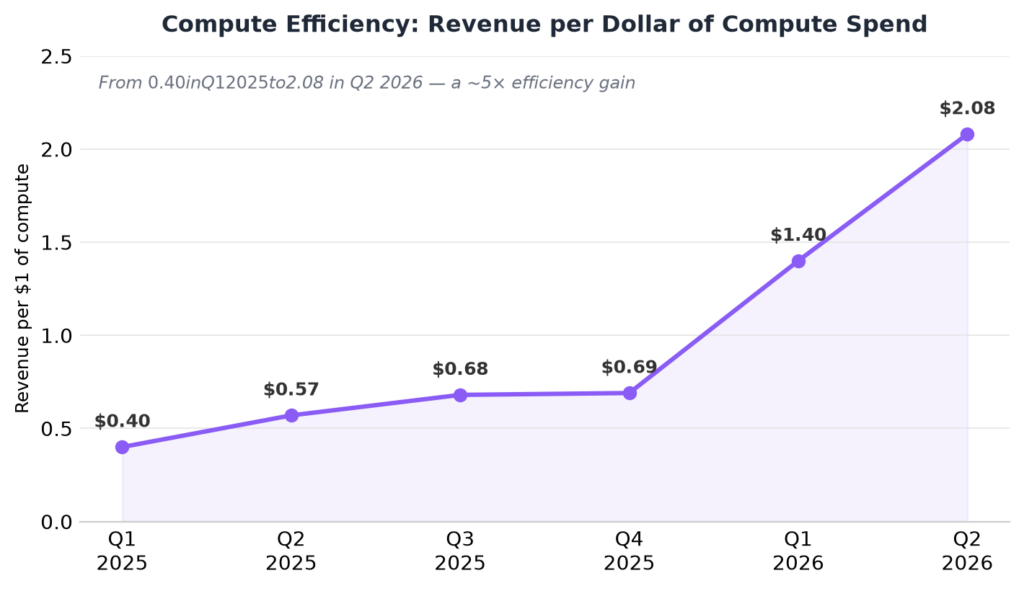
Underneath the headline numbers sits a genuine efficiency story. Anthropic now books about USD 2.08 of revenue for every dollar of compute spend, up from USD 0.40 in early 2025 — a fivefold gain. Its newest model, Claude Opus 5.5, cut the cost per task for customers by roughly 40% versus its predecessor, a reminder that cheaper inference, done right, expands demand rather than cannibalizing it.
The contract structure is the real risk
Here is where the bull and bear cases genuinely collide. Anthropic has committed to roughly USD 518 billion in future infrastructure spending, a figure that climbs toward USD 750 billion when chip-lease obligations are included. At least USD 224.5 billion of that is effectively non-cancellable, with firm minimums to Amazon running through 2036 and to Google through 2033.
The tension is one of duration. Those purchase commitments stretch across decades, while the revenue backing them is largely cancellable — customer contracts carry minimal commitments and can be dialed down with little notice. The locked-in demand and the contingent liability are, in effect, the same number viewed from opposite sides. That mismatch, not the headline loss, is the thing a serious investor should stress-test first.
What to watch next
Three signposts matter most. First, the amended filing will set the price range and issue size — the moment the USD 2 trillion question becomes concrete. Second, whether triple-digit growth holds into 2027, and whether the two-customer concentration disperses or thickens. Third, how auditors ultimately treat that multi-hundred-billion-dollar compute book once the numbers are finalized ahead of listing.